



.svg)

Why Dry Hot Summers Are Hard on Your HVAC System
How dry hot summers affect hvac performance and lifespan is something every Sacramento homeowner needs to understand before the Central Valley heat hits its peak. Here's the short answer:
How Dry Hot Summers Damage Your HVAC System
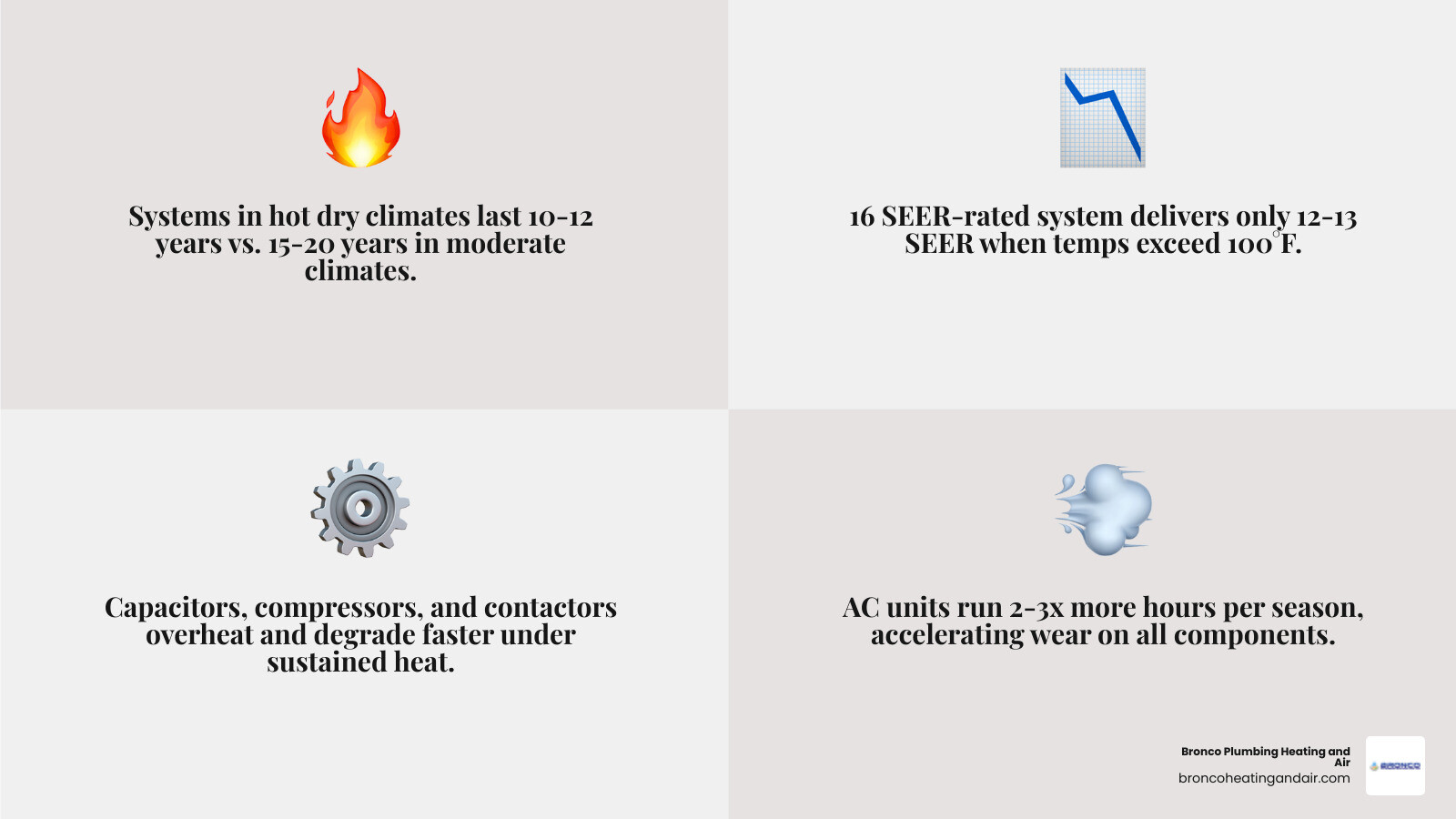
- Shorter lifespan - Systems in hot desert-like climates last 10-12 years vs. 15-20 years in moderate climates
- Lower efficiency - A 16 SEER-rated system may only deliver 12-13 SEER performance when temps stay above 100°F
- Component failure - Capacitors, compressors, and contactors overheat and degrade faster under sustained heat
- More runtime - AC units in hot climates run 2-3x more hours per season, accelerating wear on every moving part
- Refrigerant stress - High-side pressures spike at extreme temperatures, stressing joints and causing micro-leaks
- Dust damage - Dry air carries more particulates that clog coils and filters, reducing airflow and efficiency
Most residential AC systems are designed and tested at 95°F outdoor conditions. But Sacramento's Central Valley routinely pushes past 105°F, and sometimes beyond 115°F. That gap between what your system was built for and what it actually faces every summer is where the damage quietly builds up.
Think of it like this: a car driven 100,000 miles per year ages very differently from one driven 15,000 miles. An AC unit in a hot dry climate faces that same kind of compounded wear. Each summer doesn't just stress the system — it leaves it a little weaker for the next one.
The Science of Heat Stress: How Dry Hot Summers Affect HVAC Performance and Lifespan
In the Sacramento region, our summers are characterized by blistering, bone-dry heat. While we might prefer "dry heat" over a humid swamp, your air conditioner actually has to work significantly harder when the mercury climbs toward the triple digits. Understanding how dry hot summers affect hvac performance and lifespan starts with the concept of "design temperature."
Most HVAC systems are engineered to operate at peak efficiency when the outdoor temperature is around 95°F. This is the industry standard for rating a system's Seasonal Energy Efficiency Ratio (SEER). However, when we hit a typical July afternoon in Roseville or Rocklin, and the thermometer reads 106°F or higher, we’ve officially crossed a "tipping point."
Efficiency Loss at Extreme Temperatures
When the outdoor temperature exceeds 100°F, the physical laws of heat transfer change the game. Your AC works by moving heat from inside your home to the outside. The hotter it is outside, the harder it is for the system to "dump" that heat.
| Outdoor Temperature | Effective SEER (of a 16 SEER Unit) | System Strain Level |
|---|---|---|
| 82°F | 16.0 | Low (Optimal) |
| 95°F | 15.2 | Moderate (Standard Design) |
| 105°F | 13.5 | High (Efficiency Drop) |
| 115°F | 11.8 | Critical (Mechanical Stress) |
As the table shows, a high-efficiency system can lose nearly 25% of its effective cooling capacity when the Central Valley sun is at its most relentless. This is why is your air conditioning system ready for the summer? is a question we ask our neighbors in Folsom and Elk Grove every spring. If your system is already struggling with a dirty coil or low refrigerant, these extreme temperatures can trigger a total shutdown.
Cabinet Heat and the "Pressure Cooker" Effect
It isn't just the air temperature that matters; it's the internal heat buildup. On a 106°F day, the metal cabinet of your outdoor condenser unit can spike to temperatures above 130°F. Inside that metal box, sensitive electrical components are essentially sitting in a pressure cooker. This sustained thermal load degrades the lacquer on compressor windings and thins out the lubricating oil, leading to rapid mechanical "aging."
Understanding How Dry Hot Summers Affect HVAC Performance and Lifespan of Core Components
When we talk about the mechanical stress of a dry summer, we are really talking about "thermal differential." In simple terms, your AC is a heat pump. It picks up heat indoors and drops it off outdoors. When it’s 75°F inside and 110°F outside, that 35-degree difference (differential) is a massive hill for your system to climb.
This leads to several specific mechanical issues:
- Continuous Runtime: During a heatwave in Citrus Heights or Rancho Cordova, your AC might run for 10 to 14 hours straight without a break. In more moderate climates, systems might only run 800 hours a year. Here, they can easily top 2,500 hours.
- Heat Rejection Failure: If the outdoor coils are even slightly dusty, the system cannot release heat fast enough. This causes the compressor to run hotter and hotter until a safety switch (or a permanent failure) occurs.
- Component Fatigue: Every start-up cycle puts stress on the motor. In dry heat, the parts expand and contract more drastically, leading to weakened joints and brittle wiring.
To prevent these issues, it is vital to know what happens during air conditioning maintenance? Our technicians focus on cleaning those coils and testing electrical loads to ensure the system can handle the "heavy lifting" of a July afternoon.
Long-term Effects: How Dry Hot Summers Affect HVAC Performance and Lifespan in Sacramento
If you live in a place like Davis or Woodland, you might notice that your AC doesn't seem to last as long as the manufacturer’s brochure promised. Nationally, an HVAC system is expected to last 15 to 20 years. However, in our specific climate, that expectancy often drops to 10-12 years.
This "lifespan tax" is the result of cumulative damage. Think of your AC like an athlete. A marathon runner can only sprint for so long before their body starts to break down. Our dry summers force your AC to "sprint" for three or four months every year. Without a regular HVAC Tune-Up Citrus Heights CA, the small stresses of one summer turn into the major repairs of the next.
Critical Components at Risk During Extreme Heat Waves
When the heat reaches critical levels, certain parts of your AC are more likely to fail than others. Identifying these "weak links" can help you stay ahead of a breakdown.
The Capacitor: The Most Common Victim
If we had to name the number one enemy of Sacramento AC units, it would be the capacitor. This small, cylindrical device stores electricity to help your compressor and fan motor start up. Inside the capacitor is an electrolytic fluid that is very sensitive to heat.
Most capacitors are rated to handle temperatures up to 150°F. While that sounds high, the electrical compartment of your outdoor unit can reach 170°F on a 115°F day in El Dorado Hills. When that fluid degrades or vaporizes, the capacitor "bulges" and fails. If you ignore a weakening capacitor, it forces the compressor to draw more power, which can lead to a $3,000 repair instead of a simple part replacement. This is why we recommend homeowners maintain your air conditioner with our $49 tune-up special to catch these failures before they happen.
Compressor and Lubrication Breakdown
The compressor is the "heart" of your system. It pumps refrigerant through the lines. Extreme heat causes the lubricating oil inside the compressor to thin out. If the oil temperature exceeds 225°F, it can no longer protect the moving metal parts. This leads to friction, more heat, and eventually, a "seized" compressor.
The Impact of Low Humidity on System Efficiency
In the Central Valley, our "dry" heat presents a unique challenge: dust and static. While humid climates deal with mold, we deal with particulates.
Sensible Load vs. Latent Load
In a humid place, the AC spends a lot of energy removing water from the air (latent load). In Sacramento, almost all the energy goes into lowering the temperature (sensible load). Because the air is so dry, your system has to move a massive volume of air to make the house feel cool.
The Dust Threat
Dry air is a perfect carrier for dust, pollen, and wildfire smoke—common issues in places like North Highlands and Orangevale. This dust settles on your indoor evaporator coil and outdoor condenser coil. Even a thin layer of dust acts like a thermal blanket, insulating the coils and preventing heat exchange. This forces the system to run longer and hotter.
To combat this, investing in high-quality Air Filtration Systems is essential. Proper filtration protects your equipment just as much as it protects your lungs. Our IAQ Services can help you choose the right setup to keep your system's "veins" clean during the dusty summer months.
Refrigerant Pressure and Thermal Expansion
As the outdoor temperature climbs, the pressure inside your refrigerant lines increases exponentially. For example, a system running at 350 PSI on a 95°F day might spike to 480 PSI when it hits 115°F in Lincoln or Loomis.
- Micro-leaks: This high pressure puts immense stress on every joint and fitting. A tiny weakness that wouldn't leak at 80°F can become a "weeping" leak at 115°F.
- Coil Freezing: It sounds backward, but extreme outdoor heat can cause your indoor coil to freeze. If the system is struggling to reject heat outside or has a low refrigerant charge, the indoor temperature can drop below freezing, turning your AC into a block of ice.
- Thermal Expansion: The constant heating and cooling causes the metal in your coils to expand and contract. Over a decade of Sacramento summers, this can lead to "stress cracks" in the copper, resulting in expensive refrigerant loss.
If you’re looking for some tips to save on your cooling this summer, keeping an eye on your refrigerant levels is a great place to start. A system that is just 10% low on charge can lose 20% of its cooling capacity in extreme heat.
Warning Signs Your System is Struggling with Dry Heat
Your AC will usually try to tell you it’s in trouble before it finally gives up. In the Sacramento area, keep an ear and an eye out for these red flags:
- Warm Air from Vents: If the air coming out of your registers feels "lukewarm" even though the AC is running, your system has likely lost its ability to reject heat efficiently.
- Short Cycling: If the unit turns on and off every few minutes, it might be overheating. This "cycling" is the system's way of trying to protect the compressor from burning out.
- Unusual Noises:
- Humming/Buzzing: Often a sign of a failing capacitor or a stuck contactor.
- Grinding/Screeching: This usually means the bearings in your fan motor are drying out due to the heat.
- Clicking: This can indicate an electrical issue or a compressor that is struggling to start.
- Rising Utility Bills: If your bill jumps by more than 20% compared to the same month last year (and the weather is similar), your system is losing efficiency.
- Dust Buildup Around Vents: This indicates that your filtration is failing, which means your internal coils are likely getting "choked" by dust.
For those concerned about the air quality and the cleanliness of their system, UV Air Purifiers can help keep organic growth and some particulates off your coils, ensuring better heat transfer.
How to Protect Your HVAC Performance and Lifespan
While the Central Valley heat is inevitable, a system failure doesn't have to be. There are several steps you can take to protect your investment and ensure your home stays a sanctuary of cool air.
The Power of the Filter
In a dry, dusty climate like Sacramento or Fair Oaks, your air filter is your first line of defense. During the peak of summer, we recommend changing your filter every 30 to 60 days. If you have pets or live near a construction site in Natomas, check it every month. A clogged filter is like trying to breathe through a straw while running a marathon—it will wear your system out in record time.
Coil Cleaning: The "Spring Rinse"
Your outdoor unit needs to breathe. Every spring, before the 100-degree days arrive, ensure there are at least 24 inches of clearance around your condenser. Use a garden hose (not a pressure washer!) to gently rinse away the dust and "caliche" (hardened desert-like dust) from the fins. For a deeper clean, professional chemical cleaning is recommended to remove the grime that a hose can't reach.
Shading Strategies
If your outdoor unit is on the west side of your house, it’s taking the full brunt of the afternoon sun. Strategic landscaping or a trellis can provide shade, which can lower the temperature in the unit’s immediate area by 10 to 15 degrees. Just be careful not to block the airflow!
Professional Maintenance and Preparation
While DIY tasks are great, some things require a licensed eye. Our HVAC Maintenance Roseville CA service includes several "invisible" protections:
- Electrical Torque: We check and tighten all electrical connections. Heat causes metal to expand, which can loosen wires and lead to "arcing" or fires.
- Contactor Inspection: We check for "pitting" on your electrical switches. In hot weather, these switches can actually weld themselves shut, causing your AC to run 24/7 until the compressor dies.
- Refrigerant Verification: We use precision gauges to ensure your charge is perfect. Neither "too much" nor "too little" is good for your system’s health.
Adding Air Purifiers can also reduce the overall particulate load on your system, keeping the internal components running smoother for longer.
Optimizing Your Home for Peak Efficiency
Your AC doesn't work in a vacuum. The better your home holds onto the cold air, the less work the AC has to do.
- Attic Insulation: In places like Carmichael and Arden-Arcade, attic temperatures can reach 160°F. If your insulation is thin, that heat "bleeds" into your living space. Upgrading from R-19 to R-38 insulation can reduce your cooling load by up to 12%.
- Weatherproofing: Sealing leaks around windows and doors keeps the dry, hot air out.
- Programmable Thermostats: Setting your thermostat 5 degrees higher when you aren't home gives your system a much-needed "rest." This prevents "system fatigue" and extends the life of the motors.
- Humidity Balance: While we focus on dry heat, sometimes the air inside gets too dry, which can make it feel hotter than it is. Understanding how does a whole home humidifier work? can help you maintain that "sweet spot" of 30-50% humidity for maximum comfort.
Frequently Asked Questions
How much does extreme heat shorten HVAC lifespan?
In a moderate climate, you can expect 15 to 20 years of service. In the Sacramento Central Valley, that number typically drops to 10 to 12 years. This is due to "mechanical warfare"—the combination of high pressures, extreme cabinet temperatures, and 2,500+ hours of runtime per season. Regular maintenance can help you push back toward that 15-year mark, but the climate is a constant factor in equipment aging.
Does dry heat affect AC differently than humid heat?
Yes. Humid heat puts a "latent load" on the system (removing water), while dry heat puts a "sensible load" on the system (lowering temperature). In dry heat, the biggest threats are dust accumulation and the lack of moisture to help cool the outdoor coils. Humid air actually carries heat better than dry air, meaning your AC has to move more dry air to achieve the same cooling effect, which puts more strain on the blower motor.
What should I do after a major heatwave to help my system recover?
After a week of triple-digit temps, your system has been through a lot.
- Check the Filter: It likely pulled in a lot of dust during the constant operation.
- Rinse the Coils: Give the outdoor unit a gentle rinse to remove any dust that settled during the heatwave.
- Listen Closely: Turn the system off for an hour, then listen to it start back up. Any new clicks or hums should be checked by a pro.
- Professional Assessment: If your system struggled to keep up, it’s a good idea to have a technician check the capacitor and refrigerant levels to ensure no "hidden" damage occurred.
Conclusion: Keeping Sacramento Cool Since the Beginning
At Bronco Heating and Air, we live and work in the same Central Valley heat that you do. We know that how dry hot summers affect hvac performance and lifespan isn't just a technical topic—it's about the comfort and safety of your family. Whether you are in Roseville, Elk Grove, or downtown Sacramento, our licensed, professional, and courteous technicians are here to provide cost-effective solutions that stand up to our unique climate.
Don't wait for the next "haboob" or 110-degree afternoon to find out if your system is up to the task. From routine maintenance to high-efficiency upgrades, we have the local expertise to keep your AC running strong for years to come.
Ready to protect your home from the heat? Schedule your service with Bronco Heating and Air today!

Customer Testimonials
Our customer testimonials highlight the reliable service, quality workmanship, and trusted results homeowners experience with Bronco Plumbing Heating and Air.


Ready to Transform your Home?
Create a healthier, more comfortable home with expert HVAC, plumbing, and indoor air quality solutions you can trust. From efficient heating and cooling to cleaner air and reliable repairs, our experienced team is here to keep your family comfortable year-round with dependable service and upfront pricing.
Related Articles
What Actually Happens When You Set Your Thermostat to 65 Degrees in 100-Degree Heat

Repairing vs. Replacing a Blown AC Compressor Mid-Summer
The Hidden Cost of Dirty AC Coils in Dusty North Highlands Neighborhoods