



.svg)

California Energy Efficiency Standards for New HVAC Systems Explained
What California Title 24 Energy Requirements for HVAC Actually Mean for Your HomeCalifornia Title 24 energy requirements for HVAC are mandatory efficiency and construction standards that apply to heating, ventilation,…
What California Title 24 Energy Requirements for HVAC Actually Mean for Your Home
California Title 24 energy requirements for HVAC are mandatory efficiency and construction standards that apply to heating, ventilation, and air conditioning systems in all newly built or significantly altered buildings across the state. Here is a quick summary of what they cover:
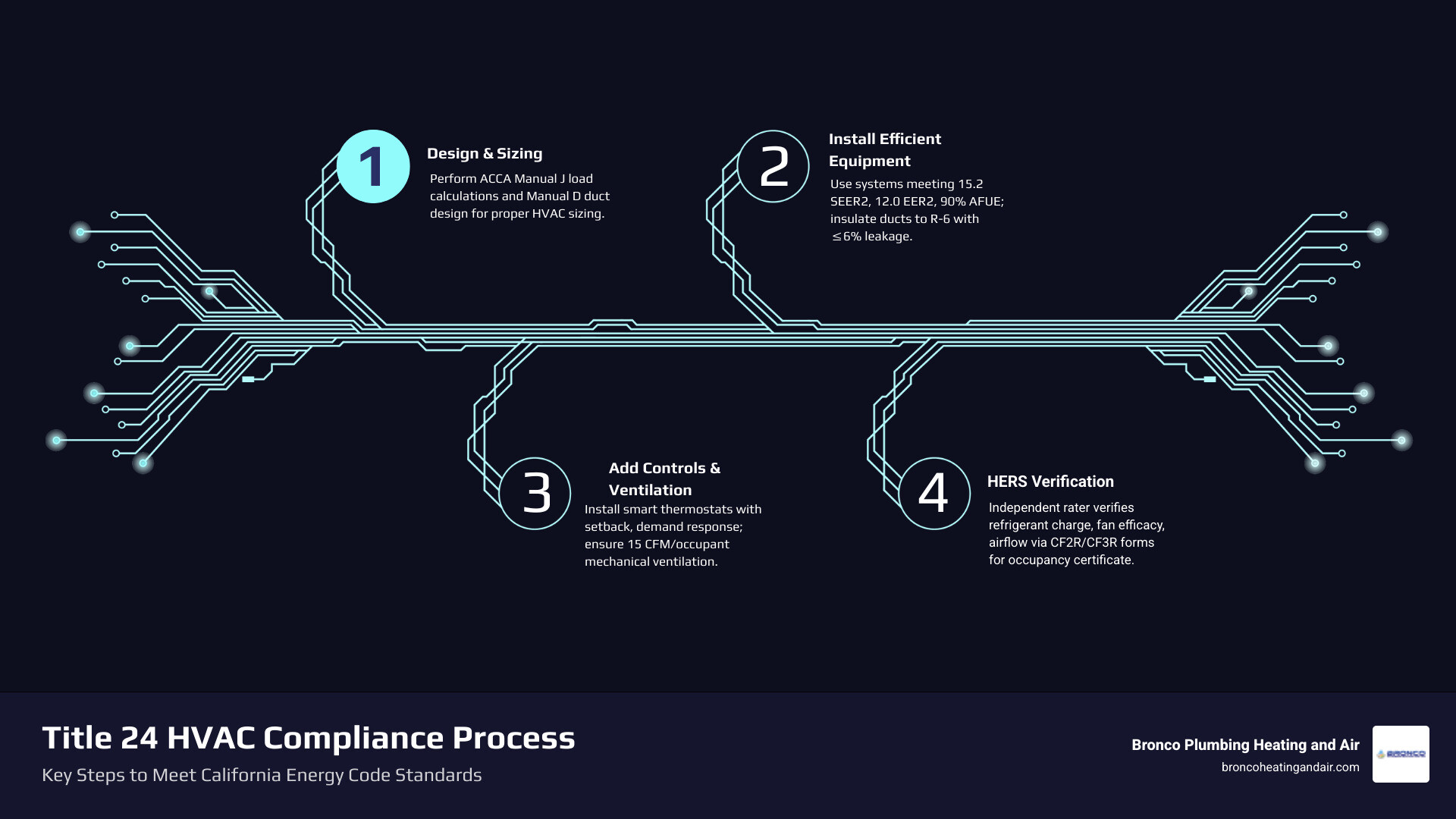
• Equipment efficiency minimums - Systems must meet ratings like 15.2 SEER2 / 12.0 EER2 for air conditioners and 90% AFUE for gas furnaces
• Duct sealing - Ducts in unconditioned spaces must be insulated to at least R-6 and sealed to limit leakage
• Proper sizing - HVAC systems must be sized using ACCA Manual J load calculations
• Ventilation - Minimum 15 cubic feet per minute (CFM) per occupant of mechanical ventilation
• Smart controls - Thermostats must include setback capability and demand response readiness
• HERS verification - An independent Home Energy Rating System rater must field-verify key measures before a Certificate of Occupancy is issued
• Compliance pathways - Projects can comply via prescriptive (meet table minimums) or performance (energy modeling) methods
These standards live in Title 24, Part 6 of the California Code of Regulations — also called the California Energy Code. The most current version is the 2022 Energy Code, which took effect on January 1, 2023. A 2025 update is already finalized and takes effect January 1, 2026.
If you own or manage a property in Sacramento, these rules affect every permitted HVAC installation, replacement, or significant alteration you do. The buildings sector accounts for roughly 25% of California's greenhouse gas emissions, and Title 24 is the state's primary tool for driving that number down — with a long-term goal of all new commercial buildings reaching Zero Net Energy by 2030.
The good news? Compliance is very achievable when you understand what is actually required. The sections below break it all down clearly.
Understanding California Title 24 Energy Requirements for HVAC
When we talk about Title 24, we are referring to a massive set of building standards designed to ensure California buildings are safe, healthy, and incredibly efficient. For those of us living in areas like Roseville or Sacramento, these codes aren't just red tape; they are the roadmap to lower utility bills and more comfortable homes.
The california title 24 energy requirements for hvac are updated every three years by the California Energy Commission (CEC). We are currently operating under the 2022 Energy Code, which introduced some of the most significant changes in years, particularly regarding the push toward electrification and high-efficiency heat pumps.
Compliance Pathways: Prescriptive vs. Performance
There are two main ways we can show the state that your project meets the code:
1. The Prescriptive Approach: This is the "checklist" method. Every single component—from your air conditioner's efficiency to the thickness of your duct insulation—must meet or exceed a specific value set by the state. It is straightforward but offers less flexibility in design.
2. The Performance Approach: This is much more popular for custom homes or complex HVAC Installation Roseville CA projects. We use approved energy modeling software (like CBECC-Res) to create a virtual version of your home. This allows for "trade-offs." For example, if you install world-class windows and extra wall insulation (the building envelope), the software might allow for a slightly different HVAC configuration because the home is already so efficient.
The performance path uses a metric called Time-Dependent Valuation (TDV). This means the code values energy saved during "peak" hours (like a hot July afternoon in Citrus Heights) more than energy saved in the middle of the night. It's all about reducing the strain on our electrical grid.
Mandatory California Title 24 Energy Requirements for HVAC Sizing and Ducts
One of the biggest mistakes in the old days of HVAC was "guessing" the size of the unit. A system that is too big will cycle on and off constantly, wasting energy and failing to remove humidity. Title 24 has put a stop to that.
ACCA Manual J Load CalculationsSince January 1, 2023, the code strictly mandates the use of ACCA Manual J (or an equivalent approved method) for sizing. This calculation accounts for your home's orientation, insulation levels, window types, and even how many people live there. Whether we are performing a new install or an HVAC Replacement Carmichael CA, we must prove the system is sized correctly for your specific square footage.
Duct Sealing and InsulationYour ductwork is the circulatory system of your home. If it leaks, you’re paying to heat your attic instead of your living room.
• Sealing: All joints must be sealed with mastic or metal-backed tape.
• Leakage Limits: For new construction, duct leakage must be verified to be 6% or less. For alterations in existing homes, the limit is typically 15%.
• Insulation: Ducts located in unconditioned spaces (like most attics in Fair Oaks or Orangevale) must have a minimum R-value of 6. This prevents "thermal gain," where the cool air inside your ducts gets warmed up by the attic heat before it ever reaches your vents.
Ventilation and Controls Under California Title 24 Energy Requirements for HVAC
Modern homes are built so tightly to save energy that they can sometimes trap stale air inside. Title 24 addresses this through strict Indoor Air Quality (IAQ) and ventilation standards.
Mechanical VentilationThe code generally requires a minimum ventilation rate of 15 cubic feet per minute (CFM) per occupant. This ensures a constant flow of fresh air. In many new homes, we install "balanced" ventilation systems or Heat Recovery Ventilators (HRVs) that swap out old air for fresh air without losing your indoor temperature.
Smart Thermostats and Demand ResponseTo comply with Title 24, thermostats must have "setback" capabilities (the ability to program different temperatures for different times of day). Furthermore, they must be "Demand Response" ready. This means they can communicate with utilities during energy emergencies to slightly adjust temperatures (with your permission) to prevent blackouts. These systems have been shown to save homeowners up to 30% on overall HVAC energy consumption.
Electric-Ready RequirementsThe 2022 code also introduced "electric-ready" mandates. Even if you are installing a gas furnace today, new homes must have the electrical infrastructure (like a dedicated 240V outlet and space in the breaker panel) to easily switch to a heat pump or electric water heater in the future. We often see this when performing HVAC Maintenance Citrus Heights CA for clients looking to future-proof their homes.
Efficiency Standards and Equipment Metrics
The language of HVAC efficiency can feel like alphabet soup. Under Title 24, there are specific minimums you need to know. As of the 2022 update, the standards moved to "Version 2" metrics (SEER2, EER2, HSPF2), which use more realistic testing conditions.
• Unitary AC (<65k Btu/h) — 2019 Minimum: 14.0 SEER — 2022/Current Minimum: 15.2 SEER2 / 12.0 EER2
• Gas Furnaces — 2019 Minimum: 80% AFUE — 2022/Current Minimum: 90% AFUE
• Air Source Heat Pumps — 2019 Minimum: 8.2 HSPF — 2022/Current Minimum: 7.5 HSPF2
• Mechanical Ventilation — 2019 Minimum: 15 CFM/occupant — 2022/Current Minimum: 15 CFM/occupant
For those of us in the Sacramento Valley, the move to a 90% AFUE (Annual Fuel Utilization Efficiency) for furnaces is a big step. It means 90 cents of every dollar you spend on gas goes directly into heating your home, with only 10 cents lost to exhaust.
The state is also heavily incentivizing heat pumps. In many climate zones, the "prescriptive" baseline is now a heat pump. This means if you choose a gas furnace instead, you may have to "make up" those energy points elsewhere in the home's design to pass the performance path. When you call us for HVAC Service Roseville CA, we can help you weigh these equipment choices against the latest code requirements.
Compliance Verification: HERS Testing and Acceptance
You might wonder: "Who actually checks that the ducts are sealed and the refrigerant is full?" That is where the HERS Rater comes in.
HERS VerificationA Home Energy Rating System (HERS) Rater is an independent, third-party inspector certified by the state. They are not the contractor; they are the "referee" who ensures the job was done right. They perform several critical tests:
• Duct Blast Test: Pressurizing the ducts to measure exactly how much air is escaping.
• Refrigerant Charge Verification: Ensuring the system has the exact amount of refrigerant needed for maximum efficiency.
• Fan Efficacy: Testing the blower motor to ensure it isn't using too much electricity to move air.
• Airflow Testing: Confirming the system is moving at least 350 CFM per ton of cooling.
The Paperwork TrailCompliance involves three main forms:
1. CF1R: The "Registration" form created during the design phase.
2. CF2R: The "Installation" form that we, as your contractor, sign to certify we installed the system according to the plans.
3. CF3R: The "Verification" form that the HERS Rater signs after passing the field tests.
For our business clients, Commercial HVAC Services often require an Acceptance Test Technician (ATT). Since October 2021, the state has required certified ATTs to perform "Acceptance Testing" on non-residential mechanical systems. Without these certified forms, you cannot receive a final Certificate of Occupancy from the building department.
Climate Zones and Their Impact on Compliance
California is a massive state with wildly different weather. To make the code fair, the CEC divided the state into 16 Climate Zones.
Sacramento and the Central Valley (CZ 12)Most of our service area—including Sacramento, Roseville, Rocklin, and Folsom—falls into Climate Zone 12. This zone is characterized by very hot, dry summers and chilly winters. Because of our extreme summer heat, the california title 24 energy requirements for hvac in our area are quite strict regarding cooling efficiency and attic insulation.
How it Affects Your Home:
• Building Orientation: If your home has giant windows facing west, you’ll need much higher efficiency HVAC or better "Solar Heat Gain Coefficient" (SHGC) glass to pass compliance.
• Fenestration: The "U-factor" (how well a window prevents heat from escaping) is strictly regulated here.
• Local Reach Codes: Some cities, like Davis or Sacramento, may have "Reach Codes" that are even stricter than the state's Title 24. They might require all-electric construction or higher solar requirements.
When we provide HVAC Repair Roseville CA, we always keep these zone-specific requirements in mind to ensure any parts or replacements we install don't compromise your home's overall compliance.
Frequently Asked Questions about Title 24 HVAC
Does Title 24 apply to HVAC alterations or just new construction?
It applies to both! While new construction has the most requirements, "alterations" (like replacing an old AC unit or adding a new room) also trigger Title 24. If you replace a central air system in an existing home, it usually triggers mandatory duct testing and efficiency minimums. However, replacing just a small part—like a motor or a thermostat—typically does not trigger a full Title 24 review.
What is the difference between the prescriptive and performance compliance paths?
Think of the prescriptive path as a rigid "recipe" where you must use every specific ingredient the state demands. The performance path is like a "calorie budget"—as long as the whole house stays under its energy limit, you can spend those calories however you like (e.g., better insulation in exchange for more windows).
Is a HERS verification mandatory for every HVAC changeout?
In Climate Zone 12 (Sacramento area), yes, most central HVAC changeouts require HERS verification for duct leakage and refrigerant charge. There are small exceptions for tiny additions or specific types of repairs, but for a standard system replacement, a HERS test is a mandatory part of the permitting process.
Ensuring Your Project Meets California Energy Standards
Navigating the california title 24 energy requirements for hvac can feel overwhelming, but it is ultimately designed to put money back in your pocket through energy savings. A home that meets the 2019 or 2022 standards might cost a bit more upfront to build, but it is estimated to save the homeowner $19,000 in energy and maintenance costs over 30 years.
At Bronco Heating and Air, we specialize in making this process seamless. From the initial load calculations to the final HERS verification, our licensed and professional technicians handle the details so you don't have to. We ensure that every HVAC Company Citrus Heights CA project we touch is fully permitted, code-compliant, and optimized for our unique Central Valley climate.
Whether you are building a new dream home in El Dorado Hills or simply replacing an aging furnace in North Highlands, we are here to provide cost-effective, professional solutions. We serve the entire Greater Sacramento area, including Folsom, Elk Grove, Rocklin, and beyond.
If you're ready to upgrade your home's comfort while meeting California's world-class energy standards, give us a call. We'll make sure your HVAC system isn't just "running"—we'll make sure it's running for the future.

Customer Testimonials
Our customer testimonials highlight the reliable service, quality workmanship, and trusted results homeowners experience with Bronco Plumbing Heating and Air.


Ready to Transform your Home?
Create a healthier, more comfortable home with expert HVAC, plumbing, and indoor air quality solutions you can trust. From efficient heating and cooling to cleaner air and reliable repairs, our experienced team is here to keep your family comfortable year-round with dependable service and upfront pricing.
Related Articles
The Truth About MERV Ratings and Air Conditioner Strain

Diagnosing Weak Airflow in the Farthest Bedroom of Your House
Why Placer County Soil Shifting Causes Underground Plumbing Stress in Late Summer