



.svg)

Does Title 24 Apply to HVAC Replacement in California? Here's What You Need to Know
Does title 24 apply to hvac replacement in california — and the short answer is yes, it does. California's Title 24, Part 6 (the California Energy Code) applies not just to new construction, but also to HVAC replacements and alterations in existing homes whenever the scope of work meets the threshold for a building permit.
Here's a quick breakdown of when and how Title 24 applies to HVAC replacements:
Title 24 HVAC Replacement — Quick Reference
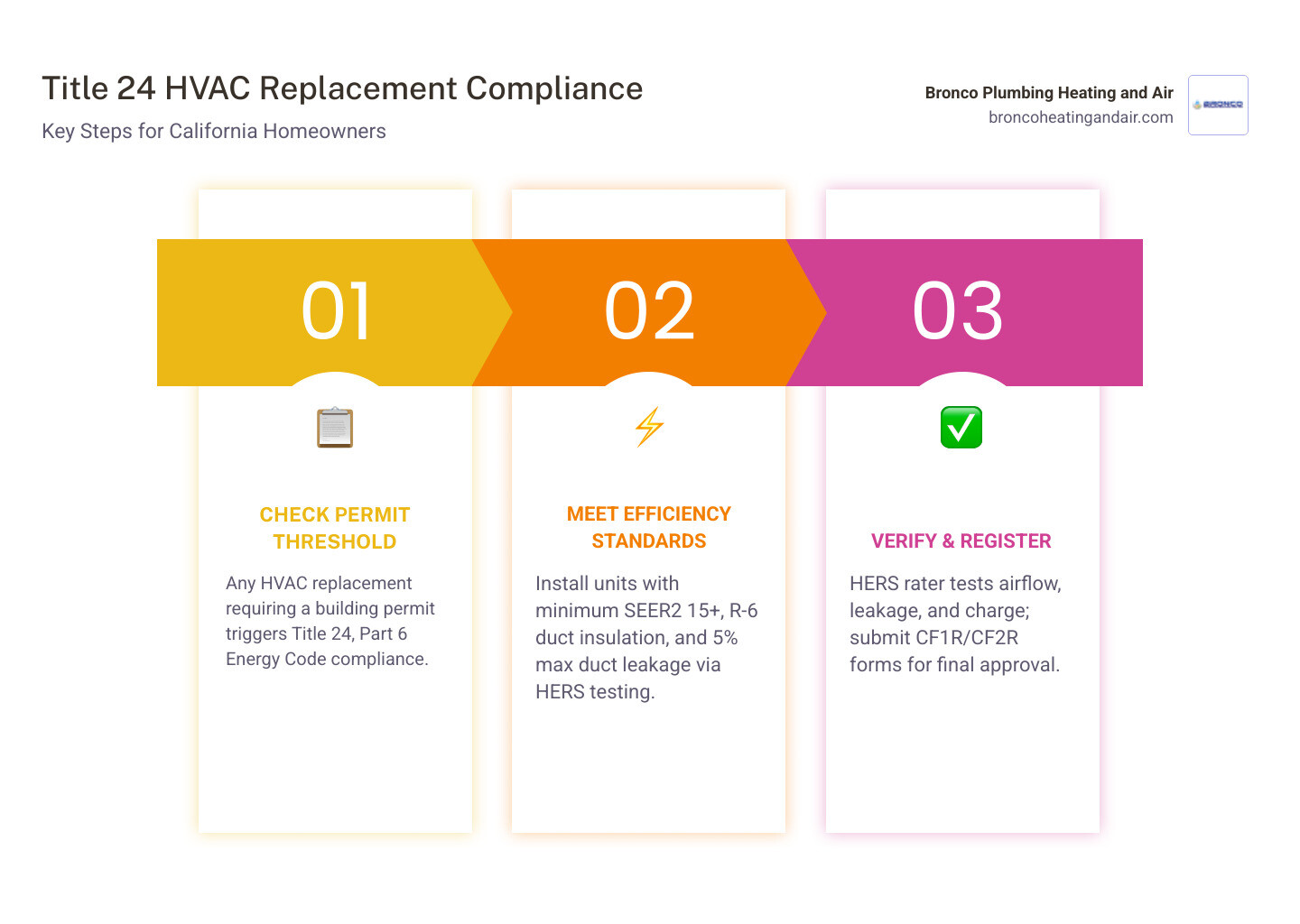
- Applies to replacements? Yes — any HVAC replacement that requires a permit triggers Title 24 compliance
- What's required? Minimum equipment efficiency ratings (SEER2 15+), duct sealing, duct insulation (R-6 minimum), and sometimes thermostat upgrades
- Duct leakage limit: No more than 5% of total airflow for replaced or new systems
- HERS testing required? Yes — a certified third-party HERS rater must verify duct leakage, airflow, and refrigerant charge
- Who enforces it? Your local building department, with oversight from the California Energy Commission (CEC)
- Latest update: The 2025 California Energy Code took effect January 1, 2026, with stricter HVAC standards
Many Sacramento homeowners are surprised to learn that swapping out an old air conditioner or furnace isn't as simple as it used to be. The days of a quick like-for-like equipment swap — no paperwork, no testing, no inspection — are largely over. Whether you're replacing a central AC unit, a furnace, or the full system, California's energy code follows the project. Miss a step, and you could face failed inspections, permit delays, or costly corrections down the line.
This guide walks you through exactly what Title 24 requires for HVAC replacements, so you know what to expect before the first wrench turns.
Does Title 24 Apply to HVAC Replacement in California?
When we talk about Title 24, we are referring to the California Building Standards Code. Specifically, Part 6 is the "Energy Code." While many people associate these rules with brand-new houses, they are equally important for alterations and additions to existing homes. If you are planning an HVAC Replacement in Citrus Heights, CA, or an HVAC Replacement in Carmichael, CA, you are likely performing an "alteration" under the law.
California is divided into 16 climate zones, and the rules can vary slightly depending on where you live. For those of us in the Sacramento Valley, including HVAC Replacement in Roseville, CA, we fall into zones that require specific attention to cooling efficiency and duct integrity due to our intense summer heat. The state uses "energy budgets" to ensure that buildings don't waste precious resources, and your HVAC system is the biggest contributor to that budget.
Understanding the Scope for Existing Homes
A common question we hear is: "Do I really have to follow these rules if I'm just swapping out an old unit?" The answer is almost always yes. Retrofit requirements apply to any significant alteration. If you are doing an AC Replacement in Citrus Heights, CA, and you are touching the refrigerant lines, the electrical, or the ductwork, you've crossed the threshold.
The code is designed to ensure that when a system reaches its end-of-life, it isn't replaced with another inefficient model. Instead, the state mandates that the new system meets modern benchmarks for performance and air sealing.
When Compliance is Triggered
Compliance is triggered the moment a project requires a building permit. In California, replacing a central heating or cooling system requires a permit from your local building department. This permit ensures that the Heating Replacement in Roseville, CA is safe and efficient. Once that permit is pulled, you are legally bound to meet the current efficiency benchmarks, which include equipment ratings and mandatory testing.
Mandatory Requirements for Ductwork and Equipment
One of the most critical parts of Title 24 involves your home's "vascular system"—the ductwork. It doesn't matter how efficient your new AC is if 30% of the cold air escapes into your attic before it reaches your bedroom. In fact, research shows that uninsulated ducts in California attics can lose 25-40% of conditioned air.
For any AC Replacement in Carmichael, CA or Heating Replacement in Carmichael, CA, the following ductwork standards apply:
- Insulation: Supply and return ducts must have a minimum R-value of 6. In some specific climate zones or scenarios, R-8 may be required.
- Sealing: All joints and connections must be sealed with mastic (a thick, gooey sealant) or UL 181-approved metal-backed tape.
- Leakage Testing: If you replace more than 40 feet of ductwork, or install a completely new system, you must pass a leakage test.
| System Type | Maximum Allowable Leakage |
|---|---|
| New Construction | 5% of total airflow |
| Altered/Replacement System | 15% (in some cases 5-10% depending on scope) |
| New Ductwork (100% replacement) | 5% of total airflow |
How Does Title 24 Apply to HVAC Replacement in California Thermostats?
Thermostats aren't just about comfort anymore; they are now considered "energy management control systems." Under Title 24, new HVAC installations must include a programmable or smart thermostat. These devices must have "setback" functionality, meaning they can be programmed to change temperatures automatically when you are asleep or away from home.
Furthermore, for an AC Replacement in Roseville, CA, the thermostat must be capable of Demand Response (DR). This allows the system to receive signals from the utility company (like SMUD or PG&E) to slightly adjust energy use during peak grid stress, helping to prevent blackouts. These specific requirements are detailed in the state's Joint Appendix 5 (JA5).
Minimum Efficiency Ratings for New Units
As of 2023, the federal and state governments moved to new testing standards called SEER2 and HSPF2. These ratings reflect more realistic operating conditions.
- SEER2: Most residential split systems in California now require a minimum of 14.3 or 15 SEER2.
- HSPF2: This measures the efficiency of heat pumps.
- AFUE: For gas furnaces, you'll typically need a minimum of 80% AFUE, though many homeowners opt for 95% or higher to maximize savings.
The state is heavily encouraging Heat Pump Installation in Citrus Heights, CA and Heat Pump Installation in Roseville, CA. Heat pumps provide both heating and cooling electrically and are a cornerstone of California's goal to reduce greenhouse gas emissions.
The Role of HERS Testing and Verification
The Home Energy Rating System (HERS) is a mandatory third-party verification process. You might wonder why a third party is needed. Essentially, the state wants an independent set of eyes to confirm that we, the contractors, did the job correctly.
When we perform an HVAC Installation in Roseville, CA or an HVAC Installation in Carmichael, CA, we schedule a HERS rater to visit your home after the installation is complete. They perform several tests:
- Duct Blaster Test: They pressurize the duct system to measure exactly how much air is leaking out.
- Airflow Measurement: They ensure the system is moving enough air (usually 350-400 CFM per ton) to operate efficiently.
- Fan Watt Draw: They measure how much electricity the blower motor uses.
- Refrigerant Charge: They verify that the AC or heat pump has the exact amount of refrigerant needed—not too much, not too little.
Why Does Title 24 Apply to HVAC Replacement in California Inspections?
Local building departments are the primary enforcers of Title 24. For an HVAC Installation in Citrus Heights, CA, the inspector will look for specific paperwork. We provide a CF2R form (Certificate of Installation), and the HERS rater provides a CF3R form (Certificate of Verification). Without these registered documents, the city or county will not sign off on your permit.
Consequences of Non-Compliance
Ignoring Title 24 isn't just a "paperwork issue." If you bypass the permit and testing process:
- Failed Inspections: If you try to pull a permit later, you may be forced to tear out drywall or redo ductwork to prove compliance.
- Resale Complications: When you sell your home, home inspectors and buyers' agents will check for permits. Unpermitted HVAC work can kill a real estate deal or force a price reduction.
- Safety Risks: Permits ensure that gas lines are leak-free and electrical connections are safe.
- Legal Penalties: Local jurisdictions can issue fines for unpermitted work.
Step-by-Step Compliance Process for Homeowners
Navigating the energy code can feel overwhelming, but we handle the heavy lifting for you. Here is the standard process for a compliant Heat Pump Installation in Carmichael, CA:
- Manual J Load Calculation: We don't just guess the size of your unit. We calculate the exact heating and cooling needs of your home based on square footage, insulation, and window types.
- Manual S Equipment Selection: We match the Load Calculation to the right equipment to ensure it isn't oversized or undersized.
- Permit Application: We submit the project details to the local building department.
- CF1R Documentation: This is the "Certificate of Compliance" that shows the proposed design meets state standards.
- Installation: Our licensed technicians install the equipment according to Title 24 and manufacturer specifications.
- HERS Testing: A third-party rater verifies the system's performance.
- Final Inspection: The city inspector visits to verify the installation and signs off on the permit.
Planning and Permitting
During the planning phase, we check the CEC Appliance Database. Not every unit sold in the U.S. is legal to install in California. We ensure the model we choose for you is "California Compliant." We also analyze your specific climate zone—Sacramento (Zone 12) has different requirements than the Bay Area or the mountains.
Installation and Final Approval
Once the system is in, we perform "commissioning." This is a fancy word for starting the system up and testing every component to make sure it’s running at peak performance. After the HERS rater uploads their passing results to the state registry, we coordinate with you for the final building department walkthrough.
Frequently Asked Questions about Title 24 HVAC Rules
How often is the California Energy Code updated?
The code is updated on a three-year cycle. This allows the state to incorporate new technologies and respond to climate goals. The 2022 standards are currently in place for many, but the 2025 update officially took effect on January 1, 2026. These updates generally make the rules stricter, such as requiring higher R-values for insulation or encouraging more electrification.
Does Title 24 apply to HVAC replacement in California for partial upgrades?
Yes, but the requirements are "scope-specific." If you only replace the furnace (the air handler), you generally don't have to do a full duct leakage test unless you also altered the ducts. However, if you add air conditioning to a home that previously only had heat, or if you replace the outdoor condenser and the indoor coil, you have triggered the full suite of Title 24 requirements, including HERS testing.
What are the long-term benefits of Title 24 compliance?
While the upfront requirements involve more steps, the long-term benefits are substantial:
- Utility Savings: A sealed and high-efficiency system can save you hundreds of dollars a year. One real-world example in a San Jose home showed annual savings of $750, leading to over $15,000 in savings over the system's life.
- Improved Comfort: No more hot and cold spots in the house.
- Indoor Air Quality: Properly sealed ducts keep attic dust, insulation fibers, and allergens out of your breathing air.
- Home Value: A fully permitted, energy-efficient home is much more attractive to future buyers.
Conclusion
California's energy goals are ambitious, aiming for a 50% reduction in building energy use by 2030 and moving toward Zero Net Energy (ZNE) homes. While these regulations might seem like a lot of red tape, they are actually a blueprint for a more comfortable, affordable, and healthy home.
At Bronco Heating and Air, we take the stress out of the process. Our licensed, professional, and courteous technicians are experts in Sacramento-area compliance. Whether you are in Roseville, Citrus Heights, or Carmichael, we ensure your HVAC replacement is done right, legally, and efficiently.
If you are ready to upgrade your home's comfort and efficiency, contact us today. We provide cost-effective solutions that meet every Title 24 standard, ensuring your project is a success from the first permit to the final inspection.
Learn more about how we can help you by visiting our HVAC Company in Citrus Heights, CA page.

Customer Testimonials
Our customer testimonials highlight the reliable service, quality workmanship, and trusted results homeowners experience with Bronco Plumbing Heating and Air.


Ready to Transform your Home?
Create a healthier, more comfortable home with expert HVAC, plumbing, and indoor air quality solutions you can trust. From efficient heating and cooling to cleaner air and reliable repairs, our experienced team is here to keep your family comfortable year-round with dependable service and upfront pricing.
Related Articles
A Practical Guide to HVAC Repair vs Replacement

Why Your AC Won't Shut Off During a Roseville Heatwave (And When to Worry)
The Definitive Guide to Tankless Water Heater Value