



.svg)


How Sacramento Climate Affects Your HVAC System Year-Round
How sacramento climate affects your hvac system is something every homeowner in the region needs to understand — because this city puts heating and cooling equipment through some of the toughest conditions in California.
Here is a quick breakdown of the key ways Sacramento's weather stresses your HVAC:
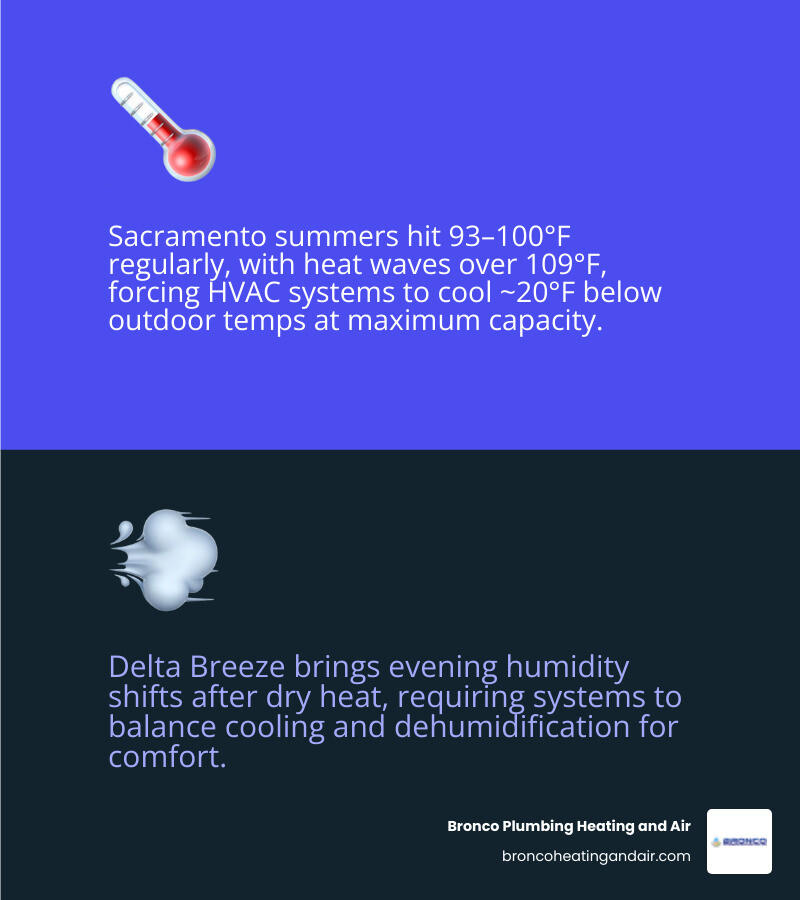
- Scorching summers — Temperatures regularly hit 93–100°F, with heat waves pushing past 109°F. Most systems can only cool a home about 20°F below the outdoor temperature, meaning your equipment works near its limit for months.
- Urban heat island effect — Downtown Sacramento can run up to 8°F hotter than surrounding areas, increasing cooling demand and pushing undersized systems to fail.
- The Delta Breeze — This evening wind brings humidity shifts after days of dry heat, forcing your system to switch between cooling and dehumidification.
- Tule fog in winter — Dense winter fog introduces moisture that can corrode HVAC components and clog filters faster than you'd expect.
- Wildfire smoke and valley smog — Poor air quality events load up filters quickly and push particulates deep into your system if it isn't properly equipped.
- Mild but wet winters — Lows around 38–42°F mean heating demand is moderate, but moisture management still matters for indoor comfort and system health.
Sacramento's Mediterranean climate sounds pleasant on paper. In reality, it means your HVAC system swings between extreme summer heat and damp, foggy winters — with wildfire smoke season layered on top. That combination wears equipment down faster, drives up energy bills, and makes proper sizing, installation, and maintenance more important here than in most other California cities.
Whether you're dealing with uneven cooling, spiking energy costs, or a system that just can't keep up on the hottest days, the local climate is almost always a factor.
The Unique Challenges of the Sacramento Valley Climate
Living in the Sacramento Valley means enjoying a unique geography, but that same geography creates a "bowl" effect that traps heat and pollutants. While coastal cities might enjoy a steady ocean influence, our climate is defined by drastic swings. From the intense sun exposure in neighborhoods like Natomas and Elk Grove to the specific airflow patterns near the river, every mile matters when it comes to home comfort.
For homeowners, this means your heating and cooling system isn't just an appliance; it's a lifeline. Understanding how sacramento climate affects your hvac system starts with recognizing the localized phenomena that don't show up on a standard weather app. Whether you need a quick repair or are looking into More info about HVAC services, local expertise is vital.
Impact of the Urban Heat Island Effect
If you live in downtown Sacramento or the more densely packed areas of Midtown and Land Park, you’ve likely noticed it stays warmer long after the sun goes down. This is the "Urban Heat Island Effect." Concrete, asphalt, and brick soak up the sun’s energy all day and radiate it back out at night.
In downtown Sacramento, this effect can boost temperatures by up to 8°F compared to rural areas. For your HVAC system, this means there is no "recovery time." While a system in a rural area might cycle off as the earth cools, an urban system has to fight against the heat radiating from the street. This leads to higher energy consumption and requires very precise system sizing to ensure the unit doesn't burn out prematurely.
The Delta Breeze and Humidity Shifts
We all love the Delta Breeze—that cool, southerly wind that kicks in when the valley reaches 90°F to 100°F. However, while it lowers the temperature, it often brings a sudden shift in moisture levels. Our bodies perceive a three-degree increase in relative humidity as a one-degree increase in temperature.
When the breeze hits, your HVAC system suddenly has a different job to do. It’s no longer just fighting dry heat; it’s managing a spike in humidity. This is where modern equipment shines. If you’re curious about systems that handle these shifts efficiently, check out our guide on the Ultimate Heat Pumps Sacramento CA. These systems are designed to transfer heat and manage moisture levels perfectly for our specific "breeze-driven" climate.
How Sacramento Climate Affects Your HVAC System During Summer
The Sacramento summer is a marathon, not a sprint. While we share the valley with our neighbors in Roseville, the cooling loads can vary based on local topography and housing age.
| Feature | Sacramento Average | Roseville Average |
|---|---|---|
| Summer Highs | 93°F – 100°F | 95°F – 103°F |
| Humidity Level | Higher (Delta Influence) | Lower (Arid/Foothill) |
| Cooling Demand | High / Persistent | Very High / Peak Heavy |
| Nighttime Relief | Moderate (Breeze) | Low (Retained Heat) |
One of the most important things to remember is the "20-degree rule." Most standard air conditioners are designed to cool your home to a maximum of 20 degrees lower than the outside air. When it hits 109°F in a Sacramento heatwave, asking your AC to keep the house at 68°F is asking for a mechanical breakdown. For those planning a new system to handle these peaks, our AC Installation Sacramento CA Complete Guide covers everything you need to know about sizing.
How Sacramento Climate Affects Your HVAC System in Triple-Digit Heat
When the mercury crosses 100°F, the pressure inside your AC system skyrockets. The compressor—the "heart" of your system—has to work much harder to move heat from inside your home to the blistering outdoors.
If your refrigerant levels are even slightly off, or if your airflow is restricted by a dusty filter, the system can overheat. In Sacramento, we often see "short-cycling," where the system turns on and off rapidly because it’s struggling to maintain the cooling load. If you hear strange noises or notice your home isn't reaching the set temperature, you may need HVAC Repair Roseville CA or Sacramento services to prevent a total compressor failure.
Roseville vs. Sacramento: Subtle Regional Differences
Even though they are only about 20 miles apart, Roseville and Sacramento have distinct HVAC needs. Roseville tends to be slightly hotter and drier, often averaging 95-103°F in the peak of summer. Because the air is drier in the foothills, homeowners there often benefit from high-efficiency central units paired with whole-house fans to take advantage of the dry evening air.
Sacramento’s higher humidity (relatively speaking) means we prioritize dehumidification more. If you are looking for a team that understands these nuances, working with a dedicated HVAC Company Roseville CA ensures your system is tuned for the specific zip code you live in.
Winter Performance: Tule Fog and Mild, Wet Conditions
Sacramento winters are famous for Tule Fog—a thick, ground-hugging mist that can linger for days. While our winters are mild (typically 38-42°F), the high moisture content of the fog presents a unique set of challenges for your heating system.
For those with older homes in East Sac or Land Park, keeping the air warm and dry is a constant battle. This is often where Ductless Heating Sacramento CA comes into play, providing targeted warmth without the energy loss associated with damp, uninsulated ductwork in a crawlspace.
How Sacramento Climate Affects Your HVAC System During Tule Fog Season
Tule fog isn't just a driving hazard; it's an HVAC hazard. The moisture in the fog can settle on the outdoor coils of a heat pump. When temperatures drop near freezing at night, that moisture turns to ice, forcing the system into a "defrost cycle."
If your system is poorly maintained, these frequent defrost cycles can lead to excessive wear on electrical components and reduce overall heating efficiency. Regular checks are essential to ensure your "auxiliary heat" isn't running more than it should, which can cause your utility bill to skyrocket. You can find more Heat Pumps Sacramento CA Tips on our blog to keep your system running smoothly through the fog.
Managing Indoor Humidity in Wet Winters
While we aren't the Pacific Northwest, our wet winters can lead to indoor humidity levels that encourage mildew growth, especially in older homes with poor ventilation. Your HVAC system’s job in the winter is twofold: provide heat and circulate air to prevent stagnant, moist pockets from forming.
Proper air exchange is key. If your windows are constantly "sweating" on the inside, your system might not be ventilating correctly. Scheduling an HVAC Service Roseville CA or Sacramento check-up can help identify if your ductwork is leaking or if your system needs a boost in its ventilation capabilities.
Optimizing Indoor Air Quality Amidst Wildfires and Smog
In recent years, "Sacramento weather" has unfortunately come to include wildfire season. Because we live in a valley, smoke from fires hundreds of miles away can settle over the city, creating hazardous breathing conditions. Smog and ozone also tend to trap near the ground during our long, sunny summers.
Your HVAC system is your home’s first line of defense against these pollutants. However, standard "builder-grade" filters aren't enough to catch the microscopic particulate matter (PM2.5) found in wildfire smoke.
Filtering Out Valley Pollutants
To truly protect your indoor air quality (IAQ), we recommend upgrading to a MERV 13+ filter. These are designed to capture the vast majority of particulates, including smoke, viruses, and mold spores. However, be careful—some older systems aren't designed for the "thick" high-MERV filters, which can actually restrict airflow and damage your motor.
Our Recommended IAQ Solutions for Sacramento:
- MERV 13 Air Filters: The "MVP" of wildfire season.
- Whole-Home Air Purifiers: Systems that use UV light or ionization to kill pathogens.
- Sealed Ductwork: Preventing smoke from being sucked in through leaks in the attic or crawlspace.
- Ventilation Controls: The ability to "close" your system to outside air during heavy smoke events.
Choosing the Right System and Maintenance Strategy
Selecting an HVAC system in Sacramento isn't just about picking a brand; it's about meeting California’s strict energy standards. As of 2023, the minimum SEER2 rating for new systems in our region is 14.3. If you're looking for tax credits, the bar is even higher—usually 16 to 17 SEER2.
We use Manual J Load Calculations to determine the exact size your home needs. We don't just guess based on square footage. We look at your insulation, the direction your windows face (crucial for that Sacramento sun!), and even the color of your roof.
Professional Installation and Pressure Balancing
A common issue in Sacramento homes—especially those with recent additions—is pressure imbalance. You might have one room that feels like an icebox while another is a sauna. This is usually a sign of poor installation or leaky ductwork.
Proper installation ensures that the "supply" and "return" air are perfectly balanced. In California, we also have to comply with Title 24 standards, which require duct testing to ensure you aren't losing 20-30% of your conditioned air to your attic. A well-balanced system lasts longer because it doesn't have to fight against itself to move air.
Seasonal Maintenance for Peak Performance
Because how sacramento climate affects your hvac system is so intense, we recommend a bi-annual tune-up schedule:
- Spring (Before May): Check the AC, clean the condenser coils, and verify refrigerant levels before the first 100-degree day.
- Fall (October/November): Inspect the heat exchanger for cracks and ensure the heat pump’s defrost cycle is working before the Tule fog arrives.
Regular maintenance can improve energy efficiency by up to 30% and extend the life of your system from the typical 10-15 years to well over 20 years.
Frequently Asked Questions about Sacramento HVAC Performance
What is the ideal summer thermostat setting for Sacramento?
We generally recommend 78°F when you are home. While it sounds high, pairing this with ceiling fans (spinning counterclockwise) can make the room feel much cooler. SMUD and Energy Star also suggest 78°F to balance comfort with energy savings. If you're away, bumping it up to 85°F can prevent your system from working unnecessarily while the house is empty.
Is it safe to run my AC during heavy Tule fog?
Yes, it is safe. In fact, running the AC (or the fan) during fog can help reduce indoor humidity and filter out pollutants trapped in the damp air. Just make sure your filters are clean, as damp fog can make a dirty filter "clog" even faster, restricting airflow to your unit.
How often should I change my air filters during wildfire season?
While the standard rule is every 3 months, you should check your filter every 2 to 4 weeks during active wildfire smoke events. If the filter looks grey or "fuzzy," replace it immediately. A clogged filter is the leading cause of blower motor failure during the summer.
Conclusion
At Bronco Plumbing Heating and Air, we live and work in the same climate you do. We know exactly what a 110-degree afternoon in Roseville feels like, and we understand the damp chill of a January morning in Land Park. Our licensed, professional technicians are experts in how sacramento climate affects your hvac system, providing cost-effective solutions that keep your family comfortable year-round.
Don't wait for the next record-breaking heatwave or the arrival of the Tule fog to think about your home's comfort. Whether you need a seasonal tune-up, an IAQ upgrade for wildfire season, or a complete system replacement, we are here to help.
Schedule your consultation in our Sacramento Service Area today and let us help you build a more resilient, energy-efficient home.

Customer Testimonials
Our customer testimonials highlight the reliable service, quality workmanship, and trusted results homeowners experience with Bronco Plumbing Heating and Air.


Ready to Transform your Home?
Create a healthier, more comfortable home with expert HVAC, plumbing, and indoor air quality solutions you can trust. From efficient heating and cooling to cleaner air and reliable repairs, our experienced team is here to keep your family comfortable year-round with dependable service and upfront pricing.
Related Articles

The Hidden Cost of Dirty AC Coils in Dusty North Highlands Neighborhoods

A Practical Guide to HVAC Repair vs Replacement
Why Your AC Won't Shut Off During a Roseville Heatwave (And When to Worry)