



.svg)

What You Need to Know About Federal Tax Credits for AC and Heat Pump Upgrades
Federal tax credits for AC and heat pump upgrades let eligible homeowners claim up to 30% of their installation costs back on their federal taxes each year through December 31, 2025.
Here's a quick breakdown of what's available:
• Air-source heat pump — Max Annual Credit: $2,000 — Key Requirement: ENERGY STAR Most Efficient certified
• Central air conditioner — Max Annual Credit: $600 — Key Requirement: SEER2 ≥ 17.0, EER2 ≥ 12.0 (split system)
• Geothermal heat pump — Max Annual Credit: 30% of total cost (no cap) — Key Requirement: Section 25D, separate from annual limits
• Other upgrades (insulation, windows, etc.) — Max Annual Credit: $1,200 — Key Requirement: Varies by improvement type
• Total annual maximum — Max Annual Credit: $3,200 — Key Requirement: Combine heat pump + other upgrades
If you're a Sacramento homeowner thinking about upgrading your heating or cooling system, the timing matters. The Inflation Reduction Act expanded two key tax incentives — Section 25C (the Energy Efficient Home Improvement Credit) and Section 25D (for geothermal systems) — giving homeowners a real financial reason to act before these credits expire. In 2024 alone, over 2.3 million families claimed these credits, averaging $880 per household. That's real money back in your pocket for upgrades that also lower your energy bills year-round.
This guide walks you through exactly how these credits work, what equipment qualifies, and how to claim every dollar you're entitled to.
Understanding Federal Tax Credits for AC and Heat Pump Upgrades
When we talk about federal tax credits for ac and heat pump upgrades, we are primarily looking at the Energy Efficient Home Improvement Credit, also known as Section 25C. This credit was significantly overhauled by the Inflation Reduction Act to provide more substantial, long-term savings for homeowners.
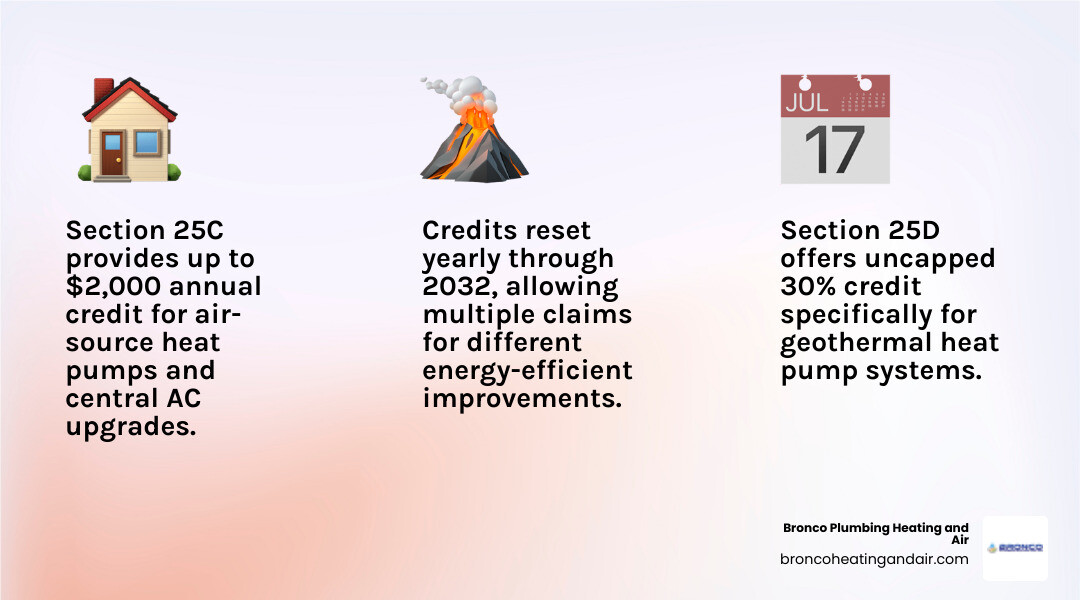
Unlike previous versions of the credit, which often had small lifetime caps, the current version resets every single year. This means you can strategically plan your home improvements to maximize your tax returns. For example, you could install a qualifying heat pump this year and claim the $2,000 credit, then upgrade your windows or electrical panel next year to claim another $1,200.
The credit covers 30% of the project cost, including labor for certain items like heat pumps and central air conditioners. However, there are specific annual limits:
• Heat Pumps and Heat Pump Water Heaters: Up to $2,000 per year.
• Central Air Conditioners: Up to $600 per year.
• Other Envelope Improvements: Up to $1,200 per year (for windows, doors, and insulation).
The total aggregate limit for Section 25C is $3,200 per year, but the $2,000 for heat pumps is its own separate "bucket" that doesn't count toward the $1,200 limit for other items. To make sure you’re choosing the right system for these savings, our team provides comprehensive AC Services to help you navigate the technical requirements.
Qualifying Equipment for Federal Tax Credits for AC and Heat Pump Upgrades
Not every unit sitting in a warehouse qualifies for these credits. To protect the environment and your wallet, the federal government requires that systems meet high efficiency standards.
1. Air-Source Heat Pumps: These are the "stars" of the tax credit program. Because they provide both heating and cooling, they are eligible for the highest credit of $2,000. For 2025, the system must be ENERGY STAR Most Efficient certified.
2. Central Air Conditioners: If you aren't ready for a full heat pump, a high-efficiency central AC unit can still net you a $600 credit. These must meet specific SEER2 and EER2 ratings, which we will detail in the efficiency section below.
3. Geothermal Heat Pumps: These fall under Section 25D. They are incredibly efficient because they use the stable temperature of the earth to regulate your home. They qualify for a 30% credit on the entire installation cost with no upper dollar limit.
4. Biomass Stoves and Boilers: These also fall into the $2,000 annual bucket, provided they have a thermal efficiency rating of at least 75%.
If you are located in the Sacramento area and need a hand picking out a qualifying unit, we offer expert AC Installation Carmichael, CA to ensure your new system meets every federal requirement.
Residential Eligibility for HVAC Incentives
Who can claim these credits? Most homeowners in our service area, from Elk Grove to Rocklin, will qualify, but there are a few rules to keep in mind:
• Primary Residence: Most of the Section 25C credits (like those for insulation or energy audits) are reserved for your primary home—the place where you live most of the year.
• Existing Homes: These credits are designed for home improvements. This means the home must already be built and in use. New construction generally does not qualify for the Section 25C credit, though it may qualify for other builder-specific incentives.
• Second Homes: Interestingly, for heat pumps and central AC units, you can claim the credit for a second home that you use as a residence. However, you cannot claim it for a property that you only rent out (landlord status).
• Renters: If you are a renter and you pay for the installation of a qualifying heat pump or AC unit in your primary residence, you may still be able to claim the credit.
Whether you are in a historic home in Land Park or a newer build in Roseville, maintaining your system is key to its longevity. We recommend regular Heat Pump Service Roseville, CA to keep your energy-efficient system running at the high standards required by the IRS.
2025 Efficiency Standards and ENERGY STAR Requirements
Beginning in 2025, the rules for federal tax credits for ac and heat pump upgrades have become more specific. The Department of Energy and the IRS now require most systems to be "ENERGY STAR Most Efficient" to qualify. This ensures that the systems being subsidized are truly the top-tier performers in terms of energy savings.
Here is a comparison of the efficiency requirements you need to look for:
• Split Ducted Heat Pump — SEER2 Requirement: ≥ 15.2 — EER2 Requirement: ≥ 10.0 — HSPF2 Requirement: ≥ 8.5
• Non-Ducted (Mini-Split) Heat Pump — SEER2 Requirement: ≥ 16.0 — EER2 Requirement: ≥ 12.0 — HSPF2 Requirement: ≥ 9.0
• Central AC (Split System) — SEER2 Requirement: ≥ 17.0 — EER2 Requirement: ≥ 12.0 — HSPF2 Requirement: N/A
• Central AC (Packaged) — SEER2 Requirement: ≥ 16.0 — EER2 Requirement: ≥ 11.5 — HSPF2 Requirement: N/A
It is also important to note that the Consortium for Energy Efficiency (CEE) sets "tiers" for efficiency. To qualify for the tax credit, your system must generally meet or exceed the highest efficiency tier (excluding any advanced tiers) established by the CEE at the start of the year in which the system is installed.
For homeowners in Citrus Heights, making sure your system hits these marks is easy when you work with pros. We handle Heat Pump Installation Citrus Heights, CA and can verify the AHRI certificate of your new unit to prove it meets these 2025 standards.
Step-by-Step Guide to Claiming Your Credit
Claiming your credit doesn't happen automatically—you have to file for it when you submit your federal income taxes. Here is our recommended step-by-step process to ensure you don't leave money on the table.
1. Verify Eligibility Before Buying: Check the ENERGY STAR website or ask us to confirm that the model you are considering is "Most Efficient" for 2025.
2. Professional Installation: Ensure the system is installed by a licensed professional. The IRS often requires proof of installation, and for certain credits, labor costs are only deductible if the installation is done correctly.
3. Collect Documentation: You will need:
— The sales receipt showing the model number and cost.
— The Manufacturer’s Certification Statement (a signed document from the manufacturer certifying the product qualifies).
— The Qualified Manufacturer (QM) Code / PIN: Starting in 2025, you must include a Product Identification Number (PIN) or QM code on your tax return for most HVAC equipment.
4. Fill Out IRS Form 5695: This is the "Residential Energy Credits" form. You will use Part II for the Energy Efficient Home Improvement Credit (Section 25C).
5. File with Your Taxes: Submit Form 5695 along with your standard 1040.
If you’re ready to start the process, our team at Bronco Heating and Air can provide the necessary documentation for your HVAC Installation Roseville, CA.
Avoiding Mistakes with Federal Tax Credits for AC and Heat Pump Upgrades
We’ve seen homeowners miss out on thousands of dollars because of simple paperwork errors. Here are the most common pitfalls to avoid:
• The Credit is Nonrefundable: This is the most important thing to understand. A nonrefundable credit can reduce the tax you owe to zero, but it won't give you a "refund" check for the difference. For example, if you owe $1,500 in taxes but qualify for a $2,000 heat pump credit, your tax bill will drop to $0, but you won't get the remaining $500 back.
• No Carryforward for 25C: Unlike the geothermal credit (Section 25D), the 25C credit for air-source heat pumps and AC units cannot be carried forward to future years. If you can't use the full credit this year, the remainder is lost.
• Timing the Installation: The credit is claimed for the year the system is installed, not the year it was purchased. If you buy a unit in December 2024 but we install it in January 2025, you claim it on your 2025 taxes.
• Forgetting the PIN: As mentioned, the 2025 requirement for a Product Identification Number (PIN) is new. Make sure your contractor or the manufacturer provides this before you file.
If the upfront cost of a high-efficiency system is a concern, we offer various Financing Options to help you bridge the gap until your tax savings kick in.
Maximizing Savings with Rebates and Local Incentives
While federal tax credits for ac and heat pump upgrades are fantastic, they are only one part of the savings puzzle. In Sacramento and surrounding areas like Folsom and Elk Grove, you can often "stack" these credits with other incentives.
• HEEHRA Rebates: The High-Efficiency Electric Home Rebate Act (HEEHRA) provides point-of-sale rebates for low-to-moderate-income households. If you qualify, you could get up to $8,000 off a heat pump installation instantly at the time of purchase. This is separate from the tax credit.
• Utility Rebates: Organizations like SMUD (Sacramento Municipal Utility District) frequently offer their own rebates for switching from gas to electric heat pumps or for installing high-efficiency AC units. These can range from a few hundred to several thousand dollars.
• Income-Based Qualifications: For HEEHRA, "low income" is generally defined as less than 80% of the Area Median Income (AMI), while "moderate income" is 80% to 150% of the AMI.
By combining a $2,000 federal tax credit with an $8,000 HEEHRA rebate and a $1,500 SMUD incentive, the cost of a high-end system becomes incredibly manageable. We are proud to serve as your local experts for HVAC Services in Sacramento, CA, helping you identify every available local and federal dollar.
Frequently Asked Questions about HVAC Tax Credits
Can I claim the tax credit for a rental property I own?
No. The Section 25C credit is specifically for homes used as a residence by the taxpayer. If you are a landlord and do not live in the property, you cannot claim this specific credit. However, there may be other business-related energy credits available to you—we recommend consulting with a tax professional for rental properties.
What is the maximum credit for a central air conditioner in 2025?
The maximum credit for a qualifying central air conditioner is $600. To qualify, the unit must meet or exceed the CEE's highest efficiency tier. For split systems, this typically means a SEER2 of 17.0 or higher and an EER2 of 12.0 or higher.
Do geothermal heat pumps have the same $2,000 annual limit?
No. Geothermal heat pumps fall under Section 25D, the Residential Clean Energy Credit. This credit is much more generous: it covers 30% of the total installation cost with no maximum dollar cap. Additionally, if the credit exceeds your tax liability for the year, you can carry the remaining balance forward to future tax years through 2032.
Conclusion
Upgrading your home’s comfort system is a significant investment, but with the current federal tax credits for ac and heat pump upgrades, there has never been a better time to make the switch. Whether you’re looking to slash your summer cooling bills in Roseville or stay cozy during a Sacramento winter, these incentives make high-efficiency technology accessible for almost everyone.
At Bronco Heating and Air, we pride ourselves on being more than just installers. We are your partners in home efficiency. Our licensed, professional, and courteous technicians are ready to help you select a system that qualifies for the maximum $2,000 credit while providing the reliable comfort your family deserves.
Don’t leave money on the table this tax season. Claim your savings with our professional AC Services and let us help you build a more efficient, comfortable home today.

Customer Testimonials
Our customer testimonials highlight the reliable service, quality workmanship, and trusted results homeowners experience with Bronco Plumbing Heating and Air.


Ready to Transform your Home?
Create a healthier, more comfortable home with expert HVAC, plumbing, and indoor air quality solutions you can trust. From efficient heating and cooling to cleaner air and reliable repairs, our experienced team is here to keep your family comfortable year-round with dependable service and upfront pricing.
Related Articles
The Mechanics of Reversing Valves in Heat Pumps During Fall Transitions


Why September is the Critical Window for Sacramento Valley Wildfire Smoke Prep
Recognizing the Difference Between Normal AC Wear and Impending System Failure