



.svg)

Why Do AC Units Wear Out Faster in Hot Climates? (The Short Answer)
Why do ac units wear out faster in hot climates is one of the most common questions Sacramento homeowners ask after getting hit with a surprise repair bill or a system that quits in the middle of July. The simple answer: heat forces your AC to work longer, harder, and under more stress than it was ever designed to handle — and that punishment adds up fast.
Here is a quick breakdown of the core reasons:
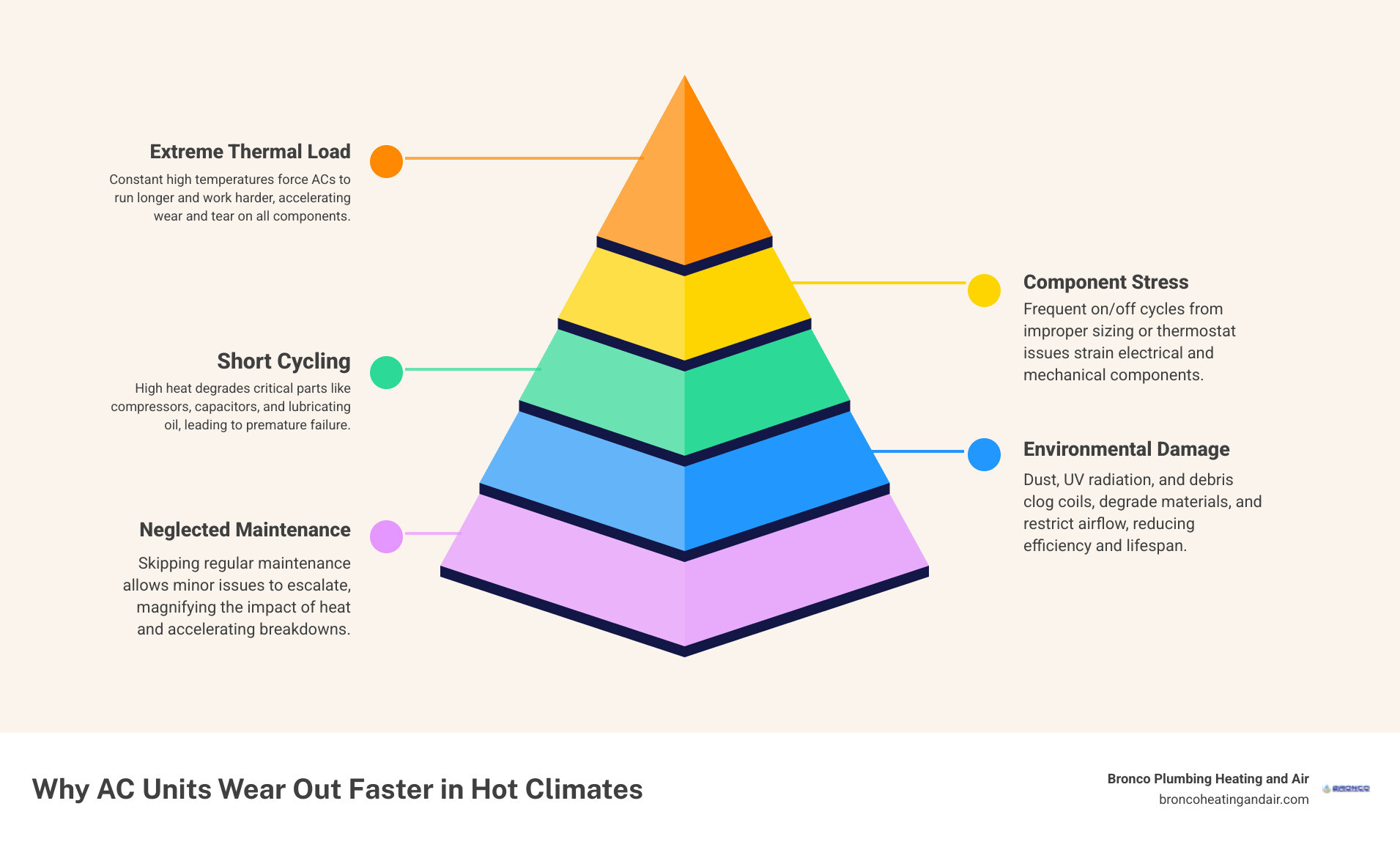
• Longer run times - In hot climates, AC systems run 2,500–3,500 hours per year versus 600–900 hours in northern states
• Higher thermal load - When outdoor temps hit 105°F+, your system must overcome a massive temperature differential just to keep your home at 75°F
• Component stress - Extreme heat degrades capacitors, thins lubricating oil, and pushes compressors past their design limits
• Short cycling - Improperly sized units turn on and off too frequently, wearing out motors and compressors faster
• Environmental damage - Dust, UV radiation, and debris accelerate corrosion and clogging of critical parts
• Neglected maintenance - Heat amplifies every small problem, turning minor issues into expensive failures
The national average lifespan for a central AC unit is 15–20 years. In hot climates like Sacramento, Phoenix, or Florida, that number drops to 8–15 years — sometimes less.
Think of it this way: running an AC in extreme heat is like driving your car 100,000 miles a year instead of 15,000. The machine is the same. The wear is not.
The rest of this guide walks through exactly what is happening inside your system, why it matters, and what you can do to slow the damage down.
Why Do AC Units Wear Out Faster in Hot Climates?
When we talk about AC longevity, we have to look at the numbers. In a moderate climate, an air conditioner is a seasonal luxury used for a few months. In the Sacramento Valley, it is a survival tool used for the better part of the year. This difference in usage creates a massive gap in how long the equipment actually lasts.
• Annual Operating Hours — Moderate Climate (e.g., Michigan): 600 – 900 hours — Hot Climate (e.g., Sacramento/Phoenix): 2,500 – 3,500 hours
• Typical Lifespan — Moderate Climate (e.g., Michigan): 15 – 20 years — Hot Climate (e.g., Sacramento/Phoenix): 8 – 12 years
• Peak Ambient Temp — Moderate Climate (e.g., Michigan): 85°F – 90°F — Hot Climate (e.g., Sacramento/Phoenix): 105°F – 115°F
• System "Recovery" Time — Moderate Climate (e.g., Michigan): High (Cool nights) — Hot Climate (e.g., Sacramento/Phoenix): Low (Hot nights)
The fundamental reason why do ac units wear out faster in hot climates is the sheer volume of work. To understand the physics behind this, you can check out How Air Conditioning Works: A User's Guide. In short, an AC doesn't "create cold"; it moves heat. When it’s 110°F outside, moving heat out of a 75°F house is like trying to push a boulder uphill. The steeper the hill (the higher the temperature), the more the machine struggles.
Why do ac units wear out faster in hot climates due to extreme thermal load?
Thermal load refers to the amount of heat energy your AC must remove to maintain a set temperature. Most residential units are engineered and tested at an outdoor design temperature of 95°F. Once the Sacramento sun pushes the mercury past 105°F, the system enters a state of "mechanical warfare."
At these temperatures, the outdoor condenser coil has a much harder time rejecting heat. On a 115°F day, the coil itself might be running at 150°F. The "temperature differential"—the gap between the coil and the outside air—shrinks, making the heat transfer process incredibly inefficient. This leads to system fatigue, where components run hotter, under higher pressure, and for much longer intervals without a break.
The impact of prolonged cooling seasons on system longevity
In places like Roseville or Elk Grove, our cooling season isn't a three-month summer; it's an eight-month marathon. We often start seeing heat spikes in April and don't get a true break until late October.
This cumulative wear is the silent killer of HVAC systems. While a unit in a northern state might accumulate 15 years of "wear and tear" over its actual 15-year life, a Sacramento unit reaches that same level of mechanical aging in just five or six years. By the time an AC unit in our region hits its 10th birthday, it is often delivering only 80-85% of its original cooling power while consuming significantly more electricity.
Step 1: Understand the Mechanical Toll on Critical Components
To prevent a mid-summer meltdown, we need to look under the hood. Extreme heat doesn't just make the system work harder; it physically degrades the materials that make the system run.
The compressor is the "heart" of your AC. It’s a motor-driven pump that pressurizes refrigerant. Under extreme heat, the lubricating oil inside the compressor thins out. When oil thins, it loses its ability to protect moving parts, leading to metal-on-metal friction. Over time, this causes compressor fatigue and, eventually, a mechanical seizure.
Furthermore, the motor windings—the copper wires inside the motor—are coated in a protective lacquer. High internal temperatures (which can spike above 225°F in the compressor) cause this lacquer to become brittle and crack, leading to electrical shorts and a total motor burnout.
Why do ac units wear out faster in hot climates due to component stress?
Aside from the compressor, your electrical components are under siege. The most common failure we see during a Sacramento heatwave is a "blown" capacitor.
Why Does My Air Conditioner Have Capacitors? These small, soda-can-sized devices provide the "kick" needed to start your motors. They contain a dielectric fluid that is sensitive to heat. While they are usually rated for temperatures up to 150°F, the electrical compartment of an outdoor unit sitting in the direct sun can easily reach 170°F or higher. This causes the fluid to vaporize, the capacitor to bulge, and the system to fail.
We also see significant "pitting" on electrical contactors. Every time your AC cycles on, a small electrical arc occurs. In extreme heat, the compressor draws more amperage, making these arcs more intense. This "arc welding effect" eventually welds the contacts shut or prevents them from closing, leaving you without air. For more on how these parts interact, see How Do the Coils in My AC System Work.
How extreme heat affects refrigerant and lubrication
The relationship between heat and pressure is a law of physics. As the temperature outside rises, the pressure within your refrigerant lines increases. For a modern R-410A system, high-side pressures can jump from 350 PSI on a mild day to over 500 PSI during a heatwave.
This intense pressure puts immense stress on every joint, seal, and copper fitting. It's the primary reason why "micro-leaks" develop. While you might think Why Your Refrigerant Doesn't Run Out means it’s a closed loop, the thermal expansion and contraction caused by our 40-degree daily temperature swings in the Central Valley eventually take a toll on the metal, leading to slow leaks that starve the compressor of the cooling it needs.
Step 2: Recognize the Impact of Short Cycling and Improper Sizing
One of the most misunderstood reasons why do ac units wear out faster in hot climates involves how the unit was sized when it was installed. In the HVAC world, "bigger" is almost never "better."
Short cycling occurs when an AC unit turns on, cools the house very quickly, and shuts off before it can complete a full cycle. This is a disaster for longevity. Why? Because the startup phase is the most stressful part of an AC's operation. Your system "gulps" down electricity at startup—often drawing 3 to 5 times its running amperage. Frequent starts and stops wear out the compressor and fan motors exponentially faster than long, steady runs.
The dangers of oversized and undersized units in the heat
In places like Carmichael or Citrus Heights, we see two major sizing issues:
1. Oversized Units: These cause the short cycling mentioned above. They cool the air so fast that they fail to remove humidity, leaving your home feeling "clammy" and causing the equipment to cycle 50-100 times a day.
2. Undersized Units: These units simply cannot keep up. They will run for 18-20 hours straight without ever reaching the set temperature. This leads to overheating and premature compressor failure.
If you find yourself asking, "My AC Isn't Cooling My House in Carmichael - Who Are the Best Rated Repair Services Near Me," it might be time for a professional load calculation to ensure your system is actually the right size for your home's square footage and insulation levels.
How thermostat placement contributes to system wear
Believe it or not, where you put your thermostat matters. If your thermostat is mounted on a wall that receives direct sunlight, or near a heat-producing appliance, it will give "false readings." This tricks the AC into thinking the house is much hotter than it actually is, leading to frequent, unnecessary cycling. A thermostat in a "hot spot" can add hundreds of unnecessary runtime hours to your system every year.
Step 3: Identify Environmental Factors Beyond Temperature
While the heat is the primary villain, it has several "sidekicks" in the Sacramento area that accelerate the wear and tear on your HVAC system.
The role of dust and debris in Sacramento’s climate
We live in a valley surrounded by agriculture and construction. This means our air is full of dust, pollen, and fine particulates. When your outdoor fan pulls air through the condenser coils, it acts like a giant vacuum cleaner.
Over time, this dust coats the aluminum fins of the coil. In our region, we often deal with "caliche"—a calcium carbonate compound that can actually bond to the coils when it gets wet (from rain or a sprinkler) and then bakes in the sun. This creates an insulating blanket that prevents heat from escaping. A coil that is even 10% blocked can force the compressor to work 20% harder. This is why regular AC Maintenance & Repair Arden Arcade CA is so critical; professional coil cleaning is the only way to remove this baked-on grime.
If the outdoor unit is struggling, the indoor unit can suffer too. Check out Seeing Leaks from Your AC? Time to Check the Condensate Array to see how dust can also lead to indoor drainage disasters.
How UV radiation destroys outdoor HVAC infrastructure
The Sacramento sun is relentless. Intense UV radiation is an underappreciated HVAC killer. Over time, the sun’s rays degrade:
• Wiring Insulation: Exposed wires become brittle, crack, and eventually short out.
• Refrigerant Line Insulation: That black foam "noodle" on your copper lines protects the refrigerant from absorbing heat before it gets to your house. UV rays turn this foam into dust in 3-5 years, causing your system to lose efficiency.
• Plastic Components: Fan blades and cabinet coatings can become brittle and fragment under the constant bombardment of UV light.
Step 4: Implement Essential Maintenance to Extend System Life
The good news is that you aren't helpless against the heat. While we can't change the weather in Folsom or Elk Grove, we can change how the system handles it. Proactive maintenance is the difference between a unit that lasts 8 years and one that lasts 15.
Why do ac units wear out faster in hot climates when maintenance is neglected?
Neglect in a hot climate leads to a "cascade failure." It starts with a dirty air filter. A clogged filter restricts airflow, causing the indoor evaporator coil to drop in temperature. This can actually cause the coil to freeze—yes, even in 100-degree weather!
When the coil freezes, liquid refrigerant can "slug" back into the compressor. Since liquids don't compress, this can destroy the compressor's internal valves in seconds. Regular check-ups, like What Happens During Air Conditioning Maintenance, ensure that these small dominos don't start falling. To make sure you're ready for the next heatwave, ask yourself: Is Your Air Conditioning System Ready for the Summer?
Warning signs your AC is struggling in the heat
You don't have to be a pro to know when your system is in trouble. Knowing How to Tell if Your AC is Broken can save you from a total system replacement. Watch for these red flags:
• Weak Airflow: If the air coming out of your vents feels like a tired whisper, your blower motor or filter is struggling.
• Unusual Noises: Squealing, grinding, or loud "clunking" sounds usually indicate that a motor bearing or the compressor is nearing the end of its life.
• Rising Utility Bills: If your bill is 20-30% higher than last July but the weather is the same, your system is losing its efficiency.
• Frequent Repairs: If you've had to replace a capacitor or contactor more than once in the last two years, the heat is winning.
Frequently Asked Questions about AC Longevity
How many years does an AC unit typically last in a hot climate?
In the Sacramento area, you can expect a well-maintained system to last between 10 and 15 years. Systems that are neglected or improperly sized often fail between the 8 and 10-year mark. This is significantly shorter than the 20-year lifespan seen in cooler northern states.
Does shading my outdoor unit actually help prevent wear?
Yes, but with a major caveat: airflow is more important than shade. A shade structure like a pergola or a "shade sail" can reduce the ambient temperature around the unit by 10-15°F, which protects the electrical components. However, you must maintain at least 24 inches of clearance on all sides and 48 inches above the unit. If you "box in" the unit to hide it or shade it too closely, you will trap the hot air and kill the compressor even faster.
When should I replace my AC instead of repairing it?
We recommend the "5,000 Rule." Multiply the age of your unit by the cost of the repair. If the total is more than $5,000, it’s usually smarter to invest that money into a new, high-efficiency system. For example, a 12-year-old unit needing a $600 repair ($7,200) is a prime candidate for replacement, especially considering that modern units are up to 40% more efficient than those made a decade ago.
Conclusion
At Bronco Heating and Air, we’ve seen how the Sacramento sun can turn a reliable air conditioner into a pile of scrap metal. The reality is that our climate is a high-stress environment for mechanical equipment. However, with the right sizing, professional installation, and a commitment to annual maintenance, you can protect your investment and keep your home comfortable for years to come.
Our licensed, professional, and courteous technicians are experts in the unique challenges of the Central Valley. Whether you are in Davis, Folsom, or right here in Sacramento, we provide cost-effective solutions tailored to your specific needs. Don't wait for the next triple-digit day to find out if your system is up to the task.
Schedule your Sacramento AC service today and let us help you beat the heat!

Customer Testimonials
Our customer testimonials highlight the reliable service, quality workmanship, and trusted results homeowners experience with Bronco Plumbing Heating and Air.


Ready to Transform your Home?
Create a healthier, more comfortable home with expert HVAC, plumbing, and indoor air quality solutions you can trust. From efficient heating and cooling to cleaner air and reliable repairs, our experienced team is here to keep your family comfortable year-round with dependable service and upfront pricing.
Related Articles

Why Summer Tree Root Intrusion Causes Unexpected Sewer Line Backups in Carmichael

Is a 24-Hour Emergency AC Repair Call Justified for a Tripped Breaker?
Surviving a Sacramento Valley Heatwave When Your AC Condenser Freezes Solid