



.svg)

The Simple Science Behind How Heat Pumps Heat and Cool Your Home
What Is a Heat Pump and How Does It Work?How does a heat pump work is one of the most common questions Sacramento homeowners ask when exploring smarter ways to…

What Is a Heat Pump and How Does It Work?
How does a heat pump work is one of the most common questions Sacramento homeowners ask when exploring smarter ways to heat and cool their homes. The short answer: a heat pump doesn't create heat — it moves it. In winter, it pulls heat from the outdoor air and brings it inside. In summer, it reverses the process, pushing indoor heat outside to cool your home. One system. Two jobs. Year-round comfort.
Quick Answer: How a Heat Pump Works
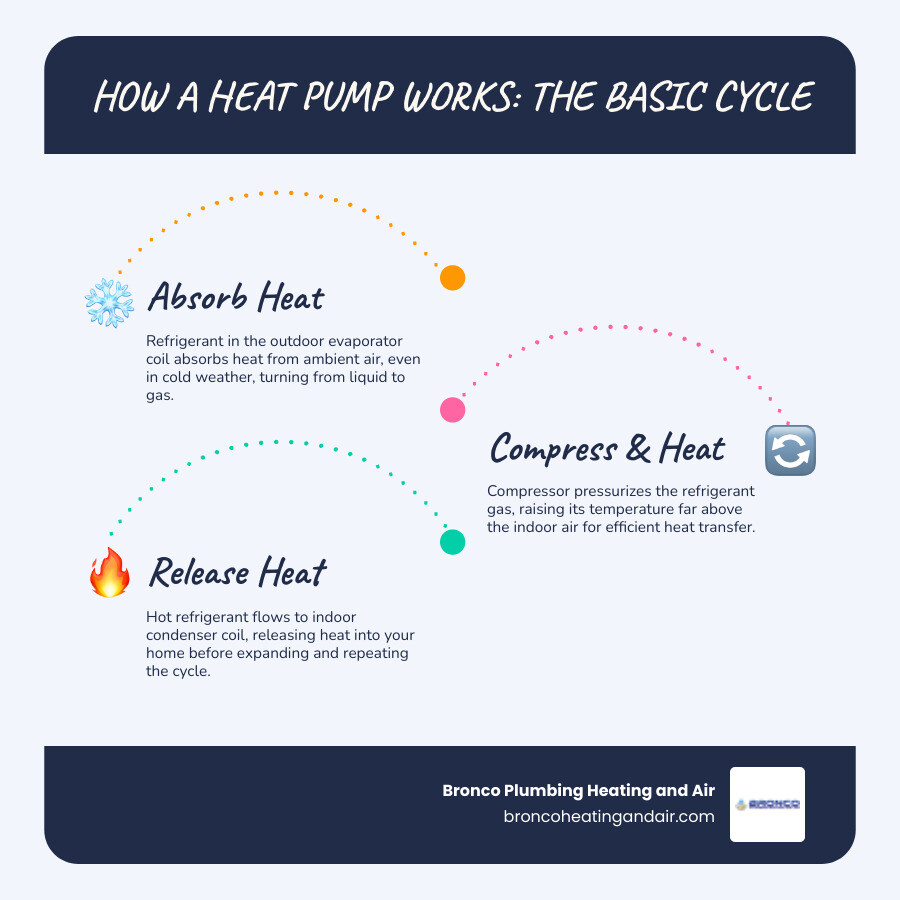
1. Absorbs heat from outside air (even cold air) using a refrigerant
2. Compresses the refrigerant to raise its temperature
3. Releases that heat indoors through an indoor coil
4. Reverses the process in summer to cool your home instead
5. Repeats the cycle continuously to maintain your set temperature
Here's what makes this so powerful: even air at freezing temperatures contains usable heat energy. Heat only disappears completely at absolute zero (-273°C), a temperature that never occurs in nature. That means your heat pump almost always has something to work with — and it moves that existing heat far more efficiently than any system that burns fuel or converts electricity directly into warmth.
Traditional heating systems like gas furnaces or electric resistance heaters generate heat by burning or converting energy. A heat pump sidesteps that entirely. Instead of spending a unit of energy to create a unit of heat, it spends one unit of electricity to move three to four units of heat. That's why heat pumps can exceed 300% efficiency — something no conventional heater can match.
For Sacramento residents dealing with hot summers and chilly winters, this dual-function efficiency is a big deal. Whether you're trying to stay cool in July or comfortable in January, understanding how a heat pump works helps you see why more and more homeowners are making the switch.
The Core Components: How Does a Heat Pump Work?
To understand how does a heat pump work, we have to look under the hood. While it might seem like magic to pull heat out of a chilly Fair Oaks night, it’s actually a very disciplined dance between a few mechanical parts and a special fluid called refrigerant.
1. The Compressor
Think of the compressor as the heart of the system. It’s located in the outdoor unit. Its job is to squeeze the refrigerant. When you compress a gas, its temperature rises significantly. This is a fundamental law of physics: higher pressure equals higher temperature.
2. The Coils (Evaporator and Condenser)
There are two sets of coils—one inside your home and one outside. Depending on whether you are heating or cooling, these coils swap roles. One acts as the "evaporator" (absorbing heat) and the other as the "condenser" (releasing heat). In the winter, the outdoor coil absorbs heat from the air, and the indoor coil releases it into your living room.
3. The Expansion Valve
This little component is the unsung hero. It acts like a nozzle on a spray can. As the refrigerant passes through it, the pressure drops instantly. This causes the refrigerant to get incredibly cold—much colder than the air outside—allowing it to start soaking up heat again.
4. The Reversing Valve
This is the "brain" that separates a heat pump from a standard air conditioner. What is the Reversing Valve and Why Does It Matter is a great question; essentially, this valve flips the direction of the refrigerant flow. With one click, your system switches from "AC mode" to "Heater mode."
5. Refrigerant
The "blood" of the system. Refrigerant is a special chemical that has a very low boiling point—often below -15°F. This allows it to turn into a gas even when it's freezing outside, carrying that captured heat energy into your home.
To keep these parts moving smoothly, regular Heat Pump Service Roseville CA is essential. Without a clean coil or a healthy compressor, the physics of the system start to break down, leading to higher energy bills.
The Step-by-Step Process of Heating and Cooling
The magic of the heat pump lies in thermodynamics—the study of how heat moves. Heat naturally wants to move from a warm place to a cold place. A heat pump uses a little bit of electricity to force heat to move "uphill" (from cold to warm).
• Outdoor Coil Role — Heating Mode: Evaporator (Absorbs heat) — Cooling Mode: Condenser (Rejects heat)
• Indoor Coil Role — Heating Mode: Condenser (Rejects heat) — Cooling Mode: Evaporator (Absorbs heat)
• Refrigerant State Indoors — Heating Mode: Hot Gas (Condensing to Liquid) — Cooling Mode: Cold Liquid (Evaporating to Gas)
• Main Goal — Heating Mode: Bring heat inside — Cooling Mode: Push heat outside
If your system isn't switching correctly between these modes, you might need Heat Pump Repair Citrus Heights CA to check the reversing valve or refrigerant levels.
How does a heat pump work to warm your home in winter?
When it’s 35°F in Sacramento, you might think there’s no "heat" outside. But scientifically, there is plenty! As long as the temperature is above absolute zero, heat energy exists.
1. Extraction: The cold liquid refrigerant flows through the outdoor coils. Because the refrigerant is even colder than the 35°F air, the "warmth" from the air flows into the refrigerant.
2. Boiling: This tiny bit of ambient heat causes the refrigerant to reach its boiling point and turn into a gas.
3. Compression: The compressor squeezes that gas, concentrating the heat and raising the temperature to over 100°F.
4. Distribution: This hot gas travels to the indoor coil. Your blower fan pushes air across the hot coil, warming your home.
5. Condensation: As the heat leaves the refrigerant to warm your air, the refrigerant cools down, turns back into a liquid, and heads back outside to repeat the cycle.
For a deeper dive into local performance, check out our Heat Pumps Sacramento CA Guide.
How does a heat pump work to cool your home in summer?
In the summer, the heat pump acts exactly like a high-end air conditioner. The reversing valve flips, and the process goes into reverse.
1. Heat Removal: The indoor coil becomes the evaporator. Cold refrigerant absorbs the heat from your indoor air.
2. Dehumidification: As the air cools, moisture condenses on the cold coil and drains away, lowering the humidity in your home.
3. Transport: The refrigerant carries the indoor heat to the outdoor unit.
4. Rejection: The outdoor coil releases the heat into the already-hot Sacramento air.
Keeping your system in top shape with Heat Pump Service Carmichael CA ensures that this heat rejection happens efficiently, even when the thermometer hits triple digits.
Why Heat Pumps Are the Most Efficient HVAC Option
Efficiency is where heat pumps truly shine. Most heating systems are rated by how much energy they create. A space heater or an electric furnace has a maximum theoretical efficiency of 100%—you get 1 watt of heat for every 1 watt of electricity.
Heat pumps use a different metric: the Coefficient of Performance (COP). Because they move heat rather than creating it, they can achieve a COP of 3 or 4. This means for every 1 watt of electricity used, the system delivers 3 to 4 watts of heat. That is essentially 300% to 400% efficiency.
Benefits of Heat Pump Efficiency:
• Lower Emissions: Since they don't burn fossil fuels, they are much better for the environment.
• Dual Functionality: You don't need to maintain a separate furnace and AC unit.
• Consistent Comfort: Modern variable-speed compressors provide steady temperatures without the "blast" of a traditional furnace.
• Versatility: Whether you need an air-source system or a ductless mini-split, there is a configuration for every home.
If you're curious about which model fits your property, our Home Heat Pumps Folsom CA Guide breaks down the options for local homeowners.
Frequently Asked Questions about Heat Pump Mechanics
Yes! This is the hardest concept for many to grasp. "Cold" is just a relative term. To a refrigerant that boils at -15°F, a 30°F winter day in Rocklin feels like a sauna.
Modern "cold climate" heat pumps are designed with advanced compressors that can maintain high efficiency even when temperatures drop to 5°F or lower. Some Carrier models we see in the field can even operate effectively down to -22°F! Unless we hit a record-breaking ice age in Sacramento, your heat pump has plenty of ambient heat to work with. You can learn more about the top-tier units in our Best Heat Pumps in Folsom CA article.
Do heat pumps use a lot of electricity?
Actually, they use significantly less electricity than traditional electric heating. Because of that 3:1 or 4:1 wattage ratio (moving 4 watts of heat for every 1 watt of power), your overall consumption drops. While your electric bill might go up slightly compared to using a gas furnace, your gas bill disappears entirely, usually resulting in a net saving for the household. For those looking for budget-friendly transitions, our Affordable Heat Pumps Folsom CA Guide offers great insights.
What is the difference between a heat pump and an air conditioner?
Technically, an air conditioner is a heat pump that only moves heat in one direction (inside to outside). The only physical difference is the reversing valve. An AC can only cool; a heat pump provides year-round comfort by doing both. If you already have a central AC system, switching to a heat pump is often a straightforward upgrade because they use the same ductwork.
Conclusion
At Bronco Heating and Air, we believe that understanding how does a heat pump work empowers you to make the best choice for your family's comfort. These systems are the future of home climate control—offering unmatched efficiency, environmental benefits, and the convenience of a single system for all seasons.
Whether you are in Elk Grove, Citrus Heights, or downtown Sacramento, our team of licensed, professional technicians is ready to help you transition to this "magic" technology. From selecting the right SEER2 and HSPF2 ratings to ensuring a flawless Heat Pump Installation Citrus Heights CA, we provide cost-effective solutions tailored to the unique climate of the Central Valley.
Ready to experience 300% efficiency in your own home? Give us a call today, and let’s get your home set for year-round comfort!

Customer Testimonials
Our customer testimonials highlight the reliable service, quality workmanship, and trusted results homeowners experience with Bronco Plumbing Heating and Air.


Ready to Transform your Home?
Create a healthier, more comfortable home with expert HVAC, plumbing, and indoor air quality solutions you can trust. From efficient heating and cooling to cleaner air and reliable repairs, our experienced team is here to keep your family comfortable year-round with dependable service and upfront pricing.
Related Articles
Why Your Vents Smell Like Mildew When the AC Kicks On in Late Summer


Single-Stage vs. Variable-Speed Compressors for Handling Late August Humidity

Decoding the Rattling Noise Your AC Makes After Three Months of Heavy Use