



.svg)

Knowing When to Replace Your California AC Before It Melts
When Should You Replace Your AC in California? Here's What You Need to KnowWhen should you replace your ac in california is one of the most important questions you can…
When Should You Replace Your AC in California? Here's What You Need to Know
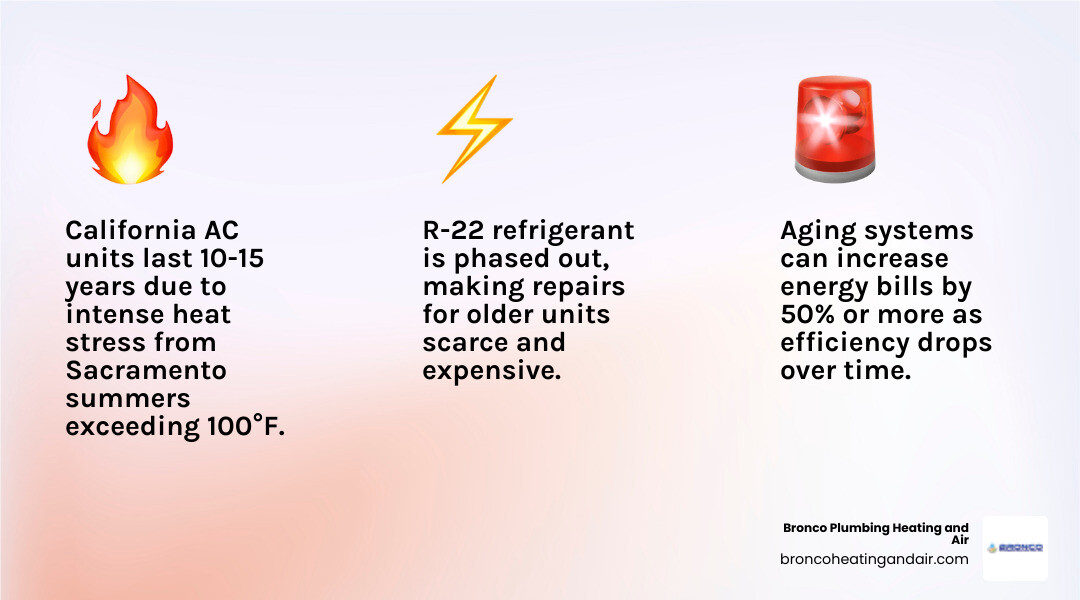
When should you replace your ac in california is one of the most important questions you can ask as a homeowner — especially if you're heading into another brutal Sacramento summer. The short answer: most AC units last 10 to 15 years, but California's intense heat means yours may need replacing sooner than you'd expect.
Here are the key signs it's time to replace your AC in California:
• Your unit is 10-15 years old (or older)
• Your energy bills keep climbing without any change in usage
• You're calling for repairs every season and costs are adding up
• Your system uses R-22 (Freon) refrigerant, which is no longer produced
• Your home has hot spots or uneven cooling
• Your AC makes grinding, rattling, or squealing noises
• There are musty or burning smells coming from your vents
• Repair costs exceed 50% of what a new unit would cost
Close to 50% of your home's energy bill goes toward heating and cooling in California. An aging, inefficient system doesn't just make you uncomfortable — it quietly drains your wallet every single month.
The stakes are especially high in the Sacramento area, where summer temperatures regularly push well past 100°F. That kind of heat puts your AC under constant, heavy stress. A unit that might last 20 years in a milder northern climate simply won't hold up as long here.
In this guide, we'll walk you through everything you need to know — from reading the warning signs to understanding California's efficiency standards and available rebates — so you can make a confident, informed decision.
Average Lifespan of an Air Conditioner in California
While the national average for a central air conditioning unit is often cited as 15 to 20 years, we find that in the Greater Sacramento area, the "useful life" is typically closer to 10 to 15 years. This discrepancy isn't because the units are built differently for Californians; it’s because our climate is an absolute workout for mechanical equipment.
Inland areas like Sacramento, Roseville, and Rocklin experience significant thermal stress. During a typical July or August, your AC might run for 12 to 18 hours a day just to keep up with the triple-digit heat. This constant cycling leads to faster component degradation. The blower motor, the compressor, and the fan motor all have a finite number of "starts" in them. When you live in a place where the sun feels like a personal affront for four months of the year, those components wear out faster.
Usage patterns play a massive role here. If you are someone who keeps the thermostat at a crisp 68°F when it’s 105°F outside, your system is under much higher pressure than a neighbor who settles for 78°F. Furthermore, the Central Valley is known for its dust and agricultural particulates. If maintenance is skipped, this dust acts like sandpaper on the internal components, further shortening the lifespan.
We always emphasize that a well-maintained unit can defy the odds. Regular AC Services like cleaning the coils and checking refrigerant levels can push a unit toward that 15-year mark. However, once you hit year 12 in a climate like ours, you are officially in the "replacement window." For a deeper dive into how this looks in specific neighborhoods, check out our AC Replacement Guide Arden Arcade CA.
Critical Warning Signs: When Should You Replace Your AC in California?
If your AC could talk, it probably wouldn't ask for a promotion; it would ask for retirement. Since it can't speak, it uses other ways to tell you it's finished. Recognizing these signs early can save you from a total system "melt-down" in the middle of a heatwave.
Rising Energy Bills
Have you noticed your SMUD or PG&E bills creeping up even though you haven't changed your habits? As AC units age, they lose efficiency. The motor has to work harder, and the compressor has to run longer to achieve the same cooling effect. If your bill is 20-30% higher than it was three summers ago, your unit is likely on its last legs.
Frequent Breakdowns
Do you know your HVAC technician's kids' names because he's at your house so often? If you are repairing your system every single summer, you are essentially "limping" the unit along. Frequent service calls are a major indicator that the system's internal components are failing in a "cascading" fashion—one part breaks, puts stress on another, and the cycle continues. Knowing how to tell if your AC is broken versus just needing a quick fix is vital for your long-term budget.
Strange Noises and Odors
Your AC should be a background hum, not a heavy metal concert. Grinding, screeching, or rattling sounds often point to a failing motor or a loose belt. Even worse are the smells. A musty odor usually indicates mold or bacteria growth inside the unit or ductwork, while a burning smell often means the wiring is overheating. If your system is failing to start and making these sounds, explore the reasons your AC isn't turning on to see if it's a simple electrical issue or a total system failure.
Poor Airflow and Humidity Control
In California, we don't just deal with heat; we deal with air quality. If some rooms feel like a sauna while others are freezing, or if the air feels "heavy" and humid, your AC is no longer dehumidifying or circulating air properly. For homeowners needing AC Replacement Roseville CA, these comfort issues are often the final straw that triggers an upgrade.
The Impact of R-22 Refrigerant Phase-Out
If your AC was installed before 2010, there is a very high chance it uses R-22 refrigerant, commonly known as Freon. Due to environmental regulations aimed at protecting the ozone layer, the production and import of R-22 was completely phased out in 2020.
Why does this matter for you? If your old R-22 unit develops a leak, "recharging" it becomes incredibly difficult and expensive because the only available R-22 is recycled stock. In many cases, the cost of a major repair on an R-22 system is so high that it simply doesn't make sense to invest in it. Modern systems use R-410A or newer, sustainable refrigerants that are much more efficient and environmentally friendly. If you're in the market for AC Replacement Carmichael CA, moving away from R-22 is one of the smartest financial moves you can make.
Determining When Should You Replace Your AC in California vs. Repairing It
Deciding whether to sink more money into an old unit or buy a new one is a classic homeowner dilemma. We use two main "rules of thumb" to help our clients in places like Citrus Heights and Elk Grove make the call.
The 50% Rule: If the cost of a single repair is more than 50% of the value of the entire system, it’s time to replace. You wouldn't put a brand-new engine in a 2005 sedan with 300,000 miles, right? The same logic applies here.
The $5,000 Rule: This is a simple math formula. Multiply the age of the unit by the cost of the repair. If the total is more than $5,000, replacement is usually the better investment. For example, if your 12-year-old unit needs a repair that costs $500, that’s $6,000—well over the limit.
• Age — Repair It If...: Under 10 years old — Replace It If...: Over 12-15 years old
• Refrigerant — Repair It If...: Uses R-410A — Replace It If...: Uses R-22 (Freon)
• Repair Cost — Repair It If...: Minor (under 10% of new system) — Replace It If...: Major (over 50% of new system)
• Efficiency — Repair It If...: Bills are stable — Replace It If...: Bills are skyrocketing
• Comfort — Repair It If...: Home is evenly cooled — Replace It If...: Hot spots and high humidity
For those looking into AC Replacement Citrus Heights CA, evaluating the long-term ROI is key. A new system might have a higher upfront cost, but the monthly savings on energy bills and the peace of mind of a new warranty often pay for the difference within a few years.
Efficiency and Performance Standards for Modern Systems
If you haven't shopped for an AC in a decade, you’ll be shocked by how much the technology has improved. California has some of the strictest energy standards in the country, specifically the Title 24 Building Energy Efficiency Standards.
SEER and SEER2 Ratings
The Seasonal Energy Efficiency Ratio (SEER) measures how much cooling a system puts out for every watt of electricity it uses. Think of it like MPG for your car. Older systems in Sacramento often have SEER ratings of 8 or 10. Today, the minimum SEER in California is 14, but many of the high-efficiency models we install reach 18, 20, or even higher.
As of 2023, the industry moved to SEER2, which uses a more rigorous testing procedure to reflect real-world conditions (like the ductwork in your attic). Upgrading to a modern, Title 24-compliant system can reduce your cooling energy usage by up to 20-50%. For a full breakdown of what this means for your home, see our AC Installation Sacramento CA Complete Guide.
Modern Features
New systems offer more than just lower bills; they offer better comfort through:
• Variable-Speed Technology: Instead of being "all on" or "all off," these units can run at lower speeds to maintain a perfectly steady temperature.
• Smart Thermostat Integration: You can control your home's climate from your phone, and the system can even learn your schedule to save energy while you're at work in Folsom or Roseville.
• Improved Filtration: Modern units do a much better job of removing dust and allergens, which is essential for healthy indoor air quality (IAQ).
Sizing and SEER: When Should You Replace Your AC in California for Better Comfort?
One of the biggest mistakes a homeowner can make is buying the wrong size AC. If the unit is too small, it will run constantly and never cool the house. If it's too large, it will "short cycle," turning on and off so quickly that it never has a chance to remove humidity, leaving your home feeling clammy.
We use a Manual J calculation to determine the exact cooling capacity your home needs based on square footage, insulation, window types, and even the direction your house faces. Proper sizing is the difference between a system that lasts 10 years and one that lasts 15. Residents can find more details in our AC Replacement Antelope CA Ultimate Guide.
California-Specific Regulations and Incentives
California is leading the way in "electrification" and energy efficiency, which is great news for your wallet. There are numerous programs designed to help homeowners offset the cost of upgrading to high-efficiency equipment.
• SMUD Programs: The Sacramento Municipal Utility District often offers significant rebates for homeowners who switch to high-efficiency heat pumps or advanced central AC systems.
• PG&E Incentives: For our customers in areas like Davis or Woodland, PG&E provides various rebates and energy-saving programs.
• TECH Clean California: This is a statewide initiative that provides market incentives to help Californians move toward low-carbon heating and cooling technologies.
• Federal Tax Credits: Under the Inflation Reduction Act, you may be eligible for federal tax credits for installing ENERGY STAR certified equipment.
Navigating these rebates can be tricky, but it’s worth the effort. Often, the rebates can bridge the gap between a standard unit and a high-efficiency model that saves you more money every month. For more regional advice, check our AC Replacement Guide Arden Arcade CA.
Frequently Asked Questions about California AC Replacement
Should I replace a 20-year-old AC if it still works?
Honestly? Yes. While it’s tempting to "wait until it dies," a 20-year-old unit is a ticking time bomb. It is likely operating at a SEER rating of 8 or 10, meaning you are paying double what you should for electricity. Furthermore, the risk of a total failure during a 105-degree Sacramento weekend is high. Replacing it on your own terms allows you to research models and take advantage of seasonal rebates rather than making a panicked decision in an emergency.
How does the Sacramento climate affect AC life?
The extreme heat stress of the Central Valley is the primary factor. Our systems run longer and harder than units in coastal areas like San Francisco. Additionally, the dust and pollen in our air can clog coils and strain motors if the system isn't maintained. This combination of heat and particulates means a "15-year" unit often reaches retirement age by year 12.
Can I replace just the outdoor condenser unit?
We strongly advise against this. Your indoor evaporator coil and outdoor condenser are designed to work as a "matched system." If you pair a new, high-efficiency outdoor unit with an old indoor coil, the system won't reach its rated SEER efficiency, and the mismatched components can lead to premature failure. Replacing both ensures you get the full warranty and the energy savings you're paying for.
Conclusion
Deciding when should you replace your ac in california doesn't have to be a guessing game. By watching for the warning signs—like skyrocketing bills, frequent repairs, and the limitations of R-22 refrigerant—you can stay ahead of the heat and keep your family comfortable.
At Bronco Heating and Air, our licensed and professional technicians are experts in the unique needs of Sacramento area homes. Whether you are in Roseville, Elk Grove, or right here in Sacramento, we provide cost-effective, high-efficiency solutions tailored to our local climate. Don't wait for your system to melt down in July. Contact us today for a professional assessment and ensure your home stays a cool sanctuary all summer long.
Explore our full Sacramento CA Service Area to see how we can help you today.

Customer Testimonials
Our customer testimonials highlight the reliable service, quality workmanship, and trusted results homeowners experience with Bronco Plumbing Heating and Air.


Ready to Transform your Home?
Create a healthier, more comfortable home with expert HVAC, plumbing, and indoor air quality solutions you can trust. From efficient heating and cooling to cleaner air and reliable repairs, our experienced team is here to keep your family comfortable year-round with dependable service and upfront pricing.
Related Articles
Does Hosing Down Your AC Condenser Actually Improve Cooling Performance?


The Real Reason Your Upstairs Bedrooms Stay Hot While the Ground Floor Freezes
Navigating Roseville Noise Ordinances When Relocating a Loud AC Condenser