



.svg)

The Great Chill Debate: Ductless vs Ducted Pros and Cons
The Great Chill Debate: What the Central AC vs Ductless Mini Split Comparison Really Comes Down ToThe central ac vs ductless mini split comparison is one of the most common…
The Great Chill Debate: What the Central AC vs Ductless Mini Split Comparison Really Comes Down To
The central ac vs ductless mini split comparison is one of the most common decisions Sacramento homeowners face when it's time to upgrade their home comfort system. And it makes sense — both systems cool your home, but they work in very different ways, with real differences in cost, efficiency, flexibility, and fit.
Here's a quick breakdown to help you decide at a glance:
• Requires ductwork — Central AC: Yes — Ductless Mini Split: No
• Energy efficiency — Central AC: Good (loses 10–30% via ducts) — Ductless Mini Split: Higher (no duct losses)
• Zoned control — Central AC: Limited (add-on required) — Ductless Mini Split: Built-in, room by room
• Best for — Central AC: Larger homes with existing ducts — Ductless Mini Split: Older homes, additions, targeted zones
• Installation disruption — Central AC: Higher (if adding new ducts) — Ductless Mini Split: Low (small hole in wall)
• Lifespan — Central AC: ~15 years — Ductless Mini Split: 20–30 years
• Aesthetics — Central AC: Hidden vents, clean look — Ductless Mini Split: Wall-mounted indoor units
• Air filtration — Central AC: Superior (high-MERV capable) — Ductless Mini Split: Basic (smaller built-in filters)
Neither system is universally better. The right choice depends on your home's layout, whether you already have ductwork, and how you use your space day to day.
For Sacramento homes — where summers regularly push past 100°F — picking the wrong system can mean higher energy bills, uneven temperatures, and a lot of regret. That's why it's worth understanding exactly how each system works before you commit.
Central AC vs. Ductless Mini Split Comparison: The Core Differences
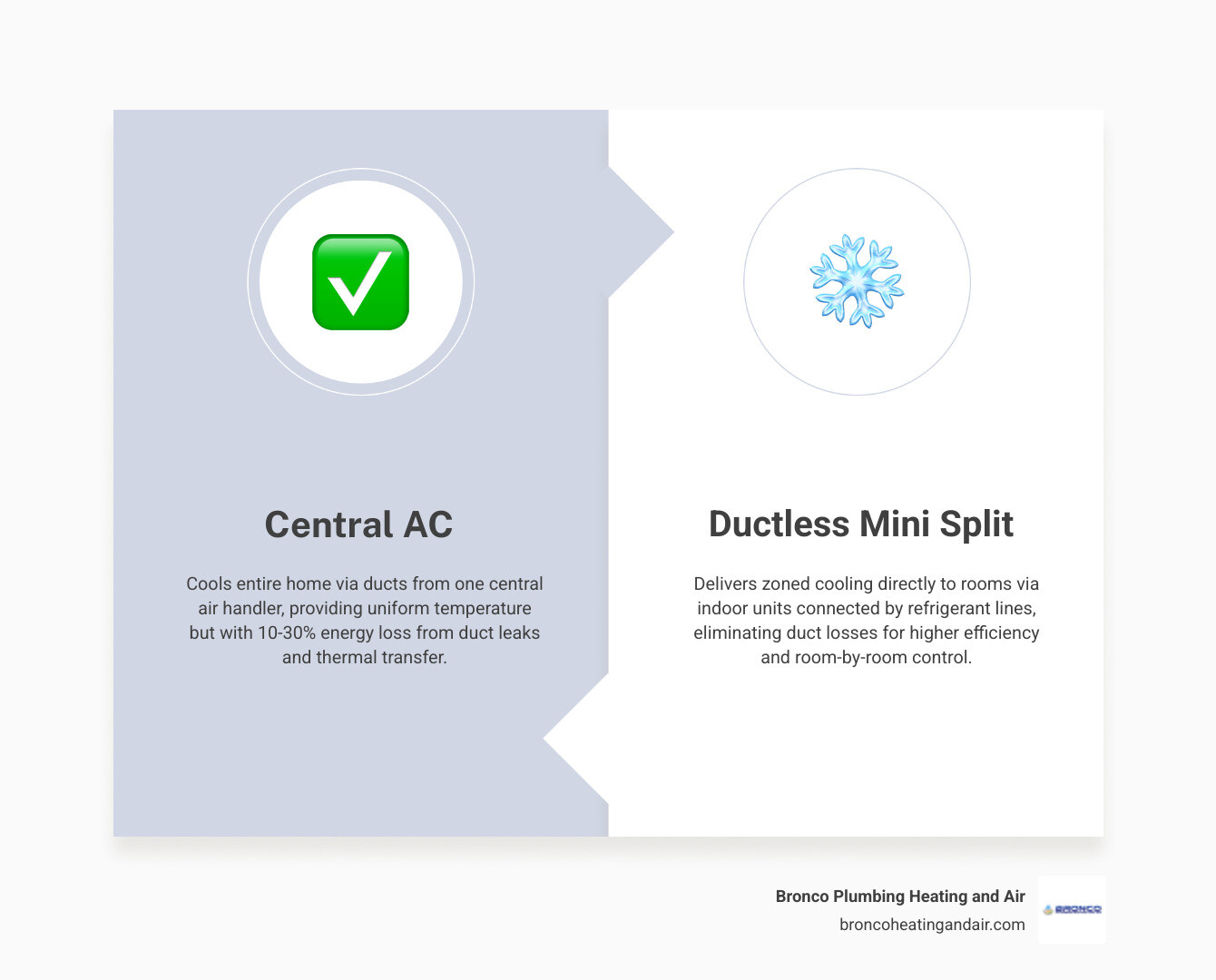
When we look at the central ac vs ductless mini split comparison, we have to start with the "how." Both systems are technically "split systems," meaning they have an outdoor unit (the condenser) and an indoor component. However, the way they move that cool air into your living room is where the paths diverge.
A central AC system is a "forced-air" setup. It uses one large indoor air handler, usually tucked away in a closet or attic, to push chilled air through a web of ducts hidden in your walls, floors, or ceilings. It relies on a single thermostat to tell the whole house what the temperature should be.
On the flip side, a ductless mini split skips the middleman (the ducts). Instead, it uses small indoor units, often called "heads," mounted directly on the walls or ceilings of individual rooms. These heads are connected to the outdoor compressor by thin copper refrigerant piping and electrical lines. Because there are no ducts, there is no "forcing" air through long, dusty tunnels.
• Distribution — Central AC: Network of hidden ducts — Ductless Mini Split: Direct-to-room indoor heads
• Indoor Component — Central AC: One central air handler — Ductless Mini Split: Multiple wall/ceiling units
• Connection — Central AC: Large metal or flexible ducts — Ductless Mini Split: Small refrigerant line sets
• Control — Central AC: Single central thermostat — Ductless Mini Split: Individual remote/thermostat per unit
At the heart of both is the refrigerant cycle. Our AC Services ensure that whether you have a massive central coil or several mini-split evaporators, the heat transfer process is seamless. The indoor unit’s evaporator coils absorb the heat from your home, and the refrigerant carries that heat to the outdoor unit to be released into the Sacramento air.
Understanding the Central AC vs. Ductless Mini Split Comparison
The technical terminology can get a bit confusing, but we like to keep it simple. Think of central AC like a whole-house audio system with speakers in every room playing the same song at the same volume. Think of Mini Split Systems like a collection of high-end Bluetooth speakers; you can have jazz in the kitchen, rock in the garage, and silence in the guest room.
The "line sets" used in ductless systems are remarkably unobtrusive. They only require a three-inch hole through the exterior wall to connect the indoor and outdoor sections. This is a massive advantage over forced-air systems that require 10-to-12-inch ducts to be routed through your home's structure.
How Each System Handles Whole-Home Cooling
Central AC is the undisputed king of "volume cooling." If you have a 3,000-square-foot home in Elk Grove or Roseville and you want every single inch of it to be exactly 72 degrees, central air is built for that. It provides a uniform temperature and high airflow capacity that is hard to match with individual units.
However, Ductless Heating How Does It Work (and cooling) offers a different kind of whole-home comfort. By using a multi-zone outdoor compressor, we can connect up to eight indoor heads to a single system. This allows for "whole-home" coverage but with the added benefit of turning off the air in rooms you aren't using, which is a game-changer for your utility bill.
Energy Efficiency and the Impact of Ductwork
Efficiency is where the central ac vs ductless mini split comparison gets really interesting. In the HVAC world, we measure this using SEER (Seasonal Energy Efficiency Ratio) ratings. Recently, the industry moved to SEER2 standards, which provide a more "real-world" look at how units perform under pressure.
Central AC systems can be very efficient, reaching ratings up to 26 SEER. However, they have a "hidden" efficiency killer: the ductwork. According to the Department of Energy, the average home loses 20% to 30% of its cooling energy through leaks, holes, and poor insulation in the ducts. If your ducts are in a hot Sacramento attic, that chilled air is warming up before it ever reaches your bedroom.
This is why we often recommend Duct Sealing for central systems. Without it, you’re literally paying to cool your attic.
Ductless mini splits avoid this "thermal loss" entirely because there are no ducts. Furthermore, mini splits almost exclusively use inverter technology. While a standard central AC is often "all or nothing" (it’s either 100% on or 100% off), a variable-speed compressor in a mini split can ramp up or down to match the exact cooling load of the room. It’s the difference between a car that only goes 0 or 60 mph versus one that can cruise smoothly at 35 mph. This precision leads to massive energy conservation. In fact, some mini splits boast SEER ratings as high as 42!
Zoned Comfort and Temperature Control
Have you ever experienced "hot upstairs syndrome"? It's a classic Sacramento problem. Your thermostat is downstairs in the hallway where it's nice and cool, so the AC shuts off—meanwhile, the upstairs bedrooms are still sweltering.
This is the primary reason Why Consider Ductless Cooling. Mini splits provide true independent zones. Each family member can have personalized comfort. If you like to sleep in a 65-degree "ice box" but your partner prefers a steady 72, a mini split makes both possible.
This occupancy-based cooling is incredibly efficient. Why pay to cool the guest room and the formal dining room at 2:00 PM if everyone is in the home office? With a remote control or a smartphone app, you can adjust each zone independently, ensuring you only use the power you actually need.
Installation Flexibility for Sacramento Homes
Sacramento is full of beautiful historic homes in areas like Land Park and Midtown that were built long before central air was a standard feature. For these homes, installing central AC is often a nightmare because there is no room for bulky ductwork without destroying the structural integrity or the aesthetic charm of the house.
Mini Split Installation Roseville CA and Mini Split Installation Carmichael CA have become incredibly popular for this very reason. We can bring modern cooling to a 100-year-old home with minimal construction—just a small hole for the refrigerant lines.
Mini splits are also the "go-to" solution for:
• Garage Conversions: Turning your garage into a gym or a "man cave"? A single-zone mini split is the perfect fit.
• Attic Living Spaces: Since heat rises, attics are notoriously hard to cool with central air.
• Room Additions: Instead of trying to "tap into" your existing central AC (which often results in undersizing the unit for the whole house), adding a dedicated mini split is much more effective.
Air Quality and Maintenance Requirements
When it comes to indoor air quality, central AC has a slight edge in terms of "scrubbing" the air. Because it uses a large, central filter, we can often install high-efficiency MERV-rated filters that trap everything from pet dander to wildfire smoke—a major concern here in the Central Valley.
However, central AC ducts can become a haven for dust accumulation over time. If you don't keep up with maintenance, your central air could be blowing allergens throughout the house.
Mini Split AC Citrus Heights CA and Mini Split AC Carmichael CA systems use smaller, built-in filters in each head. These are great at catching larger particles, and because they are so easy to access, homeowners tend to clean them more often. You simply pop the front panel, rinse the filter in the sink, and you’re good to go.
Regardless of which system you choose, annual tune-ups are non-negotiable for system longevity. We check refrigerant levels, clean coils, and ensure the drainage lines are clear. A well-maintained mini split can last 20 to 30 years, while a central AC typically reaches the end of its road around year 15.
Choosing the Right System for Your Layout
Your home’s architecture is a huge factor in the central ac vs ductless mini split comparison. In a large, open-concept home in Folsom or Granite Bay, a central AC system is often the most aesthetic choice. You only see small, discreet vents in the ceiling, leaving your walls clear for art and windows.
However, if you have a multi-story home or a layout with many closed-off rooms, Mini Split AC Roseville CA might be the better play for comfort. Some homeowners even opt for a "hybrid" setup—using central AC for the main living areas and Mini Split Installation Citrus Heights CA for the "problem rooms" like the master suite or the sunroom.
Making the Choice: Central AC vs. Ductless Mini Split Comparison
To make the final call, we look at several factors:
1. Infrastructure Assessment: Do you already have good ducts? If yes, central AC is often a simpler transition. If your ducts are leaky or non-existent, ductless is the winner.
2. Cooling Load: How much heat does your home hold? Sacramento's dry, intense heat requires a system that can keep up without breaking the bank.
3. Climate Suitability: Both systems handle our 100-degree days well, but Ductless Heating Roseville CA provides excellent supplemental heat during our chilly winter nights.
4. Lifestyle Needs: Do you work from home and only need to cool one room during the day? Mini splits will save you a fortune.
Frequently Asked Questions about Home Cooling
Are mini-splits more efficient than central air?
On paper, yes. Mini splits often have higher SEER ratings and don't suffer from the 20-30% energy loss associated with ductwork. They also allow you to cool only the rooms you are using, which is a massive efficiency boost in the real world.
Can a ductless system replace my existing central AC?
Absolutely. We can install a multi-zone system that provides cooling to every room in your house, allowing you to abandon your old, inefficient ducts entirely. Many Sacramento homeowners are making this switch to gain better control over their comfort and energy bills.
Which system is better for older homes without vents?
Ductless mini splits are almost always the better choice for older homes. Installing ducts in a home that wasn't designed for them is invasive, expensive, and can lower your ceiling heights. Mini splits provide a "no-demo" solution that keeps your home's character intact.
Conclusion
At the end of the day, the "Great Chill Debate" doesn't have a single winner—it only has the right winner for your home. Whether you need the whole-home power of a traditional ducted system or the surgical precision and efficiency of Mini Split Systems, our team at Bronco Heating and Air is here to help.
We pride ourselves on being Sacramento’s HVAC experts. Our licensed, professional technicians don't just "sell units"—we provide customized comfort solutions for families from Davis to Folsom and everywhere in between. If you're ready to stop guessing and start chilling, give us a call for a professional consultation. We'll help you navigate the central ac vs ductless mini split comparison and find the perfect fit for your lifestyle and your budget.

Customer Testimonials
Our customer testimonials highlight the reliable service, quality workmanship, and trusted results homeowners experience with Bronco Plumbing Heating and Air.


Ready to Transform your Home?
Create a healthier, more comfortable home with expert HVAC, plumbing, and indoor air quality solutions you can trust. From efficient heating and cooling to cleaner air and reliable repairs, our experienced team is here to keep your family comfortable year-round with dependable service and upfront pricing.
Related Articles

Does Hosing Down Your AC Condenser Actually Improve Cooling Performance?


The Real Reason Your Upstairs Bedrooms Stay Hot While the Ground Floor Freezes
Navigating Roseville Noise Ordinances When Relocating a Loud AC Condenser