



.svg)

Don't Sweat the Standards with Our Homeowner Guide to Title 24
What Title 24 HVAC Requirements for Homeowners Explained Actually Means for Your HomeTitle 24 HVAC requirements for homeowners explained simply: California's Building Energy Efficiency Standards require that any new or…
What Title 24 HVAC Requirements for Homeowners Explained Actually Means for Your Home
Title 24 HVAC requirements for homeowners explained simply: California's Building Energy Efficiency Standards require that any new or replaced HVAC system in your home meet strict rules around equipment efficiency, duct sealing, airflow, ventilation, and third-party testing — or your permit won't be approved.
Here's a quick summary of what Title 24 requires for residential HVAC systems:
• Minimum efficiency ratings - Cooling systems must meet at least SEER2 14.3; heat pumps must meet HSPF2 7.5; gas furnaces must meet 80% AFUE or higher
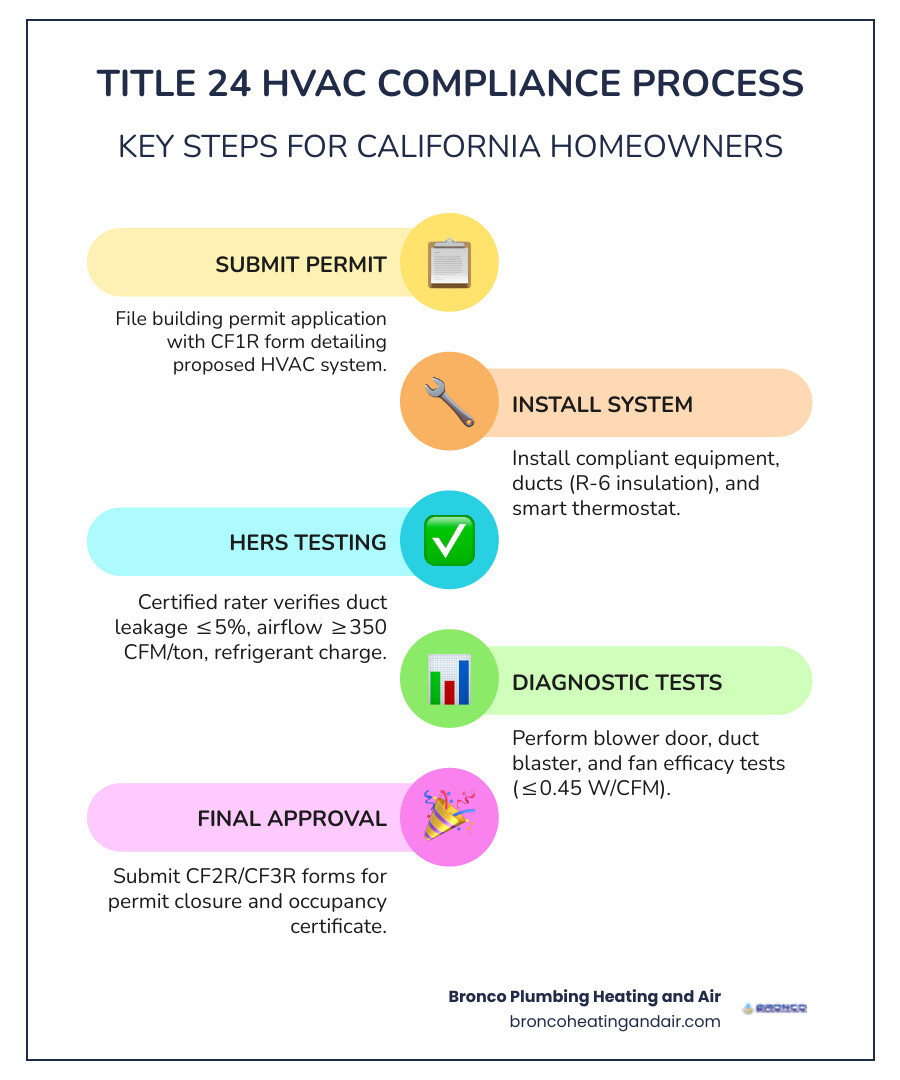
• Duct leakage limits - New duct systems must leak no more than 5% of total airflow (4% at rough-in stage)
• Duct insulation - All ducts must be insulated to at least R-6 (higher in some climate zones)
• Airflow standards - Forced-air cooling systems must deliver at least 350 CFM per ton of cooling capacity
• Fan efficiency - Air-handling units in gas furnace systems must not exceed 0.45 watts per CFM
• Ventilation - Homes must have mechanical ventilation meeting ASHRAE 62.2-2016 standards, including MERV-rated air filtration
• HERS verification - A certified third-party Home Energy Rating System (HERS) rater must verify duct leakage, refrigerant charge, and airflow before your permit closes
• Thermostat controls - Programmable thermostats with at least four setback periods per day are required
If you live in the Sacramento area and you're replacing or upgrading your HVAC system, Title 24 isn't optional. It applies to any permitted installation — not just new construction. Getting it wrong means failed inspections, costly re-work, and delays on your project.
That's exactly why Sacramento homeowners work with experienced local HVAC professionals who build compliance into every job from the start. In this guide, we'll walk you through every major requirement in plain language so you know what to expect — and what to ask your contractor.
Understanding Title 24 HVAC Requirements for Homeowners Explained
When we talk about Title 24, we are referring to Part 6 of the California Code of Regulations. These are the Building Energy Efficiency Standards created by the California Energy Commission (CEC). While it might feel like a mountain of paperwork, the goal is actually pretty great: to reduce energy consumption, lower your utility bills, and decrease greenhouse gas emissions. As of April 2026, we are operating under the 2022 Standards, with even stricter updates on the horizon for 2025 and 2026.
There are three main ways a home can comply with these standards:
1. Mandatory Measures: These are the "no-brainers" that every system must have, such as specific thermostats and basic insulation.
2. Prescriptive Path: This is a checklist approach. If you install equipment that meets or exceeds specific ratings (like a certain SEER2), you're good to go.
3. Performance Modeling: This is more flexible. We use specialized software to calculate an "energy budget" for your entire home. If your high-efficiency windows make up for a slightly less efficient furnace, the home still passes.
A huge factor in these rules is your Climate Zone. California is divided into 16 zones. In our neck of the woods—from Sacramento and Roseville to Folsom and Elk Grove—we deal with hot summers and chilly winters, which means our specific requirements for insulation and cooling capacity might differ from someone living on the coast in San Francisco.
Minimum Efficiency Standards for Heating and Cooling Equipment
One of the biggest impacts of title 24 hvac requirements for homeowners explained is the equipment you are allowed to buy. You can't just pick the cheapest unit on the market; it has to meet California’s high bar for performance.
Since 2023, the industry has shifted to "SEER2" and "HSPF2" ratings. These are more realistic ways of measuring efficiency compared to the old SEER ratings because they account for the external pressure found in real-world ductwork.
• Split-System AC — Minimum Efficiency Requirement (Prescriptive): 14.3 SEER2
• Heat Pumps — Minimum Efficiency Requirement (Prescriptive): 14.3 SEER2 / 7.5 HSPF2
• Gas Furnaces — Minimum Efficiency Requirement (Prescriptive): 80% AFUE (Annual Fuel Utilization Efficiency)
• Small-Duct High-Velocity — Minimum Efficiency Requirement (Prescriptive): 12 SEER
If you are looking at a heat pump installation in Citrus Heights, CA, you'll find that the state is heavily pushing these systems. Heat pumps provide both heating and cooling electrically, which aligns with California’s long-term goal of carbon neutrality by 2045. For homes with space constraints, mini-split systems are a fantastic, highly efficient way to meet these standards while providing localized comfort.
Mandatory Ductwork and Airflow Standards
You could buy the most expensive, high-tech air conditioner in the world, but if your ducts are leaky or uninsulated, you're just throwing money out the window. Title 24 places a massive emphasis on the "delivery system"—your ducts.
Every joint, seam, and connection in your duct system must be sealed with mastic or UL-181 approved tape. This ensures that the air you paid to cool actually reaches your living room instead of leaking into your attic. Proper duct sealing is one of the most cost-effective ways to improve home comfort and meet state codes.
Title 24 HVAC requirements for homeowners explained: Duct Sealing and Insulation
In most of our service areas, such as during an HVAC replacement in Carmichael, CA, the standard for duct insulation is R-6. However, in certain climate zones or if ducts are in unconditioned spaces like a scorching 140-degree attic, R-8 may be required prescriptively.
The "leakage limit" is a big one. For newly constructed homes, total duct leakage must be 5% or less of the system's nominal airflow. If we are just altering an existing system (like replacing the AC but keeping the old ducts), the standard is usually 15%, but we always aim for the tightest seal possible to maximize your savings.
Title 24 HVAC requirements for homeowners explained: Airflow and Fan Efficacy
Your system needs to "breathe" properly. Title 24 mandates that forced-air cooling systems provide a minimum airflow of 350 CFM (Cubic Feet per Minute) per ton of cooling capacity. If the airflow is too low, the system works too hard, loses efficiency, and can even freeze up.
We also have to measure Fan Efficacy (or fan watt draw). For a standard gas furnace air-handler, the limit is 0.45 watts per CFM. This ensures the motor inside your furnace isn't a "power hog." If you have a zone control system, we have to be even more careful with these calculations to ensure every zone gets the right amount of air without overworking the fan.
Indoor Air Quality and Ventilation Mandates
Modern homes are built "tight" to save energy, but that can trap stale air, moisture, and pollutants inside. To combat this, Title 24 adopts the ASHRAE 62.2 standard for mechanical ventilation.
This usually means your home needs a way to bring in fresh, filtered air automatically. This can be achieved through:
• Whole-house fans: Great for those cool Sacramento nights to flush out heat.
• Mechanical ventilation: Systems that pull in fresh air and exhaust stale air.
• High-efficiency filtration: Title 24 now requires MERV 13 filters in most new systems. These filters are thick enough to catch bacteria, smoke, and fine dust, but they require a properly sized rack so they don't block airflow.
Our IAQ services and air filtration systems are designed to meet these exact mandates, ensuring your home is both energy-efficient and healthy to breathe in.
The Role of HERS Verification and Refrigerant Charge
This is often the part that surprises homeowners the most. You can't just take the contractor's word that the job was done right. The State of California requires HERS Verification.
A HERS Rater is an independent, third-party professional who comes to your home after we finish the installation. They perform "Title 24 testing," which includes:
• Duct Blast Test: Pressurizing the ducts to measure exactly how much air is leaking.
• Refrigerant Charge Verification: Ensuring the AC has the perfect amount of refrigerant (not too much, not too little) to operate at peak efficiency.
• Airflow and Fan Draw: Confirming the system meets those CFM and Watt targets we discussed earlier.
Once they finish, they register the results (CF3R forms) with a state-approved provider. This is a mandatory step for AC installation in Roseville, CA or a heating installation in Citrus Heights, CA. Without this verification, the city building inspector will not sign off on your permit, which can cause major headaches when you try to sell your home later.
Frequently Asked Questions about Title 24 HVAC
Does Title 24 apply to HVAC repairs or just replacements?
Generally, Title 24 is triggered when you apply for a building permit. Simple repairs—like replacing a capacitor, a fan motor, or a thermostat—usually don't require a permit or Title 24 compliance. However, if you are replacing the entire outdoor condenser, the indoor furnace, or more than 40 linear feet of ductwork, you are performing an "alteration" that requires a permit and must meet current standards.
What is a HERS test and why is it mandatory for my permit?
HERS stands for Home Energy Rating System. It’s a "trust but verify" system. The state wants to ensure that the energy savings promised by high-efficiency equipment aren't lost due to poor installation. It protects you, the homeowner, by ensuring you actually get the performance you paid for.
Can I get compliance credit for installing higher-efficiency systems?
Absolutely! This is where the Performance Approach comes in. If you choose to install a system that far exceeds the minimum (like a 20 SEER2 unit), you can earn "credits" that might allow for more flexibility in other areas of your home renovation, such as having more window area or slightly less insulation in a specific wall.
Conclusion
Navigating title 24 hvac requirements for homeowners explained doesn't have to be a stressful experience. While the rules are technical, they are designed to put more money back in your pocket through lower monthly energy bills—often saving homeowners hundreds of dollars a year. In fact, a compliant system in a standard 1,800-square-foot home can save upwards of $15,000 over its lifetime!
At Bronco Heating and Air, we take the guesswork out of the process. Our licensed, professional technicians serve the entire Sacramento region—from Davis and Woodland to Folsom and El Dorado Hills. We handle the load calculations, the equipment selection, and coordinate the HERS testing so you don't have to.
Whether you're looking for a maintenance plan to keep your current system running at peak efficiency or you need to explore financing for a brand-new, Title 24-compliant upgrade, we are here to help.
Don't let complicated codes keep you from the comfort you deserve. Contact our expert HVAC company in Citrus Heights today, and let’s make your home the most efficient one on the block!

Customer Testimonials
Our customer testimonials highlight the reliable service, quality workmanship, and trusted results homeowners experience with Bronco Plumbing Heating and Air.


Ready to Transform your Home?
Create a healthier, more comfortable home with expert HVAC, plumbing, and indoor air quality solutions you can trust. From efficient heating and cooling to cleaner air and reliable repairs, our experienced team is here to keep your family comfortable year-round with dependable service and upfront pricing.
Related Articles
Tankless vs. Traditional Water Heaters for Large Citrus Heights Families

The Physics of Airflow: Why Closing Vents in Empty Rooms Damages Your HVAC System

Preparing Your Home Air Quality for Back-to-School Illness Season