



.svg)


Why Is My AC Running But Not Cooling the House? (Quick Answer)
Why is my ac running but not cooling the house is one of the most common — and most frustrating — problems Sacramento homeowners face when summer temperatures climb into the triple digits. You can hear the system running. Air is moving through the vents. But an hour later, the house is still hot.
The good news: many of the causes are surprisingly simple to diagnose, and some you can fix yourself in minutes.
Here are the most common reasons your AC is running but not cooling:
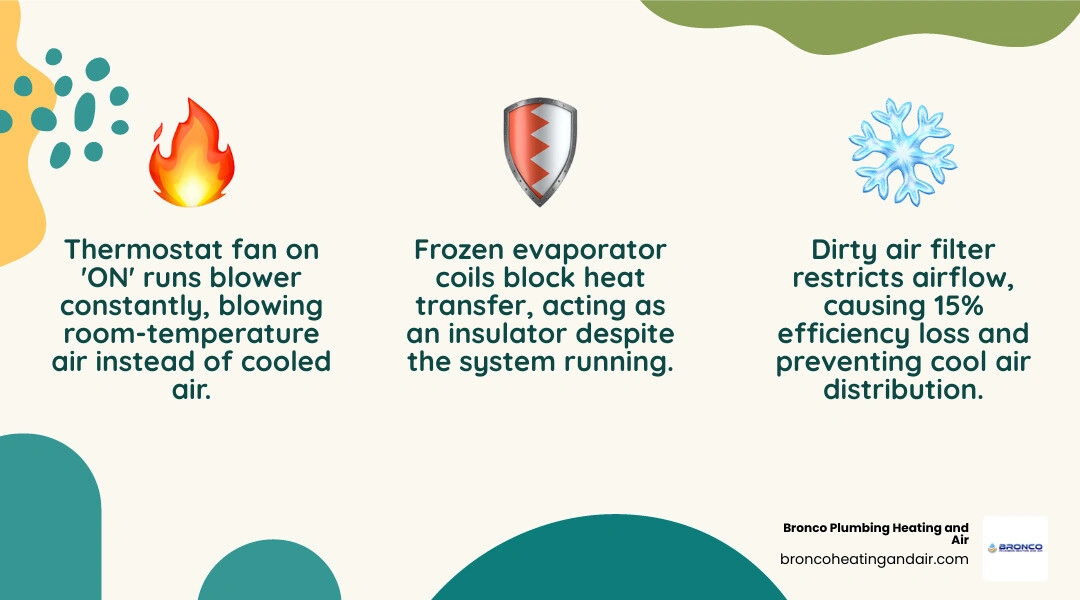
1. Thermostat fan set to "On" instead of "Auto" - The blower runs constantly, even when the cooling cycle is off, pushing room-temperature air through your vents.
2. Dirty or clogged air filter - Restricted airflow prevents cool air from reaching your living spaces and can cause the system to shut itself down.
3. Dirty or blocked outdoor condenser unit - Debris, grass clippings, or overgrown plants prevent the unit from releasing heat outside.
4. Frozen evaporator coils - Ice buildup on the indoor coil acts as an insulator, blocking heat transfer entirely.
5. Low refrigerant due to a leak - Refrigerant doesn't get "used up" — if levels are low, there's an active leak that needs to be repaired.
6. Tripped circuit breaker - The outdoor unit loses power while the indoor fan keeps blowing warm air.
7. Failed capacitor - A small electrical component fails, leaving the compressor unable to start even though the fan still spins.
8. Leaky ductwork - Up to 20–30% of cooled air can escape through duct leaks before it ever reaches your rooms.
9. Undersized or aging AC unit - A system that's too small for your home — or too old to run efficiently — will run constantly without ever reaching your target temperature.
Most of these issues follow a clear pattern: something is either blocking airflow, interrupting the refrigerant cycle, or preventing the compressor from doing its job. Understanding which one applies to your system is the first step toward getting your home cool again.
Why is my ac running but not cooling the house?
When your air conditioner hums along but the temperature in your Sacramento CA home remains stubbornly high, it’s often a sign that the "heat exchange" process has been interrupted. Your AC doesn't actually "create" cold; it removes heat from your indoor air and dumps it outside. If any part of that loop is broken, you get plenty of noise but no relief.
Common culprits range from simple user errors to mechanical failures. Sometimes, How to Tell if Your AC is Broken is as simple as feeling the air coming out of the vents. If it feels like room temperature, the system might be struggling with a power surge that tripped a specific breaker. In other cases, there are Reasons Your AC Isn't Turning On fully, such as a failed outdoor unit that leaves the indoor fan to do all the work alone.
Thermostat Settings: Why is my ac running but not cooling the house in "On" mode?
One of the most frequent service calls we receive in May 2026 involves a simple misunderstanding of fan settings. If your thermostat fan is set to "On," the indoor blower motor will run 24/7, regardless of whether the cooling compressor is actually working.
When the AC finishes a cooling cycle, the compressor shuts off, but the fan keeps spinning. This circulates room-temperature air through your home, which can make it feel like the system has stopped cooling. Switching this setting to "Auto" ensures the fan only blows when the air is actually being chilled. If you've checked your settings and the air is still warm, you might need AC Repair Citrus Heights CA to check for deeper electrical or sensor issues.
Airflow Obstructions: Why is my ac running but not cooling the house with a dirty filter?
We cannot overstate the importance of a clean air filter. A dirty or clogged filter is the single most common cause of an AC that blows warm air. When the filter is caked in dust, pet dander, and Sacramento pollen, it restricts the volume of air passing over the evaporator coil.
This restriction can lead to a 15% loss in efficiency and, eventually, cause the entire system to overheat or freeze. We recommend replacing your filters every 1 to 3 months—leaning toward every 60 days if you have pets. If you haven't changed yours recently and your home is warming up, it's time to swap it out before you need AC Repair Roseville CA for a burnt-out blower motor.
Common DIY Fixes for an AC Running But Not Cooling
Before you assume the worst, there are several steps you can take to troubleshoot the system yourself. Many times, the fix is literally in your backyard or at your electrical panel.
Safely Cleaning Your Outdoor Condenser Unit
Your outdoor unit (the condenser) is responsible for releasing the heat collected from inside your home. If the metal fins are clogged with grass clippings, spider webs, or dirt, the heat has nowhere to go. This is a primary reason Why Your AC Runs All Day During Extreme Summer Heat without making a dent in the indoor temperature.
To clean it safely:
1. Turn off the power at the outdoor disconnect box.
2. Clear away any weeds or debris to maintain at least a 2-foot clearance around the unit.
3. Use a garden hose on a gentle setting to rinse the fins. Never use a pressure washer, as it can flatten the delicate metal fins and ruin the unit.
Resetting Your System After a Power Outage
Sacramento summers often bring power flickers or grid strain. If your power blinks, your AC might need a hard reset to get the indoor and outdoor units back in sync. Sometimes the indoor fan will reset, but the outdoor compressor stays off due to a tripped breaker.
To reset properly:
1. Turn the AC off at the thermostat.
2. Flip the circuit breakers for both the indoor and outdoor units to the "Off" position.
3. Wait at least 5 minutes.
4. Flip the breakers back to "On."
5. Set the thermostat to "Cool" and wait. Most systems have a built-in delay of about 3 to 5 minutes before the compressor kicks in.
If you find yourself asking, My AC Isn't Cooling My House in Carmichael - Who Are the Best Rated Repair Services Near Me, we can help if a simple reset doesn't do the trick. We provide AC Repair Carmichael CA for those stubborn electrical issues that a breaker flip can't solve.
Identifying Mechanical Failures and Refrigerant Issues
If your filters are clean and the power is on, but you're still sweating, the problem likely lies within the mechanical "guts" of the system. This often involves the refrigerant—the chemical "messenger" that carries heat out of your home.
Signs of Frozen Evaporator Coils and Low Refrigerant
It sounds like a paradox, but your AC can actually freeze up in the middle of a 100-degree July afternoon. If you see frost or ice on the copper lines leading to your indoor unit, your evaporator coils are frozen. Ice acts as an insulator, preventing the coils from absorbing heat.
This is usually caused by either restricted airflow (that dirty filter again!) or low refrigerant. It is a myth that refrigerant needs to be "topped off" regularly. Why Your Refrigerant Doesn't Run Out is because it operates in a sealed, closed loop. If it's low, you have a leak.
If you see ice, turn the system off immediately and switch the fan to "On" to let it thaw. Running it while frozen can lead to "slugging," which can destroy your compressor—the most expensive part of the system. Understanding How Do the Coils in My AC System Work can help you spot these issues early. Also, keep an eye out for water; Seeing Leaks from Your AC - Time to Check the Condensate Array can often be the first sign of a freeze-thaw cycle.
Electrical Component Failures: Humming and Capacitors
Have you ever heard your outdoor unit making a loud humming sound, but the fan isn't spinning? This is a classic symptom of a failed capacitor. Why Does My Air Conditioner Have Capacitors is simple: they act like high-powered batteries that provide the "kick" needed to start the motors.
In the extreme Sacramento heat, these components can degrade quickly. A failed start or run capacitor will prevent the compressor or fan from turning on, even though the system is receiving a signal to cool. This requires a professional to test with a multimeter and replace, as capacitors can hold a dangerous electrical charge even when the power is off.
Environmental and Structural Cooling Barriers in Sacramento CA
Sometimes, the system is working perfectly, but the environment is working against it. In areas like Roseville CA or Folsom CA, the sun can be relentless.
Leaky Ductwork and Conditioned Air Loss
You could have the most efficient AC in the world, but if your ducts are a mess, you'll never feel the benefit. The Department of Energy estimates that the typical home loses 20% to 30% of its conditioned air through leaks in the ductwork.
Common duct issues we see in the Sacramento valley include:
• Disconnected joints: Sections of ductwork that have literally pulled apart in the attic.
• Poor insulation: Ductwork in a 130-degree attic that isn't properly wrapped will heat the air before it reaches your vents.
• Rodent damage: Small animals can chew through flex ducts, allowing your expensive cool air to dump into your crawlspace.
• Attic heat infiltration: If your attic isn't properly vented, the sheer volume of heat can overwhelm your AC's ability to keep up.
Why Do AC Units Wear Out Faster in Hot Climates is often tied to these structural inefficiencies. When your house leaks air, the AC has to work double shifts just to maintain a baseline temperature.
When to Repair vs. Replace Your Aging AC Unit
As we move through 2026, efficiency standards continue to rise. If your system is between 10 and 15 years old, you may reach a point where repairing it is no longer the most cost-effective solution.
• System Age — Repair: Under 10 years — Replace: Over 12-15 years
• Efficiency — Repair: Standard SEER — Replace: New SEER2 (Lower Bills)
• Refrigerant — Repair: R-410A (Getting Pricey) — Replace: New Eco-Friendly Standards
• Reliability — Repair: Occasional minor fix — Replace: Frequent "No Cool" calls
• Capacity — Repair: Properly sized — Replace: Undersized for home additions
If your compressor fails, the repair can cost nearly half the price of a new system. In these cases, we often recommend a replacement to take advantage of modern SEER2 efficiency ratings and a fresh warranty.
The 3-Minute Rule and Compressor Protection
Whether your system is brand new or a decade old, you should always follow the 3-minute rule. This is the practice of waiting at least three minutes before restarting an AC after it has been turned off.
This delay allows the refrigerant pressures inside the system to equalize. If you try to force a compressor to start against high pressure (short-cycling), it places immense mechanical stress on the motor windings. Most modern thermostats have this protection built-in, but if yours doesn't, manual patience can add years to your system's lifespan.
Frequently Asked Questions about AC Performance
Why is my outdoor unit humming but the fan isn't spinning?
This usually points to a failed capacitor or a seized fan motor. The humming is the sound of electricity trying to move a motor that can't get started. Turn the system off immediately to prevent the motor from burning out completely.
How long should it take to cool my house down 10 degrees?
On a typical day, a healthy AC should be able to drop the temperature by about 1 degree per hour. However, if it's 105 degrees outside in Sacramento, your system may struggle just to hold the line. AC units are generally designed to maintain a 20-degree difference between the outdoor and indoor temperatures.
Can I just add more refrigerant myself?
No. Handling refrigerant requires EPA Section 608 certification by law. Furthermore, adding refrigerant without fixing the underlying leak is like trying to fill a bucket with a hole in the bottom—it's a temporary and expensive "band-aid" that doesn't solve the real problem.
Conclusion
A home that won't cool down is more than an inconvenience; in a Sacramento summer, it's a matter of safety. While a dirty filter or a tripped breaker are easy DIY fixes, mechanical issues like refrigerant leaks and failed capacitors require the steady hand of a professional.
At Bronco Plumbing Heating and Air, we pride ourselves on being the courteous, licensed experts Sacramento CA residents trust for cost-effective HVAC solutions. Whether you are in Elk Grove CA, Roseville CA, or anywhere in the Greater Sacramento region, we are ready to get your system back in peak condition.
Don't spend another afternoon in a sweltering house. Schedule your professional AC service today and let us bring the cool back to your home!

Customer Testimonials
Our customer testimonials highlight the reliable service, quality workmanship, and trusted results homeowners experience with Bronco Plumbing Heating and Air.


Ready to Transform your Home?
Create a healthier, more comfortable home with expert HVAC, plumbing, and indoor air quality solutions you can trust. From efficient heating and cooling to cleaner air and reliable repairs, our experienced team is here to keep your family comfortable year-round with dependable service and upfront pricing.
Related Articles
Why September is the Critical Window for Sacramento Valley Wildfire Smoke Prep

Recognizing the Difference Between Normal AC Wear and Impending System Failure
The Truth About MERV Ratings and Air Conditioner Strain