



.svg)

How to Troubleshoot AC Not Cooling Properly in Extreme Heat
When Your AC Can't Keep Up: What to Check Before Temperatures Get DangerousIf your ac not cooling properly in extreme heat what to check is your main concern, here are…

When Your AC Can't Keep Up: What to Check Before Temperatures Get Dangerous
If your ac not cooling properly in extreme heat what to check is your main concern, here are the most important things to check right away:
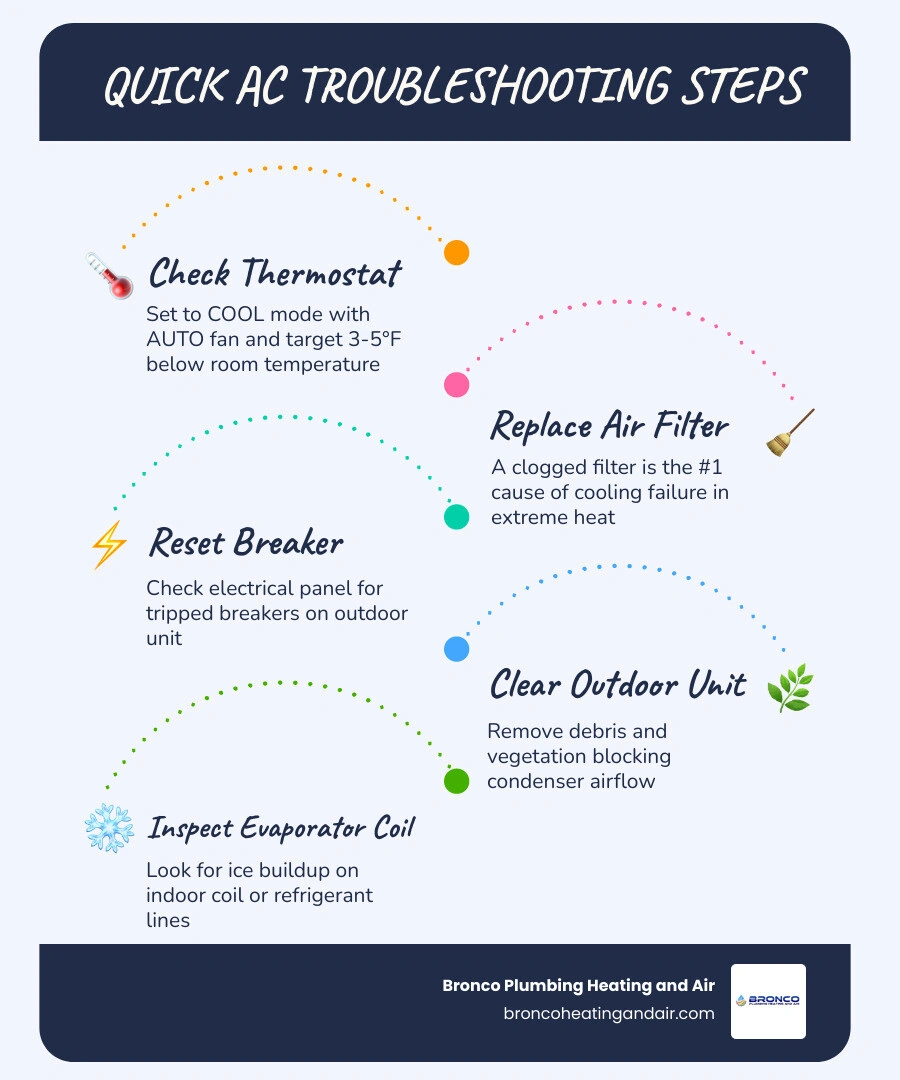
1. Thermostat settings — Make sure it's set to COOL mode, fan to AUTO, and the target temperature is at least 3–5°F below room temperature
2. Air filter — A clogged filter is the #1 cause of cooling failure; replace it if it looks gray or dirty
3. Circuit breaker — Check your electrical panel for a tripped breaker on the outdoor unit
4. Outdoor condenser unit — Clear away any debris, leaves, or vegetation blocking airflow around the unit
5. Evaporator coil — Look for ice buildup on the indoor unit or refrigerant lines
6. Vents and return grilles — Make sure none are blocked by furniture, rugs, or curtains
7. System age — If your unit is 10–15 years old, it may simply be struggling to handle extreme heat
There is nothing quite as stressful as a Sacramento summer afternoon when your AC is running nonstop but your home just won't cool down. Temperatures across the Sacramento region regularly push past 100°F, and that kind of heat puts enormous strain on any cooling system. What might have worked fine on a mild day can fall apart completely when the thermometer climbs.
The good news? A large number of AC cooling failures come down to a handful of common, fixable problems. According to HVAC field data, roughly 30% of "AC not cooling" service calls are caused by frozen evaporator coils alone — and that's just one item on a short checklist most homeowners can work through in under 30 minutes.
This guide walks you through exactly what to check, what you can safely fix yourself, and when it's time to call in a professional.
Quick DIY Troubleshooting: AC Not Cooling Properly in Extreme Heat What to Check First
Before you panic and assume you need a costly replacement, take a deep breath. When you find your ac not cooling properly in extreme heat what to check first is a list of simple, high-impact items that do not require specialized tools or technical training. Many times, the issue is a minor bottleneck in power or airflow that you can resolve in minutes.
Taking a proactive approach to your home comfort is essential, especially during our intense Northern California summers. Understanding how to handle these basic checks can save you hours of sweating in a hot house while waiting for a service call. For a complete look at getting your system ready before the worst of the summer arrives, explore our guide on Is Your Air Conditioning System Ready for the Summer.
Thermostat Settings and Power Checks
It may sound overly simplistic, but the thermostat is the brain of your entire HVAC system. If its settings are incorrect, or if it loses communication with the outdoor unit, your home will quickly heat up.
• Verify the Mode: Ensure the thermostat is set to COOL, not "HEAT" or "FAN ONLY." It is surprisingly easy for a family member to accidentally bump the mode switch.
• Set the Fan to AUTO: Always choose AUTO rather than "ON." When the fan is set to "ON," the blower runs continuously, even when the system isn't actively cooling. In high-humidity conditions or during extreme heat, this can blow warm, unconditioned air back into your living spaces and raise indoor humidity levels.
• Check the Batteries: If your thermostat has a blank or fading display, replace the batteries immediately. A weak battery can prevent the thermostat from sending the low-voltage signal to turn on your outdoor condenser.
• Inspect the Circuit Breakers: Air conditioners pull a significant amount of electrical power, especially when starting up in 100-degree weather. Go to your home's main electrical panel and look for the dedicated double-pole breaker labeled for your AC or outdoor condenser. If it is tripped, flip it completely to the OFF position, then back to ON.
If you reset the breaker and it immediately trips again, do not attempt to reset it a second time. A breaker that trips repeatedly is a safety feature indicating a severe electrical short, a failing capacitor, or a locked compressor motor. For a deeper dive into electrical and power-related issues, read about the Reasons Your AC Isn't Turning On.
Air Filter Inspection and Airflow Obstructions
Airflow is the lifeblood of a central air conditioning system. Without adequate airflow, the entire heat exchange process collapses. A dirty air filter is the single most common cause of poor cooling performance and system freeze-ups.
• The Light Test: Slide your air filter out of its slot. Hold it up to a light source. If you cannot see light passing through the fibers, it is severely clogged and must be replaced immediately. A dirty filter can reduce system operating efficiency by up to 15%, forcing your system to work harder while delivering less cool air.
• Inspect Vents and Returns: Walk through your home and verify that at least 90% of your supply registers (the vents blowing cold air) are open and completely unobstructed. Closing vents in unused rooms does not save energy; instead, it increases static pressure within your ductwork, reducing airflow and potentially damaging your blower motor.
• Clear Return Grilles: Ensure large return air grilles are not blocked by heavy furniture, drapes, or dog beds. We frequently find that a misplaced couch or a pile of laundry blocking a return grille is the sole reason a home feels stuffy and warm.
To understand how vital unrestricted airflow is to the cooling process, it helps to know how the system functions as a whole. You can read all about the mechanics in How Air Conditioning Works: A User's Guide.
Why Extreme Heat Causes Critical AC Component Failures
To understand why your air conditioner struggles when temperatures soar, you have to understand that an AC does not actually "create" cold air. Instead, it acts as a heat magnet, absorbing thermal energy from your indoor air and releasing it outside.
When the outdoor temperature reaches 100°F or higher, the temperature differential between the hot outdoor air and the refrigerant inside your condenser coils narrows. This makes it incredibly difficult for the system to dump heat outdoors. If any part of this heat transfer loop is compromised by dirt, blockages, or low refrigerant, the system will run continuously without lowering your indoor temperature. To learn more about this phenomenon, check out our article on Why Your AC Runs All Day During Extreme Summer Heat.
[Indoor Warm Air] ---> [Evaporator Coil (Absorbs Heat)] ---> [Refrigerant Lines] ---> [Condenser Coil (Releases Heat Outside)] | (Blocked by dirt/debris? Heat stays trapped!)
Dirty Condenser Coils and Outdoor Blockages
The outdoor unit (the condenser) is responsible for releasing the heat collected from inside your home. It uses a powerful fan to pull outdoor air through a series of thin metal fins wrapped around the condenser coils.
Over time, these fins collect grass clippings, dust, pollen, leaves, and spider webs. In Sacramento, dry summer winds kick up a massive amount of dust that acts like an insulating blanket over the coils. This dust prevents the refrigerant from shedding its heat. As a result, the compressor runs hotter and consumes more electricity, eventually tripping its internal thermal overload switch to prevent itself from burning out.
To clean the outdoor unit safely:
1. Turn off the power to the AC at the outdoor disconnect box (usually located on the wall near the unit).
2. Use a soft brush or broom to gently sweep away loose leaves, twigs, and cobwebs.
3. Maintain at least a two-foot clearance of open space around the entire unit by trimming back bushes, weeds, or low-hanging branches.
4. Take a garden hose with a gentle spray nozzle (never use a high-pressure washer, which will bend the delicate aluminum fins) and spray the coils from the top down to wash away embedded dirt.
Keeping these coils clean directly preserves the lifespan of your system. Learn more about how local weather patterns stress your equipment in How Dry Hot Summers Affect HVAC Performance and Lifespan.
Frozen Evaporator Coils and Low Refrigerant
The indoor evaporator coil is where the actual cooling happens. Cold refrigerant flows through this coil, absorbing heat from the household air blowing across it.
If airflow is restricted (due to a dirty filter or blocked vents), or if the system is low on refrigerant, the temperature of the evaporator coil will drop below freezing. Moisture in the air will instantly freeze onto the coil, forming a block of ice. This ice acts as an insulator, stopping any further heat transfer.
Signs of a frozen evaporator coil include:
• Weak, warm airflow coming from your vents.
• Visible ice buildup on the copper refrigerant lines connecting to your outdoor unit.
• Water dripping or pooling around your indoor furnace or air handler (as the ice melts).
If your coil is frozen, shut the system off immediately at the thermostat and set the fan switch to ON. This runs the indoor blower to help melt the ice naturally, which usually takes between 30 to 90 minutes. Do not turn the cooling back on until the ice has fully melted and you have replaced the dirty filter. If the system freezes up again with a clean filter, you likely have a refrigerant leak or a failing blower motor. For help identifying these deeper mechanical failures, see How to Tell If Your AC Is Broken.
When to Stop DIY and Call a Licensed HVAC Professional
While basic troubleshooting can resolve many minor issues, some problems require specialized training, diagnostic tools, and licensing. Attempting to repair complex electrical or refrigerant issues yourself can result in severe injury, system damage, or voided equipment warranties.
Knowing when to step back and call a professional is key to protecting your investment. If you have completed the basic checks and your home is still not cooling down, look over the Signs Your AC Needs Repair to determine your next steps.
Identifying Refrigerant Leaks and Electrical Faults
Refrigerant is not a fuel that gets "used up" or topped off like gasoline. It circulates in a closed, sealed loop. If your system is low on refrigerant, you have a leak.
Federal law requires EPA-certified technicians to handle, recover, and charge refrigerant. A certified technician will use specialized leak detection equipment (such as electronic sniffers or ultraviolet dyes) to find the source of the leak, repair it, and then recharge the system to factory specifications. You can sometimes spot a leak yourself by looking for an oily residue around the Schrader valves (the service ports on the outdoor unit) or along the copper line joints, as refrigerant contains a small amount of compressor oil.
Additionally, electrical failures like a failed run capacitor or a failing compressor require professional attention. The capacitor acts like a large battery that provides the high-voltage jolt needed to start the compressor and fan motors. High summer heat degrades capacitors rapidly. If you hear a loud humming or buzzing sound coming from a silent outdoor unit, a failed capacitor is the likely culprit.
Recognizing an Undersized or Aging AC Unit
Sometimes, the issue isn't a mechanical breakdown, but rather the physical limitations of your equipment.
Most central air conditioning systems are designed to last 10 to 15 years. As a system ages, its mechanical efficiency drops. The compressor loses its pumping capacity, and internal components wear down. Furthermore, if your home has an undersized AC unit, it will never be able to maintain a cool indoor temperature when outdoor temperatures soar past 100°F. AC capacity is measured in BTUs (British Thermal Units) or "tons," and must be accurately matched to your home's square footage, insulation quality, and local climate.
If your system is constantly running, struggling to keep up, and nearing the end of its typical lifespan, it may be time to discuss replacement options. To learn how to get the most out of your existing unit before making that leap, read our guide on How to Extend the Life of Your AC in a Hot Climate.
Preventive Maintenance to Avoid Summer Breakdowns
The best way to handle a cooling failure during a heatwave is to prevent it from happening in the first place. Regular preventative maintenance keeps your system running at peak efficiency, reduces your monthly energy bills, and catches minor component wear before it turns into a catastrophic mid-summer breakdown. For tips on keeping your system safe when temperatures spike, check out Protecting Your HVAC System During Heat Waves.
AC Not Cooling Properly in Extreme Heat What to Check on Your Filter
When managing your home's HVAC system, your primary monthly task is filter maintenance.
During the peak summer months, we recommend checking your filter every 30 days, especially if you have pets or live in a dusty area of the Sacramento Valley. For the ideal balance of filtration and airflow, choose a filter with a MERV (Minimum Efficiency Reporting Value) rating between 8 and 11. High-MERV filters (MERV 13 and above) capture tiny particles but can restrict airflow so severely that they cause your evaporator coil to freeze up during periods of heavy use.
AC Not Cooling Properly in Extreme Heat What to Check During a Professional Tune-Up
An annual professional tune-up goes far beyond what a homeowner can do. During a comprehensive maintenance visit, a licensed technician will perform critical tasks to ensure your system is ready for the summer heat. To understand the full scope of these visits, read our detailed guide on What Happens During Air Conditioning Maintenance.
During a professional tune-up, a technician will:
• Clean the outdoor condenser coils and indoor evaporator coils.
• Test all electrical connections, contactors, and capacitors.
• Measure refrigerant charge and check for leaks.
• Clear and flush the condensate drain line to prevent water damage or system shut-offs.
• Inspect the blower motor and fan blades for balance and wear.
Frequently Asked Questions About AC Performance in Extreme Heat
Why is my AC running but the house still feels warm?
In extreme heat, your system may be struggling with a high "heat load." This can be caused by poor home insulation, leaky air ducts (which can let up to 20–30% of your cooled air escape into your attic), or simple airflow restrictions like a dirty filter. If the outdoor temperature is well over 100°F, most standard AC systems are designed to maintain an indoor temperature that is roughly 20 degrees cooler than the outside air.
How long does it take to thaw a frozen evaporator coil?
It typically takes between 30 to 90 minutes for a frozen evaporator coil to melt completely, depending on the severity of the ice buildup. To speed up the process safely, turn your thermostat to OFF and switch the fan setting to ON. Never attempt to scrape or chip ice off the delicate aluminum fins, as you can easily puncture the copper refrigerant lines.
What temperature split indicates my AC is cooling properly?
To check if your system is performing correctly, you can measure the "temperature split" using an infrared thermometer. Measure the temperature of the air entering your return grille, and then measure the temperature of the cool air coming directly out of a nearby supply vent. A properly functioning AC should show a 16 to 22 degree difference between the two. A split of less than 14 degrees indicates your system is underperforming and needs professional attention.
Conclusion
When your ac not cooling properly in extreme heat what to check is the question on your mind, working through basic troubleshooting steps like checking your thermostat, replacing your air filter, and clearing your outdoor unit can often resolve the issue without a service call. However, when those quick fixes aren't enough, you need a team you can trust.
At Bronco Heating and Air, we are proud to serve families across the Greater Sacramento region, including Roseville, CA, Folsom, CA, Elk Grove, CA, Citrus Heights, CA, and Rocklin, CA. Our licensed, professional, and courteous technicians are committed to providing cost-effective, reliable cooling solutions to keep your home safe and comfortable all summer long.
Don't spend another day sweating in a hot house. Schedule professional AC services in Sacramento CA with Bronco Heating and Air today!

Customer Testimonials
Our customer testimonials highlight the reliable service, quality workmanship, and trusted results homeowners experience with Bronco Plumbing Heating and Air.


Ready to Transform your Home?
Create a healthier, more comfortable home with expert HVAC, plumbing, and indoor air quality solutions you can trust. From efficient heating and cooling to cleaner air and reliable repairs, our experienced team is here to keep your family comfortable year-round with dependable service and upfront pricing.
Related Articles
Why September is the Critical Window for Sacramento Valley Wildfire Smoke Prep

Recognizing the Difference Between Normal AC Wear and Impending System Failure
The Truth About MERV Ratings and Air Conditioner Strain