



.svg)

My AC stopped cooling during this heatwave. What are the common reasons AC stops cooling in extreme heat in Sacramento CA?
The common reasons AC stops cooling in extreme heat are easier to spot than most homeowners think. Here's a quick breakdown:
| Reason | What's Happening |
|---|---|
| Dirty air filter | Restricted airflow starves the system |
| Dirty or blocked condenser coils | Outdoor unit can't release heat |
| Low refrigerant or a leak | System loses ability to absorb heat |
| Frozen evaporator coil | Ice buildup blocks cooling entirely |
| Failed capacitor | Motor can't start or stay running |
| Undersized or aging equipment | System simply can't keep up with the heat load |
| Thermostat or electrical issues | System runs but doesn't cool properly |
It's one of the most frustrating moments of a Sacramento CA summer: you can hear your AC running, you can feel air coming from the vents, but your home just keeps getting warmer. When outdoor temperatures climb past 100°F — which happens regularly across the Sacramento Valley from late spring through early fall — your air conditioning system is already working at the edge of its limits. Any small problem that went unnoticed in mild weather can quickly turn into a full cooling failure when the heat is relentless.
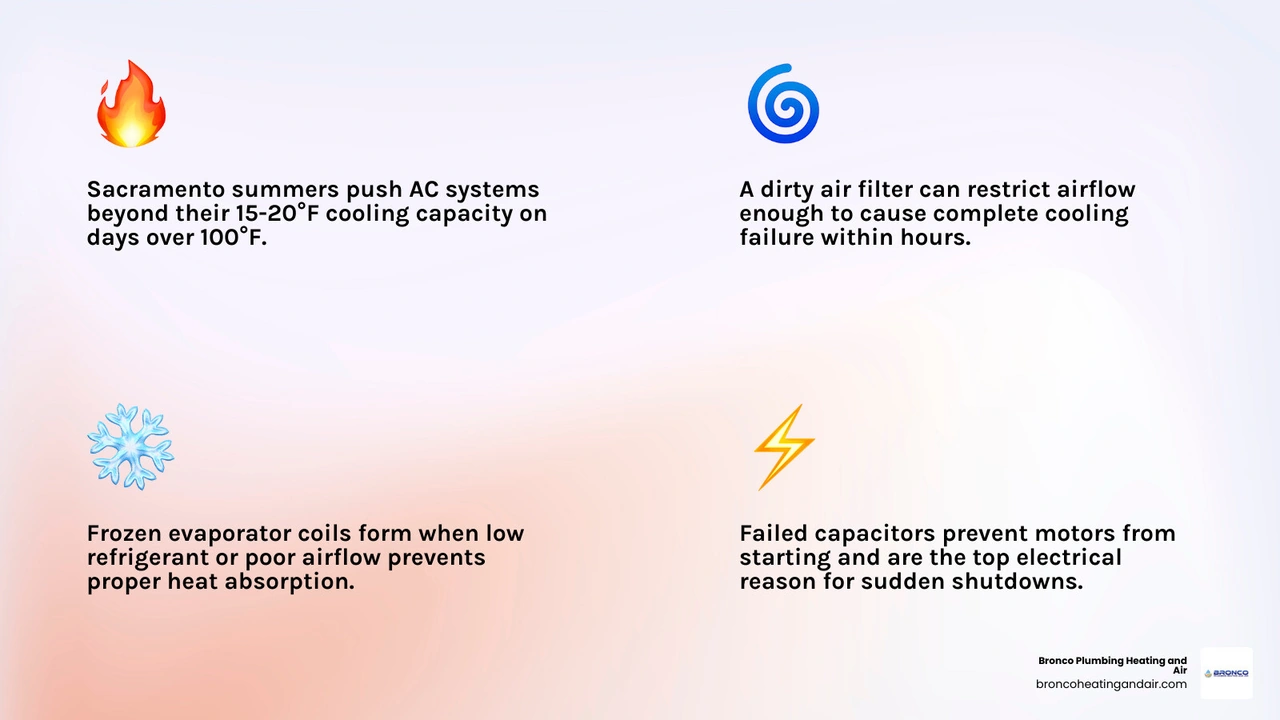
Most AC systems are designed to cool a home roughly 15 to 20°F below the outdoor temperature. That means on a 105°F Sacramento CA afternoon, your system is physically working at maximum capacity just to keep things tolerable indoors. Add a dirty filter, a weak capacitor, or low refrigerant, and the whole system can buckle under the strain.
The good news is that most of these failures are preventable — and many can be caught early with the right information. This guide covers the most common reasons AC systems stop cooling during extreme heat, what you can check yourself, and when it's time to call a licensed technician.
Why Extreme Heat Causes AC Systems to Struggle
In May 2026, as we look at the climate patterns in Sacramento CA, it is clear that our summers are becoming more demanding on HVAC equipment. To understand why failures happen, we first have to look at the physics of cooling. Your air conditioner doesn't actually "create" cold; it removes heat from your indoor air and dumps it outside.
This process relies on the temperature difference between your indoor air and the outdoor environment. Most residential systems are engineered based on a "15-20 degree rule." This means if it is 100°F in Roseville CA or Folsom CA, your AC is designed to maintain an indoor temperature of about 80°F to 85°F. When you try to force the thermostat down to 68°F on a triple-digit day, you are asking the system to perform well beyond its design specifications.
The Why Your AC Runs All Day During Extreme Summer Heat phenomenon is often just the system doing its job. During a heatwave, total daily runtime can jump from a standard 8–12 hours to 16 hours or more. In many cases, the unit may run continuously from noon until late evening. This constant operation creates a massive thermal load and puts immense stress on mechanical parts.
As discussed in our guide on How Dry Hot Summers Affect HVAC Performance and Lifespan, the outdoor condenser unit has a harder time releasing heat when the surrounding air is already scorching. If the outdoor temperature is 105°F, the air used to cool the refrigerant is already hot, making the heat transfer process much less efficient. This is where the limits of the outdoor unit are truly tested.
Common Reasons AC Stops Cooling in Extreme Heat
When the temperature spikes, small maintenance oversights become major liabilities. The most frequent culprit we see in the field is surprisingly simple: airflow restriction.

A dirty air filter is the number one cause of AC service calls. When the filter is clogged with dust and pet dander, the blower motor has to work twice as hard to pull air through. This leads to a lack of "cold" air reaching your rooms and can eventually cause the entire system to shut down to protect itself from overheating. Before assuming your unit is broken, ensure you've checked if Is Your Air Conditioning System Ready for the Summer by inspecting your filters.
Another major factor is the condition of your outdoor condenser coils. These coils are responsible for dissipating the heat collected from inside your home. Over time, they get coated in dirt, grass clippings, and debris. This layer of grime acts like a thermal blanket, trapping heat inside the system.
DIY AC Checks for Homeowners:
- Check the Thermostat: Ensure it's set to "Cool" and "Auto," not just "On" (which runs the fan constantly without cooling).
- Inspect the Filter: If you can't see light through it, replace it immediately.
- Clear the Outdoor Unit: Ensure there is at least two feet of clear space around your condenser. Remove weeds, leaves, or "shrub-fluff" that might be blocking the fins.
- Listen for Noises: Strange buzzing or clicking often indicates electrical strain.
Refrigerant Leaks: One of the Common Reasons AC Stops Cooling in Extreme Heat
Refrigerant is the lifeblood of your cooling system. It circulates in a closed loop, changing from a liquid to a gas to absorb and release heat. A common misconception is that refrigerant gets "used up" like gasoline; in reality, if your levels are low, you have a leak.
When refrigerant levels drop, the pressure inside the evaporator coil falls. This prevents the system from absorbing enough heat, leading to a steady decline in cooling capacity. You might notice your AC blowing lukewarm air or hear a faint hissing or bubbling sound. Knowing How to Tell If Your AC Is Broken often starts with checking the temperature of the air coming out of the vents. If the "split" (the difference between the air going into the return and coming out of the supply) is less than 15 degrees, a leak is a high possibility.
Poor Insulation and Undersized Equipment in Sacramento CA
Sometimes, the common reasons AC stops cooling in extreme heat have nothing to do with the mechanical parts and everything to do with the house itself. In many older homes in Land Park CA or Citrus Heights CA, attic insulation has settled or was never sufficient to begin with.
Proper attic insulation can prevent up to 40% of heat from entering through the ceiling. Without it, your AC is fighting a losing battle against "solar heat gain." Additionally, if a system wasn't sized correctly using a "Manual J" load calculation, it may simply be too small for the square footage. An undersized unit will perform fine when it's 85°F outside but will fail to maintain comfort once we hit triple digits. Learning How to Stay Cool During Sacramento Heat Waves often involves sealing air leaks and improving weatherstripping to keep the cool air inside where it belongs.
Mechanical and Electrical Failures During Heatwaves
Extreme heat doesn't just stress the air; it stresses the wires. Electrical components generate their own heat, and when combined with a 100-degree afternoon, they can reach critical failure points.
Many Reasons Your AC Isn't Turning On during a heatwave involve the outdoor unit's "start" components. The constant cycling on and off puts a massive burden on the electrical system.
| Component | Symptom of Failure | Severity |
|---|---|---|
| Capacitor | Humming sound, fan won't spin, or AC struggles to start. | Moderate (Common) |
| Compressor | Loud clunking, tripped breakers, or system runs but air is hot. | High (Major Repair) |
| Contactor | Pitting or "chattering" noise; unit won't turn on or off. | Moderate |
Capacitor Failure: The Most Common Reason AC Stops Cooling in Extreme Heat
If we look at service data, capacitor failure is the single most common AC repair. In a typical summer, thousands of these small, battery-like components fail across the Sacramento Valley. The capacitor provides the "kick" or starting torque needed to get the compressor and fan motor running.
Heat is the natural enemy of capacitors. During the peak summer demand, these components can overheat and "bulge" or leak oil. If your capacitor is weak, the motor may hum but fail to spin, which can eventually lead to the motor burning out entirely. Proactive AC Maintenance Repair Tips Carmichael CA always include testing these components before the heat hits to avoid an emergency outage.
Frozen Evaporator Coils in Triple-Digit Weather
It sounds like a contradiction, but your AC can actually freeze solid when it's 105°F outside. This happens when the temperature of the indoor evaporator coil drops below freezing, causing the humidity it collects to turn into ice.
This is usually caused by two things: restricted airflow (that dirty filter again!) or low refrigerant. Once a thin layer of ice forms, it acts as an insulator, causing even more ice to build up until the entire coil is a block of frozen slush. This blocks all airflow, and you'll notice almost no air coming out of your vents. Protecting Your HVAC System During Heat Waves requires immediate action if you see ice: turn the system to "Fan Only" mode to let it thaw safely before attempting to run the cooling cycle again.
Frequently Asked Questions about AC Cooling Failure
Why is my AC running but not blowing cold air?
This is often due to a tripped breaker for the outdoor unit, a failed capacitor, or a significant refrigerant leak. If the indoor blower is working but the outdoor unit isn't, you'll just be circulating room-temperature air. Check your thermostat settings first; ensure it hasn't been accidentally switched to "Heat" or "Fan On." If settings are correct, it's time to check How to Tell If Your AC Is Broken and call for a professional diagnostic.
Should I turn off my AC if it stops cooling?
Yes. If your AC is running but the temperature in the house is rising, turn it off. Continuing to run a malfunctioning system can cause "cascading failures." For example, a failed fan motor can lead to an overheated compressor, turning a mid-range repair into a total system replacement. Switching to "Fan Only" can help circulate air while you wait for a technician, but stop the cooling cycle to protect the compressor.
How long should my AC run when it's over 100 degrees in Sacramento CA?
On days when temperatures exceed 100°F in Elk Grove CA or Rocklin CA, it is perfectly normal for your AC to run for 12 to 16 hours a day. During the peak heat hours (usually 2:00 PM to 7:00 PM), the system may not cycle off at all. As long as the air coming out of the vents is cold and the indoor temperature is staying stable (even if it's not as cool as you'd like), the system is likely operating as intended for the conditions.
Keep Your Cool with Bronco Heating and Air
Understanding the common reasons AC stops cooling in extreme heat is the first step toward a comfortable summer. Whether you are dealing with a simple filter clog in Natomas CA or a complex electrical issue in El Dorado Hills CA, the team at Bronco Heating and Air is here to help.
We pride ourselves on providing the Greater Sacramento region with licensed, professional, and courteous technicians who understand our unique valley climate. From Carmichael CA to Davis CA and everywhere in between, we offer reliable solutions to keep your home a sanctuary from the heat. Don't wait for the next record-breaking heatwave to find out if your system can handle the strain.
If your system is struggling to keep up, or if you've noticed any of the warning signs mentioned in this guide, reach out to us today. Explore our full range of AC Services and let us ensure your family stays cool all summer long.

Customer Testimonials
Our customer testimonials highlight the reliable service, quality workmanship, and trusted results homeowners experience with Bronco Plumbing Heating and Air.


Ready to Transform your Home?
Create a healthier, more comfortable home with expert HVAC, plumbing, and indoor air quality solutions you can trust. From efficient heating and cooling to cleaner air and reliable repairs, our experienced team is here to keep your family comfortable year-round with dependable service and upfront pricing.
Related Articles
A Practical Guide to HVAC Repair vs Replacement

Why Your AC Won't Shut Off During a Roseville Heatwave (And When to Worry)
The Definitive Guide to Tankless Water Heater Value