



.svg)

The Complete Guide to Lowering AC Bills in Sacramento Summers
Why AC Bills Spike in Sacramento Summers — and What You Can Do About ItIf you're trying to figure out how to lower AC bills during Sacramento summers, you're not…
Why AC Bills Spike in Sacramento Summers — and What You Can Do About It
If you're trying to figure out how to lower AC bills during Sacramento summers, you're not alone. Sacramento's cooling season runs nearly six months — from May through October — and temperatures regularly climb past 100°F, sometimes pushing toward 110°F during heat waves. That's a long time to run your air conditioner hard.
Here's a quick overview of the most effective ways to lower your cooling costs:
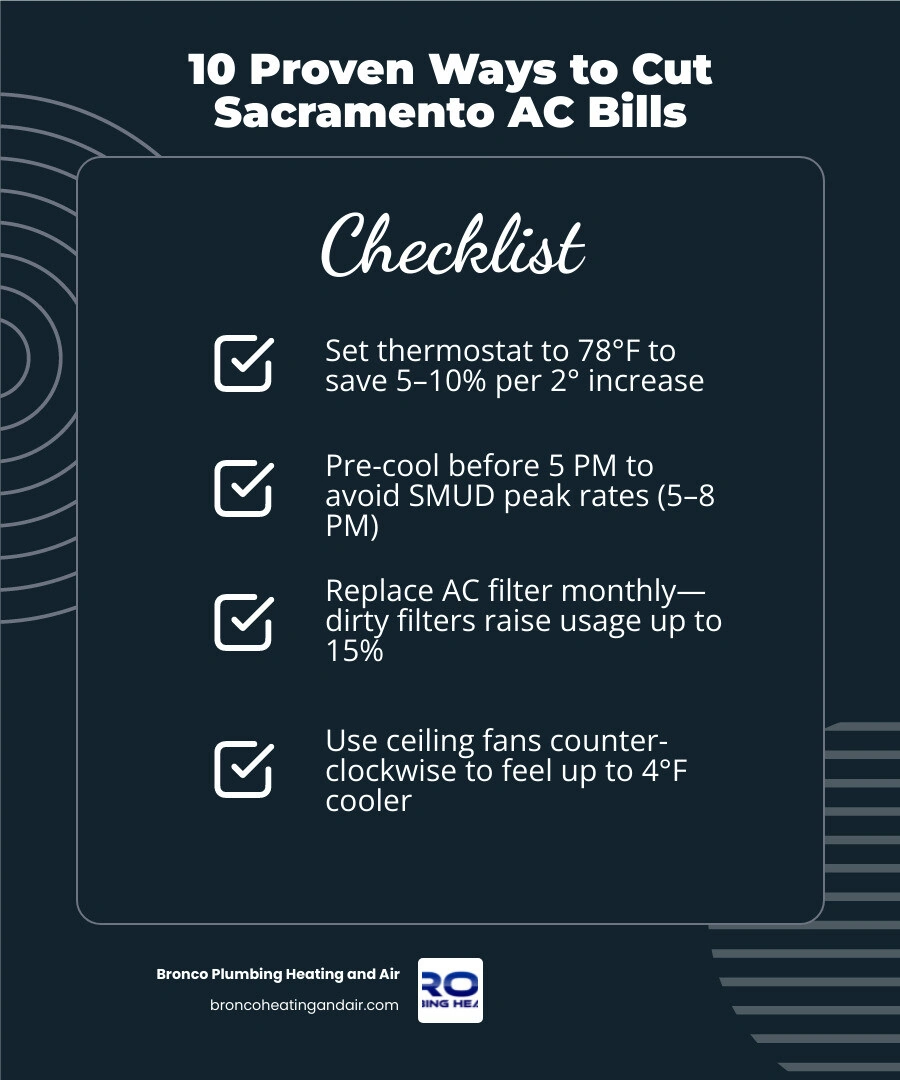
1. Set your thermostat to 78°F when home — every 2 degrees you raise it saves 5–10% on cooling costs
2. Pre-cool your home before 5 p.m. to avoid SMUD's peak rate hours (5–8 p.m. on weekdays)
3. Change your AC filter monthly during summer — dirty filters increase energy use by up to 15%
4. Block afternoon sun on west-facing windows with blackout curtains or exterior shading
5. Seal leaky ductwork — duct leaks can waste up to 20% of your cooled air
6. Use ceiling fans counter-clockwise to feel up to 4°F cooler without lowering the thermostat
7. Upgrade attic insulation from R-19 to R-49 to cut cooling loads by 15–25%
8. Schedule a professional AC tune-up before the first heat wave hits
9. Look into SMUD rebates for high-efficiency equipment upgrades
10. Cook outside or use a slow cooker to avoid adding heat inside your home
Sacramento sees the sun roughly 269 days a year, and summers here are no gentle warm season — they're a sustained test of your home's cooling system. During the July 2024 heat event, when temperatures hit 108°F, SMUD recorded a peak demand of 3,847 megawatts — about 40% above a normal summer day. That kind of strain doesn't just stress the grid. It shows up directly on your monthly bill.
The good news is that a mix of smart habits, low-cost fixes, and targeted upgrades can make a real difference — without sacrificing comfort.
Smart Thermostat Strategies: How to Lower AC Bills During Sacramento Summers
One of the easiest and most effective ways to lower your monthly electricity bill is to optimize your thermostat settings. Many homeowners in communities like Elk Grove, CA and Roseville, CA make the mistake of leaving their thermostat set to a chilly 70°F all day long. This forces the compressor to run continuously during the hottest hours of the afternoon, driving up energy consumption.
The Department of Energy recommends setting your thermostat to 78°F when you are at home during the summer. If 78°F feels a bit too warm at first, try adjusting your habits gradually. You can increase the temperature setting by just one degree per day to allow your body to acclimate to the change. Pairing this temperature setting with ceiling fans will help your living spaces feel much cooler without placing extra demand on your air conditioning unit.
If you are looking to maximize your savings, Looking for Some Tips to Save on Your Cooling This Summer is a great place to start. A smart or programmable thermostat can automate these adjustments for you, ensuring that you aren't wasting energy cooling an empty house. When you are away from home for more than four hours, setting the thermostat 7 to 10 degrees higher than your usual setting can yield substantial savings on your monthly bill.
Pre-Cooling and Time-of-Use: How to Lower AC Bills During Sacramento Summers
Understanding how your local utility company charges for electricity is crucial when learning how to lower AC bills during Sacramento summers. For residents served by the Sacramento Municipal Utility District (SMUD), electricity rates are structured around a Time-of-Use (TOU) plan. On weekdays, SMUD's rates vary significantly depending on the time of day, with average rates running between $0.12 and $0.18 per kilowatt-hour (kWh).
The most expensive "peak" hours occur on weekdays between 5:00 p.m. and 8:00 p.m. Running your air conditioner at full tilt during this three-hour window will quickly drive up your monthly bill. To bypass these high peak-hour rates, you can implement a smart pre-cooling strategy:
• Morning (Off-Peak): Lower your thermostat setting by a few degrees during the cooler morning hours to "bank" cold air in your home's walls, furniture, and floors.
• Late Afternoon (Pre-Peak): Keep the home cool as the outdoor temperature rises.
• Peak Hours (5:00 p.m. to 8:00 p.m.): Raise your thermostat setting to 78°F or higher. Because your home was pre-cooled, your AC system will not need to run as frequently during the most expensive rate period of the day.
• Late Night (Off-Peak): Return your thermostat to its normal comfortable sleeping temperature after 8:00 p.m.
By shifting your heaviest cooling usage to off-peak hours, you can maintain a comfortable indoor climate while taking advantage of lower utility rates. For more detailed advice on managing extreme weather patterns, check out our guide on Energy Saving Tips During Extreme Heat.
Reducing Heat Gain Before Turning on the AC
The most efficient way to run your air conditioner is to prevent heat from entering your home in the first place. When your home's building envelope is well-protected, your cooling system does not have to work nearly as hard to maintain your target indoor temperature.
For homeowners living in sunny areas like Folsom, CA or Citrus Heights, CA, blocking direct afternoon sunlight is one of the most effective ways to lower cooling loads. West-facing rooms are particularly vulnerable to solar heat gain in the late afternoon. Installing high-quality blackout curtains, cellular shades, or exterior window coverings can reduce the cooling load in those specific zones by 20% to 35%.
Another critical area of your home is the attic. During a triple-digit Sacramento summer day, attic temperatures can easily reach 140°F to 160°F. If your attic lacks proper insulation, this intense heat will migrate down through your ceilings and into your living spaces. Upgrading your attic insulation from R-19 to R-49 can reduce your home's overall cooling load by 15% to 25%.
Additionally, studies conducted at UC Davis have documented that installing radiant barriers under the roof deck can reduce attic temperatures by 5°F to 10°F in Sacramento Valley homes. This simple addition directly lowers the heat transfer into your home, keeping your family comfortable and your utility bills manageable. To learn more about protecting your home during severe weather, read about How to Stay Cool During Sacramento Heat Waves.
Ventilation and Airflow Optimization
Sacramento's unique geography provides a natural cooling gift known as the Delta Breeze. This cool, sea-breeze-driven air current flows from the San Francisco Bay up into the Sacramento Delta, typically arriving in the late evening and dropping outdoor temperatures significantly.
To take full advantage of this natural cooling phenomenon, you can practice nighttime ventilation. When the outdoor temperature drops below your indoor temperature in the evening, open your windows to let the cool air circulate throughout your home. Be sure to close your windows and draw your blinds by 8:00 a.m. the next morning to trap that cool air inside before the sun begins to heat up the Central Valley.
You can also optimize indoor airflow by using these simple, low-cost cooling habits:
• Ceiling Fan Direction: Ensure your ceiling fans are spinning counter-clockwise in the summer. This creates a wind-chill effect that makes the room feel about 4 degrees cooler than it actually is. Remember to turn off fans when you leave the room, as fans cool people, not spaces.
• Whole-House Fans: If your home has a whole-house fan, run it in the late evening or early morning to pull cool outdoor air in through open windows and exhaust hot air through your attic vents.
• Avoid Indoor Heat Sources: Minimize the use of heat-generating appliances like ovens, stoves, and clothes dryers during the hottest parts of the day. Instead, cook meals outside on the grill or use small countertop appliances like slow cookers and microwaves.
• Keep Vents Clear: Ensure all supply and return vents are unobstructed by furniture, rugs, or drapes so your AC system can circulate air freely.
For a deeper look into local climate factors and how they impact your home comfort systems, explore our Sacramento Heat HVAC Guide.
Essential AC Maintenance for Peak Efficiency
Regular maintenance is the foundation of an efficient and reliable cooling system. When your air conditioner is forced to operate with dirty filters, clogged coils, or leaky ductwork, it consumes significantly more electricity to achieve the same cooling effect.
The single most important DIY maintenance task is replacing your system's air filters regularly. During the peak of the cooling season in places like Rancho Cordova, CA and Woodland, CA, we recommend checking your air filter every 30 days. Replacing a dirty, clogged air filter with a fresh one can reduce your air conditioner's energy consumption by 5% to 15%. For detailed instructions on filter care, read our guide on How Often Do I Need to Change My Air Filter.
Beyond the air filter, the outdoor condenser unit must be kept clean and clear. Dust, dirt, and cottonwood fibers from local trees can accumulate on the condenser coils, insulating them and preventing the system from releasing heat efficiently. You can use a gentle garden hose to rinse away debris from the outdoor coils, making sure to maintain at least two feet of clear space around the entire unit.
Ductwork is another area where energy is frequently wasted. Over time, duct joints can loosen, allowing conditioned air to escape into your unconditioned attic or crawlspace. In fact, maintaining and sealing your ductwork can improve the overall efficiency of your heating and cooling systems by as much as 20%. To ensure your system is fully prepared for the summer heat, check out our Pre-Summer AC Tune-Up Checklist for Homeowners.
Preventing Costly Summer Breakdowns
While basic DIY tasks are highly beneficial, scheduling a professional AC tune-up before the summer heat wave hits is the best way to protect your equipment. During a professional maintenance visit, a licensed technician can identify and resolve minor issues—such as low refrigerant levels, weak capacitors, or loose electrical connections—before they turn into costly emergency repairs.
• Filter Replacement — Benefit to Your System: Restores proper airflow and protects indoor air quality — Efficiency Impact: Saves 5% to 15% on energy use
• Coil Cleaning — Benefit to Your System: Improves heat transfer at the outdoor unit — Efficiency Impact: Reduces compressor workload and runtime
• Duct Sealing — Benefit to Your System: Prevents cooled air from escaping into the attic — Efficiency Impact: Improves system efficiency by up to 20%
• Electrical Check — Benefit to Your System: Ensures safe operation and prevents sudden component failure — Efficiency Impact: Extends overall equipment lifespan
Proactive maintenance not only keeps your energy bills low but also extends the operational lifespan of your cooling system. When an air conditioner is neglected in a hot, dry climate, the constant strain of operating under extreme heat can lead to premature compressor failure. To learn more about the long-term financial benefits of seasonal care, explore our article on Do HVAC Maintenance Plans Save Money and read about How Dry Hot Summers Affect HVAC Performance and Lifespan.
High-Efficiency Upgrades and Utility Rebates
If your existing air conditioner is more than 10 to 15 years old, it may be time to consider an upgrade. Older cooling systems typically operate at much lower efficiency levels than modern equipment. Upgrading from an older, standard-efficiency system to a modern high-efficiency unit can dramatically lower your energy bills.
Modern cooling systems are rated by their Seasonal Energy Efficiency Ratio 2 (SEER2). While older systems might have ratings of 10 to 14 SEER, new high-efficiency systems can reach SEER2 ratings of 18, 20, or even higher. For a typical 2,000-square-foot home in the Sacramento area, upgrading from an older 14 SEER system to a high-efficiency 22 SEER2 system can save several hundred dollars per year in electricity costs. This efficiency premium can pay for itself in energy savings over the lifespan of the equipment.
One of the most efficient options available today is the electric heat pump. Unlike traditional air conditioners that only cool your home, heat pumps can both heat and cool by transferring heat rather than generating it. Modern heat pumps equipped with variable-speed inverter compressors can adjust their output to match your home's exact cooling needs, avoiding the energy spikes associated with traditional on/off systems.
To help you decide which system is right for your home, review this quick comparison table:
• Primary Function — Traditional Central AC: Cooling only (requires separate furnace) — Modern Electric Heat Pump: Heating and cooling in one system — Ductless Mini-Split System: Targeted heating and cooling per zone
• Efficiency Rating — Traditional Central AC: Typically 14.3 to 18 SEER2 — Modern Electric Heat Pump: Often 16 to 22+ SEER2 — Ductless Mini-Split System: Can reach extremely high SEER2 ratings
• Ductwork Required — Traditional Central AC: Yes — Modern Electric Heat Pump: Yes (ducted models) — Ductless Mini-Split System: No (uses individual indoor air handlers)
• Zoning Capability — Traditional Central AC: Limited without dampers — Modern Electric Heat Pump: Moderate — Ductless Mini-Split System: Excellent (independent room control)
To learn more about your options, read our Standard Efficiency vs High Efficiency AC Comparison and our guide on Choosing an AC for Triple Digit Sacramento Summers.
High-Efficiency Upgrades: How to Lower AC Bills During Sacramento Summers
The initial investment in a high-efficiency HVAC upgrade is often offset by a variety of utility rebates and tax incentives available to residents in the Greater Sacramento area. SMUD offers generous rebates for homeowners who transition to energy-efficient electric heat pumps. These rebates are designed to encourage local homeowners to reduce their carbon footprint while lowering their monthly energy usage.
In addition to local utility programs, California state energy programs and federal tax credits under the Inflation Reduction Act can provide significant financial relief for HVAC upgrades. For example, qualifying heat pump installations may eligible for federal tax credits that cover a substantial portion of the project.
By combining these incentives, you can make a high-efficiency upgrade much more accessible. To explore the specific programs available in your area, please review our guides on SMUD Energy Rebates for Sacramento Homeowners, California Energy Rebates for HVAC Upgrades, and Federal Tax Credits for AC and Heat Pump Upgrades.
Frequently Asked Questions about Sacramento AC Bills
What is the best thermostat setting for a 100-degree day in Sacramento, CA?
The best thermostat setting for a 100-degree day in Sacramento, CA is 78°F when you are at home. Every degree you raise your thermostat in the summer can save you between 3% and 5% on your cooling costs.
To stay comfortable at 78°F, run your ceiling fans in a counter-clockwise direction to create a pleasant indoor breeze. It is also important to avoid setting your thermostat to an unrealistically low temperature, such as 68°F, on an extremely hot day. Your air conditioner is designed to cool your home to about 20 degrees below the outdoor temperature. Setting the thermostat too low will not cool the house any faster; it will simply force the system to run continuously, which can lead to system strain. To learn more about this behavior, read Why Your AC Runs All Day During Extreme Summer Heat.
How does SMUD’s time-of-use pricing affect my cooling costs?
SMUD’s Time-of-Use pricing means that the amount you pay for electricity changes depending on the time of day and the day of the week. On summer weekdays, peak hours run from 5:00 p.m. to 8:00 p.m. During this window, electricity rates are at their highest.
To lower your cooling costs, you should minimize your electricity usage during these peak hours. You can do this by pre-cooling your home during the off-peak morning and early afternoon hours, and then raising your thermostat setting to 78°F or higher once 5:00 p.m. arrives. For more tips on keeping your system safe during extreme demand periods, see our article on Protecting Your HVAC System During Heat Waves.
Should I turn off my AC when I leave my Sacramento, CA home?
As a general rule, if you are going to be away from your home for more than four hours, it is more efficient to turn your air conditioner off or set the thermostat 7 to 10 degrees higher than your normal setting.
If you are only leaving for a short errand (less than four hours), it is best to leave the system on but raise the temperature setting by 5 degrees. This prevents your home's walls and furniture from absorbing too much heat, making it easier for your AC system to restore a comfortable temperature when you return. Utilizing a smart thermostat allows you to schedule these temperature setbacks automatically. If you suspect your system is struggling to keep up with the heat, check out our troubleshooting guide on AC Not Cooling Properly in Extreme Heat What to Check.
Conclusion
Lowering your air conditioning bills during a hot Sacramento summer does not require you to sacrifice your indoor comfort. By implementing a few smart habits—such as pre-cooling your home, taking advantage of the Delta Breeze, replacing your air filters regularly, and shifting your energy usage away from SMUD's peak hours—you can keep your home cool and your monthly utility bills under control.
If your cooling system is struggling to keep up with the summer heat, or if you are interested in exploring high-efficiency upgrades and local utility rebates, our team at Bronco Heating and Air is here to help. We provide professional, licensed, and courteous HVAC services throughout the Greater Sacramento region, including Roseville, CA, Folsom, CA, Elk Grove, CA, and Woodland, CA.
Ready to optimize your home's cooling efficiency? Contact us today to schedule your professional AC maintenance or system consultation. For more information about our local coverage, please visit our Sacramento, CA HVAC Services page.

Customer Testimonials
Our customer testimonials highlight the reliable service, quality workmanship, and trusted results homeowners experience with Bronco Plumbing Heating and Air.


Ready to Transform your Home?
Create a healthier, more comfortable home with expert HVAC, plumbing, and indoor air quality solutions you can trust. From efficient heating and cooling to cleaner air and reliable repairs, our experienced team is here to keep your family comfortable year-round with dependable service and upfront pricing.
Related Articles
Transitioning Your Heat Pump Settings as August Nights Finally Cool Down

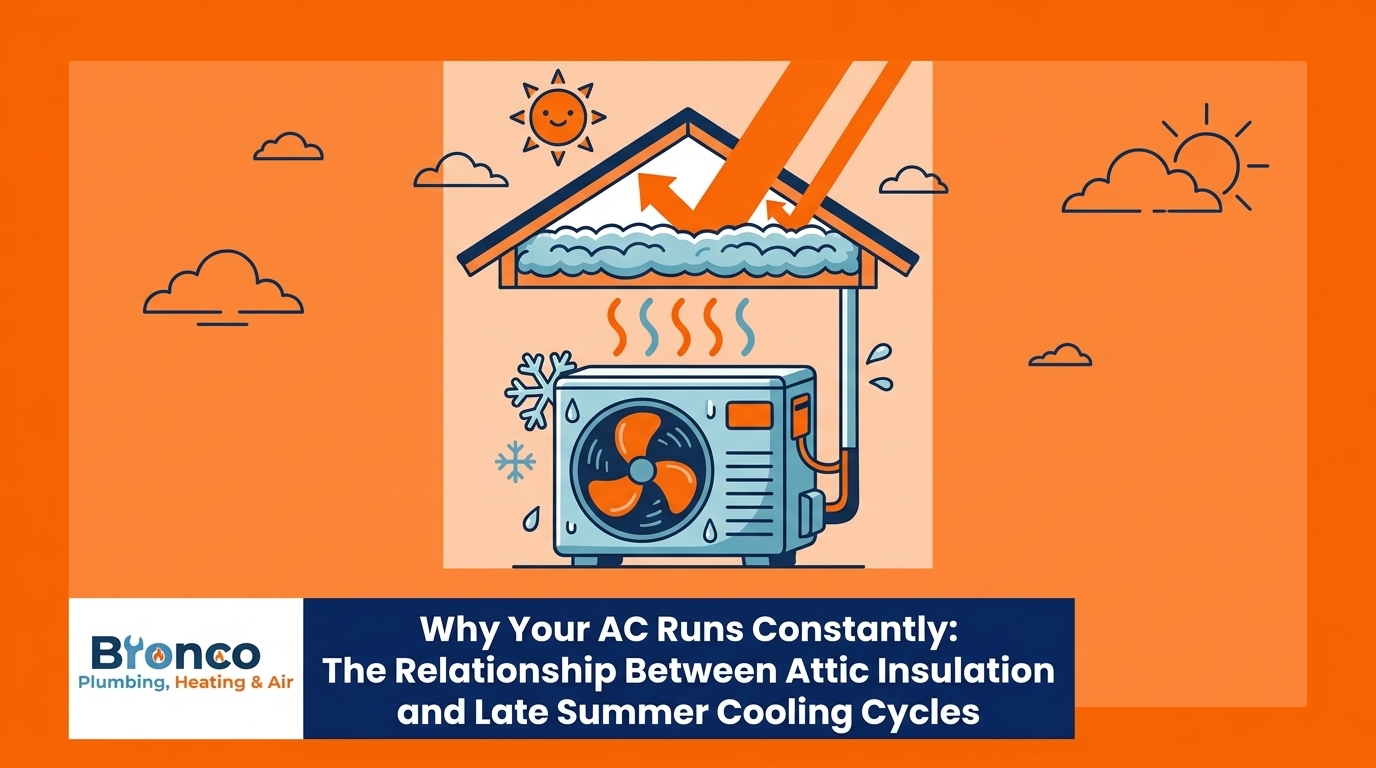
The Relationship Between Attic Insulation and Late Summer Cooling Cycles
What a Sudden Spike in Your August Electric Bill Actually Means for Your AC