



.svg)

High Efficiency AC Worth the Extra Cost in California: Cost Savings Guide
Thinking About Upgrading to a High Efficiency AC in Sacramento, CA? Here's What You Need to KnowIs a high efficiency AC worth it for homeowners in Sacramento, CA? For many…
Thinking About Upgrading to a High Efficiency AC in Sacramento, CA? Here's What You Need to Know
Is a high efficiency AC worth it for homeowners in Sacramento, CA? For many homeowners in the Sacramento area, the answer is yes, especially if your current system is older, your home deals with long summer run times, or you want better comfort during extreme heat.
Here is a quick breakdown to help you decide:
• Plan to stay in your home long term — High Efficiency AC Worth It?: Often yes
• Replacing an old 10-13 SEER unit — High Efficiency AC Worth It?: Usually yes
• Replacing a newer 15-16 SEER unit — High Efficiency AC Worth It?: Maybe
• Moving soon — High Efficiency AC Worth It?: Depends on your comfort goals
• Want quieter operation and more even cooling — High Efficiency AC Worth It?: Often yes
• Eligible for rebates and tax credits — High Efficiency AC Worth It?: Often more appealing
California's high electricity rates and long, hot summers make efficiency especially important. A higher SEER2 rating means your system uses less electricity to deliver the same cooling. In a Sacramento-area home, that can lead to lower energy use and more consistent indoor comfort.
At the same time, choosing a high-efficiency AC is not just about the equipment label. The better question is whether the system fits your home, cooling habits, comfort expectations, and long-term plans. This guide walks through the key factors Sacramento, CA homeowners should consider.
Understanding SEER2 Ratings and California Energy Standards
SEER stands for Seasonal Energy Efficiency Ratio. SEER2 is the newer version of that rating, created to test equipment under more realistic conditions. Think of it like MPG for your car: it gives you a useful comparison point, but your actual results still depend on how and where you drive. Air conditioners work the same way.
Under the newer M1 testing protocol, SEER2 uses higher external static pressure to better reflect real ductwork conditions in actual homes. That matters because a system's lab rating and a system's real-world performance are not always identical. If you want a deeper explanation, our guide on what a SEER2 rating means on an AC unit breaks it down in plain English.
For California homeowners, the efficiency conversation does not stop at the equipment label. We also have to consider Title 24 and local code requirements. Our climate, energy rules, and inspection standards all push toward better-performing HVAC systems. You can learn more in our articles on California Title 24 energy requirements for HVAC and Title 24 HVAC requirements for homeowners explained.
As of 2026, California standards are generally stricter than the old national minimums many homeowners still remember. Some sources cite California split-system cooling equipment at about 15 SEER2 under Title 24, while DOE regional minimums often show lower federal baselines such as roughly 14.3 SEER2 for southern-region split systems. The practical takeaway is simple:
• California typically pushes you above yesterday's "builder grade"
• Higher efficiency is often easier to justify here because electricity is expensive
• Comparing quotes only makes sense if all systems are shown in the same metric, preferably SEER2
For Sacramento, Roseville, Rocklin, Elk Grove, Folsom, and surrounding areas, that matters a lot. Our summers are long, hot, and not shy about hitting triple digits. A system that runs for many cooling hours every year gives efficiency upgrades more room to pay you back.
Is a high efficiency ac worth it in California for energy savings?
For energy savings alone, the best answer is often yes, but not always at the very highest tier.
In California, a jump from an older 10 SEER unit to a modern 16 SEER2 or 18 SEER2 system can produce substantial savings. Research consistently shows that moving from 10 SEER to 16 SEER can reduce cooling energy use by around 30 to 40 percent. That is a meaningful difference for a Sacramento summer utility bill.
But the savings curve flattens as you move higher. California's electricity rates make efficiency more valuable here, but the general lesson still applies: going from minimum efficiency to mid-high efficiency usually has stronger practical value than going from high efficiency to ultra-high efficiency.
Here is a simplified comparison for a typical 3-ton central AC in a hot California usage pattern:
• 14.3 SEER2 — Relative Efficiency vs 14.3 SEER2: Baseline — Estimated Annual Electricity Use: Highest use — Savings Trend: Lowest upfront efficiency
• 16 SEER2 — Relative Efficiency vs 14.3 SEER2: Better — Estimated Annual Electricity Use: Lower — Savings Trend: Good value sweet spot
• 18 SEER2 — Relative Efficiency vs 14.3 SEER2: About 20% more efficient than 14 SEER2 class — Estimated Annual Electricity Use: Much lower — Savings Trend: Strong savings for heavy users
• 20 SEER2 — Relative Efficiency vs 14.3 SEER2: About 43% more efficient than 14 SEER2 class — Estimated Annual Electricity Use: Lowest use — Savings Trend: Best for comfort and long-term stays
In high-usage parts of the Sacramento region, energy savings from minimum-efficiency equipment to 18 or 20 SEER2 can be meaningful over time. That said, the value depends on the efficiency jump:
• From old 10-13 SEER equipment to 16-18 SEER2: usually very favorable
• From current minimum efficiency to 16-18 SEER2: often still favorable in Sacramento-area heat
• From 18 SEER2 to 20+ SEER2: usually more about comfort, quiet, and premium performance than energy savings alone
If you want a broader side-by-side look, our standard efficiency vs high efficiency AC comparison is a good next step. And if you live in an area that regularly sees intense summer heat, our article on how Sacramento climate affects your HVAC system explains why local runtime matters so much.
The short version? In Roseville, Rocklin, Elk Grove, Folsom, and Sacramento, higher efficiency usually has more value than it would in a milder coastal climate. Your AC works hard here.
Maximizing Your Investment with Tax Credits and Rebates
Incentives can make the value equation much better.
At the federal level, qualifying central AC systems may be eligible for a tax credit, while qualifying heat pumps can qualify for a larger one. Based on current 25C rules referenced in the research:
• High-efficiency central AC may qualify for up to $600
• Qualifying heat pumps may qualify for up to $2,000
That difference is one reason many California homeowners compare a high-efficiency AC with a heat pump before making a final decision. If you want the current details, see our guide to federal tax credits for AC and heat pump upgrades.
California and utility incentives can also help. Depending on program funding and eligibility, homeowners may find support through statewide or utility-based rebate programs, including SMUD-related offers in parts of the Sacramento region. Our articles on California energy rebates for HVAC upgrades, how to apply for energy rebates in California, and SMUD energy rebates for Sacramento homeowners can help you sort through what applies.
A few important rebate realities:
• Program rules change often
• Efficiency thresholds matter
• ENERGY STAR certification may be required
• AHRI-matched system documentation is often needed
• You may be able to stack certain utility rebates with federal tax credits
If you are in Sacramento, Folsom, Rancho Cordova, Citrus Heights, or nearby communities, we always recommend checking incentives before installation, not after. Nothing ruins a rebate faster than finding out the paperwork should have been done first.
Beyond the Bill: Comfort and Performance Benefits
This is where high-efficiency systems often stand out even when the pure savings math is only moderate.
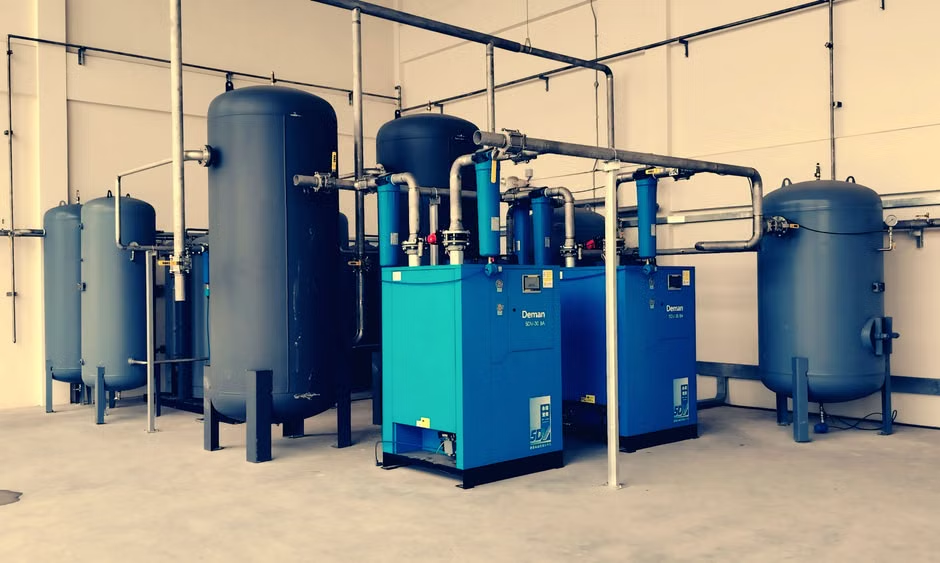
Many high-efficiency units are not just the same AC with a better number. They often include better technology, especially when you move from single-stage to two-stage or variable-speed equipment.
Here is the quick version:
• Single-stage compressors are either fully on or fully off
• Two-stage compressors can run at a lower setting most of the time and higher when needed
• Variable-speed compressors can adjust across a wide range for more precise control
That matters for several reasons.
Better temperature consistency
A variable-speed or two-stage system usually runs longer at lower output instead of blasting on, overshooting, and shutting off. That helps reduce hot and cold spots. If the upstairs in your Elk Grove or Fair Oaks home always feels much warmer than the rest of the house, staging can help.
Better humidity control
Sacramento is known more for dry heat than sticky coastal humidity, but indoor humidity control still matters during shoulder seasons, early mornings, and in homes with limited airflow. Longer run times remove more moisture and help the house feel comfortable without needing the thermostat set as low.
Quieter operation
High-efficiency equipment is often much quieter than standard single-stage systems. Less roaring startup. Less sudden cycling. Less noise late at night.
Improved filtration and air circulation
Longer, lower-speed fan operation can move air through your filter more consistently. That can help with dust, pollen, and general indoor air quality, especially when paired with the right filtration setup.
Better performance during Sacramento heat waves
When we get prolonged triple-digit weather, equipment that can modulate output tends to hold indoor comfort more steadily. Our article on choosing an AC for triple digit Sacramento summers goes deeper into this.
So if you are asking is a high efficiency ac worth the extra cost in california, the answer is sometimes yes even before you look at energy use, because comfort is part of value too.
Critical Factors That Influence Real-World Efficiency
A high SEER2 label does not magically overcome bad installation, leaky ducts, or poor sizing. In the real world, those issues can erase much of the benefit you thought you were buying.
Installation quality
Research shows poor installation can reduce real-world efficiency by up to 30 percent. That is enormous. Correct airflow, refrigerant charge, static pressure, controls setup, and commissioning all matter. A system should be installed as a matched system and verified to perform the way it was designed.
Our AC installation Sacramento CA complete guide explains what a proper installation should include.
Ductwork condition
The Department of Energy estimates that homes can lose 20 to 30 percent of conditioned air through leaky ducts. If your attic ductwork leaks heavily, your high-efficiency equipment may never deliver its rated performance.
Proper sizing
Bigger is not better. An oversized system may short-cycle, reduce dehumidification, and waste energy. An undersized system may run non-stop and still struggle. Proper load calculations matter, especially in Davis, Woodland, Rocklin, and other areas where home age, insulation, and sun exposure vary significantly.
Home insulation and envelope
If your attic insulation is weak, your windows gain too much solar heat, or your house leaks air, your AC has to work harder no matter how efficient it is.
Climate zone and usage pattern
Inland Sacramento Valley homes usually get more value from high efficiency than milder California microclimates. If your AC runs heavily from late spring into early fall, better efficiency has more hours to prove itself.
Refrigerant transition
Starting in 2025, new equipment shifted away from R-410A toward lower-GWP refrigerants such as R-454B and R-32. In 2026, that affects both equipment selection and replacement timing. Newer refrigerants are now standard on many systems, and homeowners replacing older R-410A equipment should consider long-term serviceability and compatibility as part of the decision.
Determining if a high efficiency ac is worth it in California for your home
Not every home needs the highest rating available. We usually suggest looking at the whole picture:
• How old and inefficient is your current system?
• How many years do you plan to stay in the home?
• How many cooling hours do you rack up each summer?
• Is your ductwork in good shape?
• Does your home have comfort issues now?
• Do you qualify for incentives?
If you are replacing a failing 10-13 SEER unit in a long-term home, a higher-efficiency upgrade usually makes sense. If you are replacing a relatively modern 15-16 SEER system and expect to move soon, the financial case may be weaker.
This is also why timing matters. If your current system is struggling, our guide on when you should replace your AC in California can help you decide whether it is smarter to repair or upgrade.
Why a high efficiency ac is worth it in California for long-term owners
For long-term homeowners, the answer is usually much more favorable because the benefits stack up over time:
• Lower annual cooling costs
• Better comfort through multiple summers
• More modern controls and operation
• Less stress during heat waves
• Better appeal to future buyers
System lifespan also matters. Most central AC systems last around 15 to 20 years with good installation and maintenance, and our article on how long an AC system lasts in Sacramento covers that in more detail. Over that kind of timeline, cumulative energy savings can become substantial.
In places like Woodland, Rocklin, Roseville, and El Dorado Hills, where summer cooling demand is serious business, long-term ownership usually strengthens the case for 16-20 SEER2 equipment more than minimum-efficiency options.
Frequently Asked Questions about High Efficiency AC
What is the typical payback period for a high-efficiency system in California?
For many Sacramento-area homes, a realistic payback period is often around 4 to 7 years, especially when moving from older low-efficiency equipment to a modern high-efficiency system.
The biggest factors are:
• Local electricity rates
• How many hours the AC runs each year
• The efficiency of the old system being replaced
• Whether you choose 16-18 SEER2 or go above 20 SEER2
• Available tax credits and rebates
• Duct condition and installation quality
In general, 16-18 SEER2 is the sweet spot for many homeowners. Ultra-high-efficiency 20+ SEER2 systems can still be worth it, but more often for comfort, quiet, and premium performance than for the fastest energy-only ROI.
How does the 2025 refrigerant transition affect my AC choice in 2026?
It mainly affects what equipment is available and how future-friendly your replacement is.
As of 2026, most new systems are moving to lower-GWP refrigerants like R-454B or R-32 instead of R-410A. For homeowners in Citrus Heights, Sacramento, Roseville, and surrounding areas, that means:
• New equipment choices are now built around the newer refrigerants
• Older R-410A equipment may become less attractive to install as the market moves on
• Repair economics for aging R-410A systems may become less favorable over time
• If you are replacing your system anyway, choosing current-generation equipment usually makes more sense than chasing yesterday's standard
This refrigerant shift does not automatically mean "buy the highest SEER2 possible," but it does mean 2026 buyers should think about long-term parts, efficiency, and code compliance together.
Does a high-efficiency AC require more maintenance than a standard unit?
Not necessarily more maintenance, but it does require more precise maintenance.
High-efficiency systems often include variable-speed motors, communicating controls, sensors, and more advanced electronics. That means routine service matters. Filters still need regular changing, coils need to stay clean, refrigerant charge needs to be correct, and airflow needs to remain within spec.
A few practical points:
• Keep filters clean, especially during heavy summer use
• Schedule professional tune-ups
• Make sure condensate drainage stays clear
• Do not ignore airflow issues or duct leaks
• Protect the system from running under dirty, restricted conditions
Hot inland summers also put more wear on equipment, which is one reason our article on why AC units wear out faster in hot climates is so relevant here. The good news is that lifespan depends more on installation quality and maintenance than on whether the unit is standard or high efficiency.
Conclusion
So, is a high efficiency ac worth the extra cost in california? For many homeowners in Sacramento, Roseville, Rocklin, Elk Grove, Folsom, Woodland, and nearby communities, yes. California's high electricity rates, long cooling seasons, and demanding summer temperatures make efficient equipment more valuable here than in many other parts of the country.
The best fit, though, depends on your current system, your home, your ductwork, your comfort goals, and how long you plan to stay. For many homes, 16-18 SEER2 offers the best balance of savings and value. For others, especially long-term owners who want quieter operation and better comfort, stepping into variable-speed 18-20+ SEER2 equipment can make excellent sense.
If you want help comparing your options, our team at Bronco Heating & Air can evaluate your home's cooling needs, ductwork, and efficiency goals and help you make a practical decision for Sacramento-area conditions. When you're ready, schedule your high-efficiency AC installation today.

Customer Testimonials
Our customer testimonials highlight the reliable service, quality workmanship, and trusted results homeowners experience with Bronco Plumbing Heating and Air.


Ready to Transform your Home?
Create a healthier, more comfortable home with expert HVAC, plumbing, and indoor air quality solutions you can trust. From efficient heating and cooling to cleaner air and reliable repairs, our experienced team is here to keep your family comfortable year-round with dependable service and upfront pricing.
Related Articles
Is a 24-Hour Emergency AC Repair Call Justified for a Tripped Breaker?


Surviving a Sacramento Valley Heatwave When Your AC Condenser Freezes Solid
What Actually Happens When You Set Your Thermostat to 65 Degrees in 100-Degree Heat