



.svg)


What Size Air Conditioner Do I Need for My Sacramento CA Home?
What size air conditioner do I need is one of the most important questions you can ask before buying or replacing a cooling system — especially in Sacramento CA, where summer temperatures regularly push past 100°F. Get it right, and your home stays cool and comfortable all season long. Get it wrong, and you're stuck with a system that either can't keep up or wastes energy cycling on and off every few minutes.
The quick answer: multiply your home's square footage by 20 to estimate the BTUs you need, then divide by 12,000 to get the tonnage.
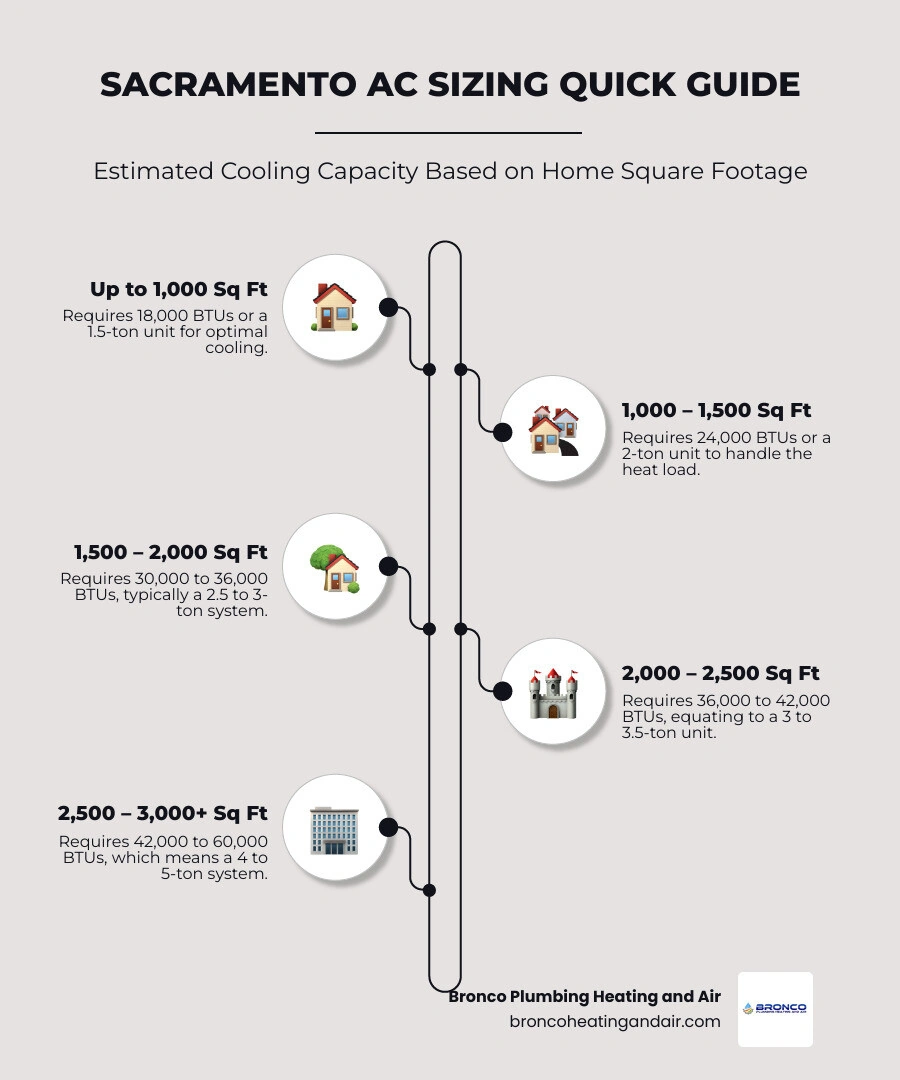
• 600 – 1,000 — Estimated BTUs Needed: 18,000 BTU — AC Tonnage: 1.5 tons
• 1,000 – 1,500 — Estimated BTUs Needed: 24,000 BTU — AC Tonnage: 2 tons
• 1,500 – 2,000 — Estimated BTUs Needed: 30,000 – 36,000 BTU — AC Tonnage: 2.5 – 3 tons
• 2,000 – 2,500 — Estimated BTUs Needed: 36,000 – 42,000 BTU — AC Tonnage: 3 – 3.5 tons
• 2,500 – 3,000 — Estimated BTUs Needed: 42,000 – 48,000 BTU — AC Tonnage: 3.5 – 4 tons
• 3,000+ — Estimated BTUs Needed: 48,000 – 60,000 BTU — AC Tonnage: 4 – 5 tons
But square footage is just the starting point. Factors like insulation quality, ceiling height, sun exposure, and Sacramento's specific climate zone can all shift your ideal unit size up or down. A bigger unit is not always better — in fact, an oversized AC can actually make your home feel more uncomfortable by failing to remove humidity from the air.
This guide walks you through exactly how to calculate the right cooling capacity for your home, what factors to consider beyond square footage, and when it makes sense to call in a professional for a precise load calculation.
Understanding the Basics: What is a BTU and AC Tonnage?
Before we dive into the math of your home, it is helpful to understand the units of measurement used in the HVAC world. When you start shopping for a new system, you will hear two terms constantly: BTUs and Tonnage.
What is a BTU?
BTU stands for British Thermal Unit. In the simplest terms, it is a measure of heat energy. One BTU is roughly the amount of energy required to raise the temperature of one pound of water by one degree Fahrenheit. When it comes to air conditioning, BTU ratings tell us the cooling capacity of the unit—essentially, how much heat the system can remove from your indoor air every hour. The higher the BTU rating, the more "cooling power" the unit has.
What is AC Tonnage?
In residential cooling, we often group BTUs into "tons." This can be confusing because it has nothing to do with the physical weight of the air conditioner. Instead, the term comes from the old days of refrigeration when people used literal blocks of ice to cool buildings. One "ton" of cooling is defined as the amount of heat required to melt one ton of ice over a 24-hour period.
In modern engineering, 1 ton of cooling capacity equals 12,000 BTUs per hour (BTUh).
Most residential air conditioners range from 1.5 tons to 5 tons. If your home requires 36,000 BTUs of cooling, you would look for a 3-ton unit. Understanding this conversion is the first step in navigating AC Services and finding the right fit for your property.
Why Proper Sizing Matters for Your Sacramento CA Home
In May 2026, as we prepare for another scorching California summer, the importance of "Goldilocks sizing"—getting it just right—cannot be overstated. Many homeowners assume that "bigger is better," thinking a larger unit will cool the house faster. Unfortunately, this is one of the most common and expensive mistakes you can make.
The Problem with Oversized Units
If your AC is too large for your square footage, it will engage in something called short cycling. Because the unit is so powerful, it reaches the temperature set on your thermostat very quickly and shuts off. While that sounds efficient, it’s actually a disaster for your comfort.
Air conditioners don’t just cool the air; they also remove moisture. Dehumidification only happens when the system runs for a long, steady cycle. An oversized unit shuts off before it can pull the humidity out of the air, leaving you with "clammy" air—cold but damp and uncomfortable. Furthermore, the constant starting and stopping puts immense strain on the compressor, leading to premature breakdowns.
The Problem with Undersized Units
On the flip side, a unit that is too small will run constantly without ever reaching your desired temperature. In places like Roseville CA or Folsom CA, where the sun beats down relentlessly, an undersized unit will work itself to death. This leads to astronomical energy bills and a significantly shortened equipment lifespan. You can learn more about why these conditions are so tough on equipment by reading about Why Do AC Units Wear Out Faster in Hot Climates.
While the "20 BTUs per square foot" rule is a great starting point, your home isn't just a flat box. Several variables can drastically change how much cooling you actually need. Sacramento is largely situated in California Climate Zone 11, which is characterized by high heat and low humidity, requiring specific considerations for HVAC performance.
Key Influencing Factors:
• Ceiling Height: Standard BTU charts assume 8-foot ceilings. If you have vaulted ceilings in your living room or 10-foot ceilings throughout your home, there is more air volume to cool, which may require a higher capacity unit.
• Insulation R-Value: A well-insulated home in Elk Grove CA acts like a thermos, keeping the cool air in. If your attic insulation is thin or old, heat will seep in from the roof, forcing your AC to work harder.
• Sun Exposure and Windows: South-facing windows are like giant heaters. If your home has large windows that catch the afternoon sun, you may need to increase your BTU count by 10%.
• Number of Occupants: People generate body heat! General guidelines suggest adding 600 BTUs for every person living in the home beyond the first two.
• Kitchen Appliances: The kitchen is the heart of the home, but it’s also a heat factory. Between the oven, stove, and dishwasher, the kitchen requires significantly more cooling power than a bedroom.
Understanding How Sacramento Climate Affects Your HVAC System is crucial for making an informed decision.
Using square footage to estimate what size air conditioner I need
To get a "ballpark" idea of your needs, you first need to know your home's total conditioned square footage. This is the area of the home that is actually reached by your ductwork (garages and unfinished basements usually don't count).
To measure a room, simply multiply the length by the width. For example, a 20' x 25' great room is 500 square feet. Once you have the total for the whole house, apply the 20 BTU per square foot rule.
• 1,000 sq ft: 1,000 x 20 = 20,000 BTUs (Requires a 1.5 or 2-ton unit)
• 2,000 sq ft: 2,000 x 20 = 40,000 BTUs (Requires a 3.5-ton unit)
• 150 sq ft — Base BTU Requirement: 5,000 BTU
• 450 sq ft — Base BTU Requirement: 10,000 BTU
• 850 sq ft — Base BTU Requirement: 15,000 BTU
• 1,300 sq ft — Base BTU Requirement: 22,000 BTU
If you are looking for a specific installation in a nearby city, such as AC Installation Roseville CA, these numbers provide a solid foundation for your initial consultation.
How environmental factors change what size air conditioner I need
Once you have your base number, it’s time to fine-tune it based on the reality of your living space.
1. The Sun Factor: If the room or house is very sunny, increase your BTU capacity by 10%. If it is heavily shaded by trees or neighboring buildings, you can actually reduce it by 10%.
2. The Kitchen Rule: If you are cooling a space that includes a kitchen, add 4,000 BTUs to the total. This accounts for the heat generated during cooking.
3. Occupancy: Add 600 BTUs for each additional person if the area is regularly occupied by more than two people.
For instance, a 400-square-foot kitchen in a sunny part of Citrus Heights would start at 8,000 BTUs (400 x 20), add 4,000 for the appliances, and another 800 (10%) for the sun, bringing the total to 12,800 BTUs.
The Importance of Manual J Load Calculations and SEER2 Ratings
While DIY math is great for a rough estimate, professional HVAC contractors use a much more scientific method called the Manual J Load Calculation. Developed by the Air Conditioning Contractors of America (ACCA), this is the industry standard for sizing.
A Manual J calculation takes into account nearly 30 different variables, including the orientation of your home, the exact type of windows you have (single vs. double pane), the color of your roof, and even the ductwork's airtightness. This ensures that when we perform an AC Installation Citrus Heights CA, the system is perfectly matched to the building's "load."
Understanding SEER2 Ratings
As of 2023, the industry shifted to SEER2 (Seasonal Energy Efficiency Ratio 2). This rating measures how much cooling a system puts out for every unit of electricity it consumes. Think of it like the "miles per gallon" for your AC.
In California, California Title 24 Energy Requirements for HVAC sets strict standards for efficiency. While a higher SEER2 rating doesn't mean you can buy a smaller unit, it does mean the unit you buy will cost less to operate. Often, choosing a high-efficiency system can qualify you for California Energy Rebates for HVAC Upgrades or Federal Tax Credits for AC and Heat Pump Upgrades.
Frequently Asked Questions about AC Sizing
What size AC unit do I need for a 2,000 square foot house in Sacramento?
Generally, a 2,000-square-foot home in the Sacramento area requires a 3-ton to 3.5-ton unit (36,000 to 42,000 BTUs). However, because our summers are so intense, a home with poor insulation or many west-facing windows might lean toward the 4-ton side to ensure it can maintain comfort during a 105-degree heatwave. A professional load calculation is the only way to be certain.
How do I know if my current air conditioner is the wrong size?
• Too Small: Your system runs 24/7 on hot days but the indoor temperature never drops to your thermostat setting.
• Too Large: The house feels "muggy" or "clammy," and the air conditioner turns on and off every 5 to 10 minutes (short cycling). You might also notice that some rooms are freezing while others stay warm.
If you suspect a sizing issue, it may be time to look into AC Replacement Roseville CA.
Does a higher SEER2 rating mean I can buy a smaller air conditioner?
No. Sizing (Tonnage/BTUs) and Efficiency (SEER2) are two different things. Sizing refers to the capacity to move heat, while SEER2 refers to the cost of moving that heat. A 3-ton unit with a 14 SEER2 rating and a 3-ton unit with a 20 SEER2 rating provide the same amount of cooling; the 20 SEER2 unit just uses significantly less electricity to do it.
Conclusion
Choosing the right air conditioner is about more than just picking a brand; it’s about engineering a solution that fits your specific home and lifestyle. From the breezy evenings in Davis CA to the high-heat afternoons in Rancho Cordova CA, your AC system is your primary defense against the elements.
At Bronco Heating and Air, we pride ourselves on being the local experts who understand the nuances of the Sacramento climate. Our licensed, professional, and courteous technicians don't just guess—we use precise calculations to ensure your home stays perfectly chilled without wasting a drop of energy. Whether you need a simple AC Tune Up Roseville CA or a full system design, we are here to provide cost-effective, reliable solutions.
Don't leave your summer comfort to chance. We serve a wide range of locations, including Rocklin CA, Elk Grove CA, and El Dorado Hills CA. Schedule your professional AC assessment today and make sure your next unit is the perfect fit for your big chill.

Customer Testimonials
Our customer testimonials highlight the reliable service, quality workmanship, and trusted results homeowners experience with Bronco Plumbing Heating and Air.


Ready to Transform your Home?
Create a healthier, more comfortable home with expert HVAC, plumbing, and indoor air quality solutions you can trust. From efficient heating and cooling to cleaner air and reliable repairs, our experienced team is here to keep your family comfortable year-round with dependable service and upfront pricing.
Related Articles
Does Hosing Down Your AC Condenser Actually Improve Cooling Performance?


The Real Reason Your Upstairs Bedrooms Stay Hot While the Ground Floor Freezes
Navigating Roseville Noise Ordinances When Relocating a Loud AC Condenser