



.svg)

Best HVAC Setup for Sacramento Weather: Ultimate Checklist
Why Sacramento's Climate Makes Choosing the Right HVAC Setup So CriticalFinding the best HVAC setup for Sacramento weather is one of the most important decisions you can make as a…
Why Sacramento's Climate Makes Choosing the Right HVAC Setup So Critical
Finding the best HVAC setup for Sacramento weather is one of the most important decisions you can make as a homeowner in the region. Sacramento's Mediterranean climate sounds easygoing on paper — but for your heating and cooling system, it means months of relentless summer heat, sudden humidity swings from the Delta breeze, and damp, foggy winters driven by Tule fog. With average summer highs regularly exceeding 100°F, 73 or more days per year above 90°F, and a cooling season that stretches six full months from May through October, Sacramento is one of the hardest climates in California on HVAC equipment.
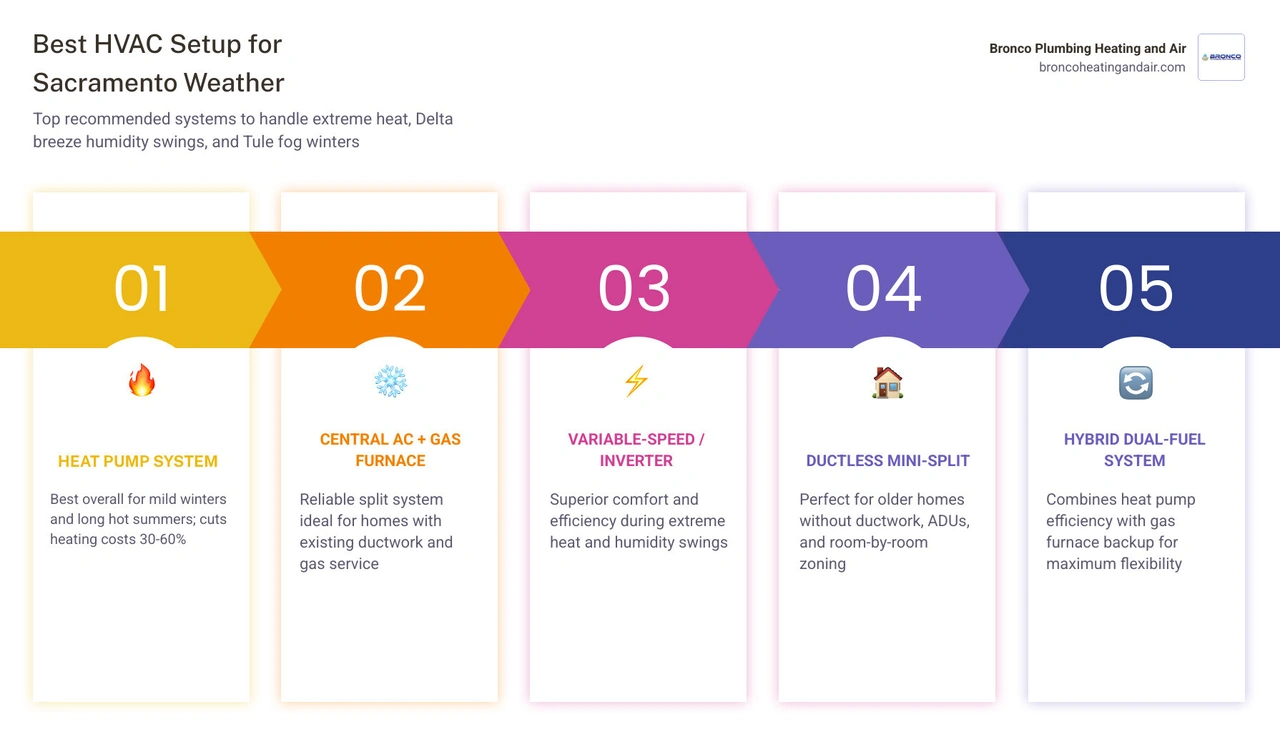
Here's a quick look at the best HVAC setups for Sacramento weather:
1. Heat pump system - Best overall choice for Sacramento's mild winters and long, hot summers; reduces heating costs by 30-60% compared to a traditional furnace
2. Central AC + gas furnace (split system) - Reliable and familiar; ideal for homes with existing ductwork and gas service
3. Variable-speed/inverter system - Best for comfort and efficiency during extreme heat and Delta breeze humidity swings
4. Ductless mini-split - Best for older homes without ductwork, room additions, ADUs, and zoning specific areas
5. Hybrid dual-fuel system - Combines heat pump efficiency with gas furnace backup for maximum flexibility
No matter which system you choose, proper sizing, quality installation, and Sacramento-specific maintenance are just as important as the equipment itself.
Sacramento's unique combination of extreme summer heat, urban heat island temperatures up to 8°F higher than surrounding rural areas, salt air corrosion from the Pacific, wildfire smoke, and winter Tule fog creates challenges that simply don't exist in most other parts of California. A system that works fine in San Francisco or Los Angeles may fall short — or wear out far faster — in the Sacramento Valley. This guide walks you through everything you need to know to choose, size, and maintain the right HVAC setup for your Sacramento home.
Best hvac setup for sacramento weather terms simplified:
• how dry hot summers affect hvac performance and lifespan
• how sacramento climate affects your hvac system
Understanding How Sacramento Climate Affects Your HVAC System

To find the perfect heating and air system, we first have to understand the unique environmental stressors our local weather puts on home equipment. Sacramento is located in ASHRAE Climate Zone 12 (Warm-Dry), which features a geographic layout that essentially acts as a heat trap between the Coast Range and the Sierra Nevada.
During the peak of summer, standard air conditioners are pushed to their absolute physical limits. Most residential cooling units are engineered to run optimally at an outdoor ambient temperature of 95°F. However, in communities like Roseville, CA, Folsom, CA, and Rocklin, CA, triple-digit days are a regular occurrence, with historic peaks climbing all the way to 116°F. When temperatures soar this high, standard single-stage air conditioners must run for 40 to 50 minutes out of every hour just to maintain a reasonable indoor temperature.
Understanding How Sacramento Climate Affects Your HVAC System requires looking at several distinct local phenomena:
• The Urban Heat Island Effect: In densely populated neighborhoods like Midtown, Downtown, and Land Park, CA, concrete and asphalt absorb heat throughout the day. This can keep local nighttime temperatures up to 8°F warmer than surrounding rural areas, preventing your home and your AC unit from getting a natural nighttime "cool down" period.
• Delta Breeze Humidity Swings: While the Delta breeze is a welcome relief that can knock 20 degrees off the afternoon heat, it introduces a sudden influx of moisture. This rapid shift in relative humidity forces your system to transition from purely sensible cooling (lowering the air temperature) to latent cooling (removing moisture from the air).
• Salt Air Corrosion: Many local homeowners are surprised to learn that Sacramento lies within a 140-mile salt intrusion zone from the Pacific Ocean. Over time, the subtle presence of salt air can corrode outdoor condenser coils, potentially cutting the lifespan of an unmaintained system from 15 years down to as little as 6 to 7 years.
• Winter Tule Fog and Heavy Rains: Winters in the Sacramento Valley are damp and foggy. Tule fog brings thick, ground-level moisture that can coat outdoor heat pump coils, triggering frequent defrost cycles.
• Wildfire Smoke: Northern California's dry summers often bring heavy wildfire smoke. When smoke blankets the region, your HVAC system's filtration becomes your home's primary line of defense, requiring heavy-duty filters that must be changed frequently to prevent system strain.
For a deeper dive into these seasonal challenges, check out our comprehensive Sacramento Heat HVAC Guide.
Finding the Best HVAC Setup for Sacramento Weather
When selecting a new climate control system for your home, there is no one-size-fits-all solution. The best setup depends on your home’s age, existing ductwork, and comfort goals. Modern variable-speed (or inverter) technology has completely changed the game for Northern California homeowners. Unlike traditional systems that turn fully "on" or "off" like a loud light switch, variable-speed systems adjust their output dynamically, running at lower, highly efficient speeds to maintain a perfectly steady indoor temperature.
To help you compare your options, let's look at the primary system types available:
• Traditional Split System (Central AC + Gas Furnace) — Best Suited For: Homes with existing ductwork and active gas lines. — Key Advantages: Highly reliable, familiar technology, and excellent heating capacity on chilly winter nights. — Considerations: Relies on natural gas; ductwork must be well-insulated and sealed.
• Air-Source Heat Pump — Best Suited For: Energy-conscious homeowners looking to go all-electric. — Key Advantages: Dual-season performance (heats and cools), incredibly energy-efficient, and eligible for major rebates. — Considerations: Efficiency can dip slightly in extreme sub-freezing temperatures (rare in Sacramento).
• Ductless Mini-Split — Best Suited For: Older homes, home offices, ADUs, and room additions. — Key Advantages: Zero duct loss, independent zone control, whisper-quiet operation, and extreme efficiency. — Considerations: Requires wall-mounted or ceiling-recessed indoor heads in each room.
For a detailed breakdown of how these technologies stack up, read our Central AC vs Ductless Mini Split Comparison and explore the Heat Pump Advantages Over Traditional HVAC.
Why Heat Pumps are the Best HVAC Setup for Sacramento Weather
In our local climate, air-source heat pumps are rapidly becoming the gold standard for home comfort. Because Sacramento experiences relatively mild winters where overnight temperatures rarely stay below freezing for long, we have the absolute perfect climate for heat pump technology.
Traditional gas furnaces create heat by burning fuel, which is capped at a maximum thermodynamic efficiency of around 95% to 98%. Heat pumps, on the other hand, do not create heat—they simply move it from one place to another. Even on a cool 40°F winter night in Elk Grove, CA or Davis, CA, there is still a massive amount of ambient heat energy in the outdoor air. A heat pump extracts this heat and transfers it indoors, operating at efficiencies of up to 300% to 400%. This process can reduce home heating costs by 30% to 60% compared to traditional combustion heating.
During the summer, the process simply reverses, drawing heat out of your home and pumping it outside. To learn more about how these highly efficient systems operate, check out our Heat Pumps Sacramento CA Guide, read the Ultimate Heat Pumps Sacramento CA overview, or learn the science behind them in our article, How Does a Heat Pump Work.
Choosing the Best HVAC Setup for Sacramento Weather in Older Homes
If you live in one of Sacramento’s historic neighborhoods, such as Land Park, CA, East Sacramento, CA, or older parts of Woodland, CA, you face a unique set of heating and cooling challenges. Many of these beautiful classic bungalows and mid-century homes were built without central ductwork, relying instead on wall heaters or window AC units. Retrofitting these properties with traditional metal ducts often requires tearing into historic lath-and-plaster walls, cutting into original wood ceilings, or sacrificing valuable closet space.
For these homes, ductless mini-split systems are the ultimate solution. A mini-split consists of a compact outdoor condenser connected to one or more indoor air handlers via small refrigerant lines that only require a three-inch hole through an exterior wall. This preserves the architectural integrity of your home while providing incredibly precise zone control.
Ductless systems also solve the notorious "hot second-story room" problem. If you have a two-story home in Folsom, CA or El Dorado Hills, CA where the upstairs bedrooms always feel like a sauna in July, installing a zoned mini-split allows you to cool only the rooms you are actively using, saving energy and maximizing comfort. Learn more about choosing the perfect system for summer survival in our guide on Choosing an AC for Triple Digit Sacramento Summers.
Sizing, Efficiency Ratings, and Smart Controls for Sacramento Homes
When investing in a new system, the quality of the installation and the accuracy of the system sizing matter far more than the brand name on the box. A premium, top-of-the-line system that is poorly installed or incorrectly sized will underperform a mid-range system installed with precision.
To ensure your system can handle a 110°F heat wave without breaking a sweat, we never rely on outdated "rules of thumb" (like sizing a system solely based on square footage). Instead, our team performs a detailed Manual J load calculation. This scientific assessment factors in:
• The exact local climate data for your specific ZIP code.
• The orientation of your home relative to the sun (solar heat gain).
• The square footage and height of your ceilings (vaulted ceilings can require 25-30% more cooling capacity).
• The R-value of your attic and wall insulation.
• The U-factor and placement of your windows.
If a system is oversized, it will constantly turn on and off in rapid 5-to-8-minute cycles (known as short-cycling). This prevents the system from running long enough to remove humidity, leaving your home feeling clammy while putting immense mechanical wear and tear on the compressor. Conversely, an undersized system will run continuously all day, struggling to reach your target temperature and driving up your utility bills. Understanding Why Your AC Runs All Day During Extreme Summer Heat is often the first step in realizing your system might be sized incorrectly or losing air through leaky ductwork.
Efficiency Ratings to Look For
In California, the minimum allowable efficiency standard is 14.3 SEER2 (Seasonal Energy Efficiency Ratio 2). However, given our long, hot summers, we highly recommend prioritizing systems rated at 17 SEER2 or higher. Upgrading from an older, low-SEER system to a modern high-efficiency unit can save you hundreds of dollars annually on your cooling bills.
Smart Controls and Zoning
Integrating your system with a modern smart thermostat is one of the easiest ways to optimize comfort and savings. In 2026, smart thermostats utilizing the Matter protocol allow seamless integration across different smart home ecosystems, ensuring your climate control can talk to your smart blinds, lighting, and home assistants.
Many smart thermostats are now "weather-aware." For example, if a hot afternoon in Rancho Cordova, CA is expected to give way to a cool Delta breeze in the evening, a smart thermostat can automatically adjust its cooling cycles or notify you when it's the perfect time to open the windows and let nature do the work.
Essential Maintenance to Protect Your System from Extreme Weather
Sacramento's dry, dusty summers and damp, foggy winters mean that proactive maintenance is absolutely essential to protect your investment and extend your system's operational lifespan.
To keep your system running at peak efficiency, we recommend following this seasonal checklist:
• Schedule Bi-Annual Professional Tune-Ups: Have an AC tune-up performed in the spring (March or April) before the first major heat wave hits, and a heating inspection in the fall (September or October) before the Tule fog rolls in.
• Check and Replace Filters Frequently: Under normal conditions, filters should be changed every 90 days. However, during peak summer cooling or active wildfire seasons, you should check your filters every 30 days.
• Upgrade to MERV 13 Filters: To protect your indoor air quality from fine dust, agricultural pollen, and wildfire smoke, use filters rated MERV 13 or higher. Ensure your system's blower motor is rated to handle the static pressure of a high-efficiency filter.
• Maintain Clear Outdoor Clearance: Keep at least two feet of clear space around your outdoor condenser unit. Trim back bushes, weeds, and grass to ensure unrestricted airflow.
• Gently Rinse Your Condenser Coils: Use a standard garden hose (never a high-pressure pressure washer, which can bend the delicate aluminum fins) to gently rinse dirt, dust, and agricultural grime off your outdoor coils.
To keep your system in top shape year-round, refer to our HVAC Maintenance Guide 2026, follow our Pre-Summer AC Tune-Up Checklist for Homeowners, and ask yourself: Is Your Air Conditioning System Ready for the Summer?
Regular care prevents the rapid degradation described in our guide on How Dry Hot Summers Affect HVAC Performance and Lifespan. Taking these simple steps is the best way of Protecting Your HVAC System During Heat Waves and maximizing How Long Does an AC System Last in Sacramento.
Frequently Asked Questions about Sacramento HVAC Setups
What is the ideal summer thermostat setting for Sacramento, CA?
For the best balance of comfort and energy savings, we recommend setting your thermostat to 78°F when you are at home. You can pair this setting with ceiling fans, which create a wind-chill effect that makes the room feel up to 4 degrees cooler than it actually is.
When you are away from home for more than four hours, raise the thermostat to 85°F or turn the system off entirely to prevent waste. Raising your thermostat by just 2 degrees during hot weather can save between 5% and 10% on your summer cooling costs.
How does the Delta breeze affect my air conditioning system?
The Delta breeze is a natural air conditioning system for the Sacramento Valley, bringing cool air in from the San Francisco Bay. However, because it travels over water, it also brings a sudden spike in humidity.
Single-stage AC units can struggle with this sudden moisture influx, occasionally leading to cold, clammy indoor air. Systems equipped with variable-speed compressors or a dedicated "dry mode" excel at managing these rapid humidity transitions, keeping your home perfectly comfortable.
When should I replace my aging HVAC system proactively?
Most well-maintained HVAC systems in the Sacramento area have a functional lifespan of 15 to 18 years. If your system is approaching or has passed the 15-year mark, replacing it proactively in the mild spring or autumn months is highly recommended.
Waiting for your system to suffer a catastrophic breakdown in the middle of a 105°F July heat wave often means dealing with emergency response times, high stress, and several uncomfortable days without cooling while waiting for replacement parts to arrive. Proactive replacement allows you to take your time, research your options, and maximize available utility rebates and incentives.
Conclusion
Finding the best HVAC setup for Sacramento weather comes down to selecting high-efficiency equipment tailored to our unique valley climate, sizing it accurately through a professional Manual J load calculation, and keeping it running smoothly with consistent, proactive maintenance. Whether you are looking to upgrade to a state-of-the-art heat pump, install a whisper-quiet ductless mini-split in a historic home, or schedule a seasonal tune-up, our team of licensed, professional, and courteous technicians is here to help.
We are proud to serve homeowners across the entire Greater Sacramento region, including Antelope, CA, Arden-Arcade, CA, Carmichael, CA, Citrus Heights, CA, Davis, CA, Del Paso Heights, CA, El Dorado Hills, CA, Elk Grove, CA, Elverta, CA, Fair Oaks, CA, Folsom, CA, Gold River, CA, Granite Bay, CA, Land Park, CA, Lincoln, CA, Loomis, CA, Natomas, CA, North Highlands, CA, Orangevale, CA, Pocket-Greenhaven, CA, Rancho Cordova, CA, Rio Linda, CA, Rocklin, CA, Roseville, CA, Sacramento, CA, and Woodland, CA.
Ready to optimize your home's comfort and efficiency? Visit our Sacramento, CA Service Page today to schedule your system evaluation!

Customer Testimonials
Our customer testimonials highlight the reliable service, quality workmanship, and trusted results homeowners experience with Bronco Plumbing Heating and Air.


Ready to Transform your Home?
Create a healthier, more comfortable home with expert HVAC, plumbing, and indoor air quality solutions you can trust. From efficient heating and cooling to cleaner air and reliable repairs, our experienced team is here to keep your family comfortable year-round with dependable service and upfront pricing.
Related Articles

Preparing Your Home Air Quality for Back-to-School Illness Season


Elk Grove's Hard Water Impact on Evaporative Coolers and Plumbing Fixtures

Why Your Vents Smell Like Mildew When the AC Kicks On in Late Summer