



.svg)

Why Knowing How Old Is Too Old for an HVAC System Can Save You Money
If you've been wondering how old is too old for an HVAC system, here's the short answer: most systems reach the end of their reliable life between 15 and 20 years, but the real warning signs often show up well before that.
Quick Reference: HVAC Lifespan by System Type
• Central Air Conditioner — Typical Lifespan: 15-20 years
• Gas Furnace — Typical Lifespan: 15-30 years
• Heat Pump — Typical Lifespan: 10-15 years
• Ductless Mini-Split — Typical Lifespan: 10-15 years
• Boiler — Typical Lifespan: 20-35 years
Most homeowners don't think about their HVAC system until something goes wrong. By then, it's often a hot Sacramento summer day or a cold winter night — the worst possible time to make a major decision under pressure.
Age alone doesn't tell the whole story. A 12-year-old system that's been poorly maintained may already be costing you more than it's worth. A 17-year-old system that's been serviced every year might still have some life left. The key is knowing what to look for before a breakdown forces your hand.
In Sacramento CA, where summer temperatures regularly push past 100°F, your cooling system works harder and wears out faster than it might in a milder climate. That makes understanding your system's age and condition even more important for local homeowners.
This guide walks you through everything you need to know — from lifespan expectations by equipment type, to the financial rules that help you decide whether to repair or replace, to the safety risks of holding on too long.
How Old Is Too Old for an HVAC System? Lifespan Expectations
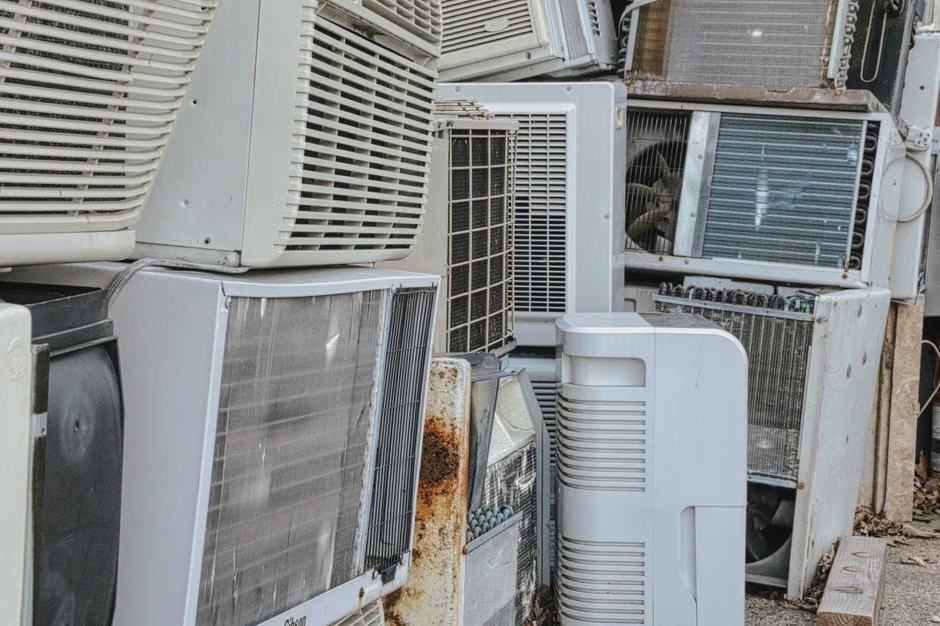
When evaluating your home’s heating and cooling equipment, the calendar is your first clue. However, a system's true age is measured not just in years, but in runtime hours, climate stress, and maintenance history.
In our region—spanning from the hot summer afternoons of Davis CA and Woodland CA to the cooler winter foothills of El Dorado Hills CA—the demands on HVAC systems fluctuate significantly. To understand if your system is nearing retirement, you first need to understand the baseline expectations for each type of equipment.
For a deeper dive into local conditions, read our guide on How Long Does an AC System Last in Sacramento.
• Central Air Conditioners (15–20 Years): Under ideal conditions, a central AC unit can last up to two decades. However, in areas with intense summer heatwaves, the median service life often drops to 12–15 years. This is the inflection point where half of all systems are expected to fail or require a major component replacement.
• Gas Furnaces (15–30 Years): Furnaces generally outlast cooling systems because they operate under less mechanical stress and are only used for a portion of the year. A well-maintained furnace can easily run for 20 years or more, though its heating efficiency will degrade over time.
• Heat Pumps (10–15 Years): Because heat pumps provide both heating in the winter and cooling in the summer, they run year-round. This double-duty usage accelerates mechanical wear, meaning they typically need replacement sooner than standalone furnaces.
• Ductless Mini-Splits (10–15 Years): Like traditional heat pumps, mini-splits handle both heating and cooling. While highly efficient, their sophisticated electronic components and continuous operation mean they usually require replacement after a decade to a decade and a half of service.
Determining How Old Is Too Old for an HVAC System by Equipment Type
To truly determine if your specific system has crossed the threshold into being "too old," you must look at how its components age under local climate stresses. In California, our environmental standards and seasonal temperature swings play a major role in equipment longevity.
If you are wondering about state-specific factors, check out our article on When Should You Replace Your AC in California.
By year 10, most central air systems operate at only 80–85% of their original efficiency. If your system is located in a high-runtime environment—such as a home with poor insulation or one located in the hotter pockets of Elk Grove CA or Rancho Cordova CA—this efficiency degradation occurs even faster. Components like compressor valves, blower motors, and outdoor coils gradually wear down, forcing the system to run longer to achieve the same indoor comfort.
Key Signs Your Heating and Cooling System is Reaching Its Limit
Waiting for your system to experience a catastrophic failure is often the most expensive replacement strategy. During peak summer heatwaves, repair wait times can increase by up to four times, leaving homeowners in places like Citrus Heights CA or Folsom CA waiting several days without cooling.
Recognizing the warning signs early allows you to plan an upgrade on your own terms. If your furnace is already acting up, you can start by reading our tips on Troubleshooting Furnace Not Heating.
Here are the primary warning signs that your HVAC system is reaching the end of its useful life:
1. Frequent Breakdowns: If you have had to call an HVAC technician multiple times over the last two to three years for minor repairs (such as replacing capacitors, contactors, or fan motors), your system is signaling systemic wear.
2. Uneven Temperatures: Are some rooms in your home freezing while others remain warm? An aging system struggles to distribute conditioned air evenly, often due to a failing blower motor or degraded ductwork.
3. Rising Utility Bills: If your energy bills have risen by 15% to 25% over a three-year period without a corresponding change in utility rates or usage habits, your system is losing its operational efficiency.
4. Strange Noises: Squealing, grinding, rattling, or banging noises indicate failing bearings, loose components, or a compressor on its last legs.
5. Excessive Dust and Humidity Issues: Older systems lose their ability to effectively control indoor humidity and filter out airborne dust, leading to stuffy air and poor indoor air quality.
Is Rust on a Furnace a Sign of System Failure?
Rust is one of the most neglected warning signs on a heating system. Many homeowners assume a little surface rust is normal for metal equipment stored in a garage, closet, or attic. However, when it comes to a gas furnace, rust can be a precursor to a dangerous safety hazard.
To understand the implications of corrosion, read our detailed articles: Is Rust on a Furnace a Problem and Does Rust on a Furnace Mean It's Time for Repair.
Rust on a furnace typically points to two potential issues:
• Condensation Leaks: High-efficiency furnaces produce acidic condensate during operation. If the condensate drain lines become clogged or crack, this moisture can pool inside the furnace cabinet, causing rapid corrosion of electrical connections and structural metal.
• Heat Exchanger Stress: The heat exchanger is the metal chamber where combustion gases heat the air circulating through your home. As a furnace ages, the constant expansion and contraction of this metal can cause microscopic stress cracks. If moisture interacts with these hot metal surfaces, rust forms.
A rusted or cracked heat exchanger is an immediate safety hazard because it can allow deadly carbon monoxide gas to leak directly into your home's airstream. If you notice rust flakes inside your furnace cabinet or near the burners, it is time for a professional safety evaluation.
The Financial Math: When to Repair vs. Replace
When an aging system breaks down, homeowners face a high-stakes decision: do you invest in a repair to buy more time, or do you put that money toward a brand-new, high-efficiency system?
To make an objective, logical decision, you can rely on established financial rules of thumb.
• System Age — Favor Repair: Under 10 years old — Favor Replacement: Over 12–15 years old
• The 50% Rule — Favor Repair: Repair cost is < 30% of replacement value — Favor Replacement: Repair cost is > 50% of replacement value
• The $5,000 Rule — Favor Repair: Age × Repair Cost is < $5,000 — Favor Replacement: Age × Repair Cost is > $5,000
• Refrigerant Type — Favor Repair: Modern R-410A or newer A2L — Favor Replacement: Phased-out R-22 (Freon)
• Efficiency Trend — Favor Repair: Utility bills remain steady — Favor Replacement: Utility bills rising 15–25%
• Repair Frequency — Favor Repair: First repair in several years — Favor Replacement: Multiple service calls in the last 2–3 years
For more guidance on navigating this choice, check out our resources on When to Repair vs Replace Your HVAC System and How to Decide Between AC Repair and Replacement.
Applying Financial Rules to Decide How Old Is Too Old for an HVAC System
Let's look at how these financial rules work in real-world scenarios.
The 50% Rule
This rule states that if the cost of a single repair exceeds 50% of the value of a brand-new system, you should always replace the unit. Investing half the cost of a new system into an old machine that carries no warranty on its other aging parts is rarely a sound financial choice.
The $5,000 Rule
This is a highly reliable, age-adjusted formula used by HVAC professionals. You multiply the age of your system by the estimated cost of the repair. If the total exceeds $5,000, replacement is the smarter financial move.
• Scenario A (Repair): You have an 8-year-old air conditioner that needs a new condenser fan motor. The repair is relatively straightforward. $$text{Calculation: } 8 text{ (years)} times text{Repair Cost} = text{Well under $5,000 threshold}$$In this case, repairing the system makes perfect sense.
• Scenario B (Replace): You have a 14-year-old system that has suffered a failed compressor or a cracked evaporator coil. $$text{Calculation: } 14 text{ (years)} times text{Major Repair Cost} = text{Significantly exceeds $5,000 threshold}$$At this age, the system is already operating at degraded efficiency, and other components (like the blower motor or control board) are likely to fail next. Replacing the system is the more cost-effective long-term decision.
Avoiding the "Repair Spiral"—where one failing component puts extra stress on remaining parts, leading to a cascade of expensive breakdowns—will save you both money and frustration.
Regulatory Impacts, Refrigerants, and Modern Efficiency Standards
National and state environmental regulations have a massive impact on the financial math of repairing older systems. The most significant of these is the phased transition of chemical refrigerants.
If you own a system manufactured before 2010, there is a very high probability that it uses R-22 refrigerant (commonly known as Freon). The EPA officially banned the production and import of R-22. Today, the only available R-22 comes from recycled or reclaimed stocks. Because the supply is extremely limited, the cost to recharge an R-22 system is exceptionally high. If an older system develops a refrigerant leak, repairing it is almost never financially viable.
Even systems using R-410A—the refrigerant that replaced R-22—are now entering a multi-year phasedown to make way for next-generation refrigerants with lower global warming potential. This means that as the years go on, older systems will become increasingly expensive to service.
For homeowners in communities like Arden-Arcade CA or Roseville CA, upgrading to a modern system brings massive efficiency gains. Modern systems utilize SEER2 (Seasonal Energy Efficiency Ratio 2) standards, which measure cooling efficiency under real-world duct pressure. Upgrading an old SEER 10 or 13 unit to a modern SEER2 system can reduce your cooling energy consumption by 20% to 40%, helping to offset rising summer utility costs.
To learn more about local replacement standards, read our AC Replacement Guide Arden Arcade CA and explore our services for HVAC Replacement Roseville CA.
Frequently Asked Questions about HVAC Lifespan
Does a 12-year-old AC always need to be replaced?
No, a 12-year-old air conditioner does not always need to be replaced immediately, but it has officially entered its "middle-aged" phase. At 12 years, the system has completed thousands of operational cycles.
Whether you should replace it depends on three main factors:
• Maintenance History: A system that has received annual professional tune-ups, regular coil cleanings, and prompt filter changes will perform much better at year 12 than a neglected system.
• Refrigerant Type: If the unit uses R-22, any major refrigerant-side failure should trigger a replacement.
• Overall Health: If the system is still cooling your home evenly, runs quietly, and has not required frequent repairs, you can keep running it. However, 12 years is the ideal time to start proactively budgeting for its eventual replacement, rather than waiting for an emergency breakdown during a triple-digit Sacramento heatwave.
What are the safety risks of running an outdated furnace?
While a failing air conditioner simply leaves you warm, a failing gas furnace can present serious physical safety hazards to your household.
The primary safety risks include:
• Carbon Monoxide (CO) Poisoning: As discussed earlier, a cracked heat exchanger can allow carbon monoxide—an odorless, colorless, and deadly gas—to mix with the air being blown through your home's vents.
• Fire Hazards: Aging electrical connections, frayed wiring, and worn-out safety controls inside the furnace cabinet can spark, presenting a direct fire hazard.
• Gas Leaks: Corroded gas valves or degraded burners can lead to fuel leaks or improper combustion.
Pro Tip: Always monitor your furnace's burner flame. A healthy burner flame should be a crisp, steady blue. If you see a flickering yellow or orange flame, it indicates incomplete combustion, which requires immediate professional attention.
How does regular maintenance extend HVAC system life?
The number one cause of premature HVAC failure is dirt and neglect. When dust and debris accumulate on your system's air filters, evaporator coils, and outdoor condenser coils, the system has to work significantly harder to move heat. This extra strain causes motors to run hotter, drawing more electrical current and accelerating mechanical wear.
To keep your system running smoothly, review our HVAC Maintenance Guide 2026.
Regular maintenance protects your investment in several ways:
• Improves Airflow: Changing your air filters every one to three months prevents air starvation, which can cause AC coils to freeze and furnace heat exchangers to overheat.
• Prevents Major Component Failure: During a professional tune-up, technicians check electrical connections, measure capacitor ratings, and lubricate moving parts. Catching a weak capacitor early can prevent it from failing and damaging your expensive compressor motor.
• Maintains Factory Warranties: Most equipment manufacturers require proof of annual professional maintenance to honor their parts warranties.
Conclusion: Take Control of Your Home Comfort
Determining how old is too old for an HVAC system ultimately comes down to balancing comfort, safety, and financial practicality. While a system can physically run for 15 to 20 years, its operating efficiency, reliability, and safety often decline significantly after the 12-to-15-year mark.
By understanding the warning signs and applying simple financial rules like the $5,000 Rule, you can make an informed decision that protects your home and your wallet.
At Bronco Heating and Air, we specialize in helping homeowners throughout the Greater Sacramento region—including Sacramento, Roseville, Rocklin, Folsom, El Dorado Hills, Davis, and Woodland—find the most reliable and cost-effective solutions for their homes. Our licensed, professional, and courteous technicians are here to provide honest, thorough evaluations of your existing equipment.
Don't wait for the next extreme heatwave or winter cold snap to test your system's limits. Schedule professional service with Bronco Heating and Air today to find out exactly where your system stands on the longevity timeline and keep your home comfortable all year long.

Customer Testimonials
Our customer testimonials highlight the reliable service, quality workmanship, and trusted results homeowners experience with Bronco Plumbing Heating and Air.


Ready to Transform your Home?
Create a healthier, more comfortable home with expert HVAC, plumbing, and indoor air quality solutions you can trust. From efficient heating and cooling to cleaner air and reliable repairs, our experienced team is here to keep your family comfortable year-round with dependable service and upfront pricing.
Related Articles
Preparing Your Home Air Quality for Back-to-School Illness Season

Elk Grove's Hard Water Impact on Evaporative Coolers and Plumbing Fixtures
Why Your Vents Smell Like Mildew When the AC Kicks On in Late Summer