



.svg)

How Sacramento SMUD Rates Impact Cooling Costs in Roseville CA
Need help understanding how Sacramento SMUD rates affect your cooling use in Roseville CA?Understanding how Sacramento SMUD rates affect your cooling use is the first step to keeping summer energy…

Need help understanding how Sacramento SMUD rates affect your cooling use in Roseville CA?
Understanding how Sacramento SMUD rates affect your cooling use is the first step to keeping summer energy use under control in Roseville CA. SMUD uses a Time-of-Day pricing structure, which means the rate you pay per kilowatt-hour changes depending on when you run your air conditioner. During the hours when most families are home and cooling demand peaks, electricity usage has a bigger impact on your bill than it does earlier in the day.
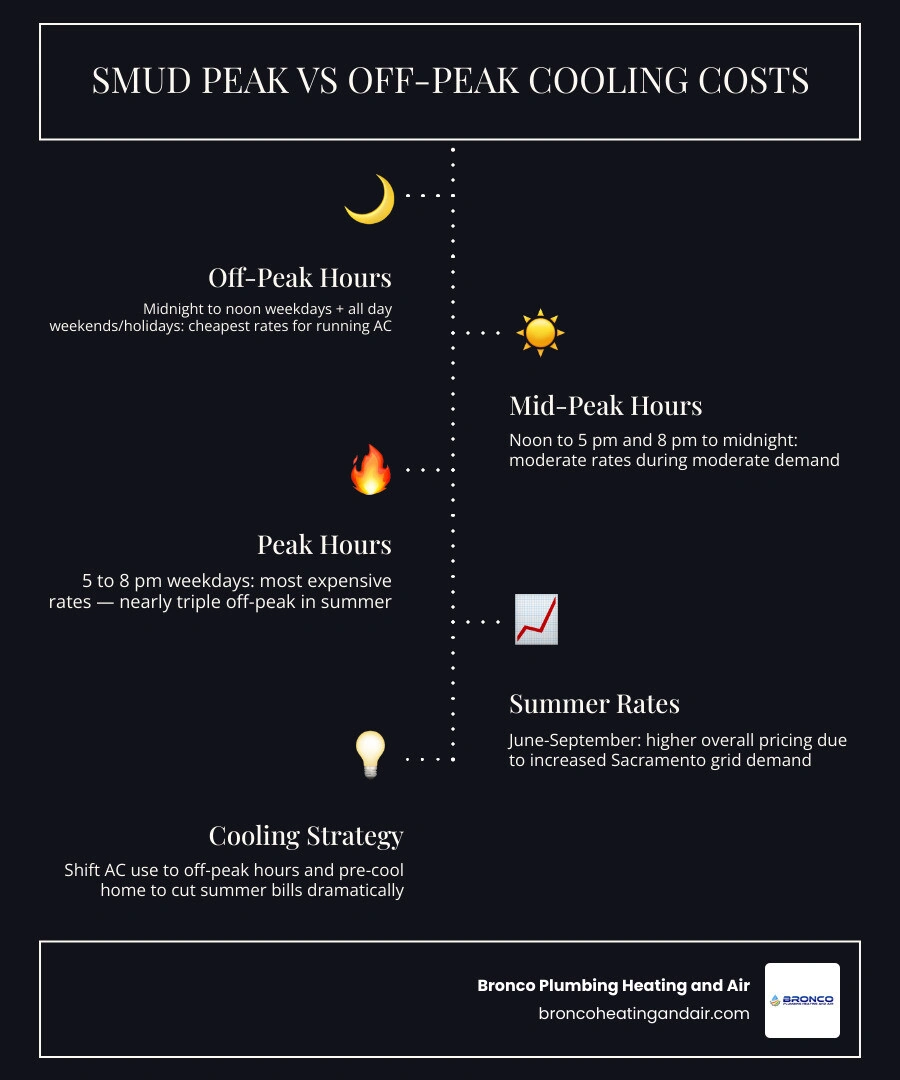
Here's a quick summary of how SMUD rates affect your cooling use:
• Peak hours (5–8 p.m. weekdays): The most important time to limit heavy AC use during summer months
• Mid-peak hours (noon–5 p.m. and 8 p.m.–midnight on weekdays): A middle tier that still matters for cooling habits
• Off-peak hours (midnight–noon weekdays, all day weekends and holidays): The best time to cool your home more efficiently
• Summer vs. non-summer: Rate differences are more noticeable June through September when Sacramento heat drives up grid demand
• The result: Homes that run AC heavily in the evening during summer may see much higher electric use during the most expensive part of the day compared to homes that shift cooling earlier
Sacramento's dry, intense heat means air conditioners work harder and longer than in milder climates — and when that heavy use lines up with peak-rate hours, the impact adds up fast. Knowing when rates are highest, and how your home's efficiency plays into that, gives you real leverage over your cooling habits.
How Sacramento SMUD Rates Affect Your Cooling Use
If you live in Roseville, Sacramento, Rocklin, Citrus Heights, Elk Grove, Folsom, or nearby areas served by SMUD, your cooling habits are shaped by two things at once:
• How much electricity your AC uses
• When your home uses that electricity
That second part is what catches many homeowners off guard.
SMUD's residential Time-of-Day plan changes by season. Summer generally runs from June through September, when afternoon and evening cooling demand is highest. Non-summer runs from October through May. Since air conditioning is often the biggest electricity user in a home, the summer schedule matters a lot.
Even if your thermostat habits stay the same, your electric use can still rise in summer because:
• The weather is hotter
• Your AC runs longer
• Evening demand is stronger
• Summer Time-of-Day rates are higher than non-summer rates
There is also a monthly fixed charge on residential service, but for cooling habits, the biggest swing usually comes from air conditioner runtime during expensive hours. That is especially true in Sacramento's climate, where long hot days can push indoor temperatures up well into the evening. For more local context, see how Sacramento climate affects your HVAC system.
What SMUD peak hours are and why 5-8 p.m. matters most
SMUD peak hours are weekdays from 5 p.m. to 8 p.m., excluding holidays. That three-hour window is the most important period to watch if you want to lower cooling-related energy use.
Why does it matter so much?
Because that is when a lot of things happen at once:
• People come home from work
• Outdoor temperatures are still high
• Homes need extra cooling
• Ovens, dishwashers, laundry, lights, and electronics all start running
So your AC is not just cooling against Sacramento heat. It is often cooling against cooking heat, body heat, warm attic temperatures, and sun that has been baking the house all day. That stack of demand is exactly why 5-8 p.m. hits harder than many homeowners expect.
During weekdays outside that peak window, SMUD uses cheaper off-peak or moderate mid-peak periods. On weekends and holidays, all hours are generally off-peak, which gives homeowners a lot more flexibility.
How Sacramento SMUD rates affect your cooling use in summer vs non-summer months
The difference between summer and non-summer is not subtle. In summer, the 5-8 p.m. peak window becomes much more important than the rest of the day.
That means cooling your house at 6 p.m. in July is not the same as cooling it at 10 a.m. in July, and it is definitely not the same as cooling it at 6 p.m. in November.
In practical terms:
• Summer evenings are the most sensitive time to rely heavily on AC
• Non-summer peak periods still matter, but the rate difference is smaller
• A home that needs long evening AC cycles in August will usually feel the biggest impact
This is why two homeowners with similar houses can have very different summer usage patterns. If one home is pre-cooled earlier and the other waits until the evening to do all the heavy lifting, the second home will usually use more electricity during the most expensive window.
How much harder your AC works during Sacramento heat
Sacramento-area summers are dry, but dry does not mean easy on equipment. In fact, prolonged high temperatures can make your system run for long stretches, especially during heat waves.
Your AC works harder when:
• Outdoor temperatures stay high into the evening
• Attics trap heat above the ceiling
• Ductwork sits in very hot spaces
• Filters are dirty
• Insulation or weather sealing is weak
• The system is older or undersized
Heating and cooling can account for a large share of household energy use, so when your AC struggles, the difference in runtime is usually noticeable.
If you want to go deeper on local wear and tear, read how dry hot summers affect HVAC performance and lifespan and protecting your HVAC system during heat waves.
Current SMUD Time-of-Day Hours and What They Mean for Evening Cooling
For most homeowners with smart meters, Time-of-Day pricing is the standard setup. That means understanding the schedule is just as important as understanding your thermostat.
Current SMUD Time-of-Day schedule Roseville homeowners should know
Here is the schedule homeowners should know in 2026:
• Off-peak — Weekday Hours: Midnight to noon — What it means for cooling: Best time to pre-cool and run major loads
• Mid-peak — Weekday Hours: Noon to 5 p.m. — What it means for cooling: Higher than off-peak, but lower than peak
• Peak — Weekday Hours: 5 p.m. to 8 p.m. — What it means for cooling: Most important time to limit heavy AC use
• Mid-peak — Weekday Hours: 8 p.m. to midnight — What it means for cooling: Still not the cheapest, but better than peak
• Weekends and holidays — Weekday Hours: All day off-peak — What it means for cooling: Best days for flexible energy use
A few helpful reminders:
• Peak pricing applies Monday through Friday
• Holidays are treated as off-peak
• Most residential customers with smart meters are on Time-of-Day pricing
• Some customers may choose a fixed-rate option, but that depends on usage habits
How much more important peak cooling is than off-peak cooling
This is the part that really affects summer comfort strategy.
Published 2026 schedules show a dramatic difference between peak and off-peak summer periods. In plain English: the same AC cycle has a much bigger billing impact in the evening than it does in the morning.
That does not mean you should sweat through dinner. It means you should avoid making 5-8 p.m. the first time your house tries to get comfortable.
Peak cooling becomes more significant when it overlaps with:
• Thermostat recovery after a warm afternoon
• Cooking dinner with the oven or stovetop
• Laundry or dishwasher cycles
• Gaming systems, TVs, and lighting
• West-facing rooms holding onto heat
If your home warms up all afternoon and then your AC has to "catch up" during the peak window, it usually runs harder and longer exactly when electricity is most expensive.
Why weekends and holidays can be better for heavy cooling and chores
Weekends and holidays are much simpler because all hours are generally off-peak. That gives you more freedom to:
• Do laundry
• Run the dishwasher
• Meal prep
• Cool the house more aggressively
• Catch up after a heat wave
This matters because appliance timing adds to your cooling load. An oven does not just use electricity by itself. It also makes your AC work harder. Moving those activities to weekends, holidays, mornings, or after 8 p.m. can take pressure off both your system and your bill.
How to Reduce AC Use During Peak Hours Without Sacrificing Comfort
Good news: saving energy during peak hours does not require living like a pioneer with a hand fan and a stern attitude.
It mostly comes down to timing, airflow, and keeping heat out before your AC has to fight it.
How sacramento smud rates affect your cooling use when you pre-cool correctly
Pre-cooling means lowering indoor temperature earlier in the day, while rates are cheaper and outdoor conditions are easier on your AC. Then, during peak hours, you let the house "coast" instead of asking the system to do all the work at once.
A basic pre-cooling approach looks like this:
1. Cool the home earlier in the morning or late morning.
2. Keep blinds or curtains closed, especially on sunny west-facing windows.
3. Seal the house up before the hottest part of the day.
4. Raise the thermostat slightly during 5-8 p.m.
5. Use ceiling fans or portable fans where people are actually sitting.
Why it works:
• Walls, floors, and furniture hold some coolness
• The AC avoids heavy peak-hour recovery cycles
• Morning air is easier and cheaper to cool
• Indoor temperature changes more slowly in a well-sealed home
SMUD-recommended habits that lower peak-hour cooling demand
SMUD's published guidance lines up with what we recommend in the field:
• Set the thermostat to 78 degrees or higher in summer when possible
• Raising the thermostat by 2 degrees can reduce cooling-related energy use
• Run laundry and dishwashers before 5 p.m. or after 8 p.m.
• Use full loads instead of partial loads
• Use warm or cold water when possible
• Avoid running multiple high-energy appliances at once
• Use smaller cooking appliances instead of the oven when practical
• Check weatherstripping and caulking around doors and windows
• Use account tools to track when your household uses the most electricity
Fans are also useful. SMUD has noted that fans can use far less electricity than AC. Just remember: fans cool people, not empty rooms. If nobody is in the room, turn them off and save the energy.
For more practical ideas, see tips on saving on your cooling this summer.
How sacramento smud rates affect your cooling use when your home is not summer-ready
If your system is dirty, neglected, or fighting your house, Time-of-Day pricing gets even more frustrating.
Common problems include:
• Dirty air filters
• Low airflow
• Leaky ducts
• Weak attic insulation
• Sun pouring through uncovered windows
• Poorly sealed doors and windows
• Thermostat issues
• AC components that are wearing out
A home that is not summer-ready often overheats during the day and then leans hard on the AC during peak hours. That creates a difficult combination: high demand, long runtimes, and expensive timing.
If your system already seems stressed, these can help:
• Is your air conditioning system ready for the summer
• Why your AC runs all day during extreme summer heat
Behavior changes help, but sometimes the home itself needs backup. The right upgrade can reduce how long your AC runs and how much of that runtime lands in peak hours.
When a whole-house fan can help reduce late-day AC demand
A whole-house fan can be a great fit in the Sacramento region because mornings and evenings are often cooler than the inside of the house, especially after a hot day.
Used strategically, a whole-house fan can:
• Pull cooler outdoor air through open windows
• Flush out warm indoor air early in the morning
• Lower indoor temperature before the day ramps up
• Reduce the need for late-afternoon and evening AC use
The usual strategy is simple:
1. Run the fan when outside air is cooler than indoor air.
2. Open windows to create airflow.
3. Shut windows and doors as outdoor heat rises.
4. Keep the house closed to hold the cooler air longer.
This can work especially well in shoulder hours before the peak window begins. For more local heat strategies, visit how to stay cool during Sacramento heat waves.
How attic ventilation and better airflow support lower cooling use
Attics get brutally hot in Sacramento summers. When attic temperatures soar, that heat radiates down through ceilings and warms ducts running through the attic.
That can lead to:
• Hotter rooms below the attic
• Longer AC runtimes
• Lower comfort in upstairs areas
• More strain during late afternoon and early evening
Better attic ventilation, including solar attic fans in the right situations, can help move trapped heat out of the attic. That may reduce ceiling heat buildup and support overall cooling performance.
This is not a magic switch, but it can be a helpful part of a larger plan when combined with insulation, duct improvements, and smart cooling habits. You can also explore broader warm-weather guidance in the Sacramento heat HVAC guide.
Why an upgraded air conditioner can improve efficiency during high-demand hours
If your current AC is older, single-stage, or struggling, a system upgrade may lower energy use while improving comfort.
Features worth understanding include:
• Higher efficiency ratings
• Two-stage cooling
• Variable-speed operation
• Better airflow control
• Smarter thermostat integration
Two-stage and variable-speed systems can be especially helpful because they do not always blast at full output. They can run more steadily and efficiently, which may improve comfort and reduce harsh on-off cycles during hot weather.
That matters in the SMUD service area because a more efficient system may recover faster, maintain steadier temperatures, and require less total energy to keep the house comfortable through the late afternoon.
If you are weighing repair, maintenance, or replacement, these resources may help:
• How to extend the life of your AC in a hot climate
• Maintain your air conditioner with our 49 tune-up special
Rebates, Incentives, and Long-Term Ways to Manage Cooling Use
Efficiency upgrades are easier to justify when rebates and tax incentives are available, and in 2026 there are still useful programs Sacramento-area homeowners should review.
SMUD rebates and incentives for efficient cooling improvements
Depending on the equipment and program rules, SMUD may offer incentives for:
• High-efficiency HVAC upgrades
• Heat pump installations
• Smart thermostats
• Home performance improvements tied to comfort and efficiency
Research indicates qualifying HVAC incentives can be substantial for certain high-efficiency systems, especially multi-stage or variable-speed equipment. Program rules can change, though, so it is smart to verify current eligibility before making decisions.
Helpful reading:
• SMUD energy rebates for Sacramento homeowners
• California energy rebates for HVAC upgrades
How to combine local rebates with federal tax credits
Some homeowners may be able to combine utility incentives with federal tax credits, depending on the equipment and current program rules.
Best practices include:
• Confirm the equipment meets efficiency requirements
• Verify whether installation must be completed by an approved contractor network
• Keep all product and installation documentation
• Review rebate deadlines and application steps before the work starts
• Ask which incentive combinations are allowed and which are not
Start here:
• How to apply for energy rebates in California
• Federal tax credits for AC and heat pump upgrades
What SMUD's lower average electric rates still mean for Sacramento-area homeowners
One important point: SMUD is generally known for lower average residential electric bills than many other California utilities.
That does not make peak-hour cooling irrelevant. Your biggest opportunity is managing when and how your home cools during Sacramento summers.
In other words:
• Summer evening cooling can still drive heavy energy use fast
• Efficient equipment and better habits still matter a lot
• Better timing can help you stay comfortable while using energy more wisely
Frequently Asked Questions about SMUD Cooling Use in Roseville CA
What are the best times to run your AC under SMUD?
The most flexible times are generally off-peak hours:
• Midnight to noon on weekdays
• All day on weekends
• All day on holidays
For many homes, the best cooling strategy is to cool earlier in the day, reduce heat gain in the afternoon, and avoid heavy thermostat recovery from 5-8 p.m.
Does switching to a fixed rate help with summer cooling use?
Maybe, but it depends on your habits. A fixed rate can simplify billing because the price does not change by time period.
If your household can pre-cool, delay chores, and reduce 5-8 p.m. demand, Time-of-Day often gives you more opportunity to manage your usage. If your lifestyle forces heavy evening use every weekday, a fixed-rate option may be worth reviewing with SMUD.
What is the best first step if your summer AC use keeps jumping?
Start with the basics before assuming you need a full system replacement:
1. Change or check the air filter
2. Review thermostat settings
3. Look at your peak-hour habits
4. Inspect weatherstripping and window coverage
5. Schedule AC maintenance
6. Review attic insulation and airflow
If your system is older, running constantly, or struggling to keep up, a professional inspection is the next smart move. You can also read best AC maintenance repair deals Sacramento.
Conclusion
For homeowners in Roseville CA and across the Greater Sacramento region, the biggest lesson is simple: your cooling use is not just about how much you cool, but when you cool.
If you understand the 5-8 p.m. peak window, pre-cool your home, reduce indoor heat buildup, and keep your AC in top shape, you can stay comfortable without making your system fight the worst part of the day at the worst time on the rate schedule.
At Bronco Heating and Air, we help homeowners make sense of local cooling demands and improve efficiency with practical, service-focused solutions. If your AC is running too long, struggling in evening heat, or just not keeping you comfortable, we are here to help.
For more information about our service area, visit More info about Sacramento CA services.

Customer Testimonials
Our customer testimonials highlight the reliable service, quality workmanship, and trusted results homeowners experience with Bronco Plumbing Heating and Air.


Ready to Transform your Home?
Create a healthier, more comfortable home with expert HVAC, plumbing, and indoor air quality solutions you can trust. From efficient heating and cooling to cleaner air and reliable repairs, our experienced team is here to keep your family comfortable year-round with dependable service and upfront pricing.
Related Articles
Addressing Older Ductwork Inefficiencies in Historic Folsom Homes

Why Late Summer is the Hardest Time on Aging HVAC Capacitors

Can You Safely Delay a Minor Refrigerant Leak Repair Until Fall?