



.svg)

How to Help Your AC During a California Heat Wave in 5 Steps
Why California Heat Waves Push Your AC to the Breaking PointKnowing how to help your AC during a California heat wave can mean the difference between a cool home and…
Why California Heat Waves Push Your AC to the Breaking Point
Knowing how to help your AC during a California heat wave can mean the difference between a cool home and a costly breakdown on the hottest day of the year. In Sacramento and the surrounding region, summer temperatures regularly climb past 100°F — and when a heat wave hits, most residential AC systems are pushed well beyond what they were designed to handle.
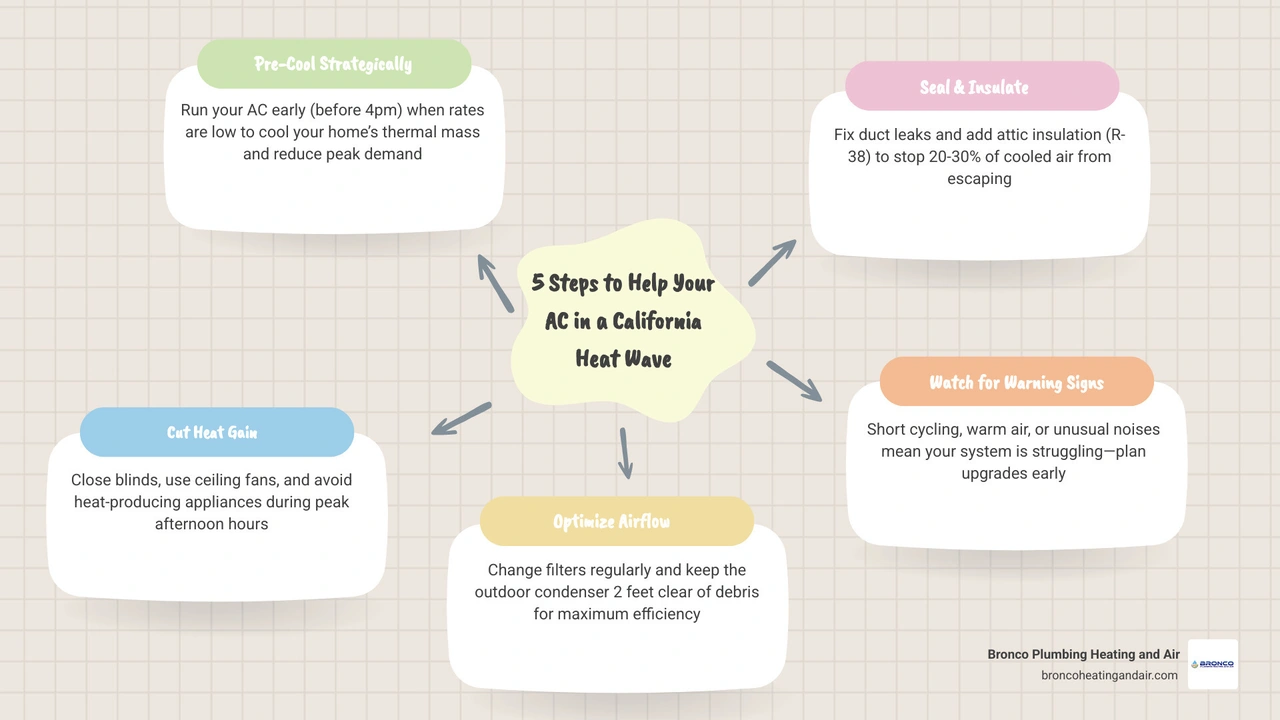
Here is a quick overview of the five most effective steps:
1. Pre-cool your home before 4 p.m. to take advantage of lower electricity rates and reduce peak-hour demand
2. Reduce solar and internal heat gain by closing blinds, using ceiling fans, and avoiding heat-generating appliances during the hottest hours
3. Optimize airflow and perform basic maintenance including filter changes and keeping the outdoor condenser clear
4. Seal your home envelope by addressing duct leaks and improving attic insulation
5. Watch for warning signs like short cycling, warm air output, or unusual noises — and know when it is time to upgrade
Most standard residential AC systems are engineered to keep your home about 20 degrees cooler than the outdoor temperature. That works fine on a 90°F afternoon. But when Sacramento hits 108°F, even a well-maintained system is being asked to do something it was never designed for. Add in a dirty filter, leaky ducts, or a sun-baked attic, and the strain compounds fast.
The good news is that a few targeted steps — taken before or during a heat event — can meaningfully reduce that strain, keep your home more comfortable, and protect your system from premature failure.
Step 1: How to Help Your AC During a California Heat Wave with Strategic Pre-Cooling
One of the most effective ways to manage extreme heat in the Sacramento Valley is to change when you cool your home. In California, our energy grid faces the most stress between 4 p.m. and 9 p.m. This is when the sun is still high, temperatures are peaking, and everyone is returning home to turn on appliances.
To combat this, we recommend a strategy called "pre-cooling." Think of your home as a giant thermal battery. By running your air conditioner early in the morning when outdoor temperatures are in the 60s or 70s, you can "charge" your home with coolness. This cools down the "thermal mass" of your house—the walls, the furniture, and the flooring.
When the 100-degree heat hits in the afternoon, your AC won't have to work nearly as hard because the structure itself is already cold. This is exactly Why Your AC Runs All Day During Extreme Summer Heat; it is fighting the heat stored in your home's bones.
By pre-cooling, you can often "coast" through the peak hours of 4 p.m. to 9 p.m. with your thermostat set higher (like 78°F or 80°F). This not only saves your equipment from running at 100% capacity during the hottest part of the day but also helps you avoid the highest Time-of-Use (TOU) electricity rates. During major heat events, California often issues Flex Alerts, asking residents to conserve energy during these peak hours to prevent grid instability. Pre-cooling is your best defense against these alerts.
Using smart thermostats to help your ac during a california heat wave
A smart thermostat is your best ally during a 2026 heat wave. These devices allow you to automate your pre-cooling schedule so you don't have to remember to adjust the dial every morning.
The Department of Energy (DOE) generally recommends setting your thermostat to 78°F when you are at home. While that might sound warm, it is the "sweet spot" for balancing comfort and system longevity. Every degree you set the thermostat below 78°F can increase your cooling costs by 6% to 8%. During a heat wave, setting the AC to 68°F can actually increase energy consumption by a staggering 80% compared to a more modest setting.
Modern smart thermostats offer features like:
• Geofencing: Automatically raising the temperature to an "away mode" (we suggest 82°F) when you leave the house.
• Adaptive Recovery: Learning how long it takes to cool your home so it can reach your target temperature right before you get home.
• Grid Integration: Some utilities offer programs that slightly adjust your thermostat during peak demand events to save you money and protect the grid.
Utilizing these features is a key part of Protecting Your HVAC System During Heat Waves. By avoiding drastic temperature swings and preventing the system from "panic cooling" when you walk through the door at 5 p.m., you significantly reduce mechanical wear and tear.
Step 2: Reduce Internal Heat Gain and Solar Load
The sun is the primary enemy of your air conditioner. In areas like Roseville CA and Folsom CA, the afternoon sun can be relentless. Solar heat gain through windows is the leading cause of temperature spikes inside California homes.
To help your AC, you must turn your home into a fortress. Closing blinds and curtains on sun-facing windows (typically the south and west sides in the afternoon) can prevent up to 40% of heat from entering through the glass. If you want to take it a step further, thermal curtains or cellular shades can reduce solar heat gain by as much as 60%.
Once the heat is kept out, you need to manage the air inside. Ceiling fans are an incredible tool for How to Stay Cool During Sacramento Heat Waves. While fans don't actually lower the room temperature, they create a "wind chill" effect by evaporating moisture from your skin. This can make you feel up to 4 degrees cooler, allowing you to raise the thermostat without losing comfort. Just remember: fans cool people, not rooms. Turn them off when you leave the room to save electricity.
Pro-Tip: Ensure your ceiling fans are rotating counter-clockwise in the summer. This pushes a cool breeze directly downward.
Minimizing appliance heat to help your ac during a california heat wave
Many homeowners don't realize that they are fighting their AC from the inside. Every time you run the oven, the dishwasher, or the clothes dryer, you are dumping gallons of hot air and moisture into your living space.
During a heat wave, your AC is already struggling to remove heat from the air. Adding the heat of a 400-degree oven makes its job nearly impossible. We recommend:
• Grilling outside: Keep the heat out of the kitchen entirely.
• Microwaving: It uses less energy and generates far less heat than a stove.
• Nighttime Laundry: Run your dryer after 9 p.m. when the outdoor air is cooler and electricity is cheaper.
• Switching to LEDs: Incandescent light bulbs are essentially small heaters. LED bulbs stay cool and use a fraction of the power.
Learning How to Extend the Life of Your AC in a Hot Climate involves managing these small internal factors that add up to a massive load on your compressor.
Step 3: Optimize Airflow and System Maintenance
Airflow is the lifeblood of your HVAC system. If the air can't move, the heat can't be removed. The most common cause of AC failure during a Sacramento summer is a dirty air filter.
When a filter is clogged with dust and pet dander, the blower motor has to work twice as hard to pull air through. This can lead to a 15% to 25% increase in energy consumption and, eventually, a frozen evaporator coil. Even on a 100-degree day, your AC can actually freeze into a block of ice if the airflow is restricted.
We recommend checking your filter every 30 days during the summer. For most homes in our service area—from Elk Grove CA and surrounding areas—a MERV 8 to MERV 11 filter provides the best balance of air filtration and airflow. Avoid ultra-high MERV filters unless your system was specifically designed for them, as they can be too restrictive for older units.
Another critical maintenance step is ensuring the outdoor condenser unit has room to breathe. The outdoor unit's job is to "dump" the heat it gathered from inside your house. If it is surrounded by tall grass, shrubs, or stored items, that heat has nowhere to go. Always maintain a 2-foot clearance around the entire unit.
For residents in Roseville and beyond, AC Maintenance Roseville CA is a year-round necessity, but it becomes an emergency priority when the mercury rises.
Cleaning condenser coils and clearing debris
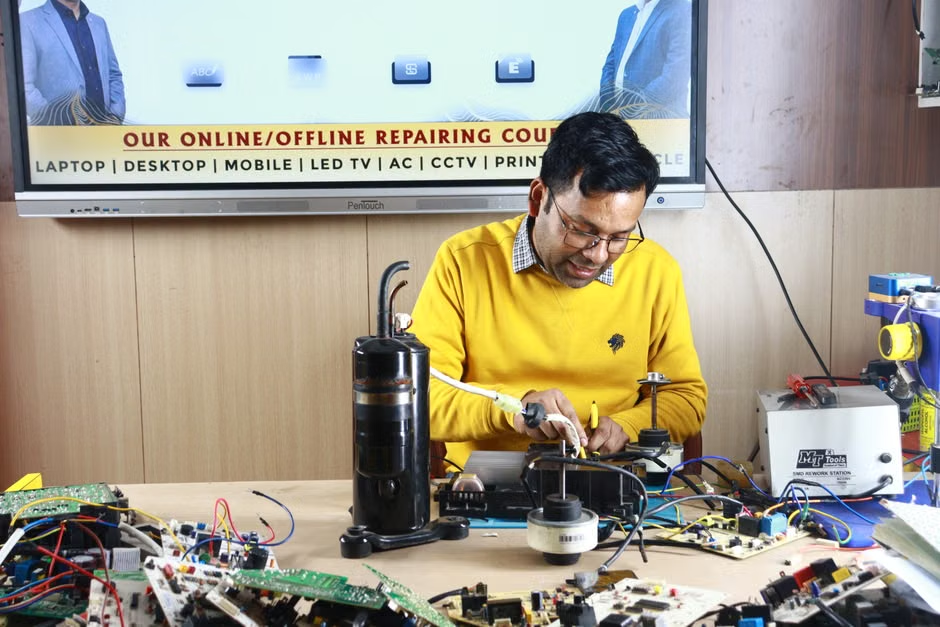
In the Sacramento Valley, we have a unique environmental challenge: the Delta Breeze. While it brings welcome cool air at night, it also carries fine dust and agricultural pollen. Additionally, late spring often brings "cottonwood fuzz" that can coat an outdoor condenser like a blanket.
Dirty condenser coils act as insulation, trapping heat inside the system. This forces the refrigerant pressures to skyrocket, putting immense strain on the compressor. If your compressor overheats, it can lead to a permanent (and expensive) failure.
You can gently rinse your outdoor coils with a garden hose (never use a pressure washer!) to remove surface dust. However, a professional deep clean is recommended annually to ensure the internal fins are clear. This is a vital part of understanding How Dry Hot Summers Affect HVAC Performance and Lifespan. A clean system runs shorter cycles and stays much cooler, even when it’s 105°F in the shade.
Step 4: Seal the Home Envelope and Improve Insulation
If your home isn't well-insulated, you are essentially paying to cool the entire neighborhood. In many older homes in areas like Land Park CA or Carmichael CA, insulation has settled or degraded over the decades.
Proper attic insulation is one of the most cost-effective ways to help your AC. Ideally, your attic should have an R-38 to R-49 rating. This thick layer of insulation acts as a barrier, preventing the 150-degree heat in your attic from radiating down into your bedrooms. Upgrading your insulation can reduce your overall energy consumption by up to 40%.
Beyond insulation, you must look at your ductwork. The Department of Energy estimates that the typical home loses 20% to 30% of its conditioned air through leaks in the duct system. If your ducts are leaking in the attic, you are literally blowing cold air into a space that no one lives in, while your AC works overtime to make up the difference.
Understanding How Sacramento Climate Affects Your HVAC System means recognizing that our dry, hot air will find every crack and gap in your home's "envelope."
• Indoor Temp (at 105°F Outside) — Without Proper Insulation/Sealing: 78°F - 82°F (Struggling) — With R-38 Insulation & Sealed Ducts: 72°F - 75°F (Stable)
• AC Runtime — Without Proper Insulation/Sealing: 18 - 24 hours/day — With R-38 Insulation & Sealed Ducts: 12 - 15 hours/day
• Energy Waste — Without Proper Insulation/Sealing: 30% + — With R-38 Insulation & Sealed Ducts: < 5%
• System Lifespan — Without Proper Insulation/Sealing: 10 - 12 years — With R-38 Insulation & Sealed Ducts: 15 - 20 years
Step 5: Recognize Warning Signs and Know When to Upgrade
Even if you follow every tip on how to help your AC during a California heat wave, older systems may simply reach their limit. It is important to know the difference between a system that is "tired" and one that is failing.
Common warning signs include:
• Short Cycling: The AC turns on and off every few minutes. This is incredibly hard on the motor and often indicates an electrical issue or an oversized unit.
• Unusual Noises: Grinding, squealing, or loud banging often points to a failing blower motor or compressor.
• Warm Air: If the air coming out of your vents isn't at least 15-20 degrees cooler than the air going into the return, you may have a refrigerant leak or a failing compressor.
• Icing Up: Seeing ice on the copper lines or the outdoor unit is a major red flag, usually caused by airflow issues or low refrigerant.
If you notice these, check our guide on Signs Your AC Needs Repair immediately. Catching a small refrigerant leak now can save you from a total compressor burnout later.
Choosing high-efficiency replacements for triple-digit heat
If your system is more than 12-15 years old, it was likely built under much older efficiency standards. In 2026, we are seeing the benefits of the new SEER2 (Seasonal Energy Efficiency Ratio 2) standards. Upgrading to a modern, high-efficiency system can cut your cooling costs by 30% to 50%.
When Choosing an AC for Triple Digit Sacramento Summers, we often recommend variable-speed systems. Unlike traditional "on/off" air conditioners, variable-speed units can ramp up or down to match the exact cooling needs of your home. They are much better at removing humidity and maintaining a rock-steady temperature.
Additionally, many homeowners are switching to high-efficiency heat pumps. These systems provide both world-class cooling in the summer and efficient heating in the winter, making them perfect for the Sacramento climate. Understanding Why Do AC Units Wear Out Faster in Hot Climates helps you realize that investing in a higher-efficiency unit isn't just about the monthly bill—it's about having a system that can actually survive a two-week heat wave without breaking a sweat.
Frequently Asked Questions about California Heat Waves
Why is my AC running but the house is still warm?
During a 105°F day, your AC is fighting "heat soak." The sun is heating up your roof, walls, and windows faster than the AC can remove that heat. If your system is working correctly, it should produce air that is 15 to 20 degrees colder than the indoor air temperature. If the "split" is less than that, you likely have a mechanical issue like low refrigerant or dirty coils. If the split is good, your home may simply need better insulation or window shading to reduce the "load."
Should I turn my AC off when I leave for work in Sacramento CA?
We generally recommend against turning the AC completely off. If you turn it off at 8 a.m. and the house climbs to 90°F by the time you get home at 5 p.m., your AC will have to run for hours at maximum capacity to cool it back down. This "heat-soaking" is very hard on the equipment. Instead, use a 4-to-5-degree offset. If you like it at 78°F, set it to 82°F while you are away. This keeps the humidity in check and makes it much easier for the system to recover.
How often should I change my filter during a 2026 heat wave?
During a heavy-use month where the AC is running 12+ hours a day, you should check your filter every 3 weeks. If you have pets that shed or if there is smoke from nearby wildfires, the filter can clog much faster than usual. A clean filter is the cheapest insurance policy you can buy for your HVAC system.
Conclusion
Surviving a California summer requires a proactive approach. By following these five steps—pre-cooling, reducing heat gain, maintaining airflow, sealing your home, and watching for warning signs—you can keep your family comfortable while protecting your wallet.
At Bronco Plumbing Heating and Air, we are dedicated to keeping the Sacramento region cool and comfortable. Whether you are in Folsom, Roseville, Elk Grove, or Davis, our team of licensed and professional technicians is here to provide cost-effective solutions for all your cooling needs. Don't wait for the next record-breaking heat wave to find out if your system is ready.
If your air conditioner is struggling to keep up or if you want to ensure it's in top shape for the peak of summer, contact us today for our comprehensive AC Services. Let’s make sure your home remains a cool sanctuary, no matter how high the temperature climbs!

Customer Testimonials
Our customer testimonials highlight the reliable service, quality workmanship, and trusted results homeowners experience with Bronco Plumbing Heating and Air.


Ready to Transform your Home?
Create a healthier, more comfortable home with expert HVAC, plumbing, and indoor air quality solutions you can trust. From efficient heating and cooling to cleaner air and reliable repairs, our experienced team is here to keep your family comfortable year-round with dependable service and upfront pricing.
Related Articles
Transitioning Your Heat Pump Settings as August Nights Finally Cool Down

The Relationship Between Attic Insulation and Late Summer Cooling Cycles
What a Sudden Spike in Your August Electric Bill Actually Means for Your AC