



.svg)

How Much Can You Really Save With a High-Efficiency AC in a Hot, Dry Climate?
Energy savings from high-efficiency AC in hot dry climates are real and measurable — and in Sacramento, CA, they can be substantial. If you're running an older, low-efficiency system through a Sacramento summer, you're likely overpaying every single month.
Here's a quick look at what the research shows:
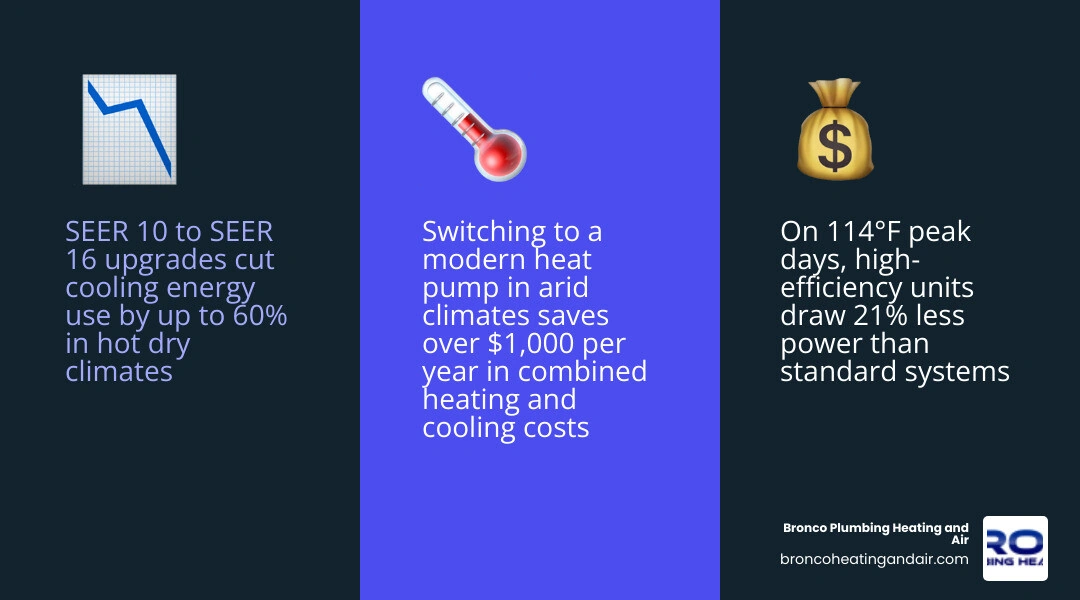
• Upgrading from a SEER 10 to a SEER 16 unit can cut cooling energy use by up to 60% in hot climates
• In field studies of Phoenix-area homes, SEER 14-16 units used 14-24% less energy than SEER 10-11 units under real summer conditions
• On a peak day of 114°F, higher-efficiency units drew 21% less power at peak demand
• Switching to a modern heat pump in a hot, dry climate can save over $1,000 per year in combined heating and cooling costs
• Ductless mini-splits in arid regions can reach up to 30 SEER2 efficiency ratings
The challenge is that not all efficiency claims translate equally to Sacramento's hot, dry summers. SEER ratings are tested under conditions that don't fully reflect triple-digit heat. That gap between the lab and your backyard matters — and understanding it is the first step to making a smart upgrade decision.
This guide breaks down what high-efficiency AC actually delivers in a hot, dry climate like Sacramento's, which systems perform best, and what to look for when choosing your next unit.
Energy savings from high efficiency ac in hot dry climates terms to learn:
• is a high efficiency ac worth the extra cost in california
• standard efficiency vs high efficiency ac comparison
The Unique Challenges of Arid Climates on HVAC Systems
Living in the Sacramento Valley means enjoying gorgeous spring afternoons and crisp autumn evenings. But when summer arrives, it brings a distinct set of environmental demands. Unlike the humid Eastern United States, where air conditioners spend a massive amount of energy pulling moisture out of the air, our local climate presents entirely different hurdles.
In places like Sacramento, CA and Woodland, CA, your air conditioner faces a combination of extreme dry heat, heavy dust, and an exceptionally long cooling season. Understanding these factors helps explain why standard air conditioning setups often struggle and why specialized high-efficiency equipment is so beneficial.
Intense, Triple-Digit Heat Waves
In our region, summer temperatures routinely climb past 100°F. When the sun beats down on your roof, attic temperatures can easily soar to 150°F. This creates an incredibly harsh thermal barrier that your air conditioner must fight against. Because the temperature difference between the blistering outdoors and your comfortable indoors is so wide, your system has to work much harder to reject heat.
Agricultural and Valley Dust
The Sacramento Valley is rich in agriculture, which is fantastic for farm-to-fork dining but tough on HVAC systems. Dry summers bring a steady stream of airborne dust, pollen, and soil particles. This dust settles directly onto your outdoor condenser coils and clogs up indoor air filters. When dust builds up, it acts like an insulating blanket, trapping heat inside the system and forcing the compressor to run longer and hotter.
To learn more about how these seasonal elements impact your home comfort, check out our guide on How Dry Hot Summers Affect HVAC Performance and Lifespan.
Extended Cooling Seasons
Our cooling season isn't limited to July and August. It often stretches from late May well into October. This extended runtime puts a massive amount of mechanical wear and tear on your equipment. When an air conditioner runs for thousands of hours every year under high-stress conditions, standard-grade components tend to degrade rapidly.
If you've ever wondered why systems in the Southwest seem to age faster than those in milder climates, explore our analysis on Why Do AC Units Wear Out Faster in Hot Climates.
Real-World Energy Savings From High Efficiency AC in Hot Dry Climates
When shopping for a new air conditioner, you will constantly see references to SEER and SEER2 ratings. But what do these numbers actually mean for your monthly utility bills in a dry climate?
Deciphering the Ratings: SEER, SEER2, and EER
• SEER (Seasonal Energy Efficiency Ratio): This measures how efficiently an AC unit operates over an entire cooling season. It is calculated by dividing the total cooling output (in BTUs) by the total electrical energy input over the same period.
• SEER2 (Seasonal Energy Efficiency Ratio 2): Introduced to reflect updated, more rigorous testing procedures that better mimic real-world ductwork resistance. SEER2 ratings are generally lower than older SEER ratings for the same physical unit, but they represent a more accurate picture of home performance.
• EER (Energy Efficiency Ratio): While SEER calculates seasonal performance across varying temperatures, EER measures efficiency at a single, steady outdoor temperature of 95°F.
In hot, dry regions, EER is often a more critical metric than SEER. Why? Because SEER testing weights milder outdoor temperatures (below 80°F) very heavily. In places like Sacramento, our systems do the bulk of their heavy lifting when it is 95°F to 105°F outside. A unit with a high SEER but a mediocre EER might underperform during our hottest afternoons.
The Real-World Savings Gap
Field studies conducted in desert environments (such as Phoenix, Arizona) reveal a fascinating trend: standard SEER calculations often slightly over-predict actual percentage savings during extreme heat, but high-efficiency systems still deliver massive, undeniable reductions in energy consumption.
For example, while theoretical math might predict a 33% energy reduction when upgrading from an old SEER 10 unit to a SEER 15 unit, real-world field monitoring showed actual energy savings of 14% to 24% across the peak summer months of July, August, and September. Furthermore, these high-efficiency units consistently reduced peak power demand by 20% to 21% on the hottest days of the year.
To see how standard and high-efficiency options stack up side-by-side, take a look at our Standard Efficiency vs High Efficiency AC Comparison.
• Average Energy Savings — Standard Efficiency (Older SEER 10 - 13): Baseline — High-Efficiency (Modern SEER2 16 - 22+): 20% to 44% reduction
• Startup Power Draw — Standard Efficiency (Older SEER 10 - 13): High (4,000 – 6,000 Watts) — High-Efficiency (Modern SEER2 16 - 22+): Low (2,000 – 3,000 Watts)
• Compressor Technology — Standard Efficiency (Older SEER 10 - 13): Single-Stage (On/Off) — High-Efficiency (Modern SEER2 16 - 22+): Variable-Speed / Inverter-Driven
• Performance at 110°F+ — Standard Efficiency (Older SEER 10 - 13): Capacity drops; high risk of tripping — High-Efficiency (Modern SEER2 16 - 22+): Maintains full cooling capacity up to 125°F
• Average Lifespan (Arid Climate) — Standard Efficiency (Older SEER 10 - 13): 10 to 15 Years — High-Efficiency (Modern SEER2 16 - 22+): 18 to 22 Years
Upgrading to a high-efficiency system represents a significant step forward in lowering your household's carbon footprint and keeping your energy bills manageable. If you are weighing the financial side of this decision, read our detailed breakdown: Is a High Efficiency AC Worth the Extra Cost in California.
How High-Efficiency Systems Perform During Extreme Heat Waves
When the afternoon temperature hits 110°F, standard air conditioners begin to lose their cooling capacity. They run continuously, struggling to keep the indoor temperature at a reasonable level, and draw maximum electrical current. This is when local power grids are pushed to their limits and homeowners experience the highest risk of system breakdowns.
High-efficiency air conditioners handle these extreme heat events completely differently, thanks to advanced engineering.
The Power of Variable-Speed Inverter Technology
Standard air conditioners are either 100% on or 100% off. When they turn on, they draw a massive spike of electricity to start the compressor, run at maximum speed until the thermostat is satisfied, and then shut off.
High-efficiency systems utilize variable-speed inverter compressors. Instead of cycling on and off, an inverter compressor can adjust its operating speed in tiny increments, running anywhere from 25% to 100% capacity.
During an extreme heat wave, a variable-speed system will start up gently, avoiding the massive power spike. It will then run continuously at a lower, incredibly efficient speed to maintain a perfectly steady indoor temperature. This continuous operation eliminates the frequent on-and-off cycling that wears out compressor motors and wastes energy.
Sensible Heat Ratio (SHR) Optimization
In HVAC terms, "sensible cooling" refers to lowering the actual air temperature, while "latent cooling" refers to removing moisture from the air. In a hot, dry climate, we have very little moisture to remove. Standard air conditioners waste up to 30% of their operating capacity trying to dehumidify dry air because they are designed for humid national averages.
High-efficiency systems optimized for arid climates feature a much higher Sensible Heat Ratio (SHR). By adjusting evaporator coil temperatures and increasing airflow, these units focus almost all of their cooling capacity on dropping the actual dry-bulb temperature, maximizing your comfort and your energy savings from high efficiency ac in hot dry climates.
For practical advice on keeping your home cool and your bills low when the weather gets severe, check out our guides on Protecting Your HVAC System During Heat Waves and Energy Saving Tips During Extreme Heat.
Maximizing Energy Savings From High Efficiency AC in Hot Dry Climates With Advanced Features
To squeeze every drop of efficiency out of your cooling system, modern high-efficiency units can be paired with several advanced technologies:
• Variable-Speed Blower Motors (ECM): Unlike standard indoor fan motors that run at a single high speed, electronically commutated motors (ECMs) adjust their speed to match your home's immediate cooling needs. They use up to 75% less electricity than standard fan motors and provide whisper-quiet airflow.
• Smart Thermostats: High-efficiency systems communicate directly with smart thermostats. These devices learn your daily schedule, utilize geofencing to adjust temperatures when you leave, and can automatically run precooling cycles during cheaper off-peak energy hours.
• Solar Readiness: Many premium high-efficiency systems are designed to integrate seamlessly with residential solar arrays. Because they draw so little starting and running wattage, they are incredibly easy to power using clean, on-site solar energy.
For a comprehensive checklist on prepping your home for the warm season, read through our Summer Energy Saving Guide 2026.
How Low Humidity Impacts Energy Savings From High Efficiency AC in Hot Dry Climates
It is a common saying in California: "But it's a dry heat!" While dry heat is certainly more comfortable than sticky humidity, it also changes the physics of how your air conditioner operates.
In humid climates, an AC unit must spend energy condensing water vapor on its cold evaporator coils. This process requires a significant amount of electrical energy that doesn't actually lower the indoor temperature.
In our dry climate, we can leverage the "Arid Advantage." Because our air is dry, high-efficiency heat pumps and air conditioners do not have to spend energy on dehumidification. This allows them to achieve incredibly high operating efficiencies.
Additionally, because dry air allows sweat to evaporate naturally from your skin, you will feel cooler at a slightly higher thermostat setting. Setting your thermostat to 78°F in dry Sacramento CA air often feels just as comfortable as 73°F in a humid climate, saving you an additional 10% to 15% on your monthly cooling costs.
To find out how to tailor your home's heating and cooling system to these exact conditions, take a look at our guide on the Best HVAC Setup for Sacramento Weather.
Selecting and Maintaining the Best HVAC System for Your Arid Home
Choosing the right system for a hot, dry climate involves more than just picking the model with the highest SEER2 rating. You must also consider the system type, proper sizing, and ongoing maintenance.
Heat Pumps vs. Ductless Mini-Splits
• Central Heat Pumps: Modern variable-speed heat pumps are incredibly well-suited for our region. They provide ultra-efficient cooling during our blistering summers and highly efficient heating during our mild winters, completely replacing the need for a separate gas furnace.
• Ductless Mini-Splits: If your home has rooms that run hot, or if you want to eliminate ductwork energy losses entirely, ductless mini-splits are an excellent choice. Traditional duct systems can lose 20% to 30% of their conditioned air through minor leaks in a hot attic. Ductless systems deliver cold air directly into individual zones, achieving efficiency ratings up to 30 SEER2.
The Critical Importance of Manual J Sizing
Many homeowners assume that a larger AC unit is always better. However, oversizing is one of the most common installation mistakes. An oversized system will quickly blast cold air into your home, satisfy the thermostat, and shut off. This constant "short-cycling" prevents the system from running long enough to reach its peak operating efficiency, increases mechanical wear, and leads to uneven temperatures.
We perform detailed Manual J Load Calculations to size your system perfectly. This calculation takes into account your home's square footage, insulation levels, window orientations, and local climate data to ensure your new system runs in its sweet spot of maximum efficiency.
Dust Mitigation and Coil Maintenance
Because our summers are so dusty, keeping your system clean is vital to maintaining its high-efficiency ratings. Dirty outdoor condenser coils can reduce your system's efficiency by 15% to 30% and lead to premature compressor failure.
To keep your system running like new, make sure to:
1. Change your indoor air filters every 1 to 3 months during the peak cooling season.
2. Keep plants, shrubs, and debris at least two feet away from your outdoor unit to ensure unrestricted airflow.
3. Schedule professional coil cleanings annually to wash away baked-on valley dust.
For more tips on choosing the perfect setup, check out How to Choose the Right AC System for Your Home and learn How to Extend the Life of Your AC in a Hot Climate.
Choosing the Right System Type for Sacramento CA Summers
When the summer sun beats down on Sacramento, CA, Folsom, CA, or Roseville, CA, your cooling system faces a true endurance test. We regularly see consecutive days of triple-digit heat, which means your system needs to be incredibly resilient.
Upgrading to a high-efficiency system is a long-term investment in your home's comfort and value. Because dry air prevents the rapid rust and corrosion common in coastal or humid states, a well-maintained high-efficiency system in our region can last 18 to 22 years — compared to just 12 to 15 years in humid climates.
To understand what to expect from your system over the years, explore our articles on Choosing an AC for Triple Digit Sacramento Summers and How Long Does an AC System Last in Sacramento.
Frequently Asked Questions About Dry Climate AC Efficiency
Are heat pumps efficient in hot, dry climates like Northern California?
Yes, absolutely! There is a common myth that heat pumps only work well in mild, humid climates. In reality, modern inverter-driven heat pumps thrive in dry heat. Because they do not have to spend energy removing humidity, they can focus 100% of their effort on cooling your home.
In places like Davis, CA, switching to a heat pump can slash your summer cooling bills and provide incredibly efficient heating during the winter, often saving homeowners over $1,000 annually in combined utility costs compared to older electric or gas setups.
How does dust affect my high-efficiency AC's performance?
Dust is the silent enemy of HVAC efficiency. In agricultural areas like Woodland, CA, fine dust settles on your outdoor condenser coils and indoor evaporator coils. This dust acts as an insulator, making it much harder for your system to release heat outdoors and absorb heat indoors.
Dirty coils can drop your system's efficiency by up to 30%, causing your energy bills to spike and putting extra strain on your compressor. Regularly changing your air filters and scheduling annual professional maintenance are the best ways to combat dust.
What rebates are available for upgrading to a high-efficiency AC in Sacramento?
Sacramento, CA homeowners have access to some of the best energy incentives in the country. Depending on the system you choose, you can combine multiple savings sources:
• SMUD Rebates: The Sacramento Municipal Utility District offers generous rebates for upgrading to high-efficiency heat pumps and smart thermostats.
• Federal Tax Credits: Under the Energy Efficient Home Improvement Credit (Section 25C), you can claim a federal tax credit of up to 30% of the installation cost for qualifying high-efficiency heat pumps.
• State Rebates: California offers various regional incentives designed to encourage homeowners to transition to clean, highly efficient electric heating and cooling.
To maximize your savings, check out our detailed guides on California Energy Rebates for HVAC Upgrades, Federal Tax Credits for AC and Heat Pump Upgrades, and SMUD Energy Rebates for Sacramento Homeowners.
Conclusion
Upgrading to a high-efficiency air conditioning system or heat pump is one of the smartest investments you can make for your Sacramento, CA home. By choosing a system designed to handle the unique challenges of our hot, dry climate, you can enjoy lower utility bills, whisper-quiet indoor comfort, and a system built to last for decades.
At Bronco Heating & Air, our team of licensed, professional, and courteous technicians specializes in designing and installing custom, cost-effective cooling solutions tailored specifically to the Sacramento Valley climate. Whether you are in Sacramento, Folsom, Roseville, Davis, or Woodland, we are here to help you maximize your home's energy efficiency.
Ready to start saving? Explore our AC Services or contact us today to schedule your personalized home comfort consultation!

Customer Testimonials
Our customer testimonials highlight the reliable service, quality workmanship, and trusted results homeowners experience with Bronco Plumbing Heating and Air.


Ready to Transform your Home?
Create a healthier, more comfortable home with expert HVAC, plumbing, and indoor air quality solutions you can trust. From efficient heating and cooling to cleaner air and reliable repairs, our experienced team is here to keep your family comfortable year-round with dependable service and upfront pricing.
Related Articles
The Truth About MERV Ratings and Air Conditioner Strain

Diagnosing Weak Airflow in the Farthest Bedroom of Your House

Why Placer County Soil Shifting Causes Underground Plumbing Stress in Late Summer