



.svg)

Is It Cheaper to Repair or Replace Your HVAC System? A Practical Cost Guide
This hvac repair vs replacement cost guide gives you a clear framework for making one of the most stressful home decisions you'll face — especially when your system breaks down during a Sacramento heat wave.
Here is a quick-reference summary to help you decide:
• System under 10 years old, minor repair — Recommended Action: Repair
• Repair cost exceeds 50% of new system price — Recommended Action: Replace
• System age × repair cost exceeds $5,000 — Recommended Action: Replace
• System uses R-22 refrigerant — Recommended Action: Replace
• Cracked heat exchanger detected — Recommended Action: Replace immediately
• Two or more major repairs in the past two years — Recommended Action: Replace
• System under warranty, single component failure — Recommended Action: Repair
Most Sacramento homeowners face this decision at the worst possible moment — when the AC stops cooling on a 105°F afternoon or the furnace goes quiet in the middle of winter. The choice between repair and replacement is rarely obvious, and making the wrong call in either direction can cost you thousands of dollars.
The good news is that there are proven, math-based rules that take the guesswork out of this decision. Understanding those rules — and knowing which warning signs demand immediate action — is exactly what this guide is built to help you do.
The Mathematical Rules of the HVAC Repair vs Replacement Cost Guide
When your heating or cooling system starts acting up, it is easy to let emotion or panic dictate your next step. Nobody wants to deal with a major home expense, but pouring money into a failing system can drain your savings without solving the underlying problem.
To make an objective, financially sound decision, we rely on established industry frameworks. By looking at your system through these mathematical lenses, you can easily determine When to Repair vs Replace Your HVAC System and protect your long-term budget.
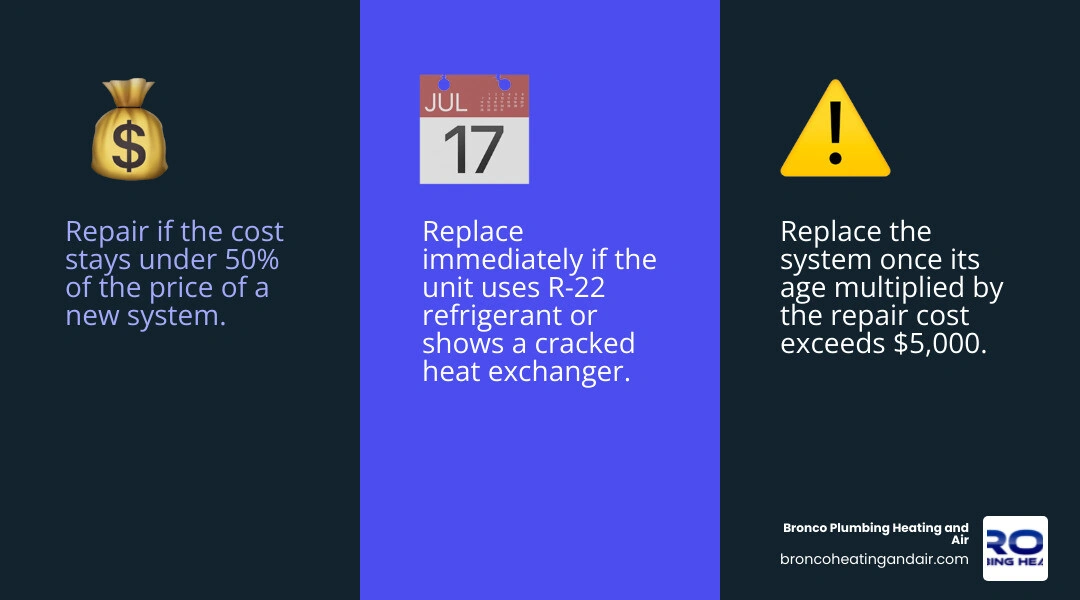
Applying the 50% Rule to Your Heating and Cooling System
The 50% Rule is one of the most straightforward guidelines used by HVAC professionals. It compares the immediate repair quote directly to the value of a brand-new system.
Under this rule, if the estimated cost of repairing your current unit is equal to or greater than 50% of the cost of a complete replacement, you should opt for a new system.
Investing a significant portion of a new system's price into an older, out-of-warranty unit is rarely a smart financial move. Older parts will continue to wear down, and you may find yourself facing another major repair bill just months down the road. By upgrading instead, you reset your system's lifespan to zero and gain the protection of a brand-new manufacturer's warranty.
How the $5,000 Rule Simplifies Your Decision
Another excellent mathematical filter is the $5,000 Rule. This formula factors in both the age of your equipment and the cost of the proposed repair to calculate whether the investment is mathematically sound.
To apply this rule, use the following simple formula:
• System Age (in Years) × Estimated Repair Cost = Your Score
If your total score is under 5,000, repairing the unit is generally the more cost-effective choice. If your score is over 5,000, the math strongly favors replacing the system.
For example, if you have a well-maintained 5-year-old air conditioner that needs a moderate electrical repair, multiplying 5 by that repair cost will yield a score well below the 5,000 threshold. Repairing is the obvious choice.
However, if you have a 12-year-old system facing a major component replacement, multiplying 12 by that substantial repair quote will easily push your score past 5,000. In this scenario, investing in a modern, reliable system is the wiser long-term decision.
Key Factors Influencing Your Repair vs Replace Decision
While mathematical formulas provide an excellent starting point, they do not tell the whole story. To make the best choice for your home, you must also evaluate the physical state of your equipment, its environmental footprint, and any potential safety hazards.
Applying an HVAC Repair vs Replacement Cost Guide to Older Systems
The age of your system is one of the most critical variables in the decision-making process. On average, central air conditioners and heat pumps have an expected lifespan of 15 to 20 years, while well-maintained gas furnaces can last a similar duration.
However, local weather conditions play a massive role in how quickly these systems degrade. In the Greater Sacramento region, our intense summer heat waves put incredible stress on cooling systems. Because our air conditioners must run at peak capacity for consecutive days during the summer, they accumulate wear and tear much faster than units in milder climates.
If you are wondering How Long Does an AC System Last in Sacramento, the reality is that local systems often begin showing signs of serious decline around the 12-to-15-year mark. To understand why our local environment is so demanding, you can read more about Why Do AC Units Wear Out Faster in Hot Climates. When an older system in Sacramento CA or Roseville CA begins to struggle, replacing it before the peak of summer is often the best way to prevent an uncomfortable emergency breakdown.
The R-22 Refrigerant Phase-Out in 2026
If your air conditioner was installed before 2010, there is a very high probability that it relies on R-22 refrigerant (often known as Freon). Because R-22 is an ozone-depleting substance, the EPA has completely phased out its production and import.
By June 2026, the remaining supply of reclaimed R-22 is incredibly scarce and difficult to source. Consequently, if your older system develops a refrigerant leak, recharging the unit is incredibly expensive.
More importantly, a refrigerant leak indicates that your system's copper coils are corroding. Simply adding more refrigerant is a temporary band-aid that does not solve the underlying issue. If your system still uses R-22, any major cooling failure is a clear sign that you should transition to a modern, environmentally friendly system that uses current, compliant refrigerants.
Critical Safety Red Flags and the Danger of a Cracked Heat Exchanger
While most HVAC decisions come down to financial practicality, safety concerns override all mathematical formulas. This is especially true when dealing with a gas furnace.
The heat exchanger is the metal chamber inside your furnace that prevents dangerous combustion gases from entering your home's breathing air. Over years of constant heating and cooling cycles, this metal expands and contracts. Eventually, the metal can fatigue, leading to a cracked heat exchanger.
A cracked heat exchanger is an immediate safety hazard because it can leak deadly carbon monoxide gas into your home. If a licensed technician discovers a crack in your heat exchanger, they are legally required to shut down the system immediately to protect your household.
Because replacing a heat exchanger is an incredibly labor-intensive process that requires dismantling the entire furnace, it is rarely practical to repair this component on an older system. If your furnace has a compromised heat exchanger, immediate system replacement is the only safe and responsible choice.
Evaluating Component Failures and the Repair Spiral
When an HVAC system begins to fail, it rarely happens all at once. Instead, homeowners often find themselves caught in a "repair spiral"—a frustrating cycle where fixing one small part only leads to another component breaking down a few months later.
To help you avoid throwing good money after bad, it helps to understand which repairs are simple, isolated fixes and which ones signal that the entire machine is reaching the end of its operational life.
• Capacitor — Repair or Replace?: Repair — Description: A simple electrical fix that is almost always worth doing, regardless of system age.
• Contactor — Repair or Replace?: Repair — Description: An inexpensive electrical switch that can be quickly replaced to restore system operation.
• Thermostat — Repair or Replace?: Repair / Upgrade — Description: Easily replaced to restore communication between your home and your HVAC equipment.
• Flame Sensor — Repair or Replace?: Repair / Clean — Description: Simple maintenance or replacement that keeps your furnace running safely.
• Compressor (System < 8 Years) — Repair or Replace?: Repair — Description: Worth replacing under warranty if the rest of the system is healthy and clean.
• Compressor (System > 10 Years) — Repair or Replace?: Replace System — Description: The "heart" of the AC; mechanical failure at this age signals systemic wear.
• Evaporator Coil (R-22 System) — Repair or Replace?: Replace System — Description: Corroded coils on an obsolete refrigerant system make repair financially impractical.
• Cracked Heat Exchanger — Repair or Replace?: Replace System — Description: A severe safety hazard that presents an immediate risk of carbon monoxide poisoning.
Minor Component Fixes That Are Always Worth Doing
Not every service call requires a panic-induced search for a new system. Many common HVAC issues are caused by minor electrical components that naturally wear out over time.
For instance, your system's capacitor acts like a small battery that delivers the electrical boost needed to start the compressor and fan motors. Capacitors are highly sensitive to summer heat and electrical fluctuations, making them one of the most common failure points in Sacramento CA, Citrus Heights CA, and Elk Grove CA.
Replacing a capacitor, a contactor, or a malfunctioning thermostat is a straightforward, cost-effective service that can instantly bring your system back to life. If you want to recognize these minor issues early, look out for the common Signs Your AC Needs Repair. If your system is completely unresponsive, checking these small parts is the first step in diagnosing the Reasons Your AC Isn't Turning On.
Major Failures That Signal It Is Time to Replace
On the other end of the spectrum are major mechanical failures. The compressor is the heart of your air conditioning system, responsible for pumping refrigerant through the coils. If your compressor suffers a mechanical failure—especially on a system that is over 10 years old—it is usually a sign of systemic neglect or advanced age.
When a compressor fails, it often releases metal debris and acid into the refrigerant lines, contaminating the entire system. Simply installing a new compressor without replacing the surrounding components can cause the new part to fail prematurely.
When facing a major component failure of this scale, it is crucial to evaluate How to Decide Between AC Repair and Replacement. In almost every case, a major mechanical failure on an older, out-of-warranty system is the final signal that it is time to invest in a replacement.
Maximizing Value with Modern System Upgrades
Choosing to replace your HVAC system is a significant home investment, but it also comes with massive long-term benefits. Modern systems are engineered to provide levels of comfort, control, and efficiency that older units simply cannot match.
Efficiency Gains and California Title 24 Compliance
If your current air conditioner was installed over a decade ago, it likely has a SEER (Seasonal Energy Efficiency Ratio) rating of 10 or lower. Modern systems must meet strict national SEER2 standards, which start at a minimum rating of 14 in California.
Upgrading from an old SEER 9 or 10 unit to a modern SEER2 system can instantly reduce your cooling energy consumption by over 35%. This drop in energy usage translates directly into lower monthly utility bills, allowing you to recoup a portion of your investment every single month. To see how these savings apply to our local area, read our guide on whether Is a High Efficiency AC Worth the Extra Cost in California.
Furthermore, when replacing an HVAC system in our region, the project must comply with California's building standards. If you are planning an installation, it is helpful to understand how these energy regulations affect your project by checking Does Title 24 Apply to HVAC Replacement in California. These standards ensure that your new system, ductwork, and ventilation are operating at peak efficiency, protecting both your comfort and your home's resale value.
Leveraging Incentives in an HVAC Repair vs Replacement Cost Guide
One of the best ways to offset the cost of a new system is by taking advantage of the wide array of financial incentives available in 2026.
Under the federal Inflation Reduction Act, homeowners can claim tax credits of up to 30% (capped at $2,000) for qualifying high-efficiency heat pumps. Additionally, federal tax credits of up to $600 are available for qualifying central air conditioners and gas furnaces. You can learn more about how to claim these savings in our guide on Federal Tax Credits for AC and Heat Pump Upgrades.
Beyond federal programs, local utility companies in the Sacramento region—such as SMUD and PG&E—frequently offer generous rebates for upgrading to energy-efficient heat pumps and smart thermostats. To explore these local savings, take a look at our detailed breakdown of California Energy Rebates for HVAC Upgrades.
Frequently Asked Questions about HVAC Decisions
How long do modern heating and cooling systems typically last?
On average, a modern central air conditioner or heat pump has an expected operational lifespan of 15 to 20 years, while a well-maintained gas furnace can last between 15 and 20 years.
However, these lifespans depend heavily on regular maintenance. Neglecting to change your air filters or skipping annual professional tune-ups can force your system to work much harder, leading to premature component failure and a significantly shorter lifespan.
Should I replace my furnace and air conditioner at the same time?
If both your heating and cooling units are over 12 years old, replacing them together is highly recommended.
Your indoor furnace and outdoor air conditioner are designed to work as a matched system. Pairing a brand-new, high-efficiency air conditioner with an old, inefficient furnace blower motor can severely limit the new system's performance and prevent you from achieving its rated efficiency. Additionally, installing both units at the same time allows you to save significantly on labor costs compared to scheduling two separate installations years apart.
What are the signs that my system is entering a repair spiral?
The most common sign of a repair spiral is needing professional service more than twice within a 24-month period.
Other red flags include a steady, unexplained increase in your monthly energy bills, uneven temperatures throughout your home, and unusual grinding, squealing, or banging noises coming from your equipment. If your system requires constant attention just to keep your home habitable, it is telling you that a complete replacement is the most cost-effective path forward.
Conclusion
Deciding whether to repair or replace your heating and cooling system is a major decision that directly affects your family's comfort, safety, and monthly budget. By using the mathematical rules and practical guidelines outlined in this hvac repair vs replacement cost guide, you can confidently make the choice that provides the best long-term value for your home.
Whether you live in Sacramento CA, Roseville CA, Folsom CA, Davis CA, or any of our other surrounding communities, our team is here to help. At Bronco Heating & Air, our licensed, professional, and courteous technicians are dedicated to providing honest, cost-effective solutions tailored to your home's unique needs.
Don't wait for your system to fail during the next major temperature swing. If you need an honest assessment of your heating or cooling system, contact us today at Bronco Heating & Air Service to schedule a professional consultation.

Customer Testimonials
Our customer testimonials highlight the reliable service, quality workmanship, and trusted results homeowners experience with Bronco Plumbing Heating and Air.


Ready to Transform your Home?
Create a healthier, more comfortable home with expert HVAC, plumbing, and indoor air quality solutions you can trust. From efficient heating and cooling to cleaner air and reliable repairs, our experienced team is here to keep your family comfortable year-round with dependable service and upfront pricing.
Related Articles
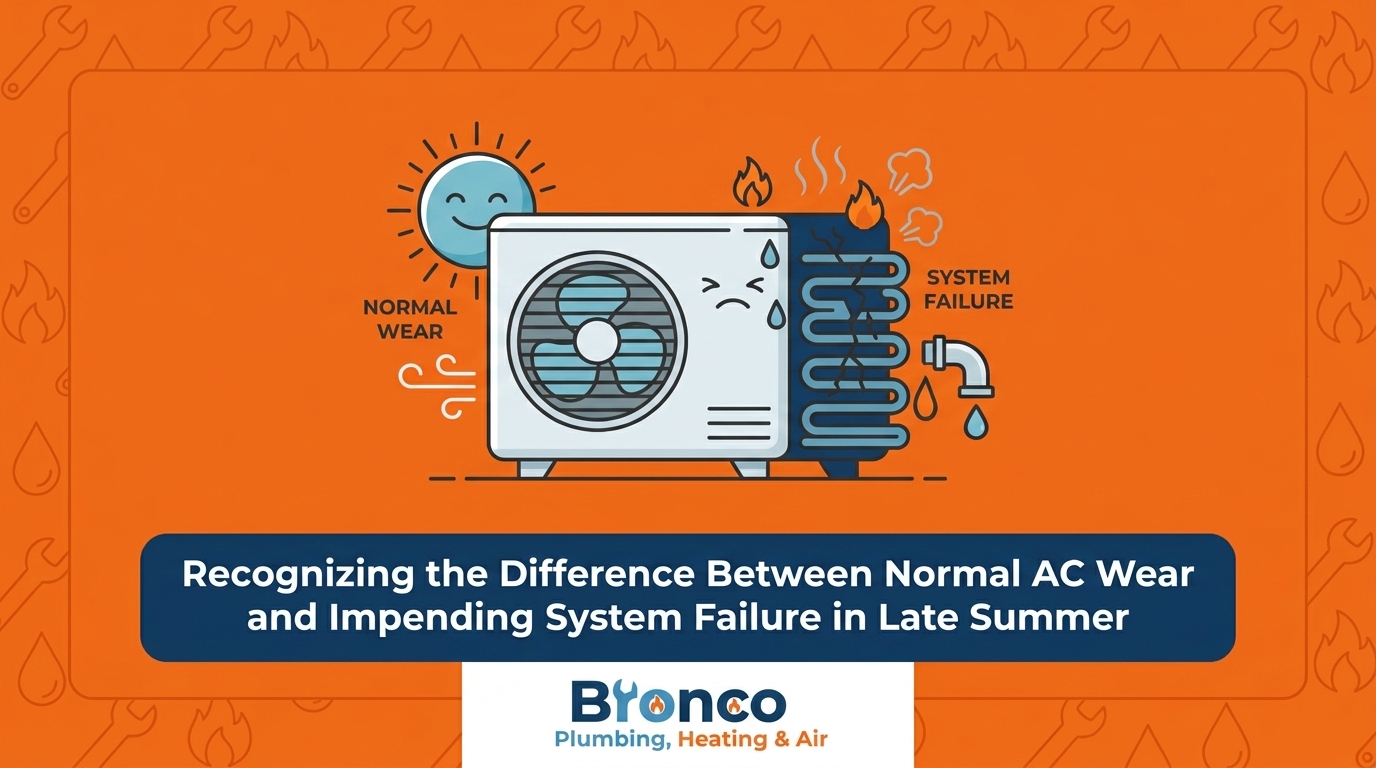
Recognizing the Difference Between Normal AC Wear and Impending System Failure

The Truth About MERV Ratings and Air Conditioner Strain
Diagnosing Weak Airflow in the Farthest Bedroom of Your House