



.svg)

Why Your AC Won't Shut Off During a Roseville Heatwave (And When to Worry)
When summer heat peaks, a constantly running air conditioner can easily cause panic. Find out how to tell the difference between normal operation and a system failure.
Battling Peak Heat: Is Continuous AC Operation Normal?
When the July temperatures skyrocket, one of the most common homeowner questions answered by our team at Bronco Plumbing, Heating & Air is why the air conditioner suddenly seems to run without ever taking a break. You hear the outdoor unit roaring for hours on end, and it is entirely natural to feel a knot of anxiety. You might wonder if the system is breaking down, if your energy bill is going to double, or if you need to call for a repair immediately. The good news is that continuous operation during extreme weather is not always a sign of mechanical failure.
If you are dealing with a cooling emergency right now, professional air conditioning services can help you accurately diagnose the issue and restore comfort to your home.
The Sound of Summer vs. The Sound of Trouble
The most critical distinction you need to make is determining exactly what kind of air is coming out of your vents while the system runs. There is a massive difference between an air conditioner that runs constantly while blowing ice-cold air, and one that runs constantly while blowing lukewarm or warm air.
During peak summer heat, your air conditioner is working against an immense thermal load. The sun is beating down on your roof, heat is transferring through your windows, and your attic is baking. If your system is blowing cold air but simply running for longer cycles, it is doing exactly what it was engineered to do. However, if the air feels tepid and your indoor temperature is slowly climbing, you have crossed the line from normal operation into a potential mechanical failure. Understanding this difference is the first step in safely triaging your system before you reach for the phone.
The Physics of Cooling During 100-Degree Days
To understand why your air conditioner refuses to shut off on the hottest days of the year, it helps to look at how residential HVAC systems are actually designed. Air conditioners are not sized to handle the absolute hottest day mathematically possible. Instead, they are sized using what engineers call a "1% design temperature."
Understanding HVAC Design Limits
The American Society of Heating, Refrigerating and Air-Conditioning Engineers (ASHRAE) sets guidelines for HVAC sizing based on historical climate data. A system is typically engineered to max out its cooling capacity when outdoor temperatures hit roughly 95 to 98 degrees Fahrenheit. At this temperature, the system is designed to run almost continuously to maintain a comfortable 72 to 75 degrees indoors.
When the Sacramento Valley's specific triple-digit heatwaves roll in, our technicians see firsthand how they fundamentally alter AC cycling and expected recovery times. If it is 105 degrees outside, your air conditioner is operating beyond its standard design limits. It will naturally run continuously just to hold the line and keep your home from getting hotter. It may not be able to cool the house down to 68 degrees, but as long as the air exiting the vents is cold, the system is safe and functioning normally.
Why Bigger Isn't Better for Extreme Heat
You might wonder why contractors do not simply install massive air conditioners that can easily cool a house in 110-degree weather. The short answer is that an oversized unit causes massive problems during the rest of the year.
• Short Cycling: An oversized system cools the house too quickly and shuts off before it has a chance to dehumidify the air.
• Poor Indoor Air Quality: Because the system turns on and off rapidly, air does not circulate through the filter enough, leading to stagnant, dusty air.
• Increased Wear and Tear: The most stressful part of an AC's operation is starting up. Turning on and off constantly wears out electrical components prematurely.
The takeaway: Continuous operation during a heatwave is actually better for your equipment than starting and stopping every ten minutes.
• Below 90°F — Expected AC Behavior: Cycles on and off regularly (15-20 min cycles) — Is This Normal?: Yes, normal operation.
• 95°F - 98°F — Expected AC Behavior: Long cycles, rarely shutting off during the afternoon — Is This Normal?: Yes, operating at design capacity.
• 100°F+ — Expected AC Behavior: Runs continuously, indoor temp may rise slightly — Is This Normal?: Yes, battling extreme heat load.
The Red Flag: Running Constantly But Blowing Warm Air
While continuous operation is normal during extreme heat, there is one scenario that requires immediate attention: your thermostat is set to cool, the system is running nonstop, but the indoor temperature is rising, and the air from the vents feels warm. This is the concrete problem that many homeowners face in Roseville CA during the height of summer, and it is a major red flag that our emergency repair dispatchers hear about constantly.
When your system runs without actually transferring heat out of your home, it is not just wasting electricity—it is actively damaging itself. The compressor, located in the outdoor unit, relies on cool refrigerant returning from the house to keep its motor from overheating. If the system is blowing warm air, that heat transfer is not happening, and the compressor is at risk of severe thermal overload.
The Anatomy of a Frozen Evaporator Coil
One of the most common hidden causes of this specific failure is a frozen evaporator coil. Your indoor unit contains a coil filled with extremely cold refrigerant. Warm indoor air blows over this coil, the refrigerant absorbs the heat, and moisture from the air condenses on the metal fins.
If airflow is severely restricted, or if the system is low on refrigerant, the coil gets too cold. That condensation freezes into solid ice. Once the coil is encased in ice, air can no longer pass through it effectively. The system keeps running, blowing unconditioned air around your house, while the outdoor compressor strains against the blockage.
This is why keeping up with routine AC maintenance is so critical. A technician can catch low refrigerant levels or dirty coils before they lead to a mid-summer freeze-up. If you notice warm air coming from your vents, the absolute most important step you can take is to turn the system off at the thermostat to prevent permanent mechanical failure.
Safe DIY Triage Checklist: What to Check First
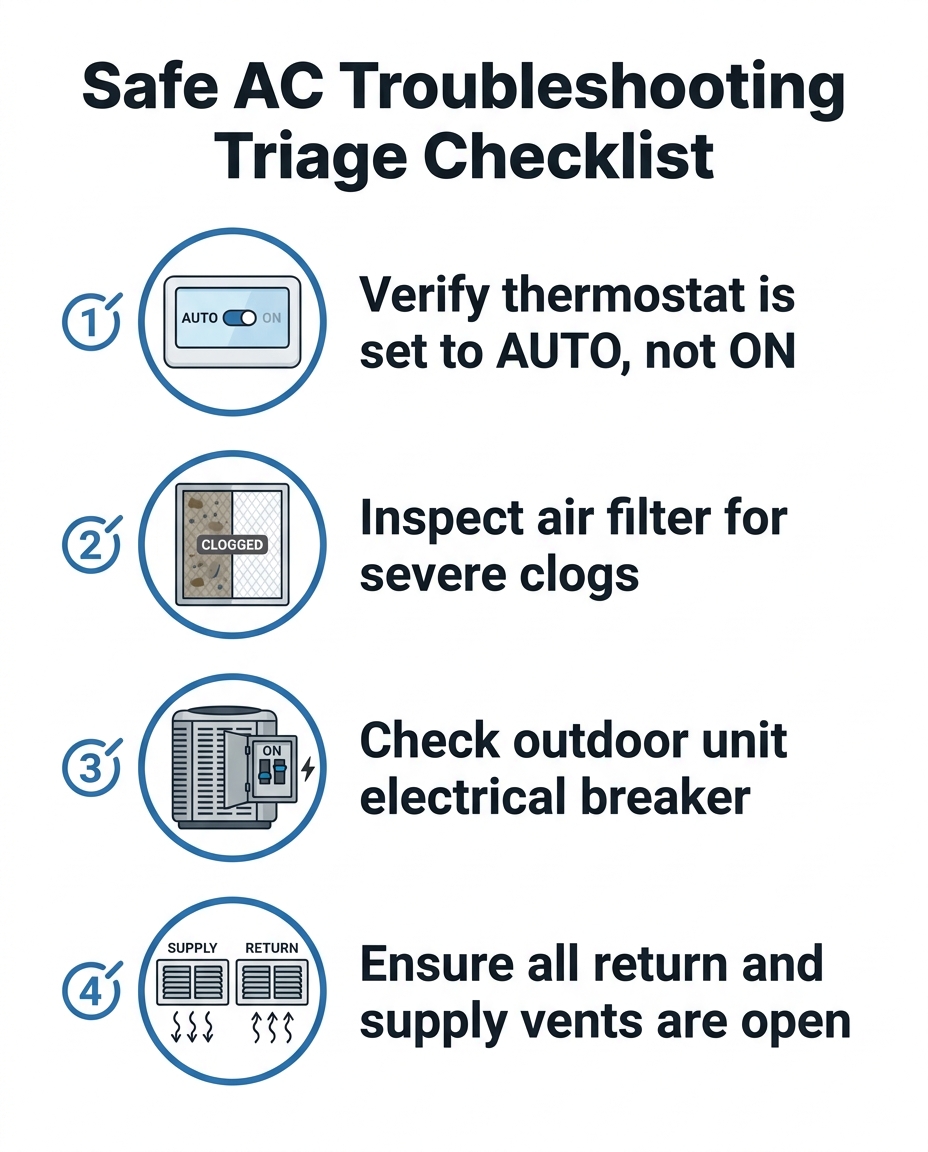
Before you call for a professional repair, there are several safe, simple checks you can perform yourself. Often, an air conditioner blowing warm air is the result of a minor issue that does not require a technician. Following this checklist ensures you do not pay a service fee for a tripped breaker or a dirty filter.
1. Verify Thermostat Settings: Check that your thermostat is set to "COOL" and the fan setting is on "AUTO." If the fan is set to "ON," the indoor blower will run 24/7, even between cooling cycles. This means it will blow unconditioned, room-temperature air through your vents, making it feel like the AC is failing when it is actually just circulating warm air.
2. Inspect the Air Filter: Locate your return air filter and pull it out. Hold it up to a light source. If you cannot see light passing through the material, the filter is severely clogged. A blocked filter starves the system of airflow, causing the indoor coil to freeze and the system to blow warm air. Replace it immediately if it is dirty.
3. Check the Electrical Breakers: Your central air conditioner has two separate power sources: one for the indoor blower and one for the outdoor compressor. If the outdoor unit's breaker trips, the indoor fan will continue to run, blowing warm air because the outdoor unit is dead. Check your main electrical panel and reset the AC breaker if it is tripped.
4. Ensure Unrestricted Airflow: Walk through your home and ensure all supply registers (where air comes out) and return grilles (where air gets sucked in) are fully open. Do not close vents in unused rooms. Closing vents increases static pressure inside the ductwork, forcing the blower motor to work harder and reducing the overall cooling capacity of the system.
If you have completed these steps and the system is still struggling, it is time to rely on our professionals serving the Roseville service area for a deeper look.

When to Turn the System Off and Call a Professional
There is a hard line between safe DIY troubleshooting and mandatory professional intervention. If you have checked your filter, verified your thermostat settings, and confirmed the breakers are on, but the system is still blowing warm air, you must turn the thermostat to "OFF" immediately.
Continuing to run a failing system is incredibly risky. Air conditioners are not self-healing appliances. If the system is low on refrigerant or has a failed electrical component, forcing it to run continuously during peak summer heat can turn a minor repair into a catastrophic failure. The compressor is the heart of your air conditioner and the most expensive part to replace. Letting it overheat because it is running without proper heat transfer is a fast track to a complete system replacement.
Secondary Warning Signs You Cannot Ignore
Beyond blowing warm air, there are several secondary symptoms that indicate a serious mechanical issue. If you notice any of the following, shut the system down right away:
• Ice on the refrigerant lines: If you see frost or solid ice on the copper pipes connected to your outdoor unit, the system is freezing up.
• Unusual hissing sounds: A distinct hissing or bubbling noise near the indoor or outdoor unit often indicates a pressurized refrigerant leak.
• Grinding or screeching: Mechanical noises suggest motor failure. If you hear your AC making strange noises, a fan motor or compressor is likely struggling to operate.
• Burning smells: Any electrical or burning odor coming from the vents means the system needs to be powered down at the breaker immediately.
By turning the system off, you protect the equipment from further damage and allow the internal components to cool down before a technician arrives.
What an HVAC Technician Will Diagnose
When you place that service call, it helps to know exactly what happens next. A professional HVAC diagnostic is a systematic process designed to isolate the root cause of the cooling failure without guesswork. Relying on local experts like our crew at Bronco Plumbing, Heating & Air ensures accurate diagnostics, because we know exactly how Sacramento Valley heatwaves impact system pressures and temperatures.
The Diagnostic Process
When a Bronco technician arrives at your home, they will typically focus on three main areas if the system is running but failing to cool:
• Refrigerant Charge Testing: The technician will connect manifold gauges to the outdoor unit to read the operating pressures of the refrigerant. If the pressure is too low, the system has a leak. Air conditioners do not "consume" refrigerant; it only leaves the system if there is a hole in the copper lines or coils. The leak must be located and sealed before recharging.
• Compressor and Capacitor Diagnostics: Using a multimeter, the technician will test the electrical components that drive the outdoor unit. The dual-run capacitor, which acts like a powerful battery to jump-start the compressor and fan motors, is a common failure point during heatwaves. If the capacitor is dead, the outdoor fan might spin, but the compressor will not engage, resulting in warm air indoors.
• Airflow and Coil Inspections: The technician will measure the static pressure of the ductwork and visually inspect the indoor evaporator coil. If the coil is packed with years of dust and pet hair, it cannot absorb heat. The technician will perform a deep chemical cleaning to restore proper airflow and heat transfer.
A proper diagnostic does more than just fix the immediate problem; it prevents recurring breakdowns during the hottest months by ensuring the entire system is operating within manufacturer specifications.
Protecting Your System Through the Hottest Months
Navigating the extreme temperatures of a Roseville CA summer requires knowing your home's HVAC system. Remember, continuous operation while blowing cold air is a perfectly normal response to triple-digit heat. Your system is simply working as hard as it can to maintain a livable environment. However, if the air turns warm, that continuous operation becomes a threat to your equipment.
By following the safe DIY triage checklist—checking your thermostat, filter, breakers, and vents—you can rule out the most common, easily fixable issues. If those steps fail to restore cold air, turning the system off and calling for a professional diagnostic is the smartest financial decision you can make.
In our years of serving the community, we've found that proactive care is the ultimate defense against mid-summer breakdowns. Having a professional inspect, clean, and test your system before the peak heat arrives provides a transparent explanation of your system's health and the peace of mind that comes with a structured, reliable cooling plan. Stay cool, stay observant, and never force a struggling air conditioner to run through the heat.
Frequently Asked Questions
Should my AC run constantly in 100 degree weather?
Yes, it is entirely normal for an air conditioner to run constantly when outdoor temperatures reach 100 degrees or higher. Residential HVAC systems are typically designed to maintain indoor comfort up to about 95 degrees. When the weather exceeds that design limit, the system must run continuously just to prevent the indoor temperature from rising, provided it is still blowing cold air.
Why is my AC running but not cooling the house?
If your AC is running but the house remains warm, the system is likely suffering from restricted airflow, a frozen evaporator coil, or a refrigerant leak. A severely clogged air filter is the most common DIY cause, as it stops air from moving over the cooling coils. If the filter is clean, the outdoor compressor may not be engaging due to a failed electrical capacitor, requiring a professional diagnostic.
Is it bad if my AC runs all day during a heatwave?
Running all day during a heatwave is not bad for your AC, as long as it is actively blowing cold air. In fact, long, continuous cycles are generally easier on the system's motors and electrical components than constantly turning on and off. However, if the system runs all day while blowing warm air, it can cause severe damage to the compressor and should be turned off immediately.
How long should an AC run on a hot day before shutting off?
On a moderately hot day (around 85 to 90 degrees), a properly sized AC typically runs in cycles of 15 to 20 minutes. However, on an extremely hot day exceeding 95 degrees, those cycles will stretch significantly. It is common and expected for the unit to run for hours at a time, or even continuously through the hottest part of the afternoon, before finally shutting off after the sun goes down.
Can a dirty air filter cause my AC to run continuously?
Yes, a dirty air filter is a primary reason an AC will run continuously without cooling the home. The dirt blocks warm air from returning to the system, which prevents the AC from removing heat from your house. This lack of airflow can also cause the indoor coils to freeze solid, further blocking air and forcing the outdoor unit to run nonstop in a failing effort to reach the thermostat setpoint.
What should I do if my AC is blowing warm air?
If your AC is blowing warm air, the first step is to check that your thermostat fan setting is on "AUTO" and not "ON," and then inspect your air filter for clogs. If the filter is clean and the settings are correct, turn the thermostat to "OFF" immediately. Continuing to run the system while it blows warm air can permanently damage the compressor; you will need to call an HVAC professional to diagnose the underlying mechanical issue.

Customer Testimonials
Our customer testimonials highlight the reliable service, quality workmanship, and trusted results homeowners experience with Bronco Plumbing Heating and Air.


Ready to Transform your Home?
Create a healthier, more comfortable home with expert HVAC, plumbing, and indoor air quality solutions you can trust. From efficient heating and cooling to cleaner air and reliable repairs, our experienced team is here to keep your family comfortable year-round with dependable service and upfront pricing.
Related Articles
Recognizing the Difference Between Normal AC Wear and Impending System Failure

The Truth About MERV Ratings and Air Conditioner Strain
Diagnosing Weak Airflow in the Farthest Bedroom of Your House