



.svg)

The Hidden Cost of Dirty AC Coils in Dusty North Highlands Neighborhoods
Environmental dust in North Highlands rapidly coats outdoor AC units, increasing energy use by up to 30%. See how this buildup impacts cooling and if specialized cleaning is worth the cost.
The Staggering Impact of Summer Dust on Cooling Efficiency
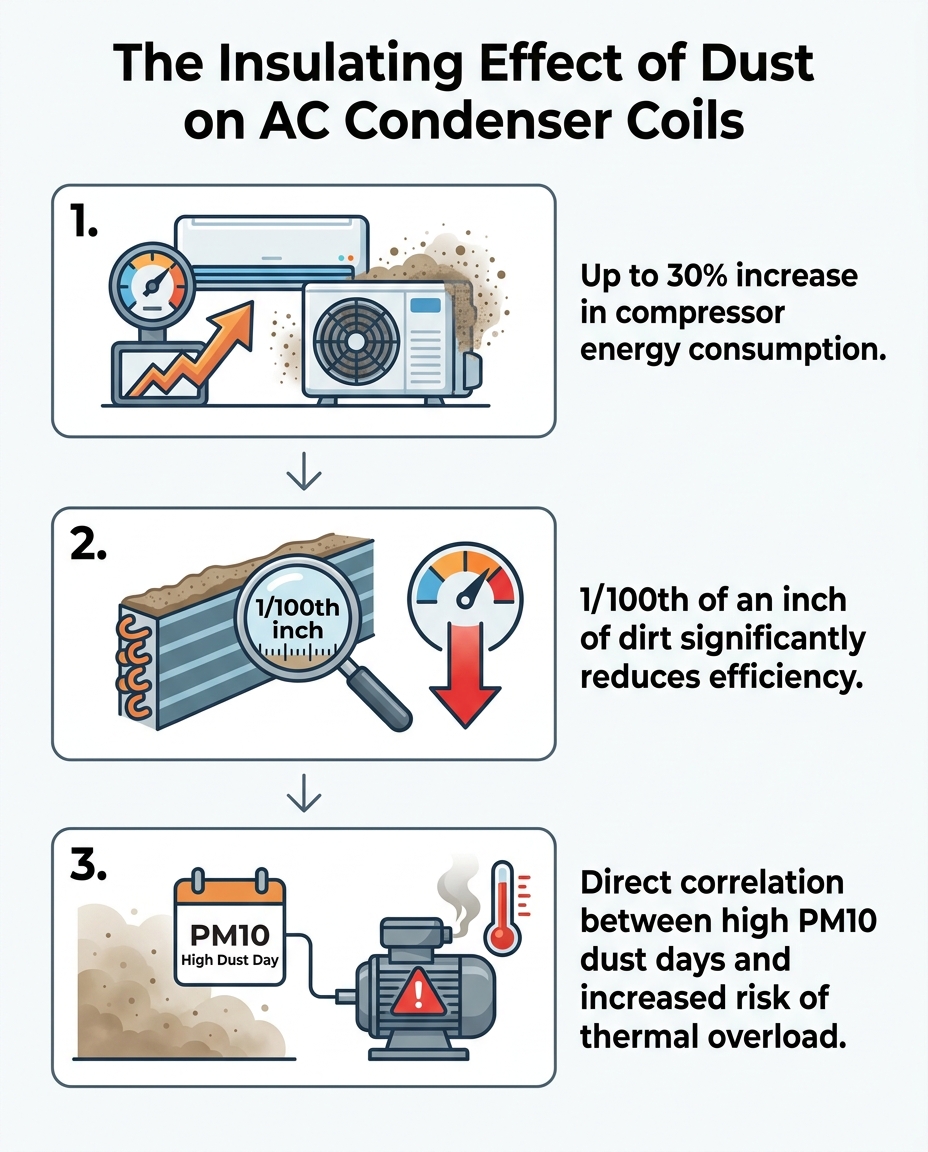
Data from the U.S. Department of Energy indicates that dirty condenser coils can increase compressor energy consumption by up to 30%, making the hidden cost of dirty AC coils in dusty North Highlands neighborhoods a significant financial burden for local homeowners. Here at Bronco Plumbing, Heating & Air, our technicians see this reality play out every summer. When environmental dust native to the area rapidly coats outdoor units, it creates a concrete problem that goes beyond a mere cosmetic issue. Homeowners face a critical decision point: address the buildup early with specialized cleaning, or risk severe cooling loss during peak summer.
During the intense peak July heat in the northern hemisphere, cooling systems are placed under maximum load. A system that is already struggling to breathe through a blanket of dirt will consume substantially more electricity while delivering less comfort. If you are concerned about your system's performance, investing in professional AC services is the most effective way to restore efficiency and protect your equipment from premature failure.
• Clean Condenser Coils — Airflow Restriction: Minimal to none — Energy Consumption: Baseline / Normal — Cooling Output: 100% capacity
• Light Dust Coating — Airflow Restriction: Moderate restriction — Energy Consumption: Up to 10% increase — Cooling Output: Noticeably reduced
• Heavy Environmental Grime — Airflow Restriction: Severe restriction — Energy Consumption: Up to 30% increase — Cooling Output: Significantly compromised
The bottom line: The longer an outdoor unit operates with restricted airflow, the more expensive it becomes to run. Recognizing the impact of local environmental factors is the first step toward maintaining a reliable, efficient home cooling system.
Why the Sacramento Valley Air Basin Uniquely Strains HVAC Equipment
Standard HVAC maintenance timelines are often based on national averages, which assume a moderate climate and typical suburban environments. However, in our experience servicing homes throughout Roseville and the greater Sacramento Valley, this air basin presents a completely different set of challenges. The combination of hot, dry summers and consistently high PM10 particulate matter uniquely strains outdoor cooling equipment in areas like North Highlands.
Agricultural and Environmental Particulates
The environmental dust found in this region is not just standard household dirt. It is a complex mixture of dry summer soils, agricultural particulates blown in from surrounding farmland, vehicle exhaust, and seasonal pollen. When these microscopic particles settle on the warm metal surfaces of an outdoor condenser unit, they do not simply blow away in the wind. Instead, the heat from the unit bakes this debris onto the aluminum fins, creating a sticky, insulating residue. Our crews frequently find that this specific type of grime requires specialized attention, as it rapidly degrades the unit's ability to transfer heat.
The Funnel Effect of Outdoor Condensers
To understand why this local dust is so problematic, it helps to look at the airflow mechanics of the outdoor unit. The large fan at the top of your condenser is designed to pull massive volumes of air through the side panels and exhaust it upward. This design essentially turns the unit into a giant vacuum cleaner for yard dust, dry grass clippings, and airborne PM10 particulates.
Key factors accelerating dust buildup:
• Proximity to bare soil: Units placed near dry, unlandscaped earth pull loose dirt directly into the fins.
• Prevailing dry winds: Summer breezes continuously introduce new agricultural dust into residential neighborhoods.
• Continuous operation: Because systems run nearly non-stop during 100-degree days, they are actively pulling in dusty air for 12 to 15 hours a day.
This relentless funnel effect means that an outdoor unit in North Highlands can accumulate more debris in a single dry summer month than a unit in a milder, wetter climate might collect in an entire year.
How a Microscopic Layer of Dirt Cripples Heat Transfer
The fundamental role of your air conditioner is not actually to create cold air, but to remove heat from inside your home and release it outside. This critical heat transfer happens at the outdoor condenser coil. When homeowners call our team searching for solutions regarding "ac coil cleaning," they are usually experiencing the mechanical consequences of this heat transfer process breaking down.
The Science of Refrigerant and Heat Rejection
Inside your home, the evaporator coil absorbs heat from your indoor air, turning the liquid refrigerant into a hot gas. This hot gas travels outside to the condenser unit, where the compressor pressurizes it, making it even hotter. The outdoor fan then pulls cooler ambient air across the aluminum fins of the condenser coil, absorbing the heat from the refrigerant and allowing it to condense back into a liquid. For this thermodynamic cycle to work efficiently, there must be absolutely unrestricted airflow through the thousands of tiny metal fins.
The Insulation Trap
When environmental dust coats these fins, it creates an "insulation trap." According to data from the American Society of Heating, Refrigerating and Air-Conditioning Engineers (ASHRAE), a buildup of just 1/100th of an inch of dirt on a condenser coil can significantly reduce system efficiency. The dirt physically blocks the metal's ability to dissipate heat into the outside air. Because the refrigerant cannot cool down sufficiently, it returns to the indoor unit still carrying excess heat.
The cycle of heat rejection failure:
1. Dust acts as a thermal blanket over the aluminum fins.
2. Refrigerant retains heat instead of releasing it outdoors.
3. The indoor coil fails to reach its target temperature.
4. The system runs constantly in a futile attempt to cool the home.
This cascading effect forces every component in the cooling cycle to work harder. Understanding how dirty condenser coils affect AC performance is crucial for recognizing the early warning signs of an insulated, struggling system before it leads to total mechanical failure.

Spiking Utility Bills: The Financial Drain of Reduced Efficiency
One of the most immediate consequences of an insulated condenser coil is a sharp increase in monthly energy costs. When heat transfer is blocked, the financial impact compounds quickly over a long, hot summer season. We often hear homeowners mistake these higher bills for standard summer rate increases, but when our technicians inspect the unit, the root cause is usually mechanical inefficiency.
Increased Energy Consumption Under Load
When the outdoor coil cannot release heat, the pressure inside the refrigerant lines spikes. This condition, known as high head pressure, forces the compressor to work against extreme resistance. To maintain the flow of refrigerant, the compressor draws significantly more electrical amperage. This hidden electrical drain happens every time the unit turns on, silently inflating your utility bill. Enrolling in a routine AC maintenance plan is a proactive measure that focuses on efficiency recovery, ensuring the system operates at its designed electrical specifications rather than straining against preventable resistance.
Longer Cooling Cycles During Peak Heat
In addition to drawing more power while running, a dirty system runs for much longer periods. Because the refrigerant is not cooling down properly outside, the air blowing out of your indoor vents is warmer than it should be. The thermostat recognizes that the home is not reaching the set temperature, so it commands the system to keep running.
• Cycle Length — Clean System Performance: 15–20 minutes per cycle — Dirty System Performance: 45+ minutes or constant operation
• Amperage Draw — Clean System Performance: Normal operating range — Dirty System Performance: Elevated due to high head pressure
• Component Wear — Clean System Performance: Standard expected lifespan — Dirty System Performance: Accelerated degradation
The compounding cost: Running constantly during peak heat not only doubles your energy consumption for that specific day but also accelerates the wear and tear on motors, capacitors, and contactors, turning a simple maintenance need into a costly repair scenario.
The Exponential Risk of Compressor Failure in July
While high energy bills are frustrating, the most severe consequence of ignoring environmental dust buildup is catastrophic equipment failure. The compressor is the heart of your air conditioning system, and it relies on the cool, returning refrigerant to keep its internal motor from overheating.
Understanding Thermal Overload
When a dirty coil prevents heat rejection, the refrigerant returning to the compressor is dangerously hot. This causes the compressor's internal temperature to skyrocket. Modern compressors are equipped with a safety device called a thermal overload switch, which is designed to cut power to the motor if it gets too hot. If your system suddenly shuts down on a 100-degree afternoon, this safety switch has likely tripped to prevent the motor windings from melting.
During peak July heat, there is absolutely zero margin for error in heat dissipation. The ambient air is already hot, so the condenser needs every square inch of its clean aluminum fins to transfer heat effectively. When those fins are caked in North Highlands dust, the risk of sudden failure grows exponentially.
As local experts who understand exactly how Sacramento Valley environmental factors uniquely degrade HVAC equipment, our team at Bronco Plumbing, Heating & Air sees this pattern repeatedly. We field countless emergency calls every July for burned-out compressors that could have been saved with a simple coil cleaning. The minor inconvenience of scheduling routine maintenance pales in comparison to the major disruption—and significant expense—of replacing a dead compressor in the middle of a heatwave.
The Connection Between Outdoor Condensers and Indoor Comfort
It is a common misconception that the outdoor unit only affects the temperature of the home. In reality, a struggling outdoor condenser directly impacts the overall system's ability to manage indoor air quality and humidity. When we visit a home for an "ac coil cleaning," the homeowner is often trying to solve indoor comfort issues that originate outside.
Reduced Dehumidification Capability
Air conditioners cool the air, but they also dehumidify it. As warm indoor air passes over the cold indoor evaporator coil, moisture condenses on the metal and drains away. However, if the outdoor unit is clogged with dust and failing to reject heat, the indoor coil will not get cold enough to extract moisture from the air effectively. The result is a home that feels sticky, clammy, and uncomfortable, even if the thermostat reads 72 degrees. Short or strained cooling cycles simply fail to remove the humidity required for true indoor comfort.
Comprehensive Air Quality Solutions
Overall system strain also leads to poor indoor air circulation. When the system is running inefficiently, airflow can become sluggish, allowing indoor pollutants, pet dander, and dust to settle in the living space rather than being pulled through the filter. Addressing outdoor efficiency is only one half of the equation. Pairing a clean, highly efficient outdoor unit with dedicated indoor air quality solutions creates a holistic approach to home health, ensuring that the air you breathe is both perfectly cooled and thoroughly purified.
Evaluating the Need for Professional Intervention
In our years of restoring AC efficiency across Roseville and North Highlands, we've found that knowing when to call a professional versus when to perform basic yard maintenance can save homeowners significant time and money. While keeping the area around the condenser clear of tall grass and debris is a great homeowner habit, physically cleaning the delicate aluminum fins requires specialized knowledge.
Signs Your System is Struggling
If you suspect environmental dust is impacting your system, look for these clear indicators:
• Visual buildup: A visible layer of gray or brown fuzz clinging to the outside of the metal fins.
• Constant operation: The unit runs continuously without ever satisfying the thermostat setting.
• Weak airflow: The air coming from your indoor vents feels lukewarm rather than crisp and cold.
• Unusual noises: A louder-than-normal buzzing or humming from the outdoor unit, indicating high pressure.
Why Specialized Cleaning is Not a DIY Task
We highly recommend avoiding DIY cleaning methods, particularly the use of a pressure washer. The aluminum fins on a condenser coil are incredibly thin and fragile. High-pressure water will instantly flatten these fins against the coil, permanently blocking airflow and ruining the unit.
Furthermore, standard water often cannot dissolve the baked-on agricultural dust typical of the Sacramento Valley. Our licensed professionals use specific, non-acidic chemical foaming agents that push the dirt out from the inside of the coil outward, safely dissolving the grime without damaging the metal. Once the system is restored to peak performance, integrating whole-home air filtration systems can help manage the indoor particulates, providing complete peace of mind throughout the dusty summer months.
FAQ
What happens if you don't clean AC condenser coils?
If condenser coils are left uncleaned, the system loses its ability to release heat outdoors. This forces the compressor to work significantly harder, leading to spiked energy bills, reduced cooling capacity inside the home, and accelerated wear on critical components. Over time, the trapped heat can cause the compressor to overheat and fail entirely.
How often should AC coils be cleaned in dusty areas like North Highlands?
In areas with high environmental dust and agricultural particulates, outdoor coils should be professionally cleaned at least once a year, ideally in the spring before peak heat arrives. Homes located directly adjacent to bare soil, busy roads, or open fields may even require a mid-summer rinse to maintain optimal efficiency during 100-degree weather.
Can dirty coils cause my AC to run constantly?
Yes, dirty coils are a primary reason an air conditioner will run without stopping. Because the dirt acts as an insulator, the system cannot effectively remove heat from the refrigerant. The air blowing inside never gets cold enough to satisfy the thermostat, forcing the unit to run continuously in a futile attempt to reach the set temperature.
Why is my AC running but not cooling the house?
When the AC is running but the air feels lukewarm, it usually means the heat transfer process has broken down. This is frequently caused by a thick layer of dust on the outdoor condenser unit, which traps the heat inside the system. It can also be caused by low refrigerant levels or a dirty indoor air filter restricting airflow.
Is it safe to use a pressure washer on my outdoor AC unit?
No, you should never use a pressure washer on an air conditioning unit. The aluminum fins on the condenser coil are extremely delicate and will easily bend or flatten under high water pressure. Flattened fins permanently block airflow, which can ruin the unit and require a costly coil replacement to fix.
Schedule Your Coil Cleaning Today
Ignoring the thick layer of environmental dust on your outdoor unit will inevitably lead to higher energy bills and the risk of sudden compressor failure. Don't wait for your system to shut down on the hottest day of July. Schedule a routine AC maintenance plan with Bronco Plumbing, Heating & Air today to ensure your system is professionally cleaned, highly efficient, and ready to handle the Sacramento Valley heat.

Customer Testimonials
Our customer testimonials highlight the reliable service, quality workmanship, and trusted results homeowners experience with Bronco Plumbing Heating and Air.


Ready to Transform your Home?
Create a healthier, more comfortable home with expert HVAC, plumbing, and indoor air quality solutions you can trust. From efficient heating and cooling to cleaner air and reliable repairs, our experienced team is here to keep your family comfortable year-round with dependable service and upfront pricing.
Related Articles
A Practical Guide to HVAC Repair vs Replacement

Why Your AC Won't Shut Off During a Roseville Heatwave (And When to Worry)
The Definitive Guide to Tankless Water Heater Value