



.svg)

Repairing vs. Replacing a Blown AC Compressor Mid-Summer
A catastrophic compressor failure during a heatwave is an immediate crisis. Weigh the upfront costs against long-term reliability to make the smartest financial choice for your home.
Facing a Blown Compressor During Peak Summer Heat
When you are faced with repairing vs. replacing a blown AC compressor mid-summer, the decision feels incredibly urgent. At Bronco Plumbing, Heating & Air, our team typically sees this exact scenario play out every July across Roseville. Your air conditioner is running nonstop, but the vents are blowing warm air, and the indoor temperature is steadily climbing. A catastrophic AC failure during a mid-summer heatwave is more than just an inconvenience; it becomes an immediate safety and comfort crisis for your household. The compressor serves as the mechanical heart of your cooling system, and when it stops working, the entire refrigeration cycle comes to a grinding halt.
To navigate this high-stakes situation, you need a clear path forward. If you require immediate assistance, reaching out for professional HVAC services is the first step to stabilizing your home's temperature. However, before any major work begins, you must weigh the immediate upfront requirements of a repair against the long-term reliability and efficiency of a full system replacement. Making a rushed, panicked decision just to get the cold air flowing again can easily lead to repeated breakdowns, mismatched components, and wasted resources. A calculated, well-informed choice, on the other hand, restores lasting comfort and protects your home for years to come.
What a Failed AC Compressor Actually Means for Your System
In our years of diagnosing residential cooling failures, we've found that to understand why this specific breakdown is so devastating, you have to look at how your air conditioner actually removes heat from your home. The compressor is a heavy-duty pump located in the outdoor cabinet. Its sole job is to pressurize warm, low-pressure refrigerant gas and transform it into a hot, high-pressure gas that can easily release its heat into the outdoor air. When this component fails, the system loses its ability to circulate refrigerant entirely. The fans might still spin, and the thermostat might still click, but no heat transfer occurs.
Mechanical vs. Electrical Failures
Our technicians typically categorize compressor failures into two camps: mechanical and electrical. A mechanical failure often means the internal valves or pistons have shattered, sometimes sending metal debris through the refrigerant lines. An electrical failure typically involves a short circuit inside the motor windings, which can create highly acidic contaminants that ruin the entire refrigerant loop. Neither scenario is a simple fix.
Often, a system will give you subtle warning signs before a total failure. If you have been ignoring strange noises coming from your AC, such as loud grinding, screeching, or hard-starting sounds where the unit shudders before turning on, you were likely hearing the compressor in its final days of operation.
Fixing this issue is highly labor-intensive and requires specialized, licensed intervention. A technician cannot simply unscrew the old part and drop a new one in. They must safely recover the existing refrigerant, unbraze the copper lines, flush the system to remove acid or debris, braze the new compressor into place, pull a deep vacuum to remove all moisture, and finally recharge the system with virgin refrigerant. Because of this massive labor requirement, replacing just the compressor is one of the most demanding repairs in the HVAC industry.
When Does Repairing the Compressor Make Sense?
Despite the severity of the breakdown, there are specific, narrow scenarios where choosing the repair route is mathematically and practically viable. If you are sweating through a July mid-summer afternoon, you might be tempted to just do whatever it takes to fix the immediate problem. However, our team at Bronco Plumbing, Heating & Air will only recommend AC repair and replacement options after verifying that a repair makes long-term sense.
Here are the specific conditions where replacing just the compressor is typically the right move:
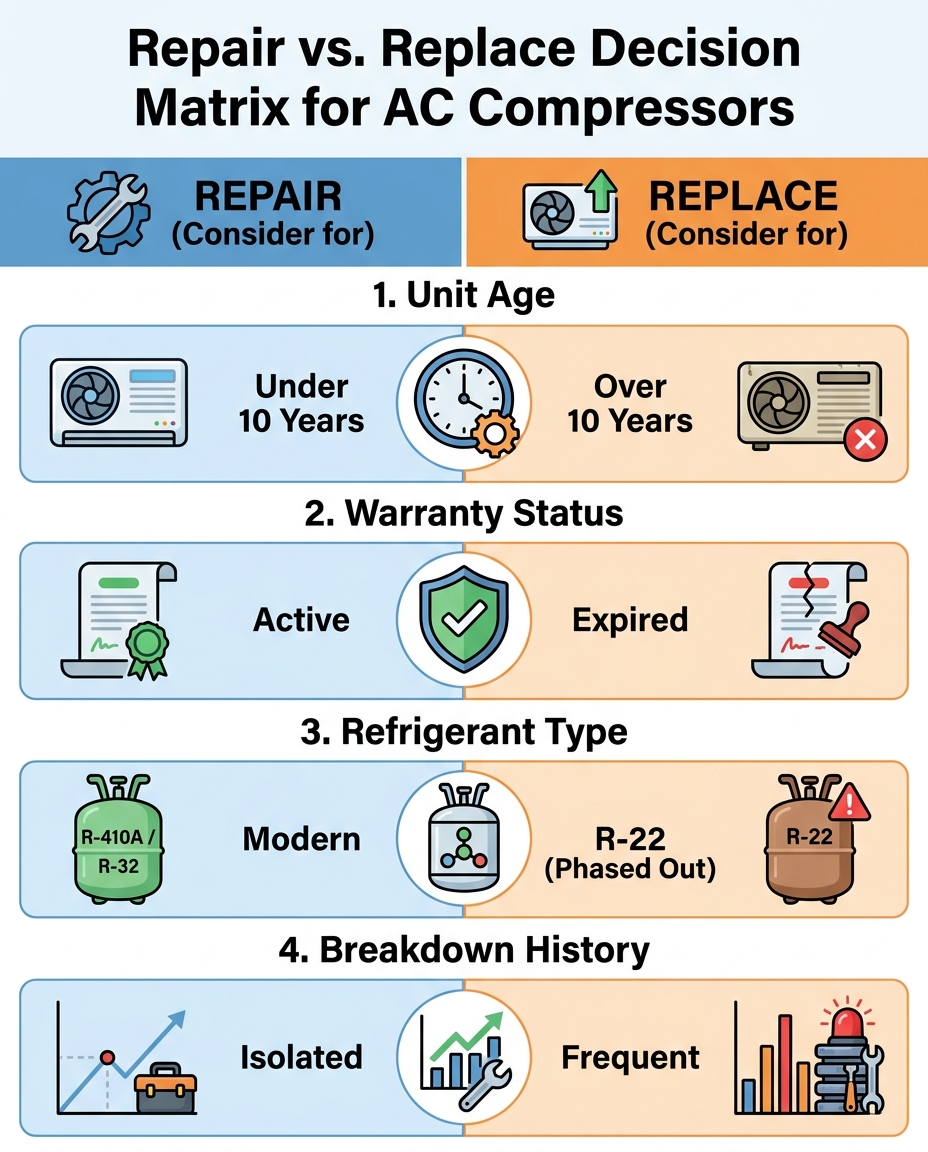
1. The unit is under a valid manufacturer warranty: If your system was registered properly and is still within its 5-year or 10-year parts warranty window, the manufacturer will cover the compressor part itself. You will only be responsible for the specialized labor and the new refrigerant, which significantly lowers your out-of-pocket exposure.
2. The overall system is relatively new: If your air conditioner is under 10 years old, the secondary components—like the condenser coils, blower motor, and electronic control boards—likely have plenty of life left in them. Putting a new compressor into a relatively young system is a sound investment.
3. The system utilizes modern refrigerant: Your unit must run on current, environmentally compliant refrigerants (like R-410A). If your system uses outdated, phased-out refrigerants, a repair becomes exponentially more difficult and impractical.
4. A comprehensive inspection reveals a healthy system: Before greenlighting a repair, our technicians thoroughly inspect the indoor evaporator coil and the ductwork. If the rest of the system is pristine, free of severe rust, and structurally sound, a new compressor will integrate smoothly without immediately triggering a secondary breakdown.
Criteria for a Complete System Replacement
When the conditions for a safe repair are not met, investing in a completely new air conditioning system is almost always the smarter choice. In our daily service runs across Roseville CA, where the peak summer heat load is intense and relentless, we see firsthand that relying on a patched-together, aging unit is a massive gamble.
The following indicators strongly suggest that a full system replacement is the most logical path forward:
• The system is out of warranty: When you have to account for both the heavy-duty compressor part and the extensive specialized labor, the total investment often approaches a significant down payment on a brand-new, highly efficient system.
• The unit is over 10 to 15 years old: Air conditioners have a finite functional lifespan. Even if you replace the compressor, a 12-year-old system is highly likely to suffer a blower motor failure or a coil leak in the near future.
• The system relies on R-22 refrigerant: The EPA has completely phased out R-22 (Freon) due to environmental regulations. Recharging an older system with R-22 is exceptionally difficult and prohibitively expensive, making replacement the only practical option.
• A history of frequent breakdowns: If you have already required multiple repairs over the last three seasons—such as replacing capacitors, contactors, or fan motors—the system is demonstrating a pattern of terminal decline.
• The need for better energy consumption: Upgrading offers access to significantly higher SEER2 ratings. California Title 24 energy efficiency standards ensure that a new, compliant system will perform vastly better under heavy regional heat loads, drastically lowering your monthly utility consumption compared to an aging, repaired unit.

Weighing Immediate Relief Against Long-Term Reliability
Making this decision while your house is sweltering in July mid-summer heat requires a framework that bridges the gap between a band-aid fix and a permanent solution. One of the most effective ways we help homeowners gauge the viability of a repair is by using the "Rule of 5,000." This simple industry formula involves multiplying the age of your equipment by the repair estimate. If the resulting number exceeds 5,000, the math strongly dictates that you should replace the unit rather than repair it. For example, if your system is 12 years old and the compressor repair estimate is high, the result easily surpasses the threshold, signaling a poor investment.
Beyond the math, you must consider the psychological toll of wondering if an aging, newly-repaired system will survive the rest of the season. Every time the system turns on, you may find yourself listening for strange noises, worried that another component is about to fail. Modern efficiency gains completely offset long-term operational demands, meaning a new system slowly pays for itself through improved energy efficiency.
The Hidden Costs of a Band-Aid Fix
If you choose to repair a severely aging unit, you take on hidden liabilities. First, you lose potential warranty coverage on the rest of the system; while the new compressor might have a brief part warranty, the 12-year-old coils and motors do not. Second, you lock yourself into continued high energy consumption during peak cooling months, using more electricity than you would with a modern, high-SEER2 system.
• Upfront Financial Impact — Band-Aid Compressor Repair: High immediate out-of-pocket requirement for specialized labor and parts. — Full System Replacement: Higher total investment, but easily manageable through structured monthly options.
• Long-Term Efficiency — Band-Aid Compressor Repair: Remains at the degraded efficiency level of the aging 10+ year old system. — Full System Replacement: Meets or exceeds modern Title 24 standards, lowering monthly utility usage.
• Warranty Protection — Band-Aid Compressor Repair: Only the new compressor part is covered; the rest of the aging system is unprotected. — Full System Replacement: Comprehensive 10-year parts warranty covers the entire system.
• Peace of Mind — Band-Aid Compressor Repair: High anxiety regarding the next inevitable component failure. — Full System Replacement: Total confidence in reliable cooling for the next decade.
The biggest hurdle for most homeowners is the upfront capital required for a new system. However, eliminating that barrier makes the smarter long-term choice accessible immediately. By utilizing flexible HVAC financing options, you can relieve the stress of a massive out-of-pocket expense. Financing allows you to choose a reliable full replacement without the panic of draining your savings, transforming a cooling emergency into a manageable, planned upgrade.
The Hidden Risks of Mismatched Components in Extreme Heat
A pattern we see often in Roseville is homeowners attempting to replace just the outdoor condensing unit (which houses the compressor) while leaving the older indoor evaporator coil and furnace in place. In the HVAC industry, indoor and outdoor components are engineered to work as a perfectly matched set. They must share the exact same refrigerant flow rates, pressure tolerances, and communication protocols to achieve their rated efficiency.
When you attach a brand-new, high-efficiency outdoor compressor to an older, restrictive indoor coil, you create a severe bottleneck in the refrigeration cycle. The new compressor will have to work twice as hard to push refrigerant through the old indoor equipment. This continuous strain drastically reduces the lifespan of the new compressor and completely voids the manufacturer's warranty, as brands require matched systems for valid coverage.
The Impact of Regional Climate
This mismatch becomes incredibly dangerous in our Northern California climate. The reality of 100-degree-plus ambient heat acts as a brutal stress test that quickly exposes weaknesses in mismatched or aging secondary components. When the outdoor temperature spikes, your air conditioner is forced to run continuously for hours on end just to maintain a livable indoor temperature.
Under this extreme heat load, a newly repaired compressor pushing against old indoor coils will run hotter and draw more electrical current. This high likelihood of a secondary breakdown occurring shortly after a major compressor repair is why our professionals strongly advise against partial replacements. Once you make the right decision to install a fully matched system, you must protect that investment through proactive, ongoing care. Enrolling in a routine AC maintenance plan ensures that your new equipment is cleaned, calibrated, and inspected annually, preventing future mid-summer emergencies.
Frequently Asked Questions About Compressor Failures
Is it worth replacing an AC compressor?
Yes, if the unit is under warranty and relatively new. If your system is under 10 years old and the manufacturer covers the compressor part, covering the labor makes practical sense. No, if the unit is old, uses R-22 refrigerant, or the repair estimate exceeds the overall value of the aging system based on the Rule of 5,000.
What happens when a home AC compressor goes bad?
The system loses its ability to circulate refrigerant entirely. This results in warm air blowing from your indoor vents, tripped circuit breakers at your electrical panel, or the outdoor unit failing to turn on at all. Because heat transfer is impossible without a functioning compressor, your home will quickly reach the temperature of the outdoor air.
Should I repair or replace my AC unit if it is over 10 years old?
Replacement is generally recommended for units over 10 years old experiencing catastrophic failure. At this age, the system has suffered significant efficiency losses, and the likelihood of future breakdowns in the blower motor or coils is very high. Investing heavily into a system nearing the end of its lifespan is rarely a sound decision.
Can you just replace the outside AC unit?
It is highly discouraged by Bronco Plumbing, Heating & Air, as well as major manufacturers. Mismatched indoor and outdoor units lead to poor performance, increased wear on the new compressor, and voided warranties. To achieve the SEER2 efficiency rating you are paying for, the outdoor condenser and indoor evaporator coil must be replaced as a matched set.
How long does an AC compressor typically last?
Under normal conditions with proper maintenance, a residential AC compressor typically lasts 10 to 15 years. Factors such as severe regional heat waves, lack of annual tune-ups, dirty air filters, and improper initial sizing can significantly shorten this lifespan by forcing the compressor to overwork.
Restore Your Home's Cooling and Peace of Mind Today
Deciding between repairing vs. replacing a blown AC compressor mid-summer ultimately comes down to balancing your immediate needs with long-term comfort and safety. A compressor failure in Roseville CA is a serious event, but you do not have to make the decision blindly. By weighing the age of your equipment, the status of your warranty, and the massive efficiency gains of a new system, you can choose a path that protects your home.
If you are currently sweating through a breakdown, know that our team is ready to help you through the crisis without panic. Do not settle for a temporary band-aid fix that leaves you worrying about the next heatwave. Contact Bronco Plumbing, Heating & Air today for an immediate assessment, and take the first step toward restoring reliable, efficient cooling to your home.

Customer Testimonials
Our customer testimonials highlight the reliable service, quality workmanship, and trusted results homeowners experience with Bronco Plumbing Heating and Air.


Ready to Transform your Home?
Create a healthier, more comfortable home with expert HVAC, plumbing, and indoor air quality solutions you can trust. From efficient heating and cooling to cleaner air and reliable repairs, our experienced team is here to keep your family comfortable year-round with dependable service and upfront pricing.
Related Articles
What Actually Happens When You Set Your Thermostat to 65 Degrees in 100-Degree Heat


The Hidden Cost of Dirty AC Coils in Dusty North Highlands Neighborhoods
A Practical Guide to HVAC Repair vs Replacement