



.svg)

What Actually Happens When You Set Your Thermostat to 65 Degrees in 100-Degree Heat
Dropping your AC to 65 degrees during a 100-degree heatwave won't cool your house any faster. Find out why treating your thermostat like a gas pedal actually freezes your system.

The Frustrating Reality of the 'Gas Pedal' Approach to Cooling
A persistent myth among homeowners is that treating your cooling system like a car's gas pedal will force it to work faster, but knowing what actually happens when you set your thermostat to 65 degrees in 100-degree heat is the key to preventing a massive repair bill. When you walk through your front door and are immediately hit by a wall of heavy, stagnant air, the physical discomfort is undeniable. The heat radiates from the walls, the floors feel warm to the touch, and the indoor air feels thick. In that exact moment, the psychological temptation to walk over to the wall and drastically drop the temperature setting is incredibly strong.
If you are struggling to keep your home comfortable this summer, exploring professional air conditioning services can help you regain control over your indoor climate.
During a 100-degree summer heatwave in Roseville, the thermal load on your house is extreme. The sun beats down on your roof, heat transfers through your windows, and the hot outdoor air constantly presses against your home's exterior. Walking into a sweltering house during peak summer triggers an instinct to demand immediate relief. You might think that by requesting a drastically lower temperature, the system will somehow shift into a higher gear and blast freezing air into the rooms.
However, this common reaction actually sets the stage for a mechanical failure rather than rapid relief. Your cooling equipment is bound by the laws of physics and mechanical design. Pushing the target temperature down to an unachievable number does not accelerate the cooling process. Instead, it forces your equipment into a dangerous state of continuous operation, stripping away its ability to cycle normally and recover. Understanding why this approach fails is the first step in keeping your house cool and your equipment safe.
Why Your HVAC System Isn't a Volume Dial
To understand why the gas pedal approach fails, you have to look at how a standard residential air conditioner actually operates. Most homes are equipped with a single-speed compressor. This means the system has exactly two modes: completely on, or completely off. It does not have a low gear, a high gear, or a turbo mode. When you demand a lower temperature, you are not telling the system to work harder or faster; you are simply telling it to run longer.
The On/Off Switch Reality
A single-speed compressor functions exactly like a standard light switch, not a dimmer dial. When the indoor temperature rises above your set point, the thermostat sends a signal to turn the system on. The equipment immediately begins operating at 100% of its cooling capacity. The air coming out of your supply vents is the exact same temperature whether your target is set to 78 degrees or if you have 65 degrees on the thermostat.
Because the system cools at a constant, fixed rate regardless of the target temperature, dropping the number on the wall does not change the temperature of the air being produced. It only changes when the system is allowed to turn off. Human impatience often clashes with this unchangeable mechanical reality of heat transfer. You want the house cool right now, but the equipment can only remove a specific amount of heat per hour.
If you are relying on outdated controls that make it difficult to manage your indoor climate effectively, looking into modern thermostat upgrades can provide better programming options to avoid these extreme temperature swings.
• Setting the temperature lower forces colder air out of the vents. — The Mechanical Reality: The vent air temperature remains exactly the same; the system just runs longer.
• The AC will cool the house faster if the target is further away. — The Mechanical Reality: The cooling rate is fixed. It takes the same amount of time to drop one degree.
• The system operates like a car engine with variable speeds. — The Mechanical Reality: Standard systems operate like a light switch: 100% on or 100% off.
• A 65-degree setting will eventually be reached if it runs long enough. — The Mechanical Reality: Extreme external heat makes reaching a 35-degree drop physically impossible.
The 20-Degree Rule and the Limits of Heat Transfer
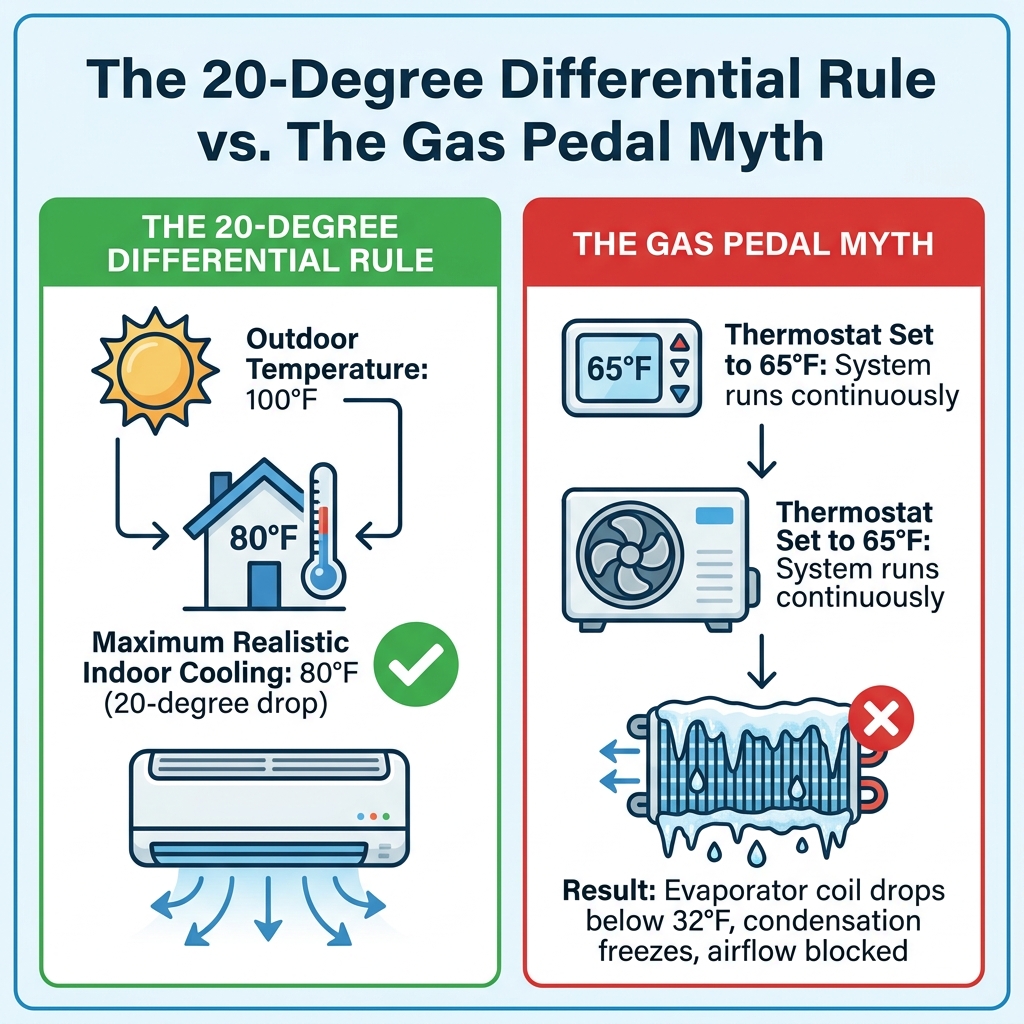
Air conditioning manufacturers design residential systems around specific performance metrics. One of the most important metrics to understand is the 20-degree temperature differential rule. This rule dictates the maximum realistic cooling capacity of a standard central air unit under heavy thermal stress.
Air conditioners are engineered to drop the indoor temperature a maximum of 15 to 20 degrees below the outdoor temperature. This is the physical limit of the heat transfer process. When the outside air is scorching, the system can only move so much heat out of your home at one time.
Fighting the External Thermal Load
During a 100-degree summer heatwave in Roseville, your house is constantly absorbing heat from the sun and the ambient air. This is known as the external thermal load. The dry, extreme heat pushes standard residential systems well beyond typical manufacturer testing conditions, which are often based on milder summer days.
When you do the math, the reality of the 20-degree rule becomes clear. If it is 100 degrees outside, maintaining an indoor temperature of 80 degrees is a realistic and successful system performance. The equipment is actively fighting a massive amount of heat gain just to hold that 20-degree difference.
Forcing the system to aim lower than this differential is a futile battle against thermodynamics. The house is gaining heat from the outside almost as fast as the air conditioner can remove it. When you set the target to an impossible number, the equipment will never reach the goal, meaning it will never receive the signal to shut off and rest.

The Domino Effect: Turning Condensation Into Ice
When you demand an impossible temperature, you trigger a specific mechanical chain reaction. Because the system cannot reach the target, it runs 100% of the time without cycling off. This continuous operation throws the delicate balance of heat transfer completely out of alignment, leading directly to a frozen system.
1. Continuous Operation: With 65 degrees on the thermostat during peak heat, the unit never shuts down. The compressor pumps refrigerant endlessly through the indoor evaporator coil.
2. Temperature Plunge: Normally, the warm indoor air blowing over the coil keeps the refrigerant inside from getting too cold. But as the system runs for hours on end, the temperature of the evaporator coil begins to drop steadily until it falls below 32 degrees Fahrenheit.
3. Moisture Freezing: As warm air passes over the freezing coil, the natural humidity in the air condenses into water droplets. Because the metal coil is now below freezing, this normal condensation instantly turns into solid ice.
4. Airflow Blockage: The ice starts as a thin layer of frost but quickly builds into a solid block of ice wrapping around the coil fins. This ice completely chokes off the passage of air. The blower motor continues to run, but no cold air can make it through the ice block and into your ductwork.
This process is heavily influenced by how clean your equipment is. Understanding how a dirty condenser coil impacts AC performance is critical, as any restriction in heat transfer makes this freezing process happen even faster. Once the coil is encased in ice, your home will quickly heat up, even though the machinery outside is still running at full speed.
Warning Signs Your Cooling System Has Reached Its Breaking Point
Identifying a system that has been pushed past its limit can save you from a burned-out compressor or severe water damage from melting ice. When the equipment is overworked, it will display several clear physical symptoms.
• Constant running with no cooling: The primary symptom is a system that runs for hours without stopping, yet the indoor temperature continues to slowly rise.
• Weak or warm airflow: Place your hand over a supply register. If the air feels weak, barely moving, or surprisingly warm, the indoor coil is likely blocked by a sheet of ice.
• Visible ice on the lines: Check the outdoor unit. If you see white frost or a thick layer of ice building up on the copper refrigerant lines leading into the house, the indoor coil is definitely frozen.
• Water pooling near the furnace: As the ice block occasionally melts and refreezes, it can overwhelm the drain pan, leading to puddles forming around your indoor air handler.
If you notice any of these signs, the most important step is to immediately turn the cooling system off at the thermostat. Switch the fan setting from 'AUTO' to 'ON'. This forces warm indoor air over the frozen coil to help it thaw safely. Keeping up with routine AC maintenance ensures your system has the proper airflow and refrigerant charge to handle heavy summer loads without freezing prematurely.
Smart Cooling Strategies When the Mercury Hits Triple Digits
Leveraging local expertise from Bronco Plumbing, Heating & Air reveals that proactive, realistic temperature management prevents the emergency breakdowns seen every summer. Working with the physics of your home rather than fighting against them is the secret to staying comfortable when the weather turns extreme.
Set a realistic target: Recommend setting the thermostat to a realistic target, such as 78 degrees, during the hottest part of the day. This allows the system to cycle normally, rest, and avoid freezing the coil. If 78 feels too warm, dropping it to 75 is safer than plummeting straight to 65.
Pre-cool your home: Take advantage of the cooler early morning hours. Drop the temperature a few degrees lower than your normal setting before the sun comes up. This builds a reservoir of cool air in your home's thermal mass (the walls, floors, and furniture), giving the system a head start before the peak heat hits.
Utilize the wind-chill effect: Support your air conditioner by running ceiling fans in occupied rooms. Fans do not lower the room's actual temperature, but moving air evaporates moisture from your skin, making you feel up to four degrees cooler without requiring the AC to work any harder.
Block radiant heat: Sunlight streaming through windows acts as a massive heater. Close your blinds, shades, and curtains on the south and west-facing sides of your home during the hottest parts of the day. Blocking this radiant heat significantly reduces the thermal load your cooling system has to fight.
Frequently Asked Questions About Summer Thermostat Settings
Does setting the AC lower make it cool faster?
No, setting the temperature lower does not increase the speed or intensity of the cooling. Standard air conditioners operate at a single speed, meaning they extract heat at a constant rate. Setting the dial lower simply forces the system to run for a longer period of time, which can lead to overworked parts and frozen coils.
Why did my AC coil freeze in the summer?
Coils freeze when the system runs continuously without cycling off, causing the evaporator coil temperature to drop below freezing. This turns normal humidity and condensation into solid ice. It is frequently caused by setting the thermostat too low during extreme heat, though dirty air filters and low refrigerant can also trigger the same freezing process.
What is the 20-degree rule for air conditioning?
The 20-degree rule states that a residential air conditioning system is designed to lower the indoor temperature by a maximum of 15 to 20 degrees compared to the outdoor air. Pushing the system to achieve a larger temperature gap exceeds its mechanical capacity and prevents the unit from cycling off properly.
How cold can an AC get a house if it's 100 degrees outside?
When the outside temperature reaches 100 degrees, a healthy, properly sized air conditioner can realistically maintain an indoor temperature of about 80 degrees. While a highly efficient system in a well-insulated home might achieve slightly better results, expecting a temperature below 78 degrees under these conditions puts extreme stress on the equipment.
Why is my AC running constantly but not cooling the house?
If your system runs non-stop without lowering the temperature, it is losing the battle against the external heat load. This often means the system is frozen, the air filter is completely clogged, or the unit is simply outmatched by the extreme outdoor temperatures and cannot move enough heat out of the house.
Should I turn my AC off completely if the coil is frozen?
Yes, you must turn the cooling function off immediately to stop the compressor from running. Switch the thermostat fan setting to 'ON' so the blower continues circulating warm indoor air over the ice block. This is the fastest and safest way to thaw the coil before a technician arrives to inspect the system.
Protect Your Equipment During the Toughest Summer Spikes
Working with the physics of your system, rather than against it, keeps the house comfortable and the equipment safe. Understanding what actually happens when you set your thermostat to 65 degrees in 100-degree heat empowers you to make smarter choices when the weather is at its worst. Having 65 degrees on the thermostat might feel like a quick fix, but patience and realistic settings are what truly prevent costly frozen coils and emergency breakdowns. If your system consistently struggles to maintain a reasonable 20-degree temperature differential, it is time to explore professional support to ensure your home stays cool and protected all summer long.

Customer Testimonials
Our customer testimonials highlight the reliable service, quality workmanship, and trusted results homeowners experience with Bronco Plumbing Heating and Air.


Ready to Transform your Home?
Create a healthier, more comfortable home with expert HVAC, plumbing, and indoor air quality solutions you can trust. From efficient heating and cooling to cleaner air and reliable repairs, our experienced team is here to keep your family comfortable year-round with dependable service and upfront pricing.
Related Articles
Repairing vs. Replacing a Blown AC Compressor Mid-Summer


The Hidden Cost of Dirty AC Coils in Dusty North Highlands Neighborhoods
A Practical Guide to HVAC Repair vs Replacement