



.svg)

Why Summer Tree Root Intrusion Causes Unexpected Sewer Line Backups in Carmichael
When summer heat dries out the soil, thirsty tree roots aggressively invade underground plumbing. Discover the early warning signs of root intrusion and why a camera inspection is your best next step.
The Hidden Cause of Unexpected Summer Sewer Backups
Understanding exactly why summer tree root intrusion causes unexpected sewer line backups in Carmichael is the first step to protecting your property from a sudden plumbing disaster. It is a frustrating and perplexing situation: your toilets are gurgling, the bathtub is draining at a glacial pace, and wastewater is threatening to back up into the lower levels of your home, yet there has not been a drop of rain in weeks. Most homeowners associate severe sewer line issues with heavy winter storms that overwhelm municipal systems, making a dry-weather backup feel entirely counterintuitive. However, the lack of surface water is precisely the catalyst driving underground biological activity that threatens residential plumbing systems.
When you need reliable solutions for these complex hidden issues, accessing professional home services, including expert plumbing services, ensures your home is protected from catastrophic structural damage.
The Collision of Urban Forests and Residential Plumbing
During the typical dry July weather, mature urban forests and residential plumbing systems are on a direct collision course. Trees are biological survival engines. When the topsoil dries out completely, their root systems must adapt instantly to survive the scorching heat. Without surface moisture to rely on, these massive root networks expand aggressively downward and outward, actively seeking out new hydration sources. Your home's sewer lateral—the main pipe carrying wastewater from your house to the municipal line—acts as a continuous, nutrient-rich underground river.
To understand why this happens primarily during the hottest months, it helps to look at the differences between seasonal plumbing threats:
• Heavy Winter Rain — Primary Threat to Sewer Lines: Hydrostatic pressure and soil shifting — Underground Biological Activity: Dormant; roots receive ample surface water
• Mild Spring Weather — Primary Threat to Sewer Lines: Minor clogs from household usage — Underground Biological Activity: Moderate growth; surface moisture is still available
• Dry July Weather — Primary Threat to Sewer Lines: Aggressive tree root infiltration — Underground Biological Activity: Hyper-active; roots actively hunt for deep moisture sources
Because the roots are starved for water, they will exploit any microscopic vulnerability in your underground pipes. What begins as a microscopic root hair following a trail of condensation can quickly escalate into a solid mass of wood blocking the entire diameter of your sewer line.
How Severe Summer Heat Triggers Aggressive Root Growth
The biological response of drought-stressed trees during zero-rainfall months is a fascinating, albeit destructive, natural process. Sacramento's extreme hot, dry summers and lack of natural rainfall create the exact conditions that force roots into residential sewer lines. When temperatures soar and the soil bakes, surface moisture completely evaporates. This triggers a survival mechanism in large, mature trees.
The Biology of Drought Stress
Drought-Stress Response: When a tree enters a state of drought stress, it redirects its energy from canopy growth to root expansion. The tree must secure a constant water supply to maintain transpiration—the process of moving water from the roots to the leaves to cool the plant. During dry July weather, the upper layers of soil offer nothing, prompting the root system to dive deeper into the earth.
Hydrotropism at Work: Tree roots possess an incredible biological trait called hydrotropism, which is the ability to sense and grow toward moisture. They do not just blindly bump into pipes; they actively detect moisture vapor escaping from underground sources. Even a microscopic crack or a slightly loose joint in a sewer pipe releases a steady plume of condensation into the surrounding soil. The roots detect this vapor trail and follow it directly to the source.
The Perfect Nutrient Source: Once the roots locate the pipe, they discover an environment that provides everything a desperate tree needs to thrive. Sewer lines offer a constant, reliable source of water, essential nutrients (from organic waste), and oxygen (flowing through the upper portion of the pipe). For a tree struggling through a blistering summer, a residential sewer line is an oasis. The roots will force their way through failing joints, expanding rapidly once inside the pipe, and transforming from tiny, hair-like tendrils into thick, woody masses that catch debris and halt wastewater flow entirely.
The Vulnerability of Mid-Century Plumbing Infrastructure
The biological threat of root intrusion is severely compounded by the specific architectural and infrastructural history of the local area. Carmichael experienced a massive construction boom from the 1950s through the 1970s. During this era, residential developers predominantly utilized vitrified clay pipe (VCP) or cast iron for underground sewer laterals. While these materials were the gold standard at the time, they possess inherent vulnerabilities that become highly problematic half a century later.
The Degradation of Clay and Cast Iron
Clay pipes are assembled in short sections, meaning a standard residential sewer line contains dozens of joints. Over decades of minor seismic activity, soil settling, and temperature fluctuations, the mortar or rubber gaskets sealing these joints degrade. This creates microscopic gaps. Cast iron pipes face a different issue: they corrode from the inside out, a process called channeling, which eventually thins the bottom of the pipe until it cracks. Once a crack or joint separation occurs, the pipe begins leaking moisture vapor into the soil, ringing the dinner bell for local vegetation.
This region is defined by its dense, mature urban forest canopy. The towering oaks, elms, and sycamores that make the neighborhoods so beautiful also possess massive, powerful root systems. The juxtaposition of a 60-year-old degrading clay pipe and a 60-year-old thirsty oak tree creates a high-risk scenario for property owners.
Older homes with recurring plumbing issues require knowledgeable, localized expertise to diagnose properly. For example, one local homeowner with an older property faced recurring plumbing issues until a thorough diagnostic approach from our lead plumber, Lupe, provided a knowledgeable and reasonable solution that properly addressed the aging system. Understanding the specific soil conditions and infrastructure age in Carmichael and surrounding service areas is critical for accurately identifying why a line keeps backing up.
The Mechanics of Root Intrusion: How Trees Breach Sewer Lines
Understanding the step-by-step physical process of how roots infiltrate and eventually block a sewer pipe highlights why early detection is critical. Root intrusion is not an overnight event; it is a progressive, mechanical failure of the plumbing infrastructure that occurs in distinct phases.
Phase 1: Vapor Detection and Initial Breach
The process begins invisibly. As discussed, hair-like roots follow moisture vapor to a loose joint or a microscopic crack in the pipe. These initial roots are as thin as a thread. They do not need a large hole to enter the plumbing system; they can slip through gaps that are virtually invisible to the naked eye. At this stage, the homeowner will notice no symptoms, and the plumbing will drain normally.
Phase 2: Expansion and the Net Effect
Once inside the nutrient-rich environment of the pipe, the roots experience explosive growth. They multiply and lengthen, hanging down into the flow of the wastewater. This creates a biological net inside your sewer lateral. As wastewater flows out of the home, this net catches toilet paper, organic waste, and grease. The pipe's internal diameter shrinks drastically. This is typically when homeowners start researching why your sewer line may sustain damage, as the first signs of slow draining begin to appear.
Phase 3: Structural Damage and Pressure
As the roots continue to grow, they expand in thickness. A root that entered as a thread can grow to the thickness of a human arm. This expansion exerts immense hydrostatic and mechanical pressure on the fragile clay or cast iron pipe. The roots act like a wedge, forcing the crack wider or pushing the joint completely apart. If left unchecked, this immense pressure will eventually shatter or collapse the pipe entirely.
Phase 4: Secondary Damage and Complete Obstruction
When the line is fully obstructed, the secondary damage begins. Wastewater has nowhere to go but backward. It will seek the lowest elevation point in the home—usually a ground-floor shower, a basement floor drain, or a downstairs toilet—and overflow into the living space. This introduces raw sewage into the home, creating severe property damage and significant health hazards that require extensive remediation.
Early Warning Signs of Root Intrusion in Your Plumbing
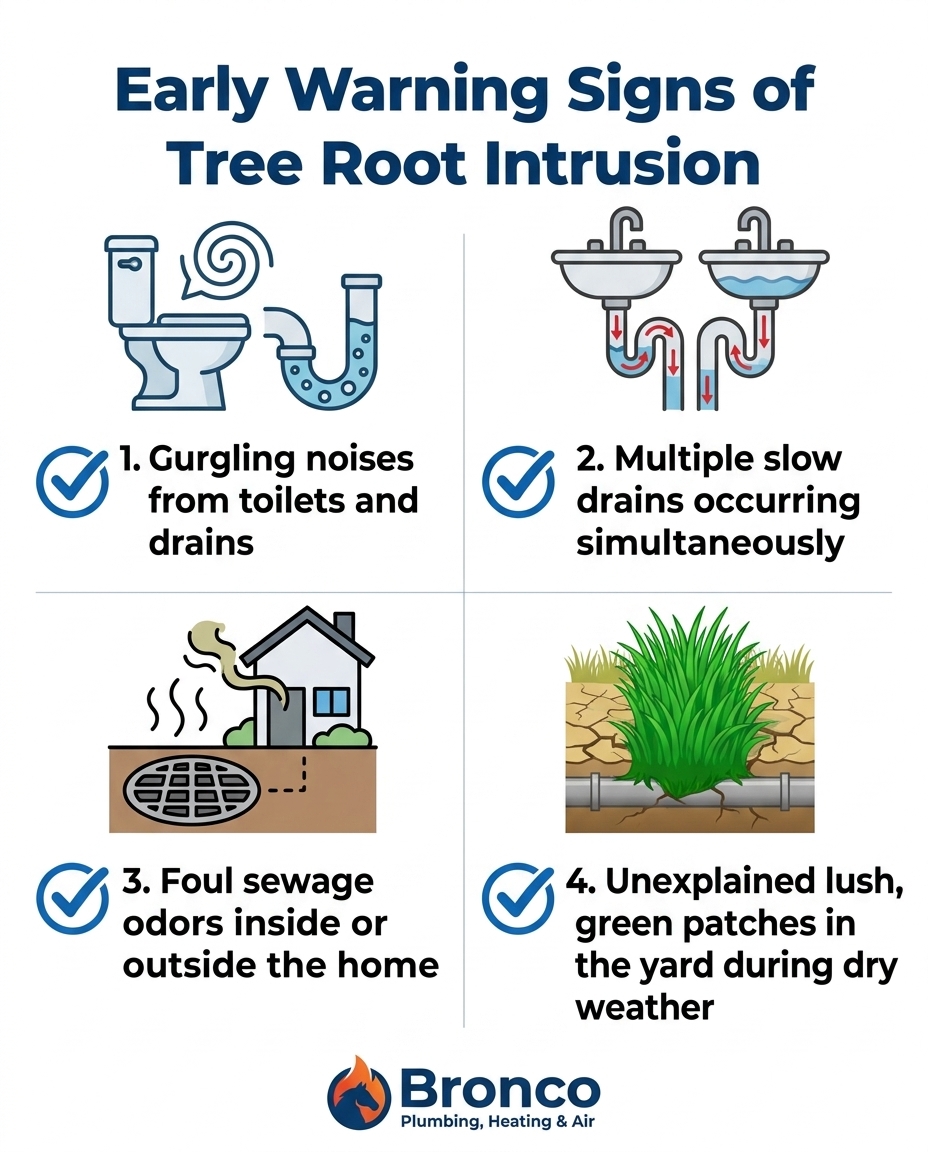
Because the initial breach happens silently underground, homeowners must remain vigilant for the secondary symptoms of a restricted flow. Catching a root intrusion early—before the roots snap the pipe—can mean the difference between a routine clearing and a massive excavation project. If you notice any of the following symptoms during dry July weather, your main sewer line is likely compromised.
• Gurgling sounds from fixtures: If you flush a toilet and hear a bubbling or gurgling sound coming from the bathtub drain or a bathroom sink, this indicates a venting issue caused by a blockage. The root mass acts as a plug, forcing displaced air to escape through the nearest water trap.
• Multiple slow drains occurring simultaneously: A single slow sink usually means a localized clog (like hair in the P-trap). However, if the kitchen sink, the laundry drain, and the hallway bathroom are all draining sluggishly at the same time, the restriction is located deep in the main sewer lateral.
• Foul odors inside or outside: A healthy sewer system is airtight and directs all sewer gases up through the roof vents. If you smell raw sewage emanating from your drains, or if you notice a distinct sewage odor in your front yard, wastewater is pooling behind a root blockage or leaking into the soil.
• Unexplained lush, green patches in the yard: If your lawn is generally dry and dormant during the peak of summer, but you have one specific patch of grass that is vibrant, green, and growing rapidly, it is likely being fertilized from below by a leaking, root-infested sewer line.
• Backups in lower-elevation fixtures: When the main line is choked by roots, wastewater will back up into the lowest drain in the house first. If running your washing machine causes water to rise in your ground-floor shower, the main line is severely restricted.
Common Myths About Clearing Tree Roots from Sewer Lines
When faced with a slow drain, many homeowners turn to the internet or the hardware store for quick fixes. Unfortunately, the plumbing aisle is full of products that promise to dissolve tree roots, leading to dangerous misconceptions about how to properly maintain a sewer line.
The Myth of Chemical Root Killers
Chemical root killers poured down the drain are not a permanent or effective fix for heavy intrusions. Products containing copper sulfate or foaming root killers may burn off the very tips of the roots, but they cannot dissolve a solid block of wood that has already choked a four-inch pipe. Furthermore, these harsh chemicals pose significant environmental risks. When poured into a severely cracked pipe, the toxic chemicals leach directly into the surrounding soil and groundwater.
Additionally, harsh chemical solvents can accelerate the degradation of older cast iron pipes, eating away at the weakened metal and turning a partial blockage into a complete structural collapse.
The Danger of Blind Mechanical Clearing
Another common myth is that simply renting a heavy-duty drain snake or auger will solve the problem. Mechanical clearing without a visual inspection can sometimes push the problem further down the line or destroy the pipe. If a clay pipe is already fractured by root pressure, aggressively running a steel cutting blade through it can shatter the remaining structure. You might clear the roots, but you will also collapse the pipe, necessitating an immediate and costly emergency excavation.
Clearing a blocked sewer line requires a licensed professional. A trained technician understands the exact torque and water pressure limits of aging infrastructure, ensuring the blockage is removed without causing further structural damage to the property.
Why Professional Camera Inspections Are the Ultimate Diagnostic Tool
The days of guessing where a pipe is broken or blindly digging up a front yard are over. Today, the high-definition sewer camera inspection is the required, definitive next step for diagnosing any main line blockage without unnecessary excavation.
Precision Diagnostics for Older Homes
High-definition sewer cameras are mounted on flexible fiber-optic cables that navigate the twists and turns of the lateral line. These cameras provide a real-time, illuminated video feed to a monitor above ground. This allows the technician to visually pinpoint the exact location, depth, and severity of the intrusion. Most modern camera heads are equipped with sonde transmitters, allowing the technician to use a locator wand above ground to mark the exact spot of the blockage on your lawn.
Crucially, these inspections differentiate between a simple flushable wipe clog, a minor root mass that can be hydro-jetted, or a fully collapsed pipe that requires immediate replacement. Knowing the exact condition of the pipe before deciding on a course of action prevents homeowners from paying for a drain clearing service when a trenchless repair is actually required.
Bronco Plumbing, Heating & Air leverages deep local expertise with the area's specific infrastructure and mature tree canopy to accurately diagnose complex intrusions. Because we understand the specific vulnerabilities of Carmichael's mid-century construction, our technicians can accurately interpret the camera footage, identifying subtle signs of joint failure or channeling that an untrained eye might miss.
Safeguarding Your Home Against Summer Sewer Emergencies
Ignoring slow drains during the peak of summer will almost certainly lead to a complete sewer line failure. The roots will not stop growing, and the dry July weather will only increase their desperate search for moisture inside your plumbing. The longer a root mass is allowed to expand inside a clay or cast iron pipe, the higher the likelihood of irreversible structural damage that requires a full line replacement.
Proactive diagnostic action is the only way to protect your home. If you are experiencing gurgling toilets, foul odors, or sluggish drains across multiple fixtures, do not wait for raw sewage to back up into your bathtubs. Schedule a professional camera inspection today to definitively identify the issue. A clear, technical understanding of your underground infrastructure allows you to resolve the problem efficiently, restoring your plumbing system's integrity before a minor root intrusion becomes a major summer emergency.
Frequently Asked Questions
Why do tree roots grow into sewer pipes?
Tree roots grow into sewer pipes because they are biologically driven to seek out moisture, oxygen, and nutrients. During dry weather, the soil loses its water content, prompting roots to grow deeper. They detect the moisture vapor escaping from tiny cracks or loose joints in underground sewer lines and force their way inside to access the continuous flow of water and organic material.
How do you know if roots are in your sewer line?
You can identify roots in your sewer line by watching for several key symptoms. The most common signs include multiple drains moving slowly at the same time, gurgling sounds coming from the toilet when you run the sink, and foul sewage odors in your home or yard. You might also notice an unusually green, lush patch of grass in your yard directly above the sewer lateral during an otherwise dry season.
Can summer heat cause sewer backups?
Yes, summer heat is a primary trigger for severe sewer backups. Extreme heat bakes the topsoil and evaporates surface moisture, causing large trees to experience drought stress. In response, their root systems aggressively expand downward and outward to find water, frequently invading residential sewer lines and creating dense blockages that stop wastewater flow entirely.
Does homeowners insurance cover tree roots in sewer lines?
In most standard policies, homeowners insurance does not cover the cost of repairing or replacing a sewer line damaged by tree roots, as this is typically classified as a preventable maintenance issue. However, if the root intrusion causes a sudden backup that floods the interior of your home, the resulting water damage to your floors and walls might be covered. You should always review your specific policy details or consult your insurance agent for exact coverage limits.
How quickly can tree roots block a sewer lateral?
Once roots breach a sewer lateral, they can create a severe blockage in a matter of months, especially during peak summer heat. The nutrient-rich environment inside the pipe causes explosive, rapid growth. What starts as a hair-thin root can expand into a dense, woody mass that completely chokes a four-inch pipe in a single dry season if left untreated.
Are older homes in Carmichael more susceptible to root intrusion?
Yes, older homes in Carmichael are significantly more susceptible to root intrusion. Properties built between the 1950s and 1970s heavily utilized vitrified clay or cast iron pipes, which degrade, crack, and separate at the joints over decades. Combined with the area's mature, dense urban forest canopy, these aging pipes present easy targets for aggressive tree roots seeking moisture.

Customer Testimonials
Our customer testimonials highlight the reliable service, quality workmanship, and trusted results homeowners experience with Bronco Plumbing Heating and Air.


Ready to Transform your Home?
Create a healthier, more comfortable home with expert HVAC, plumbing, and indoor air quality solutions you can trust. From efficient heating and cooling to cleaner air and reliable repairs, our experienced team is here to keep your family comfortable year-round with dependable service and upfront pricing.
Related Articles
Is a 24-Hour Emergency AC Repair Call Justified for a Tripped Breaker?


Surviving a Sacramento Valley Heatwave When Your AC Condenser Freezes Solid

What Actually Happens When You Set Your Thermostat to 65 Degrees in 100-Degree Heat