



.svg)

Does Hosing Down Your AC Condenser Actually Improve Cooling Performance?
When your air conditioner struggles during a July heatwave, spraying the dusty outdoor unit with water seems like a quick fix. Find out if it helps or causes expensive damage.

Is Hosing Down Your Outside AC Unit Safe During a Heatwave?
Is your air conditioner running nonstop, yet the house still feels uncomfortably warm? You might be wondering, does hosing down your AC condenser actually improve cooling performance when the system is struggling to keep up? It is a question we hear constantly from homeowners looking for immediate relief during July peak summer heatwaves. When the thermostat is climbing and the outdoor unit is visibly coated in dust, taking a garden hose to the equipment seems like a logical, quick fix to help it cool down.
While the outdoor portion of your air conditioning system is built to withstand rain and harsh weather, deliberately spraying it with water requires specific knowledge. Hitting the unit with heavy water pressure can cause permanent, expensive damage to delicate components. There is a massive difference between a gentle rinse to clear away loose leaves and the deep, chemical cleaning required to actually restore lost efficiency. If your system is failing to cool your home, the safest and most effective path forward is establishing a routine HVAC maintenance plan to keep the equipment running at peak capacity before the extreme heat arrives.
The Short Answer: Can Water Improve Your Condenser's Cooling Performance?
The short answer is yes, removing airflow obstructions improves cooling, but water only provides a temporary evaporative cooling effect and only removes loose, surface-level debris. If your condenser coil is blocked by a light layer of dry dust or grass clippings, a gentle rinse will help the unit breathe easier. However, water alone cannot dissolve the baked-on grime that severely insulates the internal coils and drives up your energy bills.
Many homeowners confuse the immediate cooling effect of cold water with actual efficiency restoration. When you spray a hot condenser with cool water, the water evaporates, rapidly absorbing heat. The system will temporarily blow colder air indoors. But once that water dries up twenty minutes later, the underlying problem remains. The dirt is still there, and the system goes right back to struggling.
Furthermore, the risks often outweigh the temporary benefits. High water pressure from a jet nozzle or a power washer will severely damage the fragile aluminum fins that wrap around the condenser. Once those fins are flattened, airflow is permanently blocked.
• Temporary Water Rinsing — What It Accomplishes: Washes away loose grass, leaves, and dry surface dust. Provides a brief evaporative cooling boost. — Primary Risk Factor: Using too much pressure can bend fins or push dirt deeper into the unit.
• Professional Chemical Cleaning — What It Accomplishes: Dissolves baked-on grime, grease, and hardened pollen from the inside out. — Primary Risk Factor: None when performed by a licensed professional who understands safe disassembly.
How Dirt and Dust Restrict Airflow in Your Condenser
To understand why hosing down your unit often falls short, you have to understand the job of the condenser coil. The outdoor unit does not actually create cold air; its primary function is to release the heat that was absorbed from inside your home into the outdoor air. The hot refrigerant travels through the copper coils outside, and the large fan pulls outdoor air across the aluminum fins to cool that refrigerant down.
In the Sacramento Valley, our dry climate, agricultural activity, and high pollen counts create a perfect storm for condenser blockages. During the summer, morning dew mixes with airborne dust and pollen, creating a sticky paste that bakes onto the coils during triple-digit afternoon heat waves. Over several months, this bakes into a hard, insulating crust.
According to data from the U.S. Department of Energy, a dirty condenser coil can increase your compressor's energy consumption by up to 30 percent. Because the dirt acts like a heavy winter blanket over the coils, the heat cannot escape. The compressor is forced to run longer and hotter to achieve the same cooling results indoors. If you want to dive deeper into the science of heat transfer, understanding how a dirty condenser coil affects AC performance is critical for protecting your investment.
The Hidden Risks of Improper DIY AC Cleaning
When homeowners take matters into their own hands without understanding the mechanics of the equipment, a well-intentioned cleaning can quickly turn into a costly repair. Here are the hidden risks of improper DIY hosing.
• Turning dry dust into caked mud: Light hosing without adequate, targeted flow can actually make the problem worse. If the water pressure isn't sufficient to push the dirt completely out of the fins, it simply wets the dust, turning it into thick mud that dries like concrete deep inside the coil matrix.
• Electrical hazards: While outdoor units are designed to handle heavy rain, rain falls straight down. Spraying a hose sideways or upward into the electrical compartment, the contactor, or directly into the fan motor vents can cause electrical shorts and immediate system failure.
• Compressor burnout: If you accidentally block airflow while trying to clean the unit, the compressor will overheat. One local homeowner experienced this exact scenario during a Sunday 106-degree heat wave. Their outside unit completely stopped turning on because the compressor failed under the extreme strain. A technician had to be dispatched for an emergency diagnostic, resulting in a fast compressor replacement to restore cooling during the dangerous heat.
Why Bent Fins Are a Serious Problem
The most common and destructive mistake homeowners make is bending the aluminum fins. These fins are incredibly fragile—often thinner than a piece of heavy aluminum foil. They are spaced very closely together to maximize the surface area for heat transfer.
If you hit these fins with a high-pressure nozzle or a power washer, they will instantly fold over and flatten against each other. When the fins are bent, they act exactly like closed window blinds, trapping all the heat inside the unit. Air can no longer pass through the coil. Straightening them requires a specialized tool called a fin comb and hours of tedious, professional patience to avoid snapping the metal entirely.
What Constitutes Safe, Gentle Rinsing?
If you notice a buildup of loose cottonwood seeds, dry grass clippings, or spider webs on the outside of your unit, you can safely rinse it away provided you follow strict boundaries. Safe rinsing is about clearing surface debris, not deep cleaning.
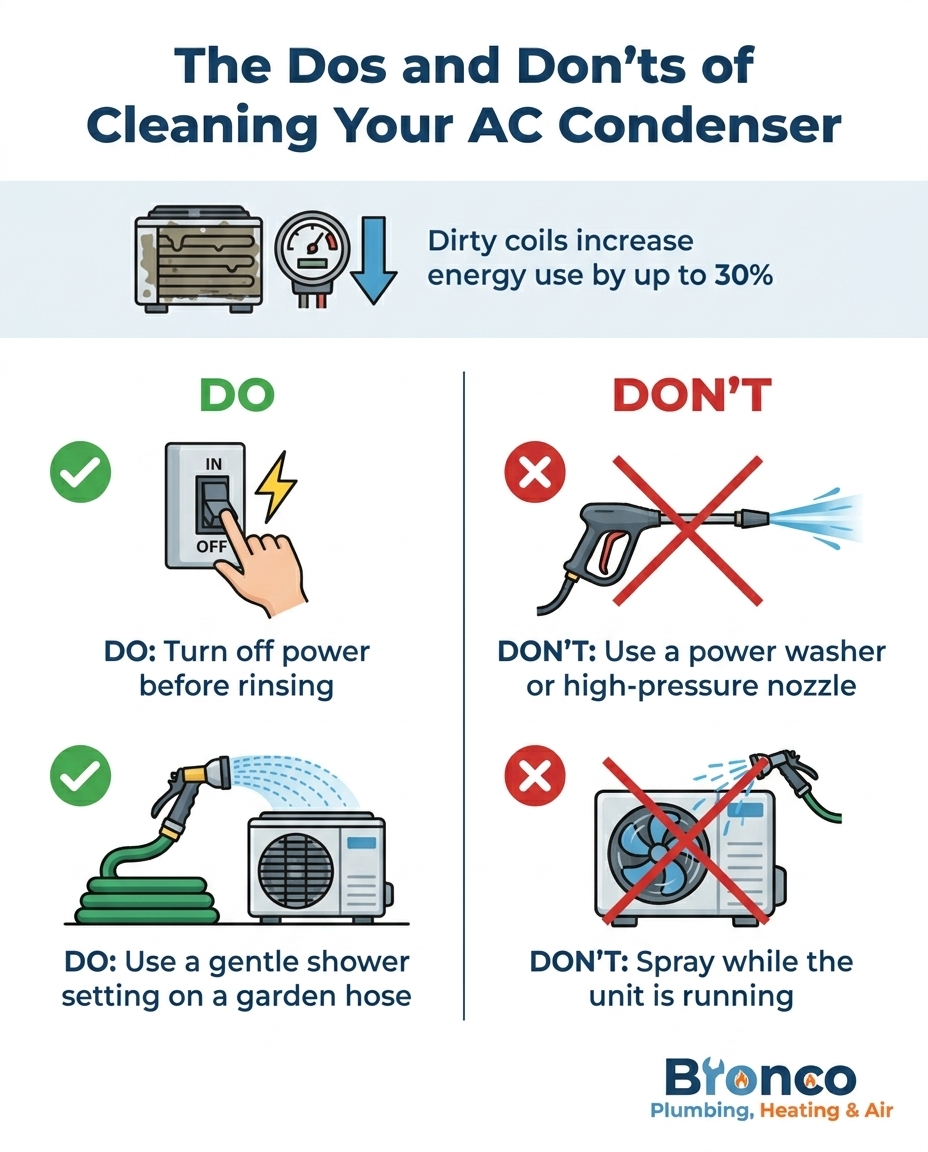
1. Always turn the power off first: Do not just turn off the thermostat. You must turn off the power at the outdoor disconnect switch (the gray box mounted on the wall near the unit) or flip the dedicated breaker in your main electrical panel. Never spray water on an energized system.
2. Use a gentle shower setting: Attach a standard spray nozzle to your garden hose and set it to the "shower" or "mist" setting. Never use the "jet" or "stream" settings, and absolutely never use a power washer. If the pressure hurts your bare hand at close range, it will bend the aluminum fins.
3. Spray at a downward angle: Aim the water at a 45-degree downward angle across the fins. Spraying straight in can push debris deeper into the center of the unit where it gets trapped.
4. Never open the cabinet: Do not attempt to remove the protective outer grates, unscrew the top fan assembly, or touch any internal electrical components. Opening the cabinet exposes you to high-voltage capacitors and requires a licensed professional.
Does This Rule Apply to All Cooling Systems?
While traditional split-system central air conditioners are the most common units subjected to DIY hosing, these safety rules apply to virtually all modern cooling equipment. Because the fundamental physics of heat transfer remain the same, the outdoor components share similar fragile designs.
Heat pumps, for example, function exactly like air conditioners during the summer months. However, because heat pumps run year-round to provide winter heating as well, their outdoor coils accumulate debris for twelve months instead of just six. This makes them even more susceptible to severe blockages and requires even more diligent professional care.
Similarly, the outdoor condenser units for ductless mini-split systems feature the exact same delicate aluminum fins. In fact, because mini-split condensers are often more compact, their fins can be spaced even tighter together, making them highly vulnerable to high-pressure water damage. Regardless of what type of system cools your home, gentle surface rinsing is the absolute limit of safe DIY maintenance.
Why Professional Coil Cleaning Outperforms a Garden Hose
The gap between a homeowner's garden hose and a technician's toolkit is massive. Professional coil cleaning is not just about water; it is a comprehensive process designed to safely restore the equipment to factory specifications without risking damage to the electrical systems or the fragile fins.
Professionals use specialized, non-acidic chemical coil cleaners that are specifically formulated for HVAC equipment. These foaming agents are applied directly to the coils. As the chemical foams up, it actively pushes baked-on dirt, grease, and stubborn pollen out from the inside of the coil matrix. More importantly, technicians safely remove the top grate and the heavy fan motor assembly to clean the system from the inside out—pushing the debris away from the unit rather than deeper into it. This level of deep cleaning is physically impossible to achieve with a garden hose from the outside.
Beyond just washing the metal, a professional tune-up includes testing the vital components that keep the system alive. Technicians check all high-voltage electrical connections, test the dual-run capacitor to ensure the motors are receiving the correct starting voltage, and measure the compressor's amperage draw. Another local family learned the value of this the hard way when their unmaintained system broke down completely on the hottest day of the summer. They required a fast, after-hours rescue from a professional technician to restore cooling and escape the extreme indoor heat. Relying on professional AC services and seasonal tune-ups is the definitive, safe alternative to risky DIY hosing, ensuring your system survives the hardest days of summer.
Frequently Asked Questions
Can I spray water on my AC unit while it is running?
No, you should never spray water on an air conditioner while it is actively running. The large fan at the top of the unit pulls air powerfully through the side panels. If you spray water while the fan is spinning, the suction can pull water directly into the fan motor vents or electrical compartments, risking a dangerous short circuit. Always turn off the power at the disconnect switch before performing any surface rinsing.
What happens if I bend the fins on my AC?
Bent fins severely restrict the airflow required to cool the hot refrigerant inside the coils. When the thin aluminum fins are flattened by high water pressure or physical impact, they act like a closed wall, trapping heat inside the condenser. This forces the compressor to work much harder, leading to higher energy bills, poor indoor cooling, and eventually, premature compressor failure.
Will a dirty AC condenser freeze up?
While a dirty indoor evaporator coil is the most common cause of a frozen system, a severely dirty outdoor condenser can also lead to systemic failures. A blocked outdoor unit causes the system to run with excessively high head pressure because it cannot release heat. While it usually results in overheating rather than freezing, the extreme strain can damage the compressor valves or cause the system's safety switches to shut the entire unit down.
How often should you wash your outside AC unit?
You should gently rinse loose debris off the outside of your unit every few months, but it requires a professional deep clean once a year. Keeping the outer surface free of leaves, grass clippings, and spider webs helps maintain basic airflow. However, the annual professional application of foaming coil cleaners is mandatory to dissolve the microscopic, baked-on dust that a garden hose cannot remove.
Is it safe to use chemical coil cleaners myself?
No, chemical coil cleaners should only be applied by licensed HVAC professionals. Proper application requires disassembling the outer cabinet and removing the fan motor to clean from the inside out, which involves handling high-voltage components. Furthermore, using the wrong type of cleaner, or failing to dilute it properly, can cause severe acidic corrosion that eats right through the copper coils, destroying the unit entirely.
Protect Your Comfort with Professional Care
Does hosing down your AC condenser actually improve cooling performance? Only slightly, and only temporarily if the unit is covered in loose, dry debris. True performance restoration requires getting rid of the baked-on grime that insulates your coils and strains your compressor. Don't risk permanently damaging your delicate system with high-pressure water or improper DIY techniques during the hottest weeks of the year. Let the professionals handle the deep cleaning, ensuring you get a definitive answer to your cooling problems, safe restoration of your system's efficiency, and reliable comfort when you need it most.

Customer Testimonials
Our customer testimonials highlight the reliable service, quality workmanship, and trusted results homeowners experience with Bronco Plumbing Heating and Air.


Ready to Transform your Home?
Create a healthier, more comfortable home with expert HVAC, plumbing, and indoor air quality solutions you can trust. From efficient heating and cooling to cleaner air and reliable repairs, our experienced team is here to keep your family comfortable year-round with dependable service and upfront pricing.
Related Articles

The Real Reason Your Upstairs Bedrooms Stay Hot While the Ground Floor Freezes

Navigating Roseville Noise Ordinances When Relocating a Loud AC Condenser

Portable AC Units vs. Fixing Your Central Air During a Week-Long Delay