



.svg)

Why Your Vents Smell Like Mildew When the AC Kicks On in Late Summer
That blast of damp, sour air from your registers in August isn't just a nuisance—it's a sign of biological growth on your indoor coil. See why changing the filter won't fix this specific odor.

Are You Noticing a Musty AC Odor as Summer Winds Down?
Is your air conditioner blasting out a smell that reminds you of a damp basement or a gym locker? If you are wondering why your vents smell like mildew when the AC kicks on in late summer, you are definitely not alone. That strange, sour burst of air is a highly common problem when August rolls around and your system has been running for months. When you notice this damp odor, your first instinct might be to swap out the air filter. While a fresh filter is always a good idea, it rarely solves this specific problem.
The root cause of a musty vent smell usually hides deep inside your cooling equipment, requiring more than a basic maintenance tweak. If you are dealing with this unsettling odor, professional AC services can help you breathe easier and restore fresh air to your home.
Unmasking 'Dirty Sock Syndrome' in Your HVAC System
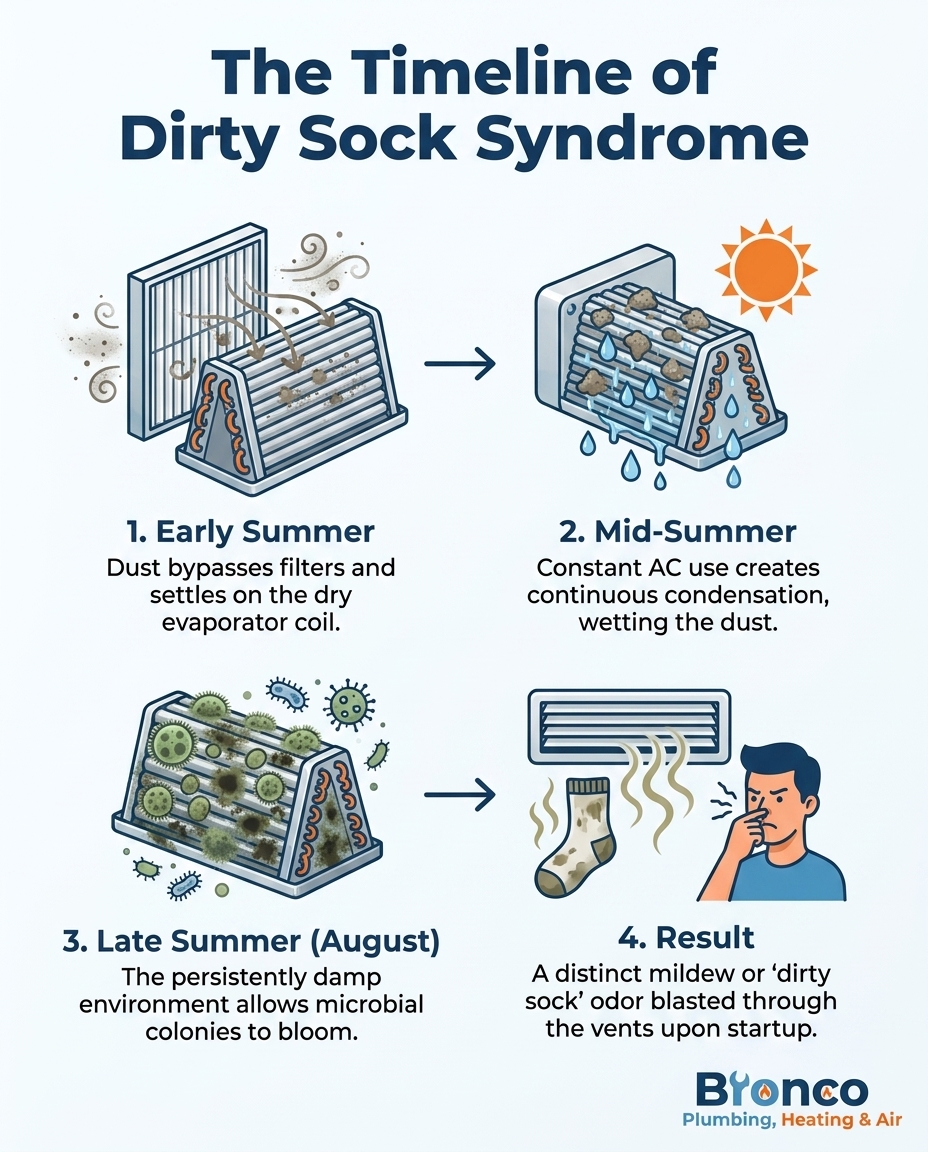
HVAC professionals have a specific name for that sour, damp smell coming from your vents: "Dirty Sock Syndrome." This highly descriptive term refers to microbial and biological growth that takes hold on your indoor evaporator coil. When you turn on your thermostat, the blower motor pushes air directly over this contaminated coil, carrying the distinct mildew odor right into your living space.
Many Sacramento CA area homes experience this issue because the dark, damp environment inside an air handler is the perfect breeding ground for biological growth. Even if you keep a spotless house, microscopic dust particles constantly circulate through your ductwork. Some of this dust inevitably bypasses your standard air filter and settles on the metal surfaces inside your cooling system. Once that dust gets wet, it acts as a food source for mildew and other microbes.
The startup blast: You will usually notice the dirty sock smell most intensely right when the system turns on. As the blower motor kicks into gear, it pushes stagnant, odor-filled air out of the ductwork and into your rooms. After the system runs for a few minutes, the smell often seems to fade—but the underlying biological growth is still there.
The Biology Inside Your Air Handler
To understand why this happens, you have to look at the environment inside your equipment. Your indoor unit is essentially a dark, enclosed metal box. When the air conditioner runs, the evaporator coil gets extremely cold. As warm indoor air blows across this cold metal, moisture from the air condenses on the aluminum fins.
This combination of darkness, constant moisture, and a steady supply of household dust creates a thriving ecosystem for microbial growth. Over time, a slimy biofilm establishes itself on the delicate aluminum fins of the coil. Because this biological layer clings tightly to the metal, ordinary airflow cannot dislodge it, allowing the odor to persist day after day.
Why Months of Continuous Cooling Lead to Late-Season Odors
You might wonder why your air conditioner smelled perfectly fine in May but suddenly smells like mildew in late summer or August. The answer comes down to the cumulative effect of heavy seasonal usage. Your air conditioner does more than just lower the temperature; it also naturally dehumidifies the air. As it pulls heat out of your home, it also extracts moisture, creating a steady stream of condensation inside the unit.
During the mild days of early summer, your air conditioner cycles on and off with plenty of rest time in between. This downtime gives the indoor evaporator coil a chance to dry out. However, Sacramento's intense summer heat requires continuous AC cycling. When the temperatures stay high for weeks on end, your system runs almost constantly. As a result, the indoor coil never has a chance to fully dry out.
The seasonal timeline usually looks like this:
• June: Microscopic biological growth begins as dust settles on the occasionally wet coil.
• July: Constant heat waves force the system to run non-stop, keeping the coil permanently damp and allowing the microbes to multiply.
• August: The biological colony reaches a tipping point. The buildup is now significant enough to produce a highly noticeable odor every time the blower engages.
This timeline explains why Dirty Sock Syndrome is a cumulative usage issue, not necessarily a sign of a sudden mechanical failure. Your system is simply reacting to months of trapped moisture and constant operation.
Indoor Evaporator Coils vs. Outdoor Condenser Coils
To fix a musty smell, you need to understand which part of your system is actually causing the problem. Your central air conditioner relies on two different coils to move heat out of your home. While both coils need to stay clean for your system to work properly, they face entirely different environmental challenges.
The indoor evaporator coil absorbs heat from your indoor air and generates heavy condensation. This is where Dirty Sock Syndrome originates. In contrast, the outdoor condenser coil releases that absorbed heat into the outside air. The outdoor unit gets extremely hot and is exposed to the sun, wind, and rain.
Because the outdoor unit gets so hot and dries out quickly, it does not grow mildew. Instead, it gets clogged with dirt, pollen, grass clippings, and leaves. While a dirty condenser coil and AC performance are closely linked, an outdoor coil will never cause a mildew smell inside your house.
• Location — Indoor Evaporator Coil: Inside the home (air handler or furnace plenum) — Outdoor Condenser Coil: Outside the home (metal cabinet in the yard)
• Function — Indoor Evaporator Coil: Absorbs indoor heat and creates condensation — Outdoor Condenser Coil: Releases absorbed heat into the outdoor air
• Common Debris — Indoor Evaporator Coil: Household dust, pet dander, biological growth — Outdoor Condenser Coil: Leaves, dirt, grass clippings, pollen
• Odor Risk — Indoor Evaporator Coil: High risk of mildew and "dirty sock" smells — Outdoor Condenser Coil: No risk of indoor odors
• Cleaning Needs — Indoor Evaporator Coil: Requires specialized foaming agents and gentle care — Outdoor Condenser Coil: Requires heavy debris removal and outdoor coil cleaner
Many Sacramento CA area homes suffer from neglected coils on both ends of the system. However, if your primary complaint is a musty smell coming from the vents, the indoor evaporator coil is the culprit that needs immediate attention.
The Reason Standard Air Filters Won't Eliminate the Smell
When bad smells start coming from the ductwork, most homeowners immediately head to the store for a new air filter. Changing your air filter is a fantastic maintenance habit, and you should absolutely keep doing it. However, a standard filter cannot eliminate Dirty Sock Syndrome.
Filters trap particles, not odors: Standard fiberglass or pleated air filters are designed to catch physical particulate matter. They trap dust, pet hair, and lint before those items can enter your equipment. They are not designed to neutralize odors or kill biological growth. Once a microbial colony has established itself on the wet indoor coil, putting a new filter in the return vent will not reach the source of the problem.
In fact, if you wait until late summer or August to change a heavily clogged filter, you might actually make the smell worse. A dirty, blocked filter severely reduces the amount of air flowing through your system. When airflow drops, the indoor coil gets even colder and produces even more condensation. This excess moisture just feeds the mildew, making the odor much stronger. While you should always maintain clean filters, you will need a more targeted approach to remove biological buildup from the equipment itself.
Why Evaporator Coil Cleaning Is Not a DIY Project
Once you realize the indoor coil is the source of the mildew smell, you might be tempted to open up the cabinet and scrub it yourself. This is a highly risky move. Evaporator coil cleaning requires specialized training, specific chemical agents, and a gentle touch. Attempting to clean it without professional experience often leads to permanent equipment damage.
Here is why Sacramento CA area homes require professional intervention for dirty evaporator coils:
• Fragile aluminum fins: The coil is made of hundreds of paper-thin aluminum fins tightly packed together. If you bump them with a brush or a vacuum nozzle, they will instantly crush and fold over. Crushed fins permanently block airflow and ruin the system's efficiency.
• Dangerous chemical reactions: Standard household cleaners, bleach, and heavy degreasers should never be sprayed inside an HVAC unit. These chemicals can severely corrode the metal components. Worse, the blower motor will circulate toxic fumes from these cleaners directly into your living space.
• Difficult accessibility: In most systems, the evaporator coil is sealed tightly within the sheet metal plenum. Accessing it often requires removing panels, navigating around the blower assembly, and working in very tight, dark spaces.
• Risk of refrigerant leaks: The coil is filled with highly pressurized chemical refrigerant. If you accidentally puncture a copper line or snap a fitting while trying to clean the fins, you will cause a massive leak that requires an expensive emergency repair.
Because the risks are so high, removing biological growth from an indoor coil is a job that must be left to licensed HVAC technicians.
Professional Solutions: Deep Cleaning and Advanced Purification
Getting rid of a musty vent smell requires a two-step approach: removing the existing biological growth and preventing it from coming back. Bronco Plumbing, Heating & Air provides specialized coil cleaning and IAQ solutions designed specifically to eliminate deep-seated biological growth that standard filter changes miss.
The first step is a professional deep cleaning. A trained technician will open the air handler and apply a specialized, non-corrosive foaming agent directly to the evaporator coil. This foam safely expands between the delicate aluminum fins, lifting the slimy biofilm and embedded dirt away from the metal. As the foam breaks down, it drips safely into the condensate drain pan, carrying the odor-causing microbes with it. This process restores the coil to its original, clean state without damaging the equipment.
However, because your system will continue to generate condensation, the smell can eventually return if you do not take preventative action. This is where advanced indoor air quality services make a massive difference for your home comfort.
The Role of Active Air Purification
To stop Dirty Sock Syndrome from returning next late summer or August, you need active protection inside the air handler. Specialized air purification systems, such as UV germicidal lights, can be installed directly over the wet evaporator coil.
These purifiers shine constant, targeted light on the wet metal surfaces. This active purification continuously neutralizes microbial growth before it can establish a colony. By treating the environment where the moisture collects, you eliminate the root cause of the odor entirely, ensuring that the air blowing into your home remains fresh and clean all season long.
Long-Term Prevention with Routine Maintenance
Preventing dirty sock syndrome starts long before the peak heat arrives. Routine professional care is the best way to keep your system clean, efficient, and odor-free. During a professional tune-up, technicians do much more than just check the thermostat; they inspect the entire condensate management system.
When your AC runs, the moisture dripping off the coil collects in a drain pan and flows outside through a PVC pipe. Over time, algae and slime can clog this drain line, causing standing water to back up inside the unit. This stagnant water creates a massive source of musty odors. A thorough maintenance visit includes clearing out these drain lines so moisture can escape your system properly.
Proactive care makes a tangible difference. For example, one Sacramento CA area homeowner reached out during a summer heatwave with a down air conditioner. Technicians Lance and Ryan arrived in less than an hour. They quickly identified the underlying issues causing the system failure, cleared the neglected components, and fixed the AC so it was running better than ever. When you invest in a regular AC maintenance plan, you ensure that your coils stay clean, your drain lines stay clear, and your equipment enjoys a much longer lifespan.
Frequently Asked Questions About Mildew Smells in AC Vents
Why does my AC smell like mildew when it first turns on?
Your AC smells like mildew at startup because biological growth has accumulated on the indoor evaporator coil. When the system sits idle, odors build up inside the dark, damp air handler cabinet. As soon as the blower motor kicks on, it immediately pushes that trapped, musty air through your ductwork and out of your vents. The smell often lessens after a few minutes of running, but the underlying microbial growth remains on the coil.
What is dirty sock syndrome?
Dirty sock syndrome is the HVAC industry term for a strong, sour, or musty odor caused by microbial growth on an indoor evaporator coil. It occurs when household dust bypasses the air filter, settles on the wet metal fins of the coil, and feeds biological colonies. The resulting smell closely resembles damp gym clothes or old, dirty socks, and it typically peaks in late summer or August after months of heavy condensation.
How do you fix a musty smelling air conditioner?
You fix a musty smelling air conditioner by having a licensed professional perform a deep chemical cleaning of the indoor evaporator coil. Because the biological growth is embedded in the delicate aluminum fins, it requires specialized foaming agents to safely lift the biofilm away. Once the coil is clean, installing an active air purifier inside the unit can prevent the damp smell from returning.
Is it safe to run AC if it smells like mildew?
While running an AC that smells like mildew will still cool your home, it is not ideal for your indoor air quality or your comfort. The smell indicates that you are actively blowing microbial spores and biological odors into your living space. If anyone in your home suffers from allergies or asthma, this poor air quality can trigger symptoms, making a professional cleaning highly recommended.
Can a clogged condensate drain cause a musty smell?
Yes, a clogged condensate drain is a major cause of musty smells in an HVAC system. When the PVC drain line gets blocked by algae or dirt, the condensation dripping off the coil has nowhere to go. This creates a pool of stagnant, dirty water in the drain pan beneath the unit, which quickly breeds mildew and sends strong odors straight into your ductwork.
Will changing my air filter fix the dirty sock smell?
No, changing your air filter will not fix the dirty sock smell. Standard air filters are designed to capture dry physical particles like dust and pet hair, not to neutralize odors or kill biological growth. Once the mildew has already established itself on the wet indoor coil, a new filter in the return vent cannot reach or remove the source of the musty odor.
Restore Fresh Air to Your Home Before Fall Arrives
Dealing with a musty smell from your vents is a frustrating experience, but it is a highly solvable result of heavy seasonal use. You do not have to spend the rest of the summer holding your breath every time the thermostat clicks on. Sacramento CA area homes face intense cooling demands, and your equipment simply needs professional attention to recover from months of constant condensation.
Professional coil cleaning and advanced indoor air quality solutions can completely eliminate the biological growth causing the odor. By taking action now, you can restore your indoor air quality and protect your system's efficiency. Consider upgrading to UV air purifiers to keep that damp smell away for good, ensuring your home stays fresh and comfortable all year long.

Customer Testimonials
Our customer testimonials highlight the reliable service, quality workmanship, and trusted results homeowners experience with Bronco Plumbing Heating and Air.


Ready to Transform your Home?
Create a healthier, more comfortable home with expert HVAC, plumbing, and indoor air quality solutions you can trust. From efficient heating and cooling to cleaner air and reliable repairs, our experienced team is here to keep your family comfortable year-round with dependable service and upfront pricing.
Related Articles

Single-Stage vs. Variable-Speed Compressors for Handling Late August Humidity


Decoding the Rattling Noise Your AC Makes After Three Months of Heavy Use
Does Hosing Down Your AC Condenser Actually Improve Cooling Performance?