



.svg)

Elk Grove's Hard Water Impact on Evaporative Coolers and Plumbing Fixtures
August heat exposes the severe toll local mineral scale takes on your home. Discover why swamp coolers and water heaters struggle, and how to fix the root cause.
The Hidden Toll of Elk Grove's Water Supply on Home Systems
More than 70% of evaporative cooler performance drops in the Sacramento Valley happen during the most intense heat of the year. If you are dealing with Elk Grove's hard water impact on evaporative coolers and plumbing fixtures, you already know the frustration of a system that cannot keep up when you need it most. Here at Bronco Plumbing, Heating & Air, our team typically sees this exact scenario play out as families try to stay comfortable. Your cooling system is running nonstop, but the house still feels warm, and you are constantly swapping out crusty cooler pads just to get a breeze.
The hot, dry Sacramento and Elk Grove climate makes evaporative (swamp) coolers a popular and efficient choice for many homes. However, this same climate creates a perfect storm for accelerated mineral scale buildup during the late summer (August) heat. When you rely heavily on water to cool your home, the quality of that water dictates how well your equipment survives the season. If you are constantly treating the symptoms by replacing parts, a pattern we see often is that it is time to look at the root cause. Consulting with our professionals for expert plumbing services can help you address these underlying water quality issues before they destroy your home's infrastructure.
The Connection Between Cooling and Plumbing
Most homeowners view a struggling swamp cooler as an isolated cooling problem. In reality, the exact same water supply feeding your roof or window unit is also flowing through your home's pipes. Our plumbers and HVAC specialists frequently find that the heavy mineral scale buildup choking your cooler pads is simultaneously causing premature wear on your traditional water heater. Treating these as separate issues leads to a cycle of endless repairs, rather than a permanent, whole-home solution.
Understanding Elk Grove's Water Quality Metrics
To understand why your home comfort systems struggle so much, you have to look at what is flowing through your pipes. In our years of servicing Elk Grove neighborhoods, we have learned firsthand how heavily the city relies on groundwater to supply homes. As water travels through the earth, it acts as a universal solvent, naturally absorbing high levels of dissolved minerals—specifically calcium and magnesium. While these minerals are perfectly safe to drink, they wreak havoc on mechanical systems.
The Science of Water Hardness
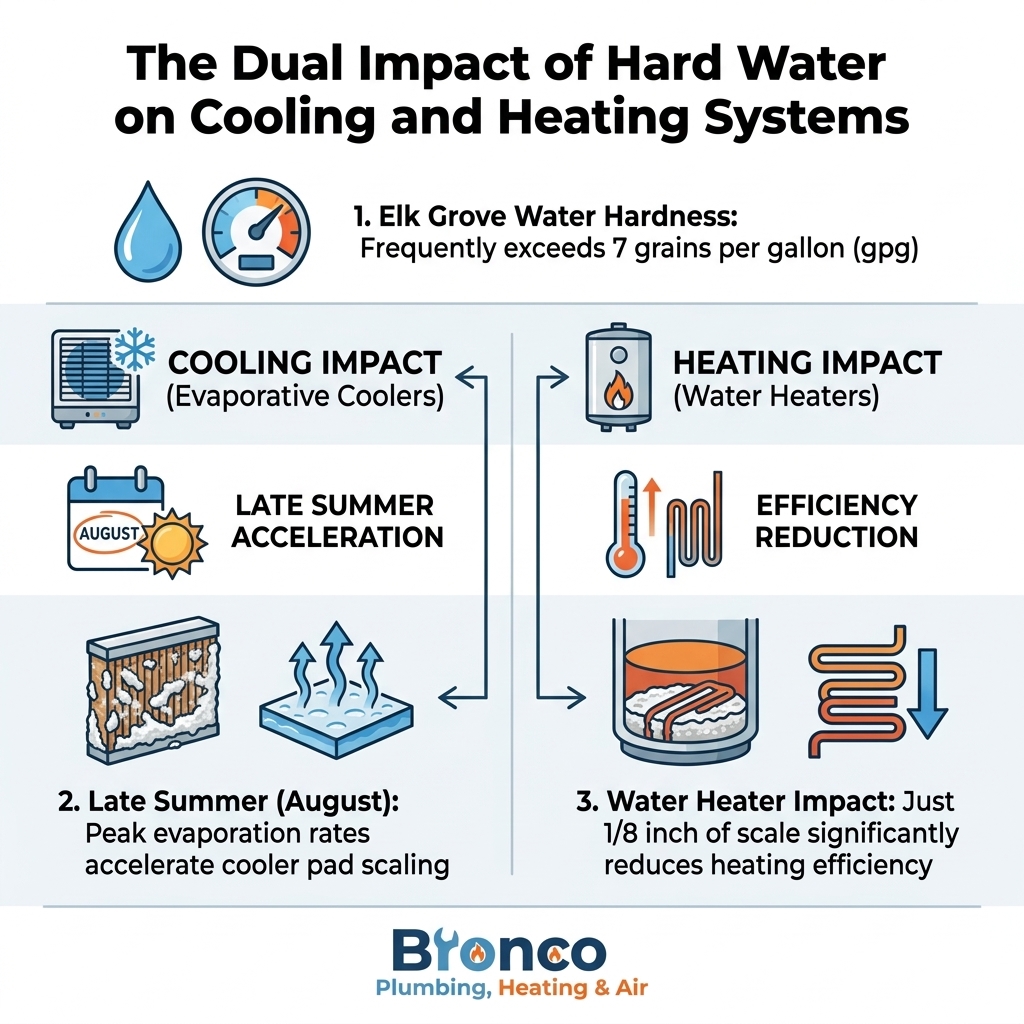
Water hardness is typically measured in grains per gallon (gpg). The municipal water supply in Elk Grove is frequently classified as hard to very hard, often exceeding 7 gpg. To put that into perspective, water is considered "hard" starting at just 3.5 gpg. When water carrying this heavy mineral load is heated or evaporated, the water molecules turn to vapor, but the minerals are left behind. They precipitate out of the liquid and form a rock-like crust known as scale.
• Soft Water — Grains Per Gallon (GPG): 0 - 1.0 gpg — Impact on Home Appliances: Optimal for plumbing and appliances; no scale buildup.
• Slightly Hard — Grains Per Gallon (GPG): 1.1 - 3.5 gpg — Impact on Home Appliances: Minor spotting on fixtures; minimal appliance wear.
• Moderately Hard — Grains Per Gallon (GPG): 3.6 - 7.0 gpg — Impact on Home Appliances: Noticeable scale on faucets; moderate water heater efficiency loss.
• Hard to Very Hard (Elk Grove Average) — Grains Per Gallon (GPG): 7.1+ gpg — Impact on Home Appliances: Severe scale accumulation; rapid degradation of coolers and water heaters.
Because this baseline hardness affects every water-reliant appliance in your home, there is no escaping its effects without intervention. Every time your evaporative cooler cycles on, and every time your water heater fires up, that 7+ grains per gallon is actively leaving behind a permanent, damaging residue.
Why Evaporative Coolers Struggle in Late Summer Heat
Evaporative coolers are beautifully simple machines. They function by drawing warm outside air through thick, water-saturated media pads. As the dry air passes through the wet pads, the water evaporates, absorbing heat and blowing cool, refreshing air into your home. It is a highly effective system for the dry Central Valley climate—until hard water enters the equation.
The Late Summer Evaporation Spike
The problems heavily compound as the season progresses. During the intense heat of late summer (August), as families prep for the back-to-school transition, evaporation rates hit their absolute peak. Our HVAC crews are typically flooded with calls this time of year because the hot, dry August weather forces your cooler to consume maximum water just to maintain a comfortable indoor temperature. Because the water is evaporating faster than at any other time of the year, it leaves behind concentrated mineral deposits at an accelerated rate.
This rapid evaporation results in heavy mineral scale buildup on the cooler pads. Within just a few weeks of peak operation, soft, absorbent pads turn crusty, rigid, and completely blocked by calcium deposits.
The Consequence of Restricted Airflow
When the media pads calcify, they can no longer absorb water evenly. The air pulls through dry spots, meaning the air entering your home is no longer being cooled. Furthermore, the rigid scale severely restricts overall airflow. Your blower motor has to work twice as hard to push air through the blocked pads, leading to reduced cooling efficiency, higher energy bills, and an overworked motor that is prone to burning out. If you find yourself needing to call for air conditioning services late in the season, our technicians almost always find calcified pads as the primary culprit.
The Silent Impact on Traditional Tank Water Heaters
While your swamp cooler suffers from rapid evaporation on the roof, your plumbing system is fighting the exact same battle in the garage. When our plumbers drain and inspect older traditional tank water heaters, we rarely see evaporation issues, but we do see the devastating effects of heating hard water. When hard water is subjected to high temperatures, it triggers thermal precipitation—a process where dissolved calcium and magnesium solidify and fall out of the water.
How Scale Destroys Heating Efficiency
According to Department of Energy data, just 1/8 inch of scale buildup inside a traditional water heater significantly reduces its heating efficiency. As the minerals precipitate, they settle at the bottom of the tank. Over months and years, this creates a thick, solid barrier of rock between the gas burner (or electric heating element) and the water it is trying to heat.
"When scale forms a barrier at the bottom of your tank, your water heater is forced to bake the calcium layer before it can even begin to heat your water, driving up energy costs and risking tank failure."
Because the unit has to run longer and hotter to push heat through that heavy mineral scale buildup, the metal tank itself becomes stressed. You will often hear loud popping, cracking, or rumbling noises when the burner is on. This sound is actually water trapped beneath the scale layer boiling into steam and violently forcing its way up through the mineral crust. The ultimate result is much higher utility bills and premature tank failure. When our team handles upgrading or maintaining traditional tank water heaters, we always account for this aggressive local water chemistry. Upgrading to a high-efficiency system might even qualify for federal tax credits or local utility incentive programs (we advise readers to verify current programs with their utility or a tax professional), but addressing the water chemistry first ensures your new equipment will actually last.
Recognizing the Signs of Hard Water Damage
Catching the effects of hard water early can save you from catastrophic appliance failure. Because Elk Grove's water affects both your HVAC and plumbing systems, the symptoms will show up across your entire home. Based on the service calls we handle every week, here is what our team recommends you look for:
• Crusty cooler pads: Evaporative cooler media pads that feel stiff, brittle, or are coated in a white, chalky residue.
• Weak airflow: A noticeable drop in cooling power or restricted airflow coming from your swamp cooler vents, even when the fan is on high.
• Fixture scaling: Chalky white scale buildup around your kitchen faucets, showerheads, and bathroom plumbing fixtures.
• Noisy water heater: Popping, cracking, or rumbling noises coming from the water heater tank during a heating cycle.
• Frequent maintenance needs: The constant need to replace cooler pads mid-season or flush the water heater just to maintain baseline performance.
If you notice several of these symptoms at once, it is a clear indicator that the municipal water supply is taking a toll on your home. Following our comprehensive water heater maintenance checklist can help you track these degradation signs before a complete breakdown occurs.
The Advantage of a Dual Plumbing and HVAC Assessment
One of the biggest mistakes we see homeowners make is treating hard water as an isolated issue. It is common to view a struggling swamp cooler as just an HVAC problem (meaning you just swap the pads) or a noisy water heater as just a plumbing problem (meaning you just flush the tank). Treating these symptoms independently leads to recurring breakdowns, ongoing frustration, and wasted money.
Why a Holistic Approach Matters
Because Elk Grove's water quality bridges the gap between plumbing and cooling, solving the problem requires a wider lens. This is exactly why our team at Bronco Plumbing, Heating & Air provides a unique advantage. Working with our cross-licensed professionals means you get a team that understands both sides of the equation. While a technician who only knows HVAC might tell you to keep buying new cooler pads, and a standalone plumber might just offer to descale your tank, we look at the whole picture.
A holistic, whole-home assessment evaluates both your plumbing infrastructure and your water-reliant cooling systems simultaneously. By diagnosing how the water flows, heats, and evaporates throughout your entire property, our professionals can recommend comprehensive solutions that prevent premature appliance failure across the board, rather than just putting a band-aid on the most immediate symptom.
Moving from Symptom Treatment to Whole-Home Solutions
Once you recognize the heavy mineral scale buildup damaging your systems, the next step is professional mitigation. Because dealing with gas lines, high-voltage cooling systems, and pressurized plumbing requires specific expertise, these are never DIY projects. Here is how our professionals move your home from temporary symptom relief to a permanent solution.
1. Professional Descaling and Cooler Maintenance: To restore late-summer airflow, our technicians carefully dismantle the evaporative cooler, remove the calcified pads, and chemically descale the water distribution tubes and reservoir. This ensures the water pump isn't straining against blockages and the new pads receive an even flow of water.
2. Expert Water Heater Flushing: A standard drain valve opening is rarely enough to remove hardened scale. Our professionals use specialized equipment to safely flush the water heater, agitating the heavy sediment at the bottom of the tank and clearing the thermal barrier without damaging the internal lining or the heating element.
3. Whole-Home Water Conditioning Systems: The definitive solution we recommend to address the root cause of Elk Grove's hard water is installing a whole-home water softener or conditioner. By removing the calcium and magnesium before the water ever reaches your water heater or your evaporative cooler, you stop scale formation entirely.
Every home consumes water differently. We highly advise consulting with our licensed professionals to determine the right water treatment capacity for your specific usage. Whether you need ongoing maintenance or complete water heater repair and replacement, addressing the water chemistry first ensures your new equipment will actually last.
Protect Your Elk Grove Home's Infrastructure
Heavy mineral scale buildup does not have to be an accepted reality of living in Elk Grove. While the local groundwater is undeniably hard, the damage it causes to your evaporative cooler and plumbing fixtures is entirely preventable. Addressing your water quality protects both your late summer comfort and your year-round plumbing infrastructure.
Do not wait until your cooler completely fails in the August heat or your water heater tank cracks under the stress of scale buildup. Schedule a comprehensive evaluation of your water heater and cooling systems with our team today. By taking a proactive approach to Elk Grove's hard water impact on evaporative coolers and plumbing fixtures, you can secure reliable, efficient performance from your home's most essential systems for years to come.
Frequently Asked Questions
How does hard water affect evaporative coolers?
Hard water leaves behind dissolved minerals like calcium and magnesium as it evaporates. In an evaporative cooler, this creates a heavy mineral scale buildup on the media pads. Over time, this crust restricts airflow, forces the blower motor to overwork, and drastically reduces the system's cooling efficiency.
What causes scale buildup in my water heater?
Scale buildup is caused by thermal precipitation, a process where heat forces dissolved minerals to separate from the water. In hard water areas like ours, these minerals fall to the bottom of the tank and harden into a rock-like layer. This barrier forces the water heater to run longer and hotter to push heat through the scale, reducing efficiency and lifespan.
Is Elk Grove water hard or soft?
Elk Grove water is generally classified as hard to very hard. Because the city relies heavily on groundwater, the water naturally absorbs high levels of calcium and magnesium from the earth. The mineral content frequently exceeds 7 grains per gallon, which is high enough to cause significant scale buildup in home appliances.
How do you treat hard water in a swamp cooler?
Treating hard water in a swamp cooler requires a combination of professional maintenance and whole-home water treatment. Our technicians regularly descale the water distribution tubes and replace heavily calcified pads. For a permanent solution, installing a whole-home water softener prevents the minerals from reaching the cooler in the first place.
How does hard water affect plumbing fixtures?
Hard water leaves a stubborn, chalky white residue on faucets, showerheads, and drains as the water dries. Over time, this scale can clog the tiny nozzles in showerheads and degrade the rubber seals inside faucets. This leads to reduced water pressure, constant dripping, and the need for premature fixture replacement.
Can a whole-home water softener improve my HVAC efficiency?
Yes, if you use an evaporative cooler, a water softener will significantly improve its efficiency. By removing the calcium and magnesium from the water supply, the cooler pads remain clean and absorbent rather than turning rigid with scale. This allows maximum airflow and optimal cooling performance during the hottest months of the year.

Customer Testimonials
Our customer testimonials highlight the reliable service, quality workmanship, and trusted results homeowners experience with Bronco Plumbing Heating and Air.


Ready to Transform your Home?
Create a healthier, more comfortable home with expert HVAC, plumbing, and indoor air quality solutions you can trust. From efficient heating and cooling to cleaner air and reliable repairs, our experienced team is here to keep your family comfortable year-round with dependable service and upfront pricing.
Related Articles
Why Your Vents Smell Like Mildew When the AC Kicks On in Late Summer


Single-Stage vs. Variable-Speed Compressors for Handling Late August Humidity

Decoding the Rattling Noise Your AC Makes After Three Months of Heavy Use