



.svg)

Preparing Your Home Air Quality for Back-to-School Illness Season
Late summer heat forces your AC to run constantly, trapping new school germs inside a sealed house. See how active UV purification neutralizes airborne pathogens.
The Late-Summer Collision of Extreme Heat and New Germs
August is here, and our team at Bronco Plumbing, Heating & Air wants to remind you that preparing your home air quality for back-to-school illness season is just as important as buying new backpacks and notebooks. The late-summer transition brings a sudden shift in daily routines, crowded new classrooms, and inevitably, a fresh wave of airborne illnesses entering your house. Right now, your air conditioner is running constantly to combat the intense heat outside. While that relentless cooling cycle keeps your family comfortable, it also locks those new germs inside, circulating them through every room in the house. The core decision you face as a homeowner is whether to continue relying on basic, passive dust filters or to take an active approach to neutralize these pathogens before they spread.
Upgrading your home's defenses with comprehensive indoor air quality services and active UV air purifiers is the modern solution to this seasonal challenge.
Understanding the 'Sealed Incubator' Effect in Your Home
The problem of trapped air: The "sealed incubator" effect happens when windows and doors remain tightly shut, forcing your HVAC system to endlessly recirculate the same stale, contaminated air. In our years of serving Sacramento CA, we've seen firsthand that simply opening a window for fresh air isn't a viable solution. With August temperatures regularly exceeding 100 degrees and regional wildfire smoke frequently rolling in, homes must remain tightly sealed against the harsh outdoor elements. Your house essentially becomes a closed loop.
The cause of indoor contamination: The EPA notes that indoor air can be two to five times more polluted than outdoor air. This metric drastically worsens when homes are closed up for the summer. Relying heavily on your AC during extreme heat waves keeps your family comfortable, but it traps microscopic threats indoors. Your cooling system works incredibly hard just to manage the temperature load. One local homeowner reached out after hours on one of the hottest days of the summer when their air conditioner suddenly stopped working; a technician arrived quickly to rescue them from the stifling heat, highlighting just how heavily we rely on these systems when the weather peaks. But while the system cools the air, it acts as a closed loop for the first wave of school germs, distributing them into every bedroom.
The solution is mechanical ventilation: Because you cannot rely on natural outdoor breezes, you have to rely entirely on mechanical whole-home indoor air quality systems. Without active intervention, our team typically sees that a sealed home will simply trap and distribute the following contaminants:
• Airborne viruses and bacteria: Brought home daily from crowded classrooms, school buses, and sports practices.
• Wildfire particulate matter: Microscopic ash and smoke that sneaks through minor gaps in your home's envelope.
• Volatile Organic Compounds (VOCs): Chemical off-gassing from new school supplies, cleaning products, and synthetic fabrics.
• Pet dander and dust mites: Agitated by increased indoor activity as the family spends more time inside to escape the heat.
Passive Defense: The Limitations of Standard HVAC Filters
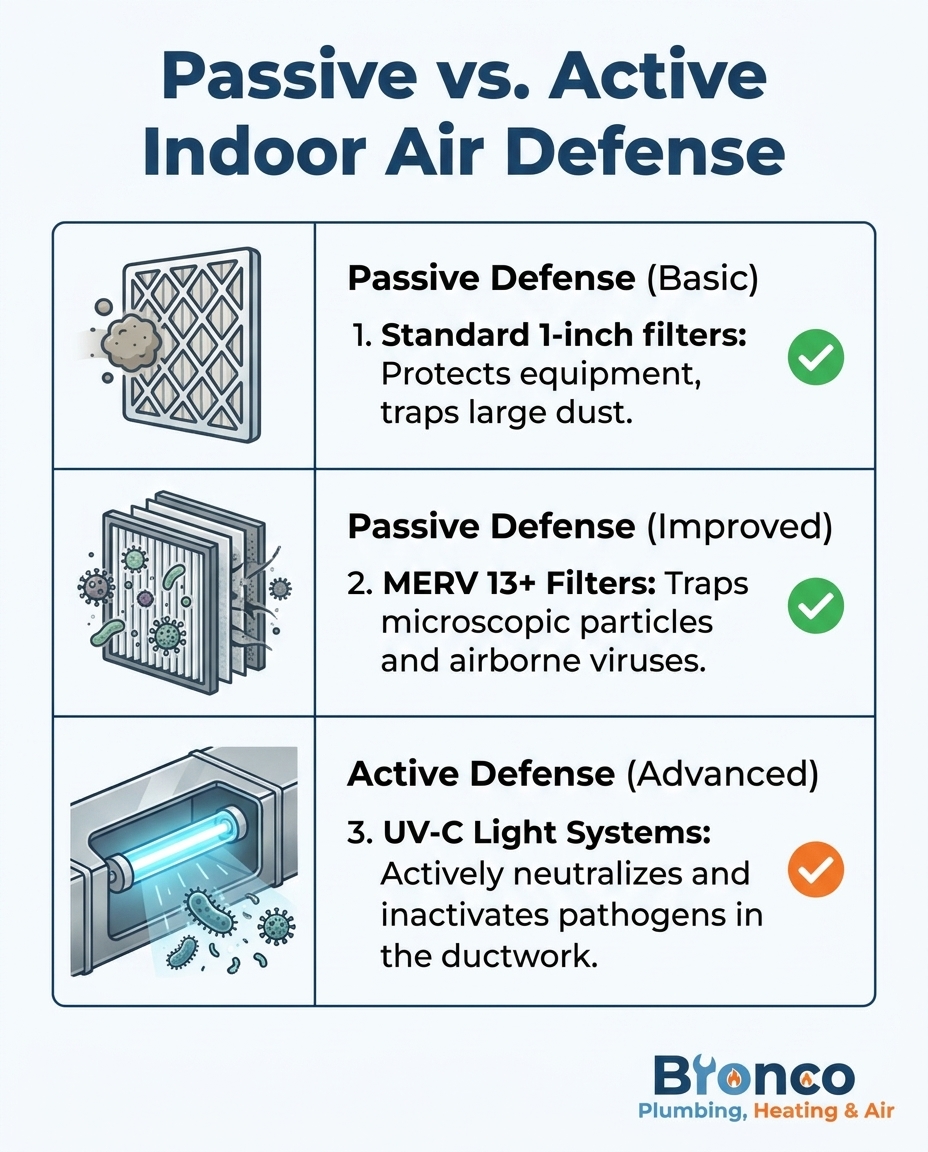
The original purpose of standard filters: During our late-summer maintenance visits, our technicians frequently find that most homeowners don't realize standard one-inch fiberglass filters were never designed to protect human health. Their original engineering purpose was strictly to protect the internal HVAC equipment—specifically the blower motor and the evaporator coil—from large dust, pet hair, and heavy debris. They act as a basic physical barrier to keep the machinery clean, not to purify the air you breathe.
The microscopic size mismatch: The core issue with passive defense is a matter of scale. Viruses and bacteria are significantly smaller than the porous gaps in standard fiberglass filters. A typical virus is thousands of times smaller than a grain of sand. When infected air is pulled into your return vents, these microscopic pathogens pass right through the standard filter mesh and recirculate back into your living spaces entirely unimpeded.
Routine maintenance and changing your air filter regularly is still critical to maintain basic airflow and prevent your system from overheating. A clogged filter will restrict air and damage your equipment, but even a brand-new one-inch fiberglass filter simply will not stop viruses. To understand why standard filters fall short during illness season, look at the vast difference in particle sizes:
• Pet Hair & Large Dust — Approximate Size (Microns): 50 - 100+ microns — Standard 1-Inch Filter Capture Rate: High (Effectively trapped)
• Pollen & Mold Spores — Approximate Size (Microns): 10 - 40 microns — Standard 1-Inch Filter Capture Rate: Moderate (Partially trapped)
• Bacteria — Approximate Size (Microns): 1 - 3 microns — Standard 1-Inch Filter Capture Rate: Very Low (Mostly passes through)
• Airborne Viruses — Approximate Size (Microns): 0.1 - 0.5 microns — Standard 1-Inch Filter Capture Rate: Zero (Passes through easily)
The transition to active systems: Because standard filters are highly porous by design, relying on them to stop the back-to-school germ wave is ineffective. Transitioning from passive dust collection to active microscopic capture requires systems designed specifically for pathogen control.
Active Defense: Upgrading to High-Efficiency Filtration Options
To move beyond basic dust protection, families need to look at advanced air filtration systems. ASHRAE (the American Society of Heating, Refrigerating and Air-Conditioning Engineers) recommends higher-rated filters to effectively trap airborne viruses. However, you cannot simply buy the thickest filter available and force it into your system. Upgrading requires a systematic, mechanical approach.
1. Assess current static pressure: At Bronco Plumbing, Heating & Air, a pattern we see often is homeowners unknowingly restricting their airflow with incorrect, overly dense filters. That is why our experts always start by assessing your system's compatibility to ensure you get cleaner air without damaging your existing HVAC equipment. Every duct system is designed to push a specific volume of air.
2. Determine MERV 13+ filtration compatibility: The critical concept here is airflow restriction. Simply slotting a dense, high-efficiency filter into an older system can drastically restrict airflow, causing the blower motor to strain, overheat, and eventually fail. Professional assessment ensures your system can handle the upgrade.
3. Select the right media cabinet: Whole-home applications often require a dedicated media cabinet installed directly into the ductwork. These cabinets house much thicker pleated filters (typically 4 to 5 inches thick) that offer massive surface area, allowing for high filtration without choking the airflow.
4. Monitor and maintain: High-efficiency filters capture significantly more microscopic debris, meaning they need consistent replacement schedules to keep the system running efficiently.
What Makes a Filter Effective Against Illness?
Advanced filters don't just rely on a tighter mesh; they utilize advanced micro-particle capture techniques. Many high-efficiency filters incorporate an electrostatic charge. Think of this like static electricity clinging to a balloon. As microscopic viruses and bacteria pass through the filter media, the electrostatic charge attracts and holds onto these tiny particles, trapping them against the fibers even though they are technically smaller than the gaps.
The engineering challenge is finding the perfect balance between capturing pathogens and maintaining comfortable home cooling. If a filter is too dense, it blocks the air completely, leaving your home hot and causing your AC coil to freeze over. A properly integrated high-efficiency system provides that perfect equilibrium, filtering out the microscopic threats while allowing the cool air to flow freely through your home.
Neutralizing Pathogens with Whole-Home UV Purification
The power of active purification: While high-efficiency filters do an excellent job of trapping particles, UV-C light technology takes your home's defense a step further by actively neutralizing them. This is the ultimate upgrade for illness season. Instead of just holding onto a virus, a UV purification system destroys its ability to infect your family.
How the technology works: UV lights are installed directly within the HVAC ductwork or positioned over the indoor evaporator coil. As the blower motor pulls air from your home and pushes it past these lamps, the air is bathed in high-intensity ultraviolet light. The UV-C wavelength penetrates the cellular walls of viruses, bacteria, and mold spores, altering their DNA. This process, known as germicidal irradiation, renders the pathogens inactive and completely harmless before the air is pushed back into your living spaces.
Silent and invisible operation: One of the greatest benefits of whole-home UV integration is that it operates entirely out of sight and makes absolutely no noise. Because these systems are installed inside the ductwork and require specific electrical and sheet metal modifications, professional installation is mandatory. A licensed technician ensures the lights are positioned at the exact angle needed to maximize exposure time as the air flows past.
Whole-home coverage versus portable units: It is important to contrast whole-home UV integration with small, portable room purifiers. A portable unit only cleans the air in the specific room where it is placed, and often lacks the power to turn over the air quickly enough to stop a spreading virus. A whole-home UV system treats all the air moving through your central HVAC system, providing comprehensive, house-wide coverage every single time the air conditioner cycles on.
Securing the System: Why Duct Integrity Matters for IAQ
The problem with leaky ducts: Our team frequently points out to homeowners that the most advanced air purifiers and high-efficiency filters cannot perform optimally if your ductwork is compromised. If your ducts are pulling in contaminated air from a dusty attic or a damp crawlspace, you are constantly fighting a losing battle against indoor air pollution.
How leaks bypass your defenses: Leaks in the return side of your duct system create negative pressure zones. This acts like a vacuum, sucking unconditioned, dirty air directly into the air stream. Worse, if these leaks occur after the air has already passed through the filter and UV light, they bypass the filtration and purification stages entirely. Your system ends up distributing attic dust, insulation fibers, and outdoor allergens right alongside your freshly cooled air.
The solution is professional sealing: Reclaiming your indoor air quality requires professional duct sealing. By systematically locating and sealing every gap, crack, and loose connection in your ductwork, technicians ensure that 100% of the air circulating in your living spaces actually passes through your IAQ defenses. Sealed ducts, high-efficiency filters, and UV lights work together seamlessly to create a comprehensive, impenetrable home health shield.
Frequently Asked Questions About Back-to-School Air Quality
How can I improve indoor air quality during cold and flu season?
The most effective way to improve indoor air quality is to upgrade from passive dust filters to active purification systems. Start by having a professional assess your HVAC system to see if it can support a high-efficiency media filter. Combining a thicker, pleated filter with a whole-home UV light system ensures that you are actively trapping and neutralizing airborne viruses before they can spread from room to room.
Do UV lights in HVAC kill viruses?
Yes, UV-C lights are highly effective at neutralizing airborne viruses within an HVAC system. The ultraviolet light penetrates the cellular walls of pathogens as they pass through the ductwork, scrambling their DNA and rendering them unable to replicate or cause infection. This technology is widely used in hospitals and is incredibly effective when properly installed in residential ductwork.
What MERV rating is best for viruses?
ASHRAE recommends a MERV 13 rating or higher to effectively capture microscopic airborne viruses and bacteria. However, you should never install a MERV 13 filter in a standard one-inch slot without a professional assessment. These dense filters can severely restrict airflow, potentially damaging your blower motor and causing your air conditioning coil to freeze over.
How do you purify the air in a sick room?
While a portable HEPA purifier can help isolate particles in a single sick room, a whole-home approach is much safer for the rest of the family. Running your central HVAC fan continuously with a high-efficiency filter and an active UV light system ensures that any contaminated air pulled from the sick room is neutralized before it can be recirculated into other bedrooms.
Can my existing HVAC system support a high-efficiency filter?
It depends entirely on your system's blower capacity and current static pressure. Older systems may struggle to push air through dense filtration media, which is why a professional assessment is crucial. A technician can measure the airflow and often install a wider media cabinet to accommodate a thicker filter, providing high filtration without choking the system.
Is a whole-home air purifier better than portable units for back-to-school germs?
Whole-home purifiers are significantly more effective because they treat the entire volume of air in your house simultaneously. Portable units are limited to the square footage of a single room and often cannot process the air fast enough to stop germs from spreading. A whole-home system leverages your existing ductwork to provide comprehensive, invisible protection in every room.
Take Control of Your Family's Indoor Air This Fall
Knowing your home is actively neutralizing back-to-school germs brings immense peace of mind during the late-summer heat. Combining upgraded filters with UV technology provides the absolute best defense for a sealed home. Schedule a professional IAQ assessment with Bronco Plumbing, Heating & Air today to find the right solution for your specific HVAC system, helping you make an informed upgrade decision so your family can breathe easier all season long.

Customer Testimonials
Our customer testimonials highlight the reliable service, quality workmanship, and trusted results homeowners experience with Bronco Plumbing Heating and Air.


Ready to Transform your Home?
Create a healthier, more comfortable home with expert HVAC, plumbing, and indoor air quality solutions you can trust. From efficient heating and cooling to cleaner air and reliable repairs, our experienced team is here to keep your family comfortable year-round with dependable service and upfront pricing.
Related Articles
Elk Grove's Hard Water Impact on Evaporative Coolers and Plumbing Fixtures

Why Your Vents Smell Like Mildew When the AC Kicks On in Late Summer

Single-Stage vs. Variable-Speed Compressors for Handling Late August Humidity