



.svg)

Tankless vs. Traditional Water Heaters for Large Citrus Heights Families
Back-to-school mornings often mean back-to-back showers and cold wake-up calls. Weigh the endless supply of a tankless system against the realities of a traditional tank replacement.
Surviving the August Back-to-School Morning Hot Water Rush
As summer winds down and the new school year approaches, your household plumbing is about to face its toughest test of the season. When weighing tankless vs. traditional water heaters for large Citrus Heights families, the decision usually comes to a head during those chaotic August back-to-school mornings. It is a familiar routine: multiple family members need to get ready at the exact same time, the showers are running back-to-back, and whoever happens to be last in line is inevitably greeted by a freezing cold wake-up call.
This daily frustration forces many homeowners to reevaluate their plumbing infrastructure. The central decision point becomes clear: should you invest in the endless supply provided by a tankless system, or is it more practical to replace an aging unit with a new, high-capacity traditional tank? Both options offer distinct lifestyle benefits, but they also come with very different physical retrofit realities that must be carefully considered.
Looking to upgrade your home's hot water supply? Explore our water heater solutions to find the perfect fit for your household's daily demands.
Understanding Hot Water Demand in Large Households
To truly solve the morning rush, it is essential to understand how simultaneous water usage taxes your home's plumbing infrastructure. The key metric to watch is Gallons Per Minute (GPM), which measures the flow rate of hot water required to keep your fixtures running at optimal temperatures.
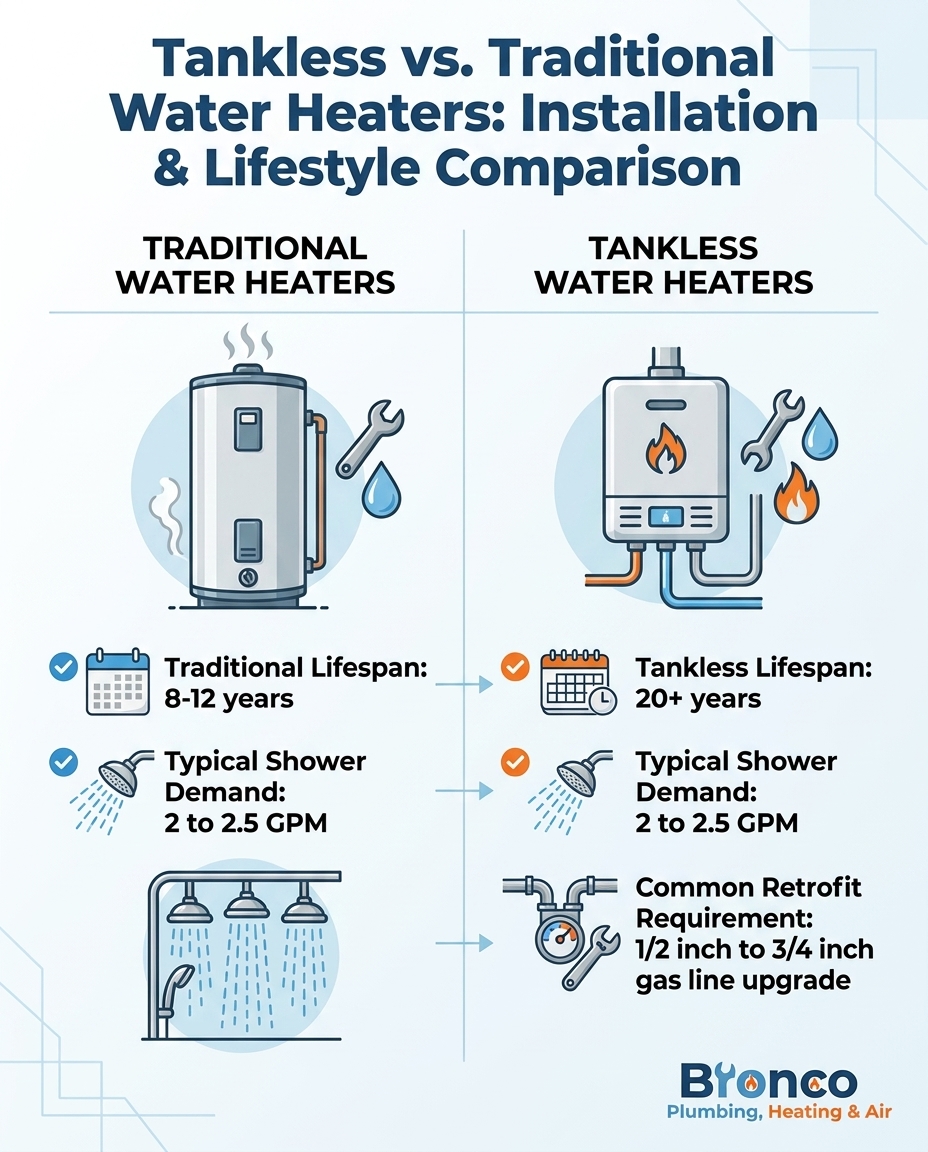
A standard modern showerhead typically uses between 2.0 and 2.5 GPM. If two people are showering in different bathrooms simultaneously, your home is instantly demanding up to 5.0 GPM of hot water. Add in a dishwasher running from the night before (roughly 1.5 GPM) or a washing machine cycling a load of gym clothes, and the compounding demand quickly overwhelms a standard plumbing setup.
The Math Behind the Empty Tank
A typical pattern we see in many older Citrus Heights suburban homes is the reliance on a standard 40- or 50-gallon traditional tank. While 50 gallons sounds like a massive amount of water, heavy, concentrated loads deplete it rapidly. If your household is drawing 6.0 GPM during the morning rush, a fully heated 50-gallon tank will run out of usable hot water in less than ten minutes. Once the tank is depleted, the recovery time—the period it takes for the burner to heat a fresh batch of cold groundwater—can take anywhere from 30 to 45 minutes.
This infrastructure challenge is deeply embedded in the design of older suburban homes, which were often built for smaller families or eras with lower simultaneous water demands. Upgrading to meet modern expectations requires more than just buying a new appliance; it requires a strategic look at how your home moves and heats water. For those looking to stick with a familiar setup, upgrading to high-capacity traditional tank water heaters is often the first step in addressing this shortfall.
The Tankless Advantage: Endless Supply vs. Retrofit Realities
The primary appeal of a tankless water heater is its ability to heat water on demand. Rather than storing a finite reservoir of hot water, these units use high-powered gas burners or electrical elements to heat water instantly as it passes through a heat exchanger. For large families, this eliminates the "empty tank" problem entirely. As long as the unit is sized correctly for your home's maximum GPM demand, the fifth shower of the morning will be just as warm as the first.
Beyond the lifestyle benefit of endless hot water, tankless systems offer an impressive lifespan. According to the U.S. Department of Energy, a well-maintained tankless unit can last 20 years or more—nearly double the expected lifespan of a traditional tank. However, achieving these benefits requires navigating some significant structural realities during installation.
The Reality of Gas Line Upgrades
Retrofitting a tankless system into an older home is a substantial infrastructure investment. Because tankless units must heat water instantly as it flows, they require a massive, sudden influx of energy—often demanding upwards of 199,000 BTUs. Standard traditional tanks, by contrast, usually operate on 40,000 to 50,000 BTUs.
• Gas Line Sizing: Many older homes are equipped with 1/2-inch gas lines, which are perfectly adequate for standard tanks. High-output tankless units almost universally require a 3/4-inch gas line to deliver the necessary fuel volume safely.
• Venting Requirements: Tankless units produce different exhaust profiles than traditional tanks. They typically require dedicated, Category III stainless steel venting or specific PVC/CPVC venting configurations routed directly outside, which may involve drilling new exterior wall penetrations.
• Electrical Modifications: Even gas-powered tankless units require a dedicated 120V electrical outlet to power the internal computer board and sensors, which is often missing in older water heater closets.
While these modifications represent a larger initial structural investment, many homeowners find the long-term reliability and endless supply well worth the effort. Proper planning for tankless water heater installations ensures that the home's infrastructure can safely support the upgraded technology.
High-Capacity Traditional Tanks: Familiar and Reliable
For some households, the extensive retrofit requirements of a tankless system may prompt a closer look at high-capacity traditional tanks. Sticking with a tank-style water heater does not mean settling for cold showers; it simply requires sizing the unit appropriately for a large family's peak demand.
Modern traditional tanks are vastly superior to the models manufactured just a decade ago. Stricter energy regulations have forced manufacturers to improve internal insulation significantly, reducing standby heat loss—the energy wasted keeping water hot while you are asleep or away at work.
Why Bigger Tanks Make Sense for Some
The strongest argument for remaining with a traditional tank is the lower initial retrofit investment. Because a new tank operates on the same basic principles and BTU requirements as your old one, the existing 1/2-inch gas lines, standard B-vent exhaust flues, and utility closet footprints can typically be reused with minimal modification.
• Sizing Up: To accommodate back-to-back showers without the need for extensive infrastructure changes, large families often upgrade from a standard 50-gallon tank to a 75-gallon or even a 100-gallon model.
• Predictable Lifespan: While they do not match the longevity of tankless units, modern traditional tanks offer a reliable 8 to 12 years of service with standard annual flushing and anode rod maintenance.
• Simpler Maintenance: Traditional tanks rely on simpler mechanical components, making routine maintenance and part replacements straightforward and highly predictable.
By sizing up the storage capacity, large households can create a sufficient buffer of hot water to survive the morning rush without undertaking a major gas line renovation.
How Sacramento County Groundwater Temperatures Affect Performance
When sizing any water heating system—but especially a tankless unit—local climate factors play a critical role in performance. The key scientific principle at work is called "Temperature Rise," often referred to in the industry as Delta-T. This is the difference between the temperature of the cold groundwater entering your home and the desired output temperature at your faucet (which is typically set to 120 degrees Fahrenheit for safety and comfort).
During the peak of summer, the groundwater entering Sacramento County homes is relatively warm. However, as the seasons change and we move into the colder months, local groundwater temperatures can drop significantly, often falling into the low 50s.
This seasonal temperature drop directly impacts a tankless water heater's maximum flow rate. If the incoming water is 50 degrees, the unit must achieve a 70-degree Temperature Rise to output 120-degree water. The harder the unit has to work to heat the water, the slower it must push that water through the heat exchanger. A tankless unit rated for 9.0 GPM in the summer might only be capable of delivering 5.5 GPM in the dead of winter.
Proper professional sizing is absolutely critical here. A system must be calibrated not just for the August back-to-school mornings, but also to ensure it can handle simultaneous showers on the coldest mornings of the year when the groundwater temperature is at its lowest.
Side-by-Side Comparison: Which System Fits Your Family?
Choosing the right system requires balancing your household's daily habits against the physical realities of your home's construction. To help clarify the decision, here is a breakdown of how the two technologies compare across the most important categories.
• Hot Water Delivery — Tankless Water Heaters: Endless supply; heats on demand — High-Capacity Traditional Tanks: Limited to tank capacity (e.g., 75 gallons)
• Expected Lifespan — Tankless Water Heaters: 20+ years (with proper maintenance) — High-Capacity Traditional Tanks: 8 to 12 years
• Structural Retrofit Requirements — Tankless Water Heaters: Often requires 3/4-inch gas line & dedicated venting — High-Capacity Traditional Tanks: Direct swap; reuses existing gas lines & flues
• Space Savings — Tankless Water Heaters: Wall-mounted, compact footprint — High-Capacity Traditional Tanks: Requires significant floor space in utility closets
• Simultaneous Usage — Tankless Water Heaters: Excellent, provided GPM is sized for winter Delta-T — High-Capacity Traditional Tanks: Excellent until the stored reservoir is depleted
Understanding these differences is the first step in finding affordable tankless water heater options or high-capacity tank solutions that align with both your lifestyle and your home's structural limits.
Navigating the Investment: Why Transparent Sizing Matters
Upgrading to a tankless water heater is a significant home infrastructure project, not just a simple appliance swap. Because the retrofit process touches your home's gas lines, venting, and electrical systems, it requires a thorough structural evaluation before any commitments are made. Guessing at your home's gas capacity or underestimating your family's peak GPM demand will inevitably lead to performance issues and unexpected installation hurdles.
At Bronco Plumbing, Heating & Air, we are committed to providing transparent cost-benefit analyses. We believe homeowners deserve to understand the real structural requirements of retrofitting older homes before the work begins. A professional assessment evaluates your current electrical capacity, maps out your existing gas line sizing, and calculates your household's peak water demand based on the number of fixtures and family members.
This upfront guidance is the best way to weigh the long-term return on investment against the initial structural requirements. If you are currently deciding whether to install a tankless water heater, a transparent evaluation ensures you choose a system that delivers reliable comfort without hidden surprises.
Frequently Asked Questions About Water Heaters for Large Families
Is a tankless water heater worth it for a large family?
Yes, a tankless water heater is highly beneficial for large families because it provides an endless supply of hot water. As long as the unit is properly sized to handle the simultaneous flow rate of multiple showers, you will never run out of hot water. Additionally, the 20-plus-year lifespan makes the initial structural investment worthwhile over the long term.
Will a tankless water heater keep up with multiple showers?
A properly sized tankless unit can easily keep up with multiple simultaneous showers. The key is ensuring the unit has a high enough Gallons Per Minute (GPM) rating to match your home's peak demand. A professional evaluation will calculate this demand, factoring in the flow rates of your specific showerheads and appliances.
What size water heater do I need for a family of 5 or more?
For a family of five or more using a traditional system, a 75-gallon or 100-gallon tank is usually recommended to prevent the reservoir from depleting during morning routines. If choosing a tankless system, you typically need a unit capable of delivering at least 7.0 to 9.0 GPM to handle the simultaneous demand of multiple bathrooms and appliances.
Do you run out of hot water with a tankless heater?
No, you do not run out of hot water with a tankless heater because it heats water continuously on demand. However, if too many fixtures are turned on at once and the demand exceeds the unit's maximum GPM capacity, the water pressure or temperature may temporarily drop until a fixture is turned off.
What are the typical retrofit requirements for switching to tankless in an older home?
Switching to a tankless system in an older home typically requires upgrading the existing gas line from 1/2-inch to 3/4-inch to handle the higher BTU demand. It also usually involves installing dedicated stainless steel or PVC venting to the exterior and adding a dedicated 120V electrical outlet nearby to power the unit's internal sensors.
How does groundwater temperature affect my tankless water heater's performance?
Colder groundwater requires the tankless unit to work harder to achieve the desired output temperature, a concept known as Temperature Rise or Delta-T. During the winter, when groundwater temperatures drop, the unit must slow down the water flow to heat it adequately, which temporarily reduces the maximum GPM available for simultaneous showers.
Upgrade Your Home's Hot Water Supply Today
Whether you choose the endless, on-demand supply of a modern tankless system or the familiar reliability of a high-capacity traditional tank, the right choice ultimately depends on your home's unique infrastructure and your family's daily routine. Surviving the morning rush shouldn't require rationing showers or waking up an hour early just to secure warm water.
Before the busy season fully sets in, take the time to have your home's gas lines, venting, and hot water demand professionally assessed. A clear, practical comparison of the physical installation requirements versus the lifestyle benefits will help you make an informed decision for your household. Reach out to schedule a comprehensive evaluation today, and secure a reliable hot water supply for the years ahead.

Customer Testimonials
Our customer testimonials highlight the reliable service, quality workmanship, and trusted results homeowners experience with Bronco Plumbing Heating and Air.


Ready to Transform your Home?
Create a healthier, more comfortable home with expert HVAC, plumbing, and indoor air quality solutions you can trust. From efficient heating and cooling to cleaner air and reliable repairs, our experienced team is here to keep your family comfortable year-round with dependable service and upfront pricing.
Related Articles

The Physics of Airflow: Why Closing Vents in Empty Rooms Damages Your HVAC System


Preparing Your Home Air Quality for Back-to-School Illness Season
Elk Grove's Hard Water Impact on Evaporative Coolers and Plumbing Fixtures