



.svg)

The Physics of Airflow: Why Closing Vents in Empty Rooms Damages Your HVAC System
Closing vents in unused rooms doesn't lower your energy bills—it suffocates your equipment. Find out how static pressure works and how to protect your blower motor from premature failure.

The Costly Illusion of Closing Vents to Save Energy
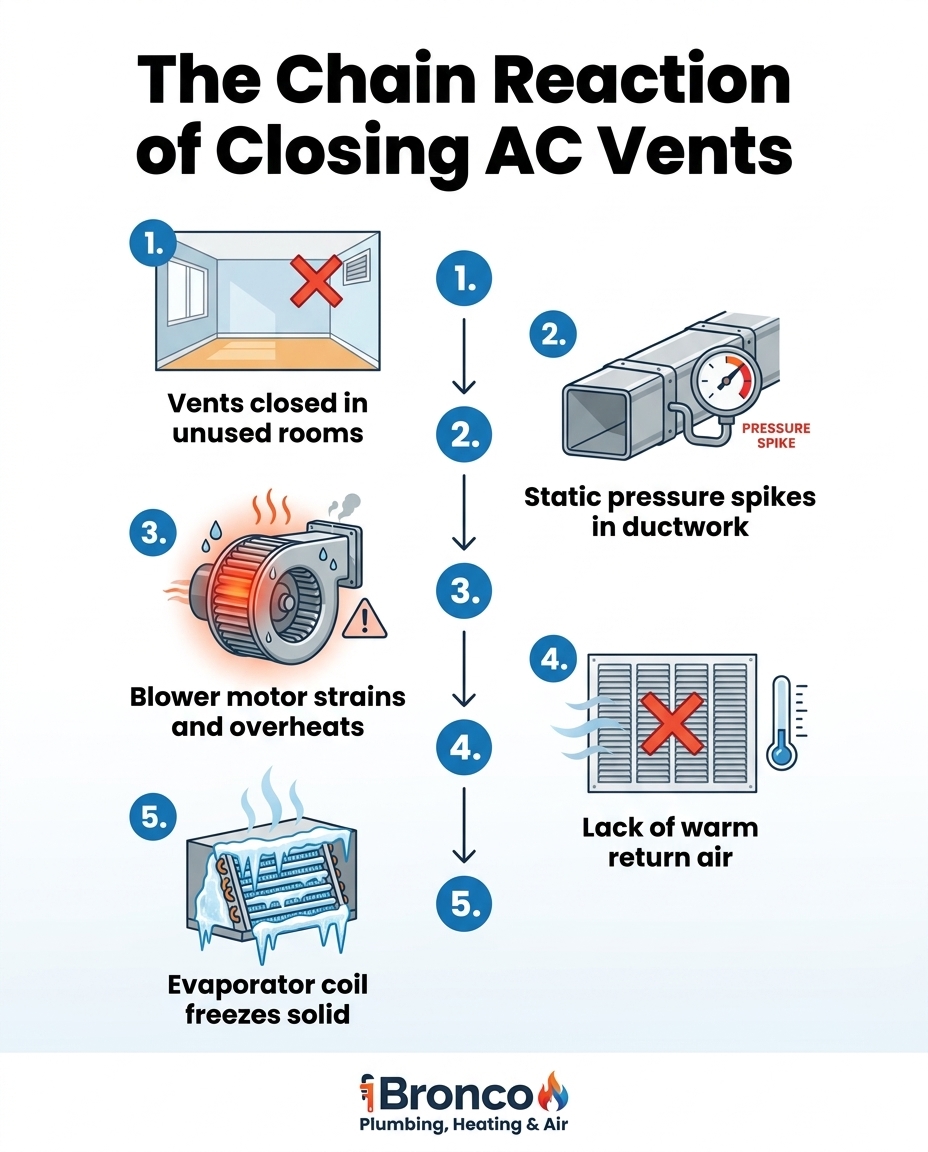
Closing vents in unused rooms doesn't save energy—it actually makes your system work much harder, which is why understanding the physics of airflow: why closing vents in empty rooms damages your HVAC system is one of the most critical lessons a homeowner can learn. A common assumption is that shutting the register in a spare guest bedroom or an empty office will force that cold air into the living room or master bedroom, lowering utility bills in the process. Unfortunately, modern cooling equipment does not work this way. Homeowners in Sacramento often face a specific decision point during peak heat: keep vents closed to supposedly "save energy" or open them to protect their expensive equipment from severe mechanical strain.
If you are already dealing with the fallout of restricted airflow, you can explore our professional AC services or learn more about our duct sealing and airflow solutions to restore your home's comfort.
Modern central air systems operate as meticulously balanced pressure loops. When the original installers sized your ductwork, they calculated the exact volume of air required to keep the system stable. Disrupting this delicate balance by blocking off registers leads to a cascade of catastrophic failures. Rather than saving you money, closing vents creates an environment where your equipment destroys itself from the inside out.
The High-Level Consequences of Closed Vents:
• Increased static pressure: The air has nowhere to go, creating a severe bottleneck inside your ductwork.
• Frozen evaporator coils: A lack of warm return air causes the indoor coil to drop below freezing, turning condensation into solid ice.
• Damaged blower motors: The motor works overtime trying to push air against a closed barrier, leading to overheating and premature failure.
• Wasted electricity: Smart motors consume maximum power trying to overcome the blockage, driving your utility bills up instead of down.
The Balanced Pressure Loop: Why Your AC Isn't a Garden Hose
To understand why closing a vent is so destructive, we have to look at the foundational physics of HVAC airflow. Most homeowners operate under the "water hose" misconception. If you have a garden hose running and you place your thumb over half of the nozzle, the water sprays out much harder and faster. It is intuitive to think that air in a duct acts the exact same way. However, your air conditioner is not a garden hose, and air is a compressible gas, not a liquid.
A central air system is designed to pull in a specific volume of warm air through the return grilles, condition it, and push out that exact same volume of cold air through the supply vents. It is a closed, balanced loop. When you close a vent, you are not redirecting the air efficiently to another room. Instead, you are creating massive backpressure. A much more accurate analogy is a kinked garden hose. If you fold a hose in half, the water doesn't magically find another way out; the pressure builds up behind the kink, stressing the material until it eventually bursts or damages the spigot connection.
During the intense heat of August late-summer cooling, your blower motor is trying to push hundreds of cubic feet of air per minute through your home. When it encounters a closed vent, it is fighting against a physical wall. The air backs up, the pressure spikes, and the system loses its ability to breathe.
• The Garden Hose Myth — What Happens When Blocked: Thumb over the nozzle redirects flow. — The Result on the System: False belief that air sprays harder into the living room.
• The Kinked Hose Reality — What Happens When Blocked: Flow is entirely restricted and backs up. — The Result on the System: Pressure builds inside the duct, causing leaks and strain.
• The Balanced Air Loop — What Happens When Blocked: Supply and return volumes become unequal. — The Result on the System: The blower motor suffocates, and the system breaks down.
Understanding Static Pressure and System Suffocation
The Problem: A Spike in Static Pressure
In the HVAC industry, the resistance to airflow inside your ductwork is called "static pressure." Think of static pressure like blood pressure for your heating and cooling equipment. A certain amount of static pressure is normal and necessary to move air through the filters, around the bends in the ducts, and out the vents. However, the system is engineered to operate within a very tight, specific range. When you close registers, you spike the static pressure well beyond what the system was designed to handle.
The Cause: Air Seeking the Path of Least Resistance
Because the blower motor continues to force air into the ducts, that highly pressurized air has to go somewhere. It begins to push against the seams, joints, and connections of your ductwork. According to data from the Lawrence Berkeley National Laboratory (LBNL), closing registers in unused rooms actually increases duct leakage. The excess pressure forces your perfectly conditioned, expensive cold air out of tiny gaps in the ductwork and into unconditioned spaces like your attic, crawlspace, or inside the walls. You end up paying to air-condition your attic.
The Solution: Recognizing the Symptoms
Homeowners in Sacramento often notice the physical symptoms of high static pressure before the system fails entirely. If you hear whistling sounds coming from your return grilles or supply vents, that is the sound of air being forced through a restricted space at high velocity. You might also notice uneven temperatures throughout the house or hear strange noises from your AC as the equipment struggles to breathe. The immediate solution is always to walk through your home and ensure every single vent is fully open and unobstructed by furniture, rugs, or heavy curtains.
How Restricted Airflow Destroys Blower Motors
The mechanical damage caused by closed vents hits the blower motor the hardest. In older systems, a standard PSC (Permanent Split Capacitor) motor would simply spin at a constant speed. If it encountered high static pressure from a closed vent, it would push less air, causing the system to run poorly but often surviving the strain for a while. However, modern HVAC systems utilize ECM (Electronically Commutated Motor) technology. These are "smart" motors designed to adjust their speed to maintain a constant, optimal airflow.
Here is where the physics of airflow becomes an expensive problem. When an ECM senses that the airflow has dropped due to a closed vent, its internal programming tells it to speed up to compensate. The motor ramps up its RPMs, spinning faster and faster, trying desperately to push the correct volume of air through the restriction. It will continue to accelerate until it reaches its maximum capacity.
The Irony of Wasted Energy: The homeowner originally closed the vent in the guest bedroom to save energy. But because of the restriction, the ECM blower motor is now consuming maximum electricity, running at top speed, and wasting a tremendous amount of power. Especially during the heavy demands of August late-summer cooling, this constant overworking generates excessive heat within the motor housing. Eventually, the motor overheats, the internal components melt or short out, and you are left with a premature, highly expensive motor burnout that could have been entirely avoided just by leaving a piece of stamped metal open.
If your system is already struggling to push air or has stopped blowing entirely, it may be time to look into professional heating services and cooling diagnostics to ensure your motor hasn't suffered permanent damage.
The Science Behind a Frozen Evaporator Coil
One of the most dramatic and confusing failures caused by closed vents is a frozen evaporator coil. It seems entirely counterintuitive to homeowners that their air conditioner could turn into a block of solid ice in the middle of a scorching summer day. But the physics of phase changes and heat transfer explain exactly why this happens.
The evaporator coil, located inside your home near the blower motor, is filled with extremely cold liquid refrigerant. Its job is not actually to "make" cold air, but rather to absorb the heat from the warm air passing over it. When you restrict airflow by closing vents, you drastically reduce the amount of warm return air flowing over that coil. Without that constant supply of heat from the house, the thermodynamics of the system fall out of balance.
The Cascading Failure Process:
1. Loss of Heat Load: Vents are closed, reducing the volume of warm air crossing the indoor evaporator coil.
2. Temperature Plummet: Without enough warm air to absorb the cold energy of the refrigerant, the surface temperature of the copper coil drops rapidly below 32°F (0°C).
3. Condensation Freezes: Air conditioners naturally pull humidity out of the air. Normally, this condensation drips down a drain line. But with the coil below freezing, that moisture instantly turns to frost.
4. Ice Blockage: The frost builds into a solid block of ice, further suffocating the airflow and compounding the problem.
5. Compressor Damage: Because the refrigerant didn't absorb enough heat to turn from a liquid into a gas, liquid refrigerant travels back outside to the compressor. Compressors can only pump gas, not liquid. This phenomenon, called "liquid slugging," can destroy the outdoor unit entirely.
During August late-summer cooling, the humidity and heat load demand that the coil operates flawlessly. Restricting the airflow removes the essential heat needed to keep the system functioning, turning a simple closed vent into a catastrophic compressor failure.
Why Sacramento Heatwaves Magnify Airflow Problems
The physics of restricted airflow are problematic year-round, but environmental factors heavily influence how quickly a system will break down. Sacramento's triple-digit August heat creates an environment where your HVAC system has absolutely zero margin for error. When the temperature outside climbs past 100°F, your air conditioner is forced to run longer, more continuous cycles to maintain a livable temperature indoors.
During these extended runtimes, the equipment is operating at its absolute maximum capacity. The blower motor is hot, the compressor is working relentlessly, and the refrigerant is absorbing massive amounts of thermal energy. If you restrict the airflow during these peak periods, you eliminate any buffer the system might have had. A slightly elevated static pressure that might be tolerable in a mild spring month becomes a fatal flaw during a heatwave.
One Sacramento homeowner reached out to us during one of the hottest days of the summer when their air conditioner broke down completely. Because it was after hours, the situation was urgent. Our technicians arrived quickly, provided fast, professional service, and rescued the customer on a very hot day. During the diagnostic process, it became clear that restricted airflow had pushed the system past its breaking point. The equipment was already fighting the brutal outdoor temperatures, and the added internal stress of closed vents caused the system to fail when the family needed it most.
The takeaway: Extreme weather magnifies every small inefficiency in your home. Closing vents during a heatwave practically guarantees a frozen coil or an overheated blower motor on the hottest day of the year.
Safe Alternatives for Balancing Your Home's Temperature
If closing vents is so destructive, how do you handle a home where the upstairs is boiling but the downstairs is freezing? Or a guest room that always feels like an icebox? The good news is that there are safe, mechanically sound ways to balance your home's temperature without suffocating your HVAC system.
Bronco Plumbing, Heating & Air provides transparent, expert diagnostic advice so homeowners understand exactly why their system is struggling, empowering them to prevent self-inflicted damage. We want you to achieve optimal comfort without risking your equipment.
Safe Temperature Control Checklist:
• Keep all vents fully open: Walk through your home and ensure every single supply register and return grille is 100% open and unobstructed by rugs, couches, or heavy drapes.
• Utilize ceiling fans: Fans do not lower the temperature of a room, but they create a wind-chill effect on your skin. Running a ceiling fan in a warm room can make it feel several degrees cooler without altering the duct pressure.
• Leave interior doors cracked: Central air systems rely on air returning to the central grille. If you close a bedroom door completely, you trap the air in that room, increasing pressure. Leave doors open or slightly cracked to promote circulation.
• Request a professional duct evaluation: If certain rooms are always too hot or too cold, the issue is likely improperly sized ductwork, crushed ducts in the attic, or severe air leaks. A professional can seal or modify the ducts to deliver the right amount of air.
• Consider a multi-zone system: For true room-by-room temperature control, a ductless mini-split system or a professionally installed zoning system with automated dampers bypasses the static pressure problem entirely.
To keep your system running smoothly and catch airflow issues before they cause a breakdown, consider enrolling in a comprehensive HVAC maintenance plan to ensure your equipment is always prepared for the August late-summer cooling season.
Protect Your Equipment and Maintain Consistent Comfort
The short answer is that keeping your vents open is the easiest, most effective way to protect your HVAC system from severe static pressure damage. Modern air conditioners are carefully calibrated machines that require a balanced pressure loop to function. By leaving the registers open, you allow the system to breathe, preventing frozen coils, blown motors, and wasted electricity.
What truly satisfies a homeowner isn't shutting a door to save a few pennies, but having a properly balanced, highly efficient system that cools the entire house reliably. If you are struggling with uneven temperatures, high utility bills, or poor airflow in your Sacramento home, don't try to force the system to behave by blocking vents. Reach out for professional diagnostic help to solve the root cause of the problem and enjoy consistent, worry-free comfort all summer long.
Frequently Asked Questions
Does closing vents save money?
No, closing vents does not save money and usually increases your utility bills. Modern HVAC systems have smart blower motors that will actually consume more electricity as they speed up to fight the restricted airflow. Furthermore, the increased static pressure forces cold air out of duct leaks into your attic, wasting the energy you paid to condition.
Why did my evaporator coil freeze?
Your evaporator coil froze because there was not enough warm indoor air blowing across it to keep the temperature above freezing. When you close vents, you restrict the airflow, causing the cold refrigerant inside the coil to freeze the natural condensation on the metal fins. This ice block eventually stops all airflow and can severely damage your outdoor compressor.
What happens when you close AC vents?
When you close AC vents, you create a massive spike in static pressure inside your ductwork. This suffocates the blower motor, causes the evaporator coil to freeze over, and forces conditioned air out of the seams of your ducts into unconditioned spaces. Over time, this leads to premature system failure and expensive repairs.
Does closing vents redirect air to other rooms?
Closing vents does not efficiently redirect air to other rooms; instead, it creates a bottleneck. While a tiny amount of air might be pushed elsewhere, the vast majority of the air backs up in the ductwork, increasing pressure and causing leaks. Your system is not designed like a water hose, and blocking the flow only damages the equipment.
How can I safely cool specific rooms without damaging my system?
You can safely cool specific rooms by using ceiling fans to circulate the air and keeping interior doors open to allow proper return airflow. If a room is consistently too hot, you should have a professional evaluate your ductwork for leaks or sizing issues. For precise control, consider installing a ductless mini-split system for that specific area.

Customer Testimonials
Our customer testimonials highlight the reliable service, quality workmanship, and trusted results homeowners experience with Bronco Plumbing Heating and Air.


Ready to Transform your Home?
Create a healthier, more comfortable home with expert HVAC, plumbing, and indoor air quality solutions you can trust. From efficient heating and cooling to cleaner air and reliable repairs, our experienced team is here to keep your family comfortable year-round with dependable service and upfront pricing.
Related Articles
Preparing Your Home Air Quality for Back-to-School Illness Season

Elk Grove's Hard Water Impact on Evaporative Coolers and Plumbing Fixtures
Why Your Vents Smell Like Mildew When the AC Kicks On in Late Summer