



.svg)

Can You Safely Delay a Minor Refrigerant Leak Repair Until Fall?
Discovering an AC leak in late August forces a tough choice: fix it now or limp through September. Running on low refrigerant forces your compressor to overheat, risking total system failure.
The Late-Summer Dilemma: Can Your AC Wait Out the Heat?
You notice your air conditioner is running longer than usual, and the air coming from the vents just isn't as cold as it was in June. After a quick inspection, you discover the culprit: a slow freon drip. Now you are faced with a frustrating question: can you safely delay a minor refrigerant leak repair until fall? With the late August back-to-school transition already stretching your schedule and budget, the temptation to just let the system limp through September is incredibly strong. Here at Bronco Plumbing, Heating & Air, it is a dilemma we help Sacramento homeowners navigate every late summer.
It is completely understandable to want to defer a repair when the cooling season feels like it is almost over. However, air conditioning systems are highly pressurized, finely tuned machines. What looks like a tiny, insignificant drip on the outside actually represents a fundamental shift in how your equipment operates on the inside. Ignoring the problem often turns a straightforward fix into a massive mechanical failure. If you are weighing your options, securing professional HVAC services for proper diagnostics is the smartest first step. Getting reliable air conditioning repair services now can save you from a complete system breakdown during the hottest weeks of the year.
The Short Answer: Why Refrigerant Leaks Are Never Truly Minor
The short answer is no—delaying a refrigerant leak repair is never safe for your equipment. To understand why, you have to look at how central cooling actually works. Your air conditioner does not consume refrigerant like a car consumes gas. Instead, it is a completely closed-loop system. The chemical continuously circulates between the indoor and outdoor units, absorbing heat from inside your house and releasing it outside.
Because it is a sealed loop, any loss of refrigerant indicates a physical breach in the copper lines or coils. In our experience diagnosing local AC units, there is no such thing as a "normal" drop in freon levels. When that chemical escapes, it does more than just reduce your cooling power; it fundamentally alters the internal pressure of the entire system. Your compressor and coils are engineered to operate at very specific pressure metrics.
This pressure imbalance becomes highly destructive during 90-100+ degree Sacramento late-summer days. When the outside temperature spikes, your system has absolutely zero margin for error. Operating with compromised pressure forces every moving part to work twice as hard just to achieve a fraction of the cooling. If you are curious about the science behind this closed loop, you can learn more about why your AC refrigerant doesn't just run out. Ultimately, a leak means the system is bleeding its lifeblood, and the mechanical consequences escalate rapidly.
The Mechanical Chain Reaction: From Low Pressure to Frozen Coils
When you lose refrigerant, the damage does not happen all at once. Instead, it sets off a predictable, destructive chain reaction inside your HVAC system. During the late August back-to-school transition, when your house is empty during the day and demands heavy cooling in the late afternoon, this chain reaction accelerates.
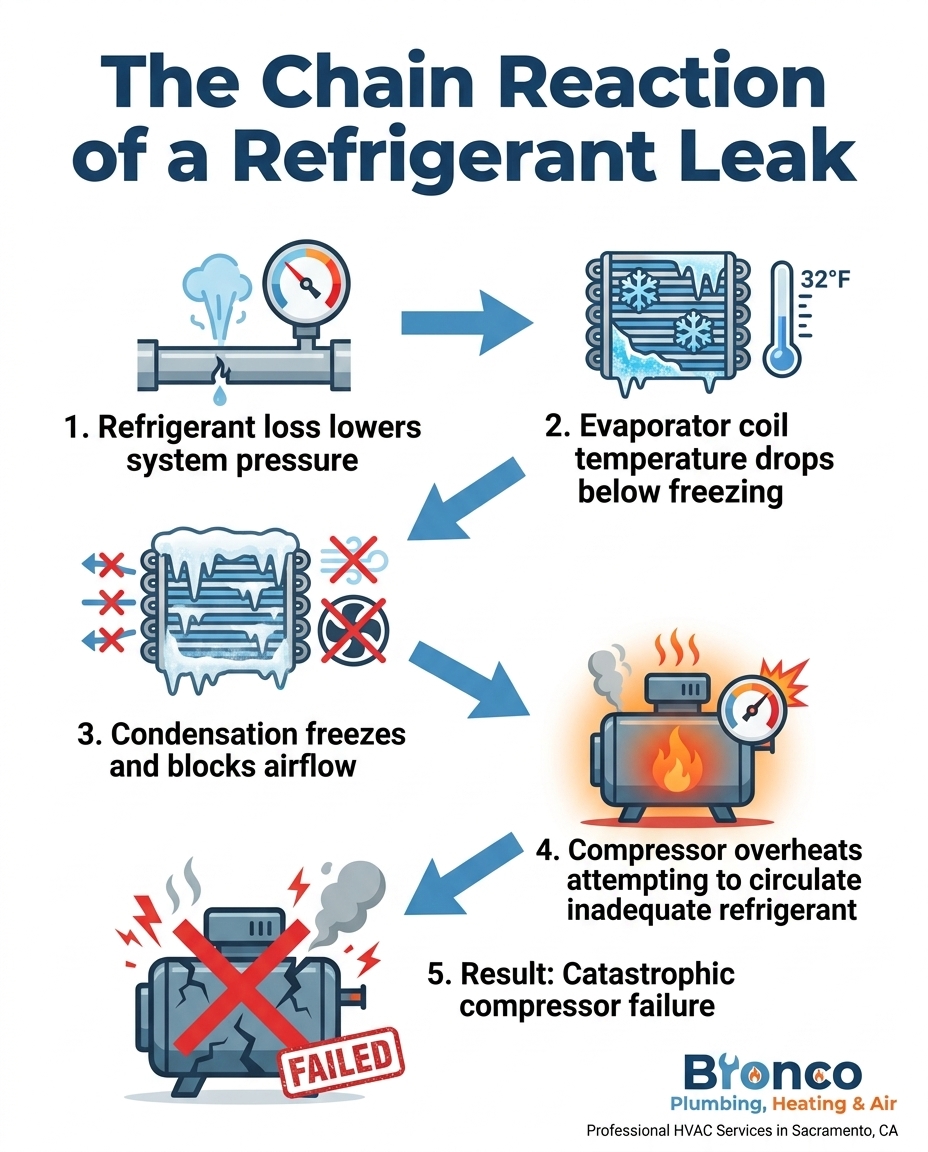
1. The initial pressure drop: As refrigerant leaks out of the copper lines, the overall volume of the chemical decreases. In a sealed system, lower volume equals lower pressure. This pressure drop is most severe inside your indoor evaporator coil.
2. The temperature plummets: It sounds counterintuitive, but lower pressure makes the remaining refrigerant absorb heat too rapidly, causing the temperature of the indoor coil to drop well below the freezing point of water.
3. Condensation turns to ice: Normally, your indoor coil extracts humidity from the air, which drips safely into a drain pan. When the coil drops below freezing, that natural condensation instantly freezes to the metal. Over a few hours, a thick block of solid ice forms over the delicate fins.
4. Airflow is completely blocked: Once the ice forms, warm indoor air can no longer pass through the coil. Your vents will stop blowing cold air entirely, even though the thermostat is still calling for cooling.
5. The system runs continuously: Because the thermostat never registers a drop in room temperature, it keeps sending the signal to run. The outdoor unit grinds away endlessly, fighting a losing battle against a frozen indoor coil, multiplying the wear and tear on your motors.
The Ultimate Danger: Catastrophic Compressor Failure
The Problem: The most severe risk of ignoring a slow leak is the total destruction of your compressor. The compressor is the heart of your outdoor unit. It is responsible for pumping the refrigerant through the lines, and it relies on that very same refrigerant to keep itself cool during operation. When the chemical levels drop, the compressor loses its primary cooling mechanism.
The Cause: Running on low charge leads to a phenomenon known as "liquid slugging" or severe overheating. As the system struggles to pressurize an inadequate amount of fluid, the compressor motor strains heavily. Furthermore, Sacramento historically experiences extreme heat well into September, offering no natural climate relief for a struggling unit. The 90-100+ degree Sacramento late-summer days bake the outdoor unit while it is already overheating from the inside. Eventually, the electrical windings inside the compressor melt, or the mechanical valves shatter under the stress.
The Solution: Fixing a minor leak early requires locating the hole, patching or replacing the affected section, and recharging the system. It is a straightforward repair. Replacing a burned-out compressor, on the other hand, is one of the most labor-intensive and costly jobs in the HVAC industry—often making it more practical to replace the entire air conditioner. Our team sees this exact scenario play out frequently across the Sacramento area. One local homeowner called us on a 90-degree day when their outside AC unit simply refused to turn on or off properly. Our technician diagnosed a severe compressor issue caused by prolonged strain and had to replace the component to get their home cooling again. Catching the underlying pressure issue before it kills the compressor is always the better path.
The Hidden Costs of Waiting: Efficiency and Energy Bills
We find it is incredibly common for our customers to look at a late August back-to-school transition and think, "If I can just make it three more weeks, I won't have to deal with this until next spring." The budget anxiety is completely valid. Deferring a repair feels like a smart financial move in the short term. However, the financial math of a struggling air conditioner never works out in the homeowner's favor.
When your system lacks the proper refrigerant charge, its energy efficiency plummets. A unit designed to cool your home in 15-minute cycles will suddenly need to run for 45 minutes or even continuously just to drop the temperature a single degree. This relentless operation drastically inflates your monthly utility bills. The meter on the side of your house spins rapidly as the compromised motors draw maximum amperage hour after hour.
• Healthy Refrigerant Levels — Average Cycle Length: 15 - 20 minutes — Energy Draw: Normal / Baseline — Wear and Tear Risk: Low (Standard operation)
• Minor Refrigerant Leak — Average Cycle Length: 45+ minutes — Energy Draw: High (Continuous running) — Wear and Tear Risk: Moderate (Overheating motors)
• Severe Refrigerant Loss — Average Cycle Length: Never shuts off — Energy Draw: Maximum (Spiking bills) — Wear and Tear Risk: Extreme (Compressor failure)
The perceived "savings" of delaying the repair are quickly eaten up by wasted electricity. By the time October rolls around, you may have paid the utility company enough in wasted energy to cover a large portion of the repair costs, and you still have a broken air conditioner sitting in your yard.
Why 'Topping Off' the Refrigerant Isn't a Real Solution
A common misconception we hear in the field is that a technician can simply come out and "top off" the freon to get you through the rest of the season. While adding refrigerant will temporarily restore cooling, it is not a real solution. Adding chemical to a leaking system is exactly like putting air in a tire that has a nail stuck in the tread. You might be able to drive on it for a few miles, but it is going to go flat again, and you risk a blowout at high speeds.
Beyond the mechanical risks, there are strict environmental regulations regarding residential cooling chemicals. The Environmental Protection Agency (EPA) has specific guidelines concerning the handling, recovery, and intentional venting of refrigerants. Because these chemicals can be harmful to the environment, professionals are required to find and fix significant leaks rather than endlessly refilling a compromised system.
During those punishing 90-100+ degree Sacramento late-summer days, a topped-off system will still leak. As the pressure fluctuates, the mechanical strain continues behind the scenes. The only true fix is a professional leak detection service. Technicians use electronic sniffers, ultraviolet dye, or nitrogen pressure tests to pinpoint the exact location of the breach so it can be permanently sealed.
Protecting Your System and Your Budget
Dealing with unexpected home repairs is stressful, especially during the late August back-to-school transition when family expenses are already high. But taking action now protects both your comfort and your wallet. A professional diagnostic is a low-stress way to get all the facts. A trained technician can accurately locate the leak, assess the overall health of your compressor, and give you a clear picture of what needs to be done.
At Bronco Plumbing, Heating & Air, our team is committed to providing honest assessments and transparent diagnostics. We believe in solving the immediate problem without upselling unnecessary equipment. For example, another local customer reached out to our crew late in the summer needing an urgent AC fix; our technician arrived right on time, clearly explained what needed to be done without using confusing jargon, and fixed the unit efficiently. They noted they were treated honestly and fairly from start to finish. That is the standard of care every home deserves.
If a leak repair feels out of reach right now, you do not have to resort to running a dying system. We offer flexible HVAC financing options that make it easy to fix the problem today while managing the costs over time. Financing a repair is a much safer, smarter alternative to risking a total system replacement.
The Role of Routine Maintenance
The best way to handle refrigerant leaks is to catch them before they impact your daily comfort. Tiny micro-leaks often develop over months or years due to standard vibration and chemical wear. By enrolling in a routine AC maintenance plan, you ensure a professional checks your system's pressure levels every single spring. Regular tune-ups catch these minor pressure drops early, allowing you to seal the leak long before the summer heat arrives and the compressor is put in danger.
Frequently Asked Questions About AC Refrigerant Leaks
What happens if I ignore a low refrigerant leak?
Ignoring a low refrigerant leak causes the system's internal pressure to drop, which forces the indoor evaporator coil to freeze solid. Once the coil freezes, airflow is blocked, and your home will stop cooling entirely. If the system continues to run in this state, the overworked compressor will eventually overheat and fail completely.
Can an AC run on low refrigerant for a month?
While an AC might technically continue to turn on for a month with low refrigerant, doing so is highly destructive. The unit will run almost continuously to try and reach the thermostat setting, causing your energy bills to skyrocket. Operating in this compromised state during 90-100+ degree Sacramento late-summer days virtually guarantees severe mechanical damage to the motors.
Will a minor AC leak cause my compressor to fail?
Yes, even a minor leak can eventually cause catastrophic compressor failure. The compressor relies on a specific volume of circulating refrigerant to keep itself cool while pumping. When that volume drops, the compressor overheats, strains its internal valves, and will eventually burn out if the leak is not sealed.
How long can an AC run with a refrigerant leak?
There is no safe timeframe to run an AC with a known leak, as the damage compounds every hour the system operates. Depending on the size of the hole, a system might limp along for a few days or a few weeks before the coil freezes over entirely. However, every cooling cycle increases the risk of permanent motor damage.
Is a small freon leak dangerous?
A small leak is primarily dangerous to the mechanical health of your HVAC equipment and your monthly budget. While modern residential refrigerants are generally safe when contained, they displace oxygen and should never be inhaled. If you suspect a leak, it is important to have a professional handle the chemical safely according to environmental regulations.
Does late-summer heat accelerate AC damage from leaks?
Absolutely. Extreme ambient temperatures force the air conditioner to work at maximum capacity just to maintain a baseline temperature. When the system is already struggling with low pressure, the added burden of intense late-summer heat accelerates the overheating process, pushing the compressor to the point of failure much faster than it would in mild weather.
Make an Informed Decision Before the Next Heatwave
When you spot the signs of a struggling air conditioner during the late August back-to-school transition, ignoring the problem is a gamble you are likely to lose. Making an informed decision to repair a leak now is vastly superior to crossing your fingers and hoping the machinery survives until autumn. The dual risks of skyrocketing energy bills and catastrophic compressor failure simply outweigh the temporary convenience of waiting.
You do not have to navigate this dilemma alone. Scheduling a professional diagnostic secures your peace of mind for the rest of the cooling season. A trained technician can pinpoint the leak, restore the proper pressure, and ensure your home stays consistently comfortable without putting your vital equipment in jeopardy.

Customer Testimonials
Our customer testimonials highlight the reliable service, quality workmanship, and trusted results homeowners experience with Bronco Plumbing Heating and Air.


Ready to Transform your Home?
Create a healthier, more comfortable home with expert HVAC, plumbing, and indoor air quality solutions you can trust. From efficient heating and cooling to cleaner air and reliable repairs, our experienced team is here to keep your family comfortable year-round with dependable service and upfront pricing.
Related Articles

Tankless vs. Traditional Water Heaters for Large Citrus Heights Families

The Physics of Airflow: Why Closing Vents in Empty Rooms Damages Your HVAC System

Preparing Your Home Air Quality for Back-to-School Illness Season