



.svg)

Why Late Summer is the Hardest Time on Aging HVAC Capacitors
After months of relentless heat, your AC's electrical parts reach their breaking point. Find out how thermal fatigue impacts capacitors in August and what to do before a total breakdown.
August Heat: The Breaking Point for Your AC System
August in Northern California is notorious for pushing cooling equipment to the brink, which is exactly why late summer is the hardest time on aging HVAC capacitors. Here at Bronco Plumbing, Heating & Air, our technicians spend the back-to-school season fielding a massive influx of calls for this exact issue. The transition into fall usually brings the anticipation of cooler evenings, but the reality is often a relentless string of August late-summer heat waves. You know the feeling: it is late afternoon, the thermostat is set to 72 degrees, but the indoor temperature keeps creeping up. You step outside, and instead of the familiar roar of the condenser fan, you hear a troubling electrical buzz.
When an air conditioning system struggles to start or suddenly stops blowing cold air mid-August, our team typically finds that the capacitor is the most common culprit. This small, cylindrical electrical component does the heavy lifting every time your cooling cycle kicks on. By the time late summer arrives, your system has already endured months of heavy usage. Recognizing the early signs of a struggling capacitor allows you to act before minor electrical wear turns into major mechanical damage.
Understanding how this specific component handles heat is the first step in protecting your system. Proactive care and timely air conditioning services can prevent a simple part replacement from escalating into a total system breakdown during the hottest weeks of the year.
What an AC Capacitor Actually Does
To understand why our team replaces this specific part so frequently, it helps to know what it actually does inside your condenser unit. Think of the AC capacitor as a powerful, rechargeable battery or a heavy-duty jump-starter for your compressor and fan motors. Air conditioners require a massive jolt of electricity to start up—significantly more power than your home's standard electrical wiring can provide in a single instant.
The Start Capacitor: This component delivers a massive, split-second surge of voltage to get the heavy compressor motor spinning from a dead stop. It takes immense torque to compress refrigerant, and the start capacitor provides the necessary kick.
The Run Capacitor: Once the motor is running, the run capacitor takes over. It supplies a continuous, steady stream of optimized electrical current to keep the motor spinning efficiently without overheating.
Every single time your thermostat registers a warm room and signals the AC to turn on, the capacitor stores and releases this massive burst of energy. Over a single cooling season, this results in thousands of start-and-stop cycles. This constant storing and discharging of high voltage is inherently taxing on the internal materials of the component. The capacitor acts as a buffer, taking the brunt of the electrical stress so your expensive compressor motor does not have to.
The Compounding Toll of Sacramento's Dry Heat
In our years of serving Sacramento CA, we've learned firsthand that the failure rate of electrical components spikes dramatically in late summer due to the specific climate challenges of our region. Sacramento experiences frequent, prolonged stretches of triple-digit dry heat. Unlike regions that get occasional hot afternoons followed by cool nights, the Central Valley often endures multi-day heat waves where the temperature barely drops overnight. This lack of a cooling-off period prevents your condenser unit from fully resting.
Our HVAC professionals measure cooling stress using a metric called "cooling degree days." By the time August arrives, your air conditioner has already accumulated a massive number of cooling degree days. The groundwork for a late-summer failure was laid in June and July. The capacitor has been working overtime for months, and the cumulative wear is starting to show.
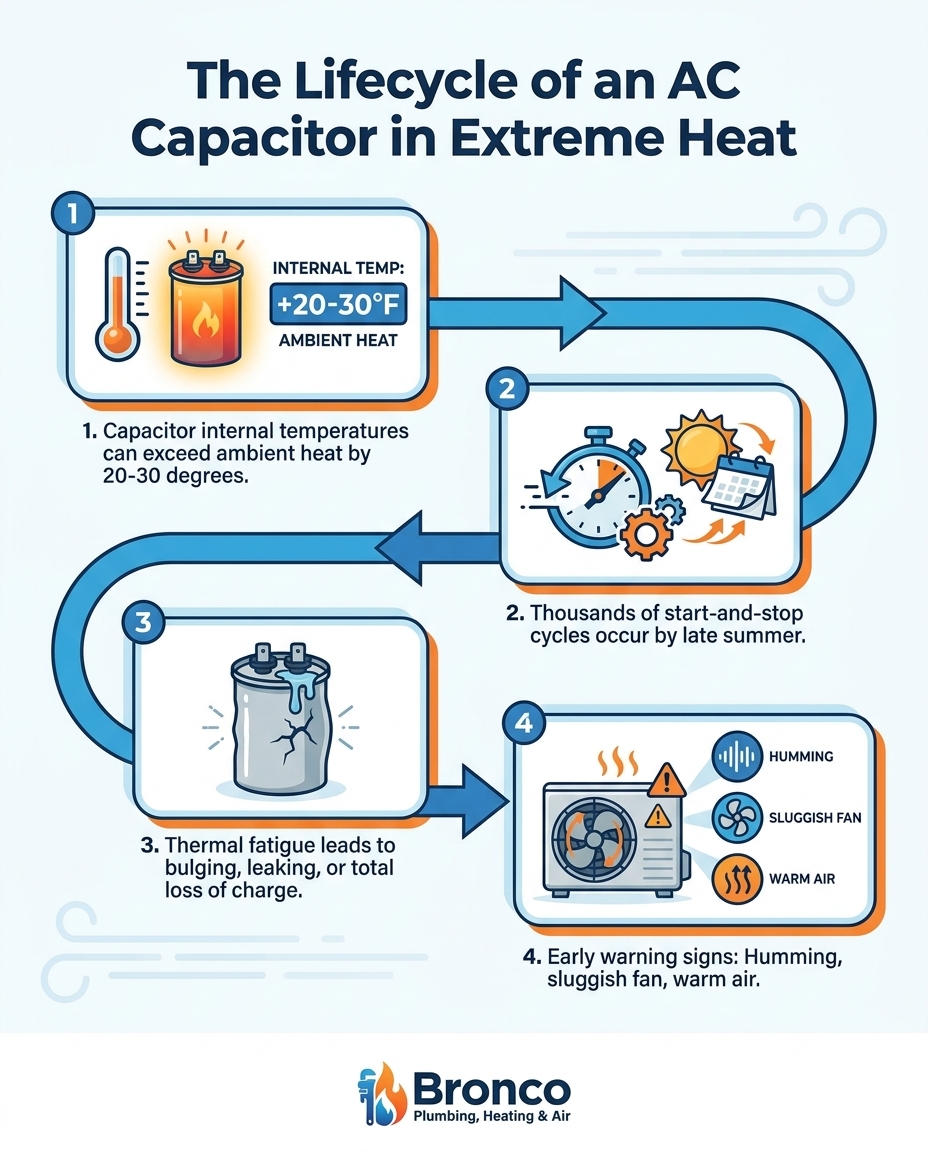
Furthermore, ambient outdoor temperature is only half the story. The internal operating temperature of your outside condenser unit is significantly hotter than the air around it.
• 85°F (Mild Summer Day) — Internal Condenser Temperature: 105°F - 110°F — Component Stress Level: Normal operation, standard thermal load
• 95°F (Typical July Afternoon) — Internal Condenser Temperature: 115°F - 125°F — Component Stress Level: Elevated stress, continuous fluid expansion
• 105°F+ (August Heat Wave) — Internal Condenser Temperature: 125°F - 135°F+ — Component Stress Level: Critical stress, approaching maximum thermal limits
Most standard HVAC capacitors are rated to operate safely up to about 158°F (70°C). When you combine multi-day stretches of 100-plus degree heat with the massive heat generated by the compressor itself, the internal environment inside the metal cabinet pushes these electrical components dangerously close to their maximum standard temperature ratings.
Thermal Fatigue: Why Late Summer Triggers Failure
The combination of thousands of start-and-stop cycles and August late-summer heat waves results in a condition known as thermal fatigue. Thermal fatigue is the gradual physical degradation of the capacitor's internal fluids and insulating materials due to relentless temperature fluctuations.
Here is exactly how we see thermal fatigue destroy a capacitor over the course of the summer:
1. Continuous Thermal Expansion: Inside the metal casing of a capacitor are layers of thin metallic foil separated by an insulating dielectric fluid or film. As the component heats up during a long cooling cycle, these internal materials physically expand.
2. Incomplete Contraction: When the cycle ends, the materials cool and contract. However, during severe heat waves, the unit turns back on before the component can fully cool down. The materials remain in a state of partial expansion.
3. Fluid Degradation: Over months of this repetitive expansion and contraction, the chemical composition of the dielectric fluid begins to break down. It loses its ability to insulate the electrical charge effectively.
4. Pressure Buildup and Venting: As the fluid degrades, it generates gas. This gas creates immense internal pressure. To prevent an explosion, capacitors are designed with a safety mechanism: the top of the metal casing will bulge upward, physically breaking the internal electrical connection.
When one of our technicians finds a capacitor with a swollen, domed top or fluid leaking down the sides, thermal fatigue is the direct cause. The sheer volume of these cycles finally pushes the internal mechanisms past their breaking point. Fortunately, this is a predictable mechanical failure. A blown capacitor is an isolated component issue, not necessarily a sign that your entire air conditioning system is dying.
Warning Signs Before Total Capacitor Failure
Capacitors rarely fail without warning. Because the degradation happens gradually over thousands of start-and-stop cycles, your air conditioning system will usually exhibit noticeable symptoms before the component dies completely. Catching these warning signs early can save you from a hot, sleepless night—a pattern we see often in our late-summer emergency calls.
• A distinct humming or buzzing noise: If you walk past your outside condenser unit and hear a loud electrical buzz or hum, but the fan blades are not spinning, the capacitor is likely failing. This sound is the motor trying to draw power to start, but failing because the capacitor cannot deliver the necessary jump-start.
• Sluggish fan blades: You might notice that the top fan on the outside unit is spinning much slower than usual, or it takes a long time to get up to full speed. Important safety warning: Never stick a stick, screwdriver, or any other object through the metal grate to try and "push start" the fan blades. This is incredibly dangerous and can result in severe injury or permanent motor damage.
• Warm air blowing indoors: If the indoor blower motor is running but the outside compressor cannot start due to a dead capacitor, your vents will blow room-temperature or warm air. The system is moving air, but no actual heat transfer or cooling is taking place.
• Hard starting and short cycling: If you hear the outside unit violently shudder or make a loud clunking noise when it turns on, this is called "hard starting." The compressor is struggling to overcome mechanical resistance without adequate electrical support. You might also notice the system turning on and off in very short bursts, unable to sustain a full cooling cycle.
If you notice any of these symptoms, it is time to investigate. Ignoring strange noises coming from your AC usually leads to more expensive problems down the line.
Protecting Your Compressor from Secondary Damage
The biggest danger of a failing capacitor is not the loss of cooling—it is the secondary damage inflicted on the compressor motor. When the capacitor stops providing the necessary starting voltage, the compressor does not just give up. It continuously tries to pull power directly from your home's electrical grid.
This creates a condition known as "locked rotor amps." The motor pulls massive amounts of electricity, causing the internal copper windings to overheat rapidly. Most modern compressors have an internal thermal overload switch that will shut the motor down before it melts, but this switch is only designed to trip a few times. If the system is left running for days with a bad capacitor, the constant overheating will eventually burn out the compressor windings entirely.
Replacing a capacitor is a fast, straightforward repair. Replacing a burnt-out compressor is a major, labor-intensive overhaul that often requires discussing HVAC financing options for a full system replacement.
Our team recently helped a local homeowner who experienced this exact cascade of events during a Sunday service call in the middle of a 106-degree heat wave. Their outside AC unit was completely unresponsive. Upon arrival, our technician diagnosed the issue and determined that the extreme electrical strain had ruined the compressor—a situation that rapid intervention can sometimes prevent if caught at the capacitor stage. If you suspect your capacitor is failing, the safest action is to turn your thermostat to the "off" position immediately and call for professional help.
Rapid Emergency Response When You Need It Most
Air conditioning breakdowns rarely happen at convenient times. They almost always occur on the hottest days of the year, right when the equipment is under maximum stress. When your system fails in the middle of an August heat wave in Sacramento CA, waiting three days for an appointment is not an option.
You need a reliable local team that prioritizes rapid emergency response to restore your home's cooling quickly. For example, our dispatch team recently received an after-hours call from a customer on the absolute hottest day of the summer when their air conditioner went completely down. Because they called our team, which is fully equipped for rapid response, our technicians arrived quickly and provided the fast, professional after-hours service necessary to rescue the home from dangerous indoor temperatures.
While a capacitor replacement is a straightforward fix for a licensed professional, preventing the breakdown entirely is always the better route. During a professional tune-up, our technicians use a specialized multimeter to measure the capacitor's microfarads—the unit of electrical capacitance. If the reading drops below the manufacturer's specified range, the technician can replace the weakened part before it fails completely.
Testing electrical components under load is a standard part of a comprehensive AC maintenance plan. Checking these microfarad readings before the extreme heat sets in ensures your system has the electrical support it needs to survive the late summer peak.
Frequently Asked Questions About Summer AC Breakdowns
Why do AC capacitors fail in summer?
In our experience, capacitors fail in the summer due to the combination of high ambient temperatures and the massive internal heat generated by the condenser. The extreme heat degrades the dielectric fluid inside the component. Additionally, the increased frequency of cooling cycles means the capacitor is constantly storing and discharging high voltage without enough time to cool down.
What does a failing capacitor sound like?
Our customers typically describe a distinct electrical buzzing or loud humming sound from the outside condenser unit. You may also hear a clicking sound as the system attempts to start, but the compressor and fan fail to engage. These sounds indicate the motor is trying to pull power but lacks the jump-start it needs.
Can extreme heat cause AC failure?
Yes, extreme heat is the primary catalyst for AC component failure. Excessive heat degrades electrical insulation, overheats motors, and forces the entire system past its designed thermal limits. When the outside air is over 100 degrees, the internal cabinet temperature can easily exceed the safe operating ratings of standard electrical parts.
How long do AC capacitors last in hot climates?
In hot climates like ours with long cooling seasons, a standard AC capacitor typically lasts between 5 and 7 years. However, units exposed to direct afternoon sun or systems that run constantly without maintenance may experience capacitor failure in as little as 3 to 4 years due to accelerated thermal fatigue.
Can a hot day cause an AC capacitor to fail?
A single hot day rarely destroys a healthy capacitor on its own. Instead, a severe hot day is usually the tipping point for a capacitor that has already been weakened by months or years of cumulative wear. The extreme heat simply pushes an already degraded component past its breaking point.
Is it safe to run my AC if the capacitor is failing?
No, we strongly advise against it as it is not safe for the equipment. Running an air conditioner with a failing capacitor forces the compressor motor to pull excessive electrical current, which leads to severe overheating. Continuing to run the system in this state can permanently damage or destroy the compressor, turning a minor repair into a major expense.
Don't Wait for a Total Breakdown This Summer
Late-summer wear and tear on your cooling equipment is inevitable, but sudden, catastrophic breakdowns do not have to be. August late-summer heat waves will always test the limits of your system, but recognizing the signs of electrical fatigue gives you the upper hand. If you hear a loud humming from your outside unit, notice the fan blades struggling to spin, or feel warm air coming from your vents, turn the system off immediately.
Do not wait for the compressor to overheat and fail. A weakened capacitor is a simple, affordable component replacement when caught early. Reach out to the team at Bronco Plumbing, Heating & Air for an expert inspection today to ensure your electrical components are operating safely, and enjoy the peace of mind that comes with a reliable, fully functioning air conditioning system for the rest of the summer.

Customer Testimonials
Our customer testimonials highlight the reliable service, quality workmanship, and trusted results homeowners experience with Bronco Plumbing Heating and Air.


Ready to Transform your Home?
Create a healthier, more comfortable home with expert HVAC, plumbing, and indoor air quality solutions you can trust. From efficient heating and cooling to cleaner air and reliable repairs, our experienced team is here to keep your family comfortable year-round with dependable service and upfront pricing.
Related Articles
Can You Safely Delay a Minor Refrigerant Leak Repair Until Fall?

Tankless vs. Traditional Water Heaters for Large Citrus Heights Families
The Physics of Airflow: Why Closing Vents in Empty Rooms Damages Your HVAC System