



.svg)

Addressing Older Ductwork Inefficiencies in Historic Folsom Homes
A brand-new AC will still struggle in the late August heat if it relies on failing, leaky vents. Understand why vintage distribution systems bottleneck modern cooling and when to retrofit them first.
The Hidden Bottleneck: Why Upgraded Cooling Fails in Older Properties
You invested in a brand-new cooling unit to escape the heat, but addressing older ductwork inefficiencies in Historic Folsom homes is often the missing piece when that new system still leaves your living room uncomfortably warm. Your AC is running nonstop, yet the house still feels stifling and humid. It is incredibly frustrating to pay for a major equipment upgrade only to experience poor cooling when you need it most. Before you blame the new machinery, it is critical to look at the hidden delivery system above your ceilings and beneath your floors.
To ensure your entire system works in harmony, exploring proper indoor air quality services can help you evaluate the true condition of your air distribution network.
The root cause of a struggling new air conditioner is rarely the unit itself. Instead, the problem usually lies in the aging, leaky distribution system attached to it. Air takes the path of least resistance. If your ducts have failing seams, disconnected joints, or degraded insulation, the cold air your new system works so hard to produce simply spills out into your attic or crawlspace. You end up paying to cool the rafters while your living spaces remain hot.
When homeowners face this dilemma, they hit a critical decision point: evaluating whether to proceed with an equipment upgrade alone or retrofit the vintage ductwork first. During periods of triple-digit late August heat, the flaws of unsealed ductwork become impossible to ignore. Minor inefficiencies turn into major comfort issues as massive amounts of energy are lost into unconditioned spaces right when end-of-season cooling demands are at their highest. Taking a proactive approach to the ductwork ensures that the new equipment you purchase actually delivers the comfort you expect.
The Static Pressure Mismatch: Modern Blowers vs. Aging Ducts
The Problem: You might notice that your newly installed air conditioner turns on, blasts air for a few minutes, and then abruptly shuts off before the room reaches the target temperature. This is known as short-cycling, and it is a common symptom of a severe airflow imbalance between the new equipment and the old house.
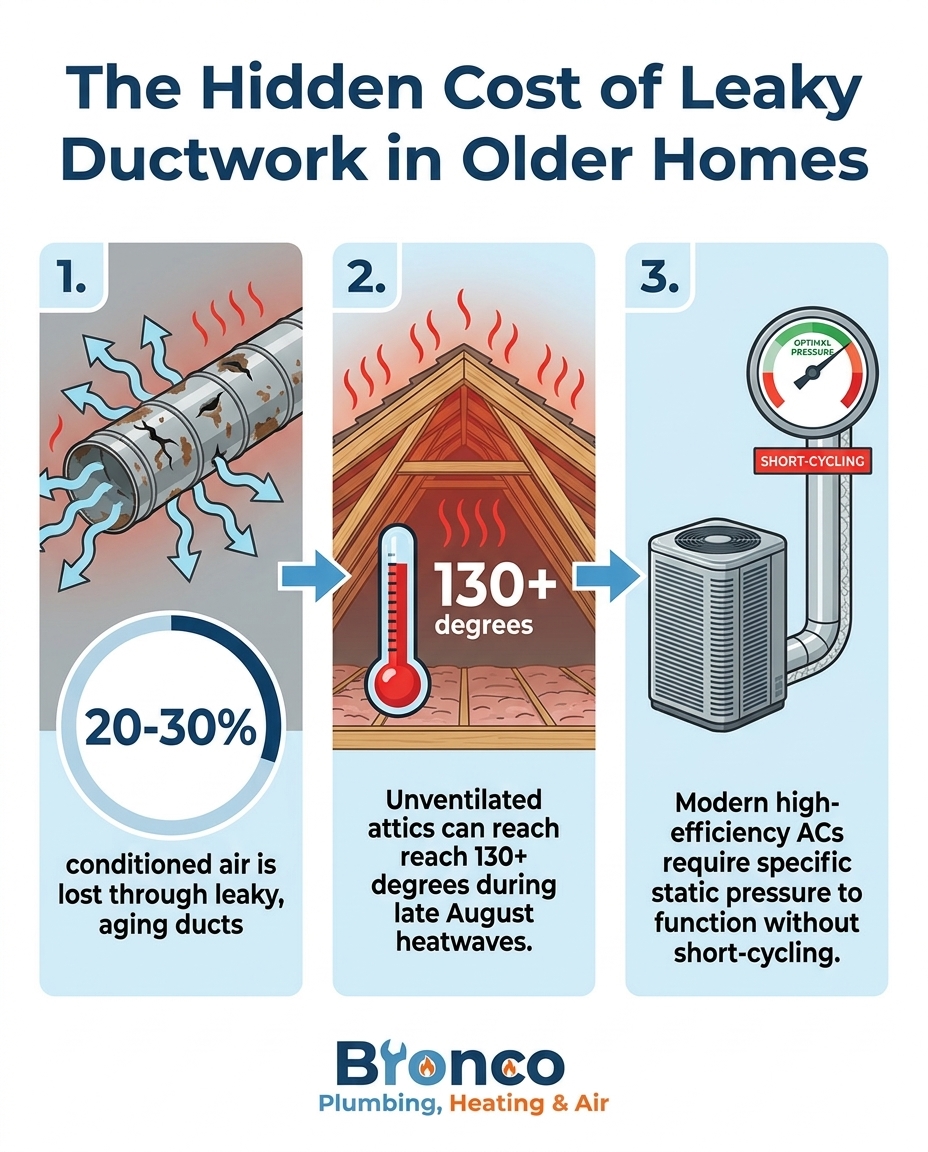
The Cause: The issue comes down to a physics concept called static pressure. Think of static pressure like blood pressure for your HVAC system—it is the resistance to airflow within the ductwork. Today's modern high-efficiency AC systems feature advanced variable-speed blowers that require very specific static pressure parameters to operate efficiently. Vintage ducts, however, are notoriously leaky and often undersized. Holes, failing tape, and poorly connected joints cause a massive drop in pressure. When the blower tries to push high-velocity air through restrictive, leaky, or improperly sized vintage ducts, the system is forced to overwork. It cannot maintain the correct pressure, leading to immense strain on the blower motor and compressor.
The Solution: The only way to stop this premature wear is to match the distribution system to the equipment. By properly sealing leaks and ensuring the duct sizing matches the output of the new blower, the system can finally "breathe." This allows the variable-speed motor to ramp up and down smoothly, delivering consistent temperatures without constantly tripping its own safety sensors. Ignoring this static pressure mismatch does not just ruin your comfort; it actively shortens the lifespan of your cooling equipment by forcing it to operate outside of its designed parameters.
Navigating the Structural Quirks of Vintage Architecture
Homes built from the late 1800s to the mid-1900s carry unmatched charm, but their architectural quirks present unique hurdles for HVAC upgrades. In Historic Folsom, older housing stock was constructed long before central air conditioning became a standard feature, meaning the infrastructure to support modern ductwork simply was not part of the original blueprint.
• Tight crawlspaces and unventilated attics: Many vintage homes have severely limited access points. The original ductwork was often squeezed into shallow crawlspaces or routed through steep, restrictive attic cavities. These physical constraints make standard, invasive retrofits incredibly difficult and require specialized techniques to navigate safely.
• Lath-and-plaster walls: Unlike modern drywall, which can be easily cut and patched, lath-and-plaster walls are fragile and interconnected. The plaster is held in place by "keys" that squeeze between wooden slats. Forcing oversized, rigid modern ducting through these walls makes standard invasive retrofits risky and aesthetically damaging. A heavy-handed approach can crack plaster far beyond the immediate work area.
• Material degradation: The materials used in older ductwork degrade over decades. Early flexible ducting develops brittle outer liners, rigid metal connections lose their mastic sealant, and older insulation simply falls apart. This deterioration is a primary contributor to the 20 to 30 percent air loss average seen in typical older homes.
Navigating these structural realities requires specialized assessment. Working with Bronco Plumbing, Heating & Air means you benefit from extensive local expertise in navigating tight historic crawlspaces and preserving the aesthetic of older properties during retrofits. A tailored approach ensures that your home retains its historic integrity while still achieving modern comfort standards, blending the best of vintage architecture with contemporary climate control.
The Thermal Penalty of Late-Summer Attic Heat
The environment surrounding your ductwork plays a massive role in how well your system performs. During a severe heatwave, the physical environment of an unventilated attic transforms into an oven. Temperatures frequently exceed 130 degrees, creating a hostile environment for any climate control equipment.
When your ductwork runs through this extreme environment, it suffers from what industry professionals call a "thermal penalty." If those vintage ducts are uninsulated and leaky, they actively absorb this extreme heat. As the newly cooled air travels from your indoor unit through the sweltering attic, it warms up significantly before it ever reaches your living space. This heat gain is the direct cause of the frustrating phenomenon where new AC units run continuously without ever properly cooling the home.
The triple-digit late August heat in the Sacramento region exacerbates this issue, turning uninsulated attic ductwork into a massive heat-gain liability. The equipment is forced to run non-stop to compensate for the lost cooling capacity, which puts immense stress on vital components. Overworked components in these conditions are highly prone to sudden breakdowns right when you need them most.
One local homeowner experienced this exact scenario during a sweltering 90-degree summer day when their outside AC unit completely stopped turning on. The continuous strain from a struggling system had led to a failed compressor. Fortunately, a technician arrived quickly, diagnosed the problem, and replaced the compressor, restoring comfort much faster than the homeowner anticipated.
To prevent these sudden failures and ensure your system isn't fighting a losing battle against attic temperatures, investing in comprehensive air conditioning services is essential. Properly insulating and sealing the ductwork eliminates the thermal penalty, allowing the cold air to stay cold all the way to your vents.
Understanding California Energy Standards for Older Properties
Upgrading an HVAC system in California involves strict regulatory compliance, regardless of the age or historical status of your property. The state's energy goals are heavily focused on reducing waste, which means your ductwork is subject to rigorous evaluation during any major equipment replacement.
An overview of California Title 24 energy standards reveals that replacing an HVAC unit often triggers mandatory duct leakage testing. This applies even to older properties in Historic Folsom. The state recognizes that installing high-efficiency equipment is counterproductive if the distribution system wastes a significant percentage of the energy produced. When you upgrade your system, a certified third-party rater will typically test the ductwork to measure the exact percentage of air loss.
If the existing vintage ducts fail the leakage threshold during a system upgrade, you are legally required to address the leaks before the project can pass final inspection. Failing to meet these standards can delay your project, hold up permits, and complicate future property sales.
Proactive sealing is the best way to handle this requirement. It ensures compliance, guarantees you will pass inspection, and secures long-term energy savings. A typical pattern we see is homeowners successfully navigating these upgrades by addressing the system as a whole. For instance, a customer upgrading to a new 5-ton split gas HVAC system during the fall experienced a seamless process because the installation prioritized both the equipment and the distribution network. The result was a high-quality installation that satisfied all performance expectations and easily met state guidelines.
For a deeper dive into how these regulations impact your specific project, reviewing the California Title 24 energy requirements for HVAC can provide valuable clarity before you begin your upgrade.
Strategic Upgrades: Deciding Between Duct Sealing and Full Replacement
Making an informed decision on how to address your ductwork requires a clear understanding of your current system's condition. Not every vintage home requires a complete duct tear-out, but ignoring the problem is not an option when installing modern high-efficiency AC systems. You need an actionable framework to decide between professional sealing and full replacement.
• Structural Integrity — Professional Sealing: Ducts are mostly intact with no major collapses. — Full Replacement: Ducts are crushed, rusted through, or deeply degraded.
• Sizing & Airflow — Professional Sealing: Existing diameter supports modern blower output. — Full Replacement: Pipes are too narrow for the new system's velocity.
• Insulation Status — Professional Sealing: Insulation is adequate or easily retrofitted. — Full Replacement: Insulation is missing entirely or contains hazardous materials.
• Cost Impact — Professional Sealing: Highly cost-effective compliance solution. — Full Replacement: Larger upfront investment, but solves fundamental flaws.
When to Choose Professional Sealing
Professional duct sealing is often sufficient when the core structure of the ductwork remains viable. If your ducts are accessible and structurally intact, sealing is a highly effective route. In these scenarios, the primary issue is air loss at seams and connections. When the bulk of the inefficiency comes from disconnected joints or degraded mastic tape, applying modern sealants can restore the network's integrity. This is a less invasive, cost-effective way to meet Title 24 compliance and improve efficiency without tearing into historic walls.
When Full Replacement is Required
Sometimes, vintage ductwork is simply too far gone or fundamentally incompatible with modern equipment. If the existing ducts are too small for modern airflow requirements, the new variable-speed blower will suffer from severe static pressure issues. Furthermore, if materials are crushed, degraded, or beyond repair, sealing will not fix the underlying structural failure. Finally, if insulation is non-existent and cannot be retrofitted effectively due to tight clearances, replacing the old pipes with pre-insulated modern ducting is the only way to stop the thermal penalty.
Proper sizing and sealing provide an immediate return on investment by allowing the new AC to run at its rated efficiency. Addressing the ductwork is a strict prerequisite for achieving optimal comfort and system longevity.
Protect Your Cooling Investment with Local HVAC Expertise
Ultimately, a brand-new cooling system is only as good as the ductwork delivering the air. If you pair state-of-the-art machinery with a leaky, degraded distribution network, you will inevitably face poor performance, high energy bills, and premature breakdowns. Evaluating vintage ductwork in Historic Folsom does not have to be an overwhelming process when you have the right local guidance to help you navigate the structural quirks and regulatory requirements.
Before you commit to a major equipment upgrade, take the time to assess your air distribution network. Schedule an inspection to evaluate your duct integrity, and explore professional duct sealing to ensure your cooling investment delivers the comfort and reliability you deserve.
Frequently Asked Questions
Why is my new AC not cooling my old house?
The most common reason is that your new AC is connected to old, leaky ductwork. When ducts have holes or disconnected joints, the cold air spills into your attic or crawlspace before it reaches your living areas. Fixing the distribution system allows the new unit to actually cool the home.
Should I seal or replace ductwork in a historic home?
The decision depends on the structural condition and size of your existing ducts. If the ducts are intact and properly sized, sealing the joints is a cost-effective, non-invasive solution. However, if the ducts are crushed, undersized for modern equipment, or lack insulation, full replacement is usually necessary.
Is it worth replacing old ductwork before an AC upgrade?
Yes, addressing the ductwork is crucial before an upgrade. Installing a modern, high-efficiency AC on degraded ducts leads to short-cycling, immense strain on the blower motor, and wasted energy. Fixing the ducts ensures your new equipment operates at its rated efficiency and lasts longer.
How much energy is lost through leaky ducts in older homes?
In typical older homes, about 20 to 30 percent of the conditioned air is lost due to leaks, holes, and poorly connected ducts. This massive energy loss forces your HVAC system to work harder, driving up utility bills and reducing overall indoor comfort.
Can you seal vintage ductwork without damaging lath and plaster walls?
Yes, professional sealing can often be done without invasive demolition. Technicians can access duct joints from crawlspaces, basements, or attics, and advanced aerosol sealing technologies can seal leaks from the inside out, preserving fragile lath-and-plaster walls.
Does California Title 24 apply to historic home HVAC replacements?
Yes, California Title 24 energy standards generally apply to HVAC replacements in historic homes. The regulations often require mandatory duct leakage testing to ensure the system meets state efficiency goals. Passing this test usually requires professional duct sealing or replacement.

Customer Testimonials
Our customer testimonials highlight the reliable service, quality workmanship, and trusted results homeowners experience with Bronco Plumbing Heating and Air.


Ready to Transform your Home?
Create a healthier, more comfortable home with expert HVAC, plumbing, and indoor air quality solutions you can trust. From efficient heating and cooling to cleaner air and reliable repairs, our experienced team is here to keep your family comfortable year-round with dependable service and upfront pricing.
Related Articles

Why Late Summer is the Hardest Time on Aging HVAC Capacitors

Can You Safely Delay a Minor Refrigerant Leak Repair Until Fall?

Tankless vs. Traditional Water Heaters for Large Citrus Heights Families