



.svg)

How Clogged Condensate Drains Cause Ceiling Leaks in Two-Story Homes
A simple algae clog in your attic AC unit can silently turn into a drywall disaster below. Spot the early warning signs of a blocked drain pan before the secondary system fails.
When Late Summer Heat Threatens Your Ceiling
As August late summer temperatures reach their absolute peak, understanding how clogged condensate drains cause ceiling leaks in two-story homes becomes critical for homeowners. Your air conditioner is running nonstop to combat the intense outdoor heat, and while it keeps your living space comfortable, it is also generating massive amounts of condensation up in your dark, sweltering attic. What begins as a microscopic algae spore in a damp drain pan can silently multiply into a thick blockage, turning a standard cooling cycle into a slow-moving structural disaster.
The most frustrating part of attic water damage is that it happens entirely out of sight. A simple algae clog in an attic-mounted air handler can silently lead to extensive drywall damage below before you ever feel a drop of water. Recognizing the early warning signs of a clogged primary drain pan before the secondary emergency system fails is the only way to protect your property. If you suspect your system is struggling to drain properly, reaching out for professional air conditioning services is the safest way to prevent these hidden disasters.
The Anatomy of an Attic-Mounted Air Handler
To understand why Sacramento two-story homes are particularly vulnerable to sudden ceiling leaks, we have to look at the mechanical layout of the HVAC system hidden above your ceiling. When your air conditioner runs, it does more than just pump cold air into your rooms; it actively extracts humidity from the indoor air. Warm, moist air is pulled across freezing cold evaporator coils, causing the moisture to condense into liquid water—much like a cold glass of ice water sweating on a hot patio.
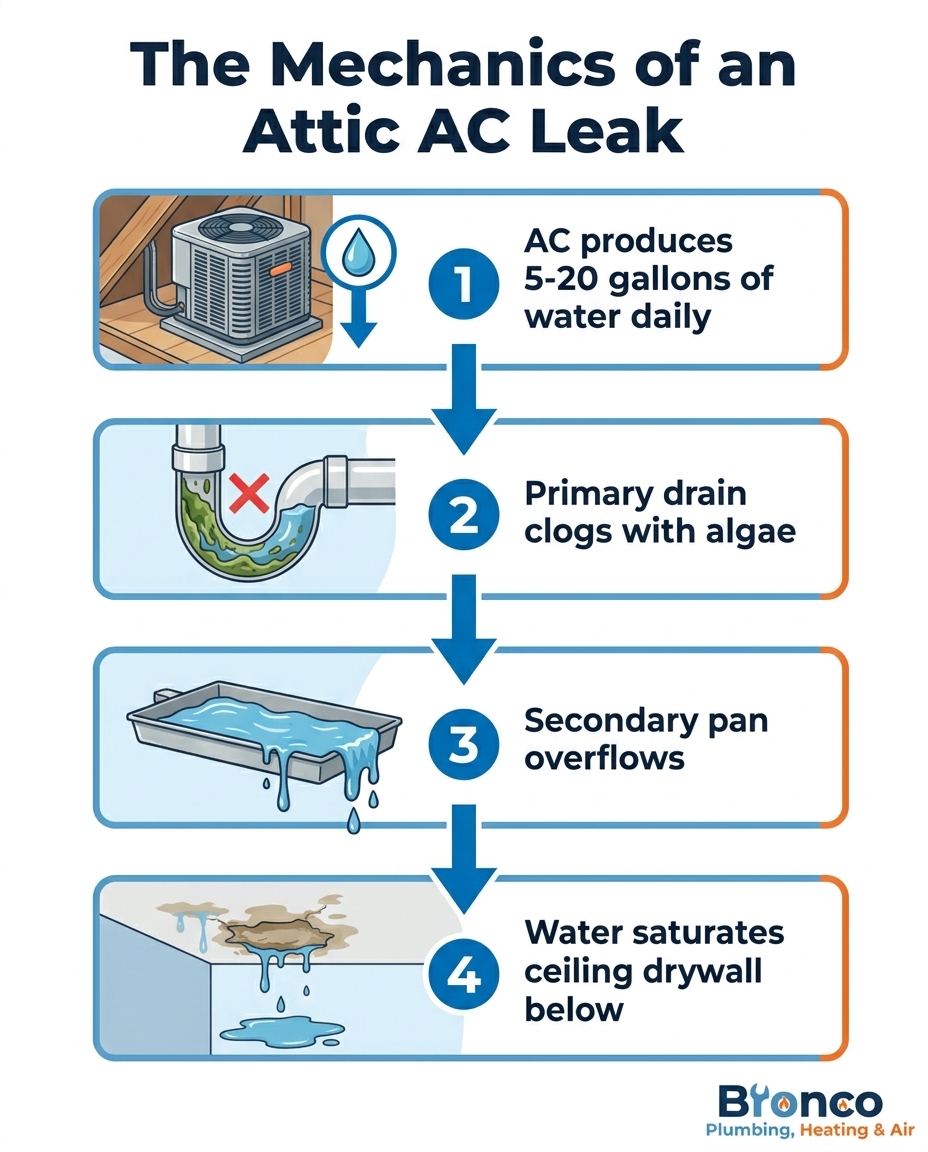
During peak operation, a standard residential air conditioner can produce anywhere from 5 to 20 gallons of condensation per day. All of that water has to go somewhere safely. In an attic installation, the stakes are incredibly high because gravity dictates that any escaped water will immediately travel down into your insulation and ceiling drywall, unlike a basement unit where a leak might just puddle on a concrete floor.
Primary vs. Secondary Drain Pans
The water management system inside your attic air handler is built with layers of redundancy, but those layers require clear pathways to function.
1. The Primary Drain Pan: Located directly underneath the evaporator coil, this metal or plastic tray catches the constant drip of condensation. It connects to a primary PVC drain line that relies on gravity to route the water safely outside your home.
2. The Secondary Drain Pan: This is the emergency backup system. It sits beneath the entire air handler unit. If the primary pan overflows, the water spills into this larger, shallower secondary pan.
3. The Float Switch: Mounted on the edge of the secondary pan (or sometimes on the primary drain line), this small electronic sensor is designed to detect rising water levels. If the secondary pan starts to fill up, the float switch trips and automatically shuts off your air conditioner to stop the production of condensation.
• Primary Drain Line — Primary Function: Routes 5-20 gallons of water outside daily — Vulnerability: Highly susceptible to algae and biological sludge blockages
• Secondary Drain Pan — Primary Function: Catches emergency overflow from primary failure — Vulnerability: Can rust, crack, or overflow if its own drain line is also clogged
• Float Switch — Primary Function: Shuts down the AC to prevent water damage — Vulnerability: Can fail mechanically or be bypassed by improper installation
Why Constant AC Runtime Accelerates Drain Failures
Sacramento's intense dry heat forces high AC runtimes, creating extreme volumes of condensation that overwhelm partially clogged systems rapidly. When the outdoor thermometer pushes past 100 degrees for days on end, your air conditioner may cycle continuously without taking a break. This constant AC runtime during peak heat waves creates a permanent high-moisture microclimate inside the cold, dark air handler.
While the attic itself might be baking at 130 degrees, the interior of the evaporator coil cabinet remains cool, damp, and completely shielded from UV light. This dark, warm, and constantly wet environment is the perfect breeding ground for rapid algae growth. Biological matter, dust particles that slip past your air filter, and airborne microbes mix with the standing water in the primary drain pan to form a thick, gelatinous sludge.
During milder weather, the system might cycle off long enough for the pan to dry out slightly, slowing biological growth. But in the relentless heat of late summer, the water never stops flowing. The algae colony expands exponentially, forming a dense mat that slowly creeps toward the narrow opening of the primary PVC drain line. Once that sludge gets sucked into the pipe, it acts like a cork, trapping gallons of newly formed condensation with nowhere to go.
How Clogged Condensate Drains Cause Ceiling Leaks in Two-Story Homes: The Domino Effect
When a clogged primary condensate drain overflows, the secondary emergency pan catches the excess water. If the secondary drain line also clogs, or if the float switch fails to shut off the air conditioner, gallons of water will rapidly spill over the edge of the pan, saturate the attic insulation, and seep directly into the ceiling drywall of the Sacramento two-story homes below.
Here is the exact step-by-step sequence of how this mechanical failure translates into severe property damage:
• Step 1: The Initial Blockage. Algae, dirt, and biological debris completely block the primary condensate drain line. Water begins pooling rapidly in the primary pan beneath the evaporator coil.
• Step 2: The Emergency Overflow. Unable to drain outside, the water breaches the lip of the primary pan and pours down into the secondary emergency drain pan situated beneath the entire unit.
• Step 3: The Safety Failure. In a perfectly maintained system, the float switch would now trigger and shut the AC off. However, if the switch is mechanically stuck, improperly wired, or if the secondary drain pipe itself is blocked by wasp nests or debris, the failsafe is compromised.
• Step 4: Structural Saturation. With the AC still running and producing gallons of water, the shallow secondary pan overflows. The water dumps directly onto the attic floor, soaking through the blown-in or batt insulation until it hits the back of your ceiling drywall. Once drywall gets wet, it loses its structural integrity, leading to sagging, bubbling paint, and eventually, a collapsed ceiling.
Early Warning Signs Before the Ceiling Leaks
The key to preventing extensive drywall damage is catching the drainage issue before the water breaches the secondary pan. Your HVAC system will usually give you several subtle clues that a blockage is forming. By late August late summer, keeping an eye out for these symptoms can save your ceiling:
• Unexplained system shutdowns: If your thermostat is set to cool but the air conditioner randomly turns off and refuses to turn back on, your float switch may be doing its job. A tripped switch breaks the electrical circuit to protect your home.
• Musty or mildew-like odors: If the air blowing out of your vents smells like dirty socks or a damp basement, you likely have stagnant water and algae blooming inside your drain pan.
• Visible water dripping outside: The secondary drain pipe is often routed to drip over a highly visible area, like right above a prominent window or a patio door. If you see water dripping from a pipe high up on your exterior wall, it means your primary drain has already failed.
• Unusual dripping sounds: If you hear a distinct "plink, plink, plink" sound coming from the ceiling above a hallway or bedroom when the AC is running, water may already be missing the primary pan and hitting the metal secondary pan.
Why Dual Expertise Matters for Attic Water Damage
Addressing a severe condensate leak isn't just about fixing the mechanical cooling components of the air conditioner; it involves complex drainage, gravity flow, and plumbing dynamics. Because Bronco Plumbing, Heating & Air holds dual expertise in both trades, they are uniquely equipped to understand and resolve both the AC mechanical failure and the resulting water drainage issues simultaneously.
Professionals who understand both HVAC systems and plumbing codes can properly route PVC drain lines with the correct pitch, calibrate sensitive float switches, and ensure that emergency overflow pipes are safely directed away from the home's foundation. When you are dealing with water routing inside a residential structure, having a technician who thinks like both an AC mechanic and a plumber is invaluable.
During extreme heat emergencies, rapid diagnosis is critical. For example, one local homeowner reached out after hours on one of the hottest days of the summer when their system completely shut down during a very hot period. A technician provided fast, professional service to diagnose the mechanical issue, clear the blockage, and restore cooling, rescuing the customer from the intense heat without leaving a mess behind. Constant AC runtime during peak heat waves leaves no margin for error, which highlights the distinct value of relying on professional plumbing services combined with top-tier HVAC knowledge.
Safe Preventative Steps to Protect Your Home
While clearing a heavily clogged main drain line requires specialized tools and a licensed professional, there are several safe, proactive steps homeowners can take to reduce the risk of an attic leak as August late summer drags on.
Change your air filters regularly: A dirty air filter restricts airflow across the evaporator coil. When airflow drops, the coil gets too cold and literally freezes into a block of solid ice. When the system eventually turns off, that ice melts rapidly, dumping a massive volume of water into the drain pan all at once—often overwhelming the drain line and causing an instant overflow.
Perform visual attic inspections: Safely peek into your attic space with a flashlight. Look at the area immediately surrounding the air handler. If you see dark water stains on the wood framing, rust forming on the outside of the metal cabinet, or water sitting in the secondary pan, you have a problem. Do not attempt to cut or flush the PVC drain lines yourself, as improper handling can crack the brittle plastic and worsen the leak.
Keep the outdoor unit clear: Ensure the outdoor condenser unit is free of leaves, tall grass, and debris. While this doesn't directly affect the indoor drain, keeping the outdoor unit breathing easily ensures the entire system doesn't overwork and produce excess condensation.
Bring in the professionals: The most effective prevention strategy is to schedule an AC maintenance and tune-up. A licensed technician will use specialized equipment to flush the condensate lines clear of sludge and treat the drain pan with algaecide tablets to prevent future biological growth.
Frequently Asked Questions About Attic AC Leaks
Why is my attic AC leaking through the ceiling?
Your attic AC is leaking through the ceiling because the primary condensate drain line has clogged, and the backup safety systems have failed. When the primary line blocks, water overflows into a secondary pan. If that secondary pan also clogs, or if the safety float switch fails to turn off the system, the condensation will spill over the pan, soak through your attic insulation, and saturate the drywall of Sacramento two-story homes.
What happens if AC drain line is clogged?
If the AC drain line is clogged, the water extracted from your home's air has nowhere to escape. The water will back up into the primary drain pan until it overflows. Depending on your system's setup, this will either trigger a float switch that shuts your entire air conditioner down to prevent damage, or it will overflow into your home, causing severe water damage to surrounding structural materials.
What are the signs of a clogged AC drain pan?
The most common signs of a clogged AC drain pan include your air conditioner shutting off unexpectedly, a musty or moldy smell blowing through your air vents, and visible water dripping from the secondary emergency drain pipe outside your house. You might also hear unusual dripping or splashing sounds coming from the ceiling directly below where the attic air handler is installed.
How much water does an AC produce?
A standard residential air conditioner can produce between 5 and 20 gallons of water per day during peak summer operation. The exact amount depends on the humidity levels inside your home, the size of your cooling system, and how long the unit runs during the day. In hot, dry climates where the AC runs constantly, condensation production remains extremely high.
Can I clear an AC drain line myself, or do I need a professional?
You should always hire a licensed professional to clear a clogged AC drain line. While it might seem like a simple plumbing issue, the PVC pipes connected to your air handler are brittle and easily cracked. A professional has the right vacuum equipment, compressed air tools, and algaecide treatments to clear the blockage safely without damaging the delicate evaporator coil or violating building codes.
Protect Your Home with Proactive Care
Understanding exactly how clogged condensate drains cause ceiling leaks in two-story homes is the first and most important step in protecting your property. By the time August late summer arrives, your cooling system has already processed hundreds of gallons of water, making it prime time for algae blockages to strike. Don't wait for a suspicious brown water stain to appear on your ceiling before taking action.
We encourage you to explore a comprehensive preventative HVAC maintenance plan to keep your drains clear, your float switches calibrated, and your systems running smoothly. Proactive care ensures that you stay perfectly cool and comfortable without the hidden threat of water damage hanging over your head.

Customer Testimonials
Our customer testimonials highlight the reliable service, quality workmanship, and trusted results homeowners experience with Bronco Plumbing Heating and Air.


Ready to Transform your Home?
Create a healthier, more comfortable home with expert HVAC, plumbing, and indoor air quality solutions you can trust. From efficient heating and cooling to cleaner air and reliable repairs, our experienced team is here to keep your family comfortable year-round with dependable service and upfront pricing.
Related Articles

Addressing Older Ductwork Inefficiencies in Historic Folsom Homes


Why Late Summer is the Hardest Time on Aging HVAC Capacitors
Can You Safely Delay a Minor Refrigerant Leak Repair Until Fall?