



.svg)

Upgrading to a Smart Thermostat vs. Reprogramming Your Old Honeywell
Legacy thermostats rely on strict schedules that fail to adapt to erratic back-to-school routines. See why modern learning algorithms offer superior late-summer cooling efficiency over rigid timers.

Beyond the Basic Schedule: Rethinking Your Home's Climate Control
At Bronco Plumbing, Heating & Air, our technicians frequently encounter a persistent myth in home climate control: that sticking to a strict daily schedule is just as efficient as Upgrading to a Smart Thermostat vs. Reprogramming Your Old Honeywell unit. When evaluating home energy efficiency, many homeowners assume that a rigid, timer-based approach will yield the exact same utility savings as a modern learning algorithm. The reality we see in the field is far more complex. While legacy digital units were a massive leap forward from manual dials, their reliance on perfectly predictable routines makes them vulnerable to the chaotic reality of modern life.
For comprehensive air conditioning services or to explore a smart thermostat upgrade, professional guidance ensures your system operates at peak performance.
The late-summer challenge: Managing end-of-summer cooling efficiency becomes particularly difficult during August back-to-school schedule transitions. When household routines shift from predictable summer days to erratic school and work schedules, a static thermostat program quickly falls out of sync with actual occupancy. The house might be cooled to 72 degrees for hours while no one is home, or it might remain uncomfortably warm when family members arrive earlier than expected. This creates a critical decision point for homeowners: continue battling the interface of an older unit to constantly update the schedule, or invest in automated technology that adapts to these shifts in real time.
Here's the thing: evaluating true efficiency gains requires looking beyond the basic ability to turn the air conditioner on and off. It demands an objective, technical look at how different generations of thermostats process data, react to the environment, and ultimately communicate with your broader HVAC system. By understanding the underlying mechanics of these devices, you can make an informed decision about whether a technological upgrade is the right long-term investment for your property.
Why Static Schedules Struggle During Routine Shifts
Older programmable models rely entirely on the assumption that your life operates on a flawless, unchanging loop. To achieve their promised energy efficiency, these devices require you to input specific temperature setpoints for the morning, day, evening, and night. When your routine matches the program perfectly, the system works as intended. However, the moment your daily occupancy fluctuates, that rigid 7-day schedule becomes obsolete almost immediately.
The problem with unpredictability: We see this pattern often during August back-to-school schedule transitions. Sports practices, after-school activities, and shifting work hours mean the house is rarely occupied at the exact same times every day. A static schedule cannot adapt to these variations. If the thermostat is programmed to begin cooling the house at 5:00 PM, but the family arrives home at 3:30 PM due to an early dismissal, they walk into a hot, uncomfortable environment.
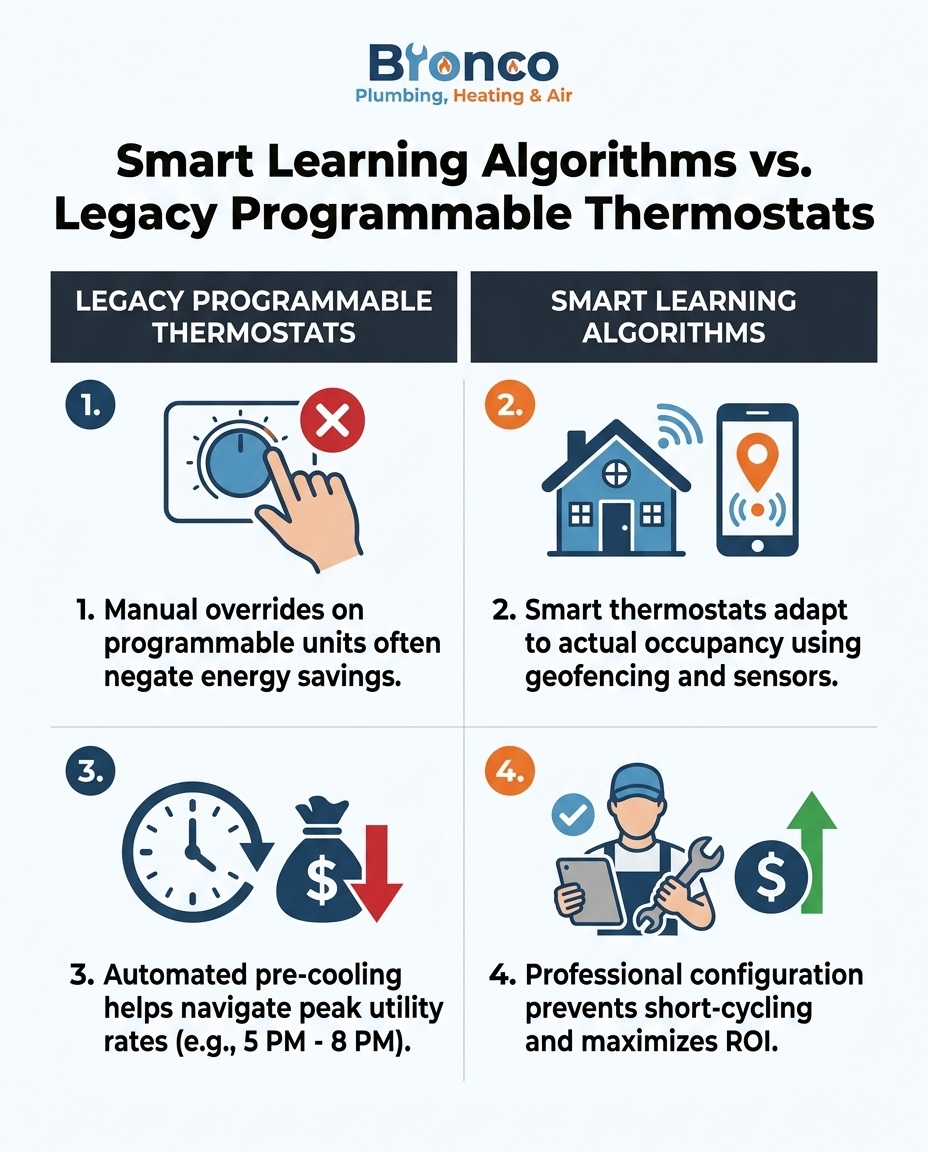
The cause of wasted energy: Faced with an uncomfortable home, the immediate human reaction is to walk over to the thermostat and manually lower the temperature. This action overrides the pre-set schedule. According to ENERGY STAR data, manual overrides on programmable units often completely negate their intended efficiency benefits. The system is forced to work harder to overcome the sudden temperature drop, consuming significantly more power than if it had been managing the climate dynamically.
The solution through automation: Modern smart systems eliminate this friction by removing the reliance on a static timer. Instead of forcing the homeowner to adapt to the thermostat's schedule, the thermostat adapts to the homeowner's actual behavior, ensuring comfort is delivered only when it is actually needed.
The Trap of the Manual Override
On our late-summer maintenance visits, our team routinely finds that temporary holds frequently become permanent energy drains. When you manually adjust a legacy programmable thermostat, the device typically holds that new temperature until the next scheduled block—or indefinitely, depending on the model's specific settings. If you forget to reset the schedule, the air conditioner might run continuously through the night or while the house is empty the following day.
Furthermore, there is a significant psychological barrier to reprogramming complex legacy interfaces. Navigating the tiny screens, confusing acronyms, and sequential button presses required to alter a 7-day schedule on an older unit is frustrating. Because the process is tedious, homeowners often leave the system on a manual "hold" setting entirely, treating their programmable thermostat exactly like an old-fashioned manual dial and sacrificing all potential energy savings.
The Technology Gap: Learning Algorithms vs. Pre-Set Timers
When we explain the difference in efficiency to our Sacramento customers, we like to break down how these devices process cooling commands. Legacy programmable thermostats (e.g., standard Honeywell 5000 series) operate on basic timer-based functionality. They contain a simple internal clock and a thermometer. When the clock reaches a specific time, the device checks the ambient temperature. If the temperature exceeds the setpoint, it sends a basic on/off voltage signal to the HVAC equipment. There is no situational awareness, no data processing, and no adaptation.
Modern smart systems, by contrast, are equipped with sophisticated microprocessors and learning algorithms. These devices do not just look at the clock; they analyze patterns over time. A learning algorithm adapts to actual occupancy by monitoring when you adjust the temperature and recognizing your preferred comfort levels at different times of the day. Within a few weeks of installation, the system builds a dynamic climate profile based on real-world habits rather than assumed times.
The power of geofencing: One of the most significant technological leaps is the integration of geofencing. By linking the smart thermostat to the location services on your smartphone, the system can detect when you leave a designated perimeter around your house. When the house is empty, it automatically shifts into an energy-saving "away" mode. As soon as you cross the invisible boundary on your way home, the system begins cooling, ensuring the environment is perfectly comfortable the moment you walk through the door. This entirely eliminates the need to predict your arrival time.
Enhanced sensor capabilities: Legacy units rely on a single-point temperature reading, measuring the climate only in the hallway or living room where the device is mounted. If that room is naturally cooler than the rest of the house, the upstairs bedrooms might swelter. Smart thermostats are frequently compatible with remote, multi-room sensors. These wireless sensors can be placed in bedrooms or home offices, allowing the thermostat to average the temperature across the home or prioritize specific rooms based on occupancy. For homes that utilize zone control systems, this granular level of data collection is critical for maximizing both comfort and efficiency.
Navigating Peak Utility Rates with Automated Adjustments
Thermostat technology does not exist in a vacuum; it interacts directly with regional energy grids and utility pricing structures. This becomes especially critical during the late-summer heat, when air conditioners are running at maximum capacity and utility companies implement their most aggressive pricing tiers.
Understanding Time-of-Day pricing: The short answer is that when you use electricity matters just as much as how much you use. Time-of-Day (TOD) utility rates charge significantly more for electricity during periods of high demand. With Sacramento's extreme summer heat, SMUD's 5 PM - 8 PM peak rates make automated pre-cooling a critical feature for managing utility costs. During these peak hours, running an air conditioner at full capacity can cause monthly cooling bills to skyrocket.
Smart thermostats can be professionally configured to execute an automated pre-cooling strategy. The system will proactively lower the home's temperature during the mid-afternoon when electricity is cheaper. By super-cooling the house to a comfortable level before 5:00 PM, the system can then coast through the expensive peak window, minimizing active run-time when rates are at their highest. Contrasting this with legacy units highlights a major deficiency: approximating this same cost-saving strategy on a standard timer requires complex, exact manual programming that must be constantly adjusted as the weather changes.
Reliable, automated climate control is also essential during severe heat waves when HVAC systems are under immense stress. One of our Sacramento customers reached out to us on a Sunday during a 106-degree heat wave when their AC compressor failed completely. Our technician diagnosed the issue and replaced the compressor, restoring cooling during a dangerous temperature spike. That kind of extreme system stress is exactly what automated pre-cooling helps mitigate. By shifting the bulk of the cooling workload to the slightly cooler afternoon hours and reducing strain during the late-afternoon peak, smart thermostats can help protect critical components from overheating. For more insights into optimizing your equipment for this region, exploring the best HVAC setup for Sacramento weather can provide further clarity.
Hardware and Features: A Side-by-Side Comparison
When weighing a mid-funnel decision about your home's infrastructure, seeing the technical differences laid out clearly can help clarify the true value of an upgrade. The gap between legacy programmable thermostats (e.g., standard Honeywell 5000 series) and modern smart models extends far beyond just the scheduling algorithms.
• User Interface — Legacy Programmable Thermostats: Basic digital push-button screens, often requiring sequential presses and referencing a manual to navigate complex menus. — Smart Learning Thermostats: High-resolution touchscreens and intuitive mobile apps that allow for effortless adjustments from anywhere.
• Connectivity — Legacy Programmable Thermostats: Strictly offline operation. No ability to adjust settings remotely or integrate with other devices. — Smart Learning Thermostats: Wi-Fi enabled for remote access, voice control compatibility, and seamless smart home integration.
• Energy Tracking — Legacy Programmable Thermostats: Zero feedback. Homeowners only see the result of their usage when the monthly utility bill arrives. — Smart Learning Thermostats: Detailed monthly energy reports, usage insights, and real-time data on how much energy is being saved.
• HVAC Protection — Legacy Programmable Thermostats: Basic on/off operation with no diagnostic capabilities or system awareness. — Smart Learning Thermostats: System health monitoring, automatic filter change alerts based on run-time, and early warnings for potential malfunctions.
The Role of Professional Configuration in Long-Term ROI
A common misconception we hear is that upgrading your climate control is as simple as swapping out a light switch. It is vital to clarify that smart thermostats are not merely plug-and-play gadgets; their advanced algorithms must be precisely tuned to the specific HVAC equipment installed in your home. Extracting the full value from a smart thermostat upgrade requires professional configuration, which is why DIY installation is heavily discouraged by industry experts.
Avoiding DIY pitfalls: Modern thermostats require constant, stable power to run their Wi-Fi radios and high-definition screens. This power is typically supplied by a "C-wire" (common wire). Legacy programmable thermostats (e.g., standard Honeywell 5000 series) often run on basic AA batteries and do not require a C-wire. When homeowners attempt to install a smart unit without a dedicated C-wire, they often resort to power-stealing workarounds that can cause the HVAC control board to malfunction or short out entirely. Additionally, misconfiguring heat pump auxiliary settings during a DIY install can cause expensive backup heating strips to engage inappropriately, leading to massive, unexpected utility bills.
The importance of calibration: Professional calibration ensures the thermostat accurately interprets the home's thermal envelope. A technician will adjust the swing settings, cycle rates, and staging delays based on the exact tonnage of your air conditioner and the insulation levels of your property. Our team's expertise at Bronco Plumbing, Heating & Air in configuring these systems specifically to optimize performance against Sacramento's unique climate and energy rate structures ensures that the device operates exactly as intended.
Proper setup prevents short-cycling—a condition where the system turns on and off rapidly, failing to dehumidify the air while putting immense wear on the compressor. By ensuring the thermostat communicates flawlessly with the equipment, professional installation protects the lifespan of the entire system. Incorporating these checks into a regular HVAC maintenance plan further guarantees that the algorithms remain perfectly synced with the mechanical reality of your equipment over the long term.
Frequently Asked Questions About Thermostat Upgrades
Is it worth replacing a programmable thermostat with a smart thermostat?
In our experience, the short answer is yes, particularly if your household schedule fluctuates. While legacy programmable thermostats (e.g., standard Honeywell 5000 series) work well for perfectly rigid routines, they fail to adapt to early arrivals or late departures. A smart thermostat learns your actual habits, uses geofencing to detect when you are away, and optimizes energy usage without requiring constant manual reprogramming. Over time, the automated efficiency and utility bill reductions typically justify the initial investment.
Does a smart thermostat use less electricity than a programmable one?
Yes, a smart thermostat generally facilitates lower overall electricity usage by eliminating the inefficiencies of manual overrides. When homeowners get frustrated with a programmable unit, they often place it on a permanent "hold," which wastes significant energy. Smart models dynamically adjust the climate based on real-time occupancy and can proactively pre-cool your home before peak utility rates take effect, ensuring your AC uses power when it is most cost-effective.
Can I replace my old Honeywell with a smart thermostat?
In almost all cases, older digital or mechanical thermostats can be replaced with modern smart systems. However, the wiring infrastructure behind the wall dictates how straightforward the process will be. Smart models require a continuous power source, usually delivered via a C-wire, which older battery-operated units may not have utilized. Our professional assessment will determine if new wiring needs to be pulled or if an adapter kit is required to safely power the new device.
How do smart thermostats handle unexpected schedule changes?
Smart thermostats excel at managing unpredictability through a combination of motion sensors, remote room sensors, and smartphone geofencing. If you leave work early, the system detects your phone crossing the geographic boundary and begins cooling the house before you arrive. If you stay out late, the system recognizes the home is still empty and delays the cooling cycle, ensuring you never pay to air condition an unoccupied house.
Do I need a C-wire to upgrade to a smart learning thermostat?
Most high-resolution, Wi-Fi-enabled smart thermostats require a C-wire to maintain a constant flow of 24-volt power without draining the HVAC system's control board. While some models claim to work without one by "pulsing" the power, this can lead to system instability, dropped Wi-Fi connections, and accelerated wear on your furnace or air handler. Having one of our professionals verify or install a proper C-wire is the safest way to ensure reliable operation.
Will a smart thermostat work if my Wi-Fi goes down?
Yes, a smart thermostat will continue to operate your heating and cooling equipment even if your home's internet connection drops. It will function much like a traditional programmable thermostat, executing the last known schedule and maintaining the current set temperature. However, you will temporarily lose access to remote app control, geofencing features, and real-time weather updates until the Wi-Fi connection is restored.
Making the Right Choice for Your Household's Cooling Needs
In our years of helping Sacramento homeowners evaluate the true efficiency gains of modern climate control, the conclusion becomes clear: while legacy units function adequately for strictly rigid routines, dynamic modern schedules require dynamic technology. The friction of manual overrides, the inability to adapt to August back-to-school schedule transitions, and the lack of communication with time-of-day utility rates make older programmable models a liability for long-term energy management.
Upgrading to a system equipped with learning algorithms, geofencing, and automated pre-cooling strategies provides a level of responsiveness that a static timer simply cannot match. By investing in modern hardware and professional calibration, you protect your broader HVAC equipment from unnecessary strain while optimizing your comfort. If you are ready to stop fighting with an outdated interface and start maximizing your home's efficiency, scheduling a professional consultation with Bronco Plumbing, Heating & Air for a smart thermostat upgrade is the right next step. A clear, fluff-free assessment of your current wiring and household needs will help you decide exactly which model makes the most sense for your changing routine.

Customer Testimonials
Our customer testimonials highlight the reliable service, quality workmanship, and trusted results homeowners experience with Bronco Plumbing Heating and Air.


Ready to Transform your Home?
Create a healthier, more comfortable home with expert HVAC, plumbing, and indoor air quality solutions you can trust. From efficient heating and cooling to cleaner air and reliable repairs, our experienced team is here to keep your family comfortable year-round with dependable service and upfront pricing.
Related Articles

How Clogged Condensate Drains Cause Ceiling Leaks in Two-Story Homes


Addressing Older Ductwork Inefficiencies in Historic Folsom Homes
Why Late Summer is the Hardest Time on Aging HVAC Capacitors