



.svg)

What a Sudden Spike in Your August Electric Bill Actually Means for Your AC
A high late-summer utility bill isn't always just the weather. Failing cooling components silently consume excess electricity before breaking down. Know when to call a professional.
Is Your August Utility Bill a Weather Warning or an AC Cry for Help?
August late-summer peak heat has arrived, and opening a surprisingly high SMUD or PG&E statement can be an unwelcome shock. You might find yourself wondering what a sudden spike in your August electric bill actually means for your AC, especially if you haven't changed your thermostat habits. It is completely normal for an air conditioning system to run longer cycles during extreme heat waves, but a sudden, disproportionate jump in energy consumption often points to something more serious than just the weather outside.
When mechanical components inside your cooling system begin to fail, they do not always stop working immediately. Instead, struggling parts start consuming significantly more electricity to produce the same amount of cooling. This hidden energy waste can drive your utility costs up silently, long before the system actually breaks down. By understanding the difference between normal weather-related usage and a mechanical cry for help, you can take action before a minor part failure turns into a major system replacement. Professional diagnostics can pinpoint the exact cause of the power drain without jumping straight to the conclusion that the entire unit needs to be swapped out.
If you need immediate assistance diagnosing a sudden change in your system's performance, explore our HVAC and plumbing services to get your home back to normal.
Weather vs. Wear: Understanding Ambient Heat Load
To determine if your air conditioner is simply battling the weather or actively failing, it helps to understand the concept of ambient heat load. Ambient heat load refers to the total amount of heat energy that your air conditioner must remove from your indoor space to maintain your desired temperature. During the hottest month of the year, the ambient heat load naturally peaks. The sun beats down on your roof, heat transfers through your walls, and your AC must work harder to reject that heat into an already sweltering outdoor environment.
Air conditioners are inherently energy-intensive machines. In fact, cooling systems account for roughly 6% of all the electricity produced in the United States, making them the largest single household draw for most families. When the outdoor temperature climbs into the triple digits, even consistent thermostat settings will yield higher bills because the system's duty cycle—the percentage of time it spends actively running—increases dramatically to keep up with the heat transfer.
However, there is a clear threshold where a high bill transitions from an expected weather response to a warning sign of mechanical failure. If your home's energy consumption doubles while the outdoor temperatures only rose slightly compared to the previous month, weather alone is rarely the culprit.
• Run Times — Normal Weather Response: Longer cycles during the hottest part of the afternoon. — Mechanical Warning Sign: System runs non-stop overnight when outdoor temperatures have dropped.
• Cooling Output — Normal Weather Response: Air coming from vents remains consistently cold. — Mechanical Warning Sign: Air feels lukewarm or room temperatures slowly creep up.
• Energy Bill — Normal Weather Response: Gradual increase aligning with historical summer usage. — Mechanical Warning Sign: Sudden, unexplained spike that breaks historical patterns.
• System Noises — Normal Weather Response: Standard humming and fan noises. — Mechanical Warning Sign: Buzzing, clicking, or hard-starting sounds from the outside unit.
When the signs point toward mechanical wear rather than just summer weather, it is time to look into professional AC repair and diagnostics to stop the energy drain.
The Silent Energy Waster: Excess Amperage Draw
The most common technical reason for a sudden utility bill spike is a phenomenon known as excess amperage draw. Amperage is the measurement of the volume of electricity flowing through a circuit. In the HVAC industry, measuring the exact amperage of different components is considered the gold standard for diagnosing system health. Every motor and compressor in your air conditioner has a specific, rated amperage range for safe and efficient operation.
Think of your air conditioner's compressor like a vehicle driving up a steep hill. If the vehicle is in good condition, it uses a predictable amount of fuel to reach the top. But if the engine is struggling, the tires are flat, or it is towing a heavy load, it requires far more fuel to accomplish the exact same task. Similarly, when an HVAC component faces mechanical resistance—whether from internal wear, electrical degradation, or physical blockages—it pulls more electricity to force itself to keep working. This excess power draw occurs silently. The system may still blow cold air, leaving the homeowner completely unaware of the issue until the monthly utility statement arrives.
Because these electrical struggles often begin late in the cooling season after months of heavy use, you can learn more about why late summer is tough on aging HVAC capacitors and other internal components. Identifying excess amperage draw is strictly a job for a qualified professional. It requires safely opening high-voltage electrical panels and using a specialized multimeter while the system is actively running under load. Attempting to test these components without proper training and safety equipment is highly dangerous.
Hidden Mechanical Failures That Spike Summer Electric Bills
When an air conditioning system begins drawing excess amperage, the root cause usually traces back to a handful of specific mechanical failures. These components either directly consume more power when failing or force other parts of the system to work overtime. Here is a breakdown of the primary mechanical culprits we frequently encounter that cause sudden spikes in summer utility bills.
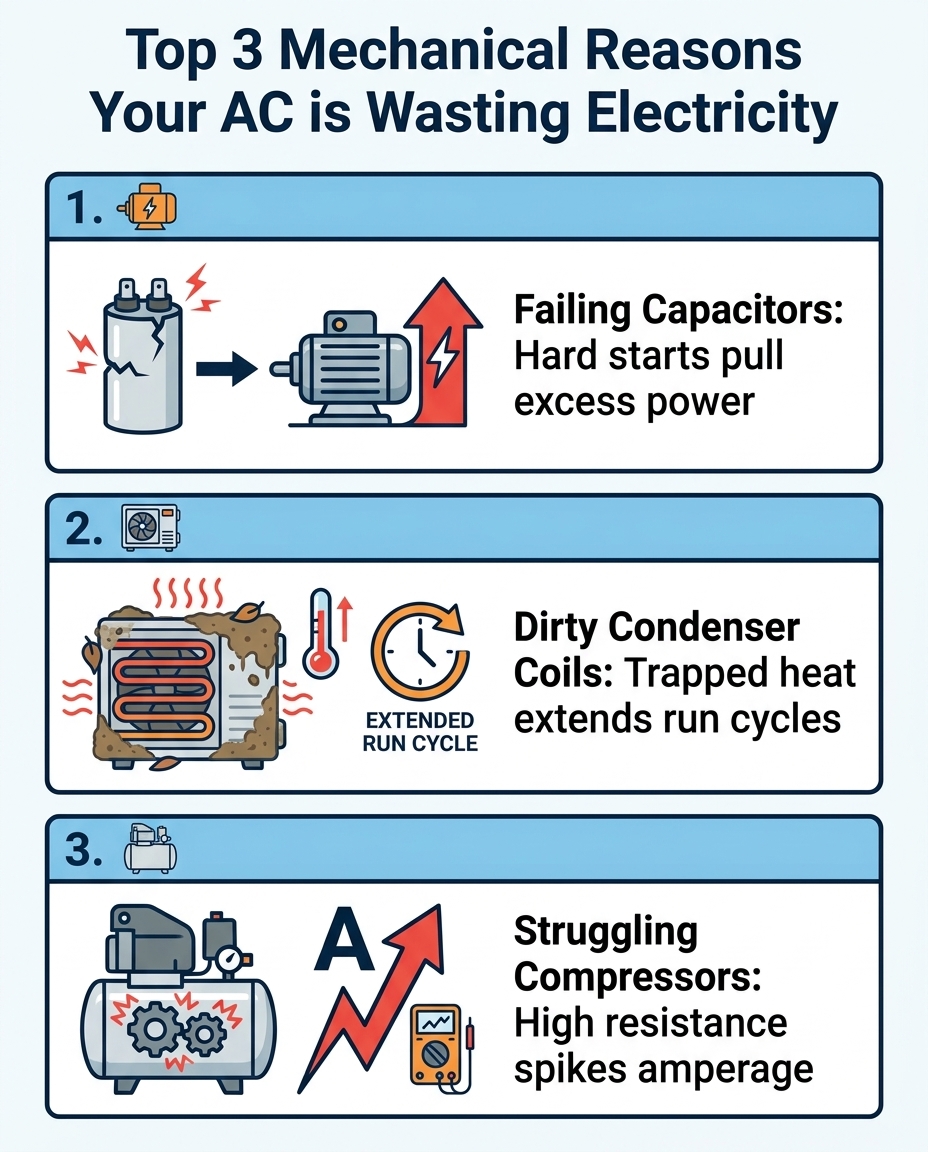
1. Failing Capacitors Causing Hard Starts
2. Dirty Condenser Coils Restricting Heat Transfer
3. Struggling Compressors Facing High Resistance
Failing Capacitors
The capacitor acts as the battery jump-starter for your air conditioning system. Because the compressor and fan motors require a massive jolt of electricity to start spinning—far more than the standard household wiring can provide instantly—the capacitor stores energy and releases it to get the motors moving. When a capacitor becomes weak due to age or extreme heat exposure, it loses its ability to deliver that crucial starting jolt. As a result, the system draws massive amounts of electricity directly from the grid just to turn on. This repeated "hard starting" not only causes a significant spike in energy consumption but also places severe thermal stress on the motors themselves.
Dirty Condenser Coils
Your outdoor unit contains a large network of metal fins and tubing known as the condenser coil. Its primary job is to release the heat absorbed from inside your home into the outdoor air. Over the course of the spring and summer, these coils become caked with dust, pollen, yard clippings, and dirt. In our experience servicing Sacramento neighborhoods, we often pull thick mats of debris off these units during late-summer service calls. This layer of grime acts as an insulating blanket, trapping the heat inside the system. Because the heat cannot escape efficiently, the compressor is forced to run hotter, harder, and significantly longer to achieve the desired indoor temperature. This drastically increases the overall energy consumption per cycle.
Struggling Compressors
The compressor is the heart of the air conditioning system, responsible for pumping refrigerant through the lines. When the compressor encounters internal mechanical resistance, its amperage spikes dramatically. This often presents as the outside unit failing to cycle properly during extreme heat waves. In one recent summer scenario during a 106-degree heat wave, our team at Bronco Plumbing, Heating & Air responded to a local homeowner with a one-year-old child who noticed their outside unit was not clicking on and off, but rather staying off completely. Our professional technician tested the system, diagnosed a severe compressor issue, and replaced the component, restoring the cooling quickly and safely. Keeping these vital components running efficiently requires consistent care, which is why routine preventative AC maintenance is so critical for long-term energy savings.
How Extreme Heat Masks Underlying HVAC Issues
In our years of serving Sacramento tract homes and older properties alike, we've seen firsthand how living through extreme triple-digit August heat changes how homeowners perceive their comfort systems. During a continuous heat wave, an air conditioner running non-stop feels entirely normal. You hear the system blowing air, you feel the relief indoors, and you naturally assume the equipment is just doing its job. This continuous operation perfectly masks the warning signs of excess amperage draw and mechanical wear.
The financial impact of this masked inefficiency is heavily compounded by local utility providers. Providers like SMUD and PG&E often utilize time-of-day peak demand schedules during the summer months. When your air conditioner is struggling mechanically and drawing excess power, it is usually doing so during the late afternoon and early evening—the exact hours when electricity rates are at their absolute highest. A mechanically inefficient AC running during peak demand hours will cause a utility bill to skyrocket far faster than a healthy system running under the same weather conditions.
Furthermore, August represents the culmination of end-of-season wear and tear. The system has been running hard since May or June, accumulating dust on the coils, wearing down the electrical contacts, and degrading the capacitors. By the time late summer arrives, these hidden failures finally surface in the form of a massive utility bill. Homeowners are strongly advised not to dismiss a sudden spike as "just the weather" without having a professional assessment to rule out underlying mechanical failures.
Airflow and Thermostat Factors You Can Control
While excess amperage draw and failing capacitors require professional intervention, there are several non-mechanical, user-controlled factors that contribute heavily to high summer bills. When a system is already battling high ambient heat, poor airflow and improper controls force the AC to over-deliver, compounding the energy waste.
The Airflow and Thermostat Checklist:
• Replace dirty air filters: A clogged air filter starves the blower motor of air. The motor has to work twice as hard to pull air through the dirt, increasing energy usage and potentially causing the indoor coil to freeze over.
• Check thermostat calibration: If your thermostat's internal sensor is uncalibrated, it may read the room as being warmer than it actually is, forcing the AC to run phantom cycles. Upgrading your controls is often a great step, and you can explore smart thermostat upgrades to gain better insights into your daily usage.
• Unblock return and supply vents: Closing vents in unused rooms does not save energy. It actually increases the static pressure inside your ductwork, forcing the blower motor to fight against the restricted airflow and pulling more electricity in the process.
• Utilize ceiling fans properly: Fans cool people, not rooms. Ensure your ceiling fans are rotating counterclockwise to create a downdraft, allowing you to set the thermostat a few degrees higher without sacrificing personal comfort.
If you have managed all of these basic airflow and thermostat factors and your utility bill remains unusually high, the sudden spike definitely points toward a mechanical failure requiring diagnostic testing.
Frequently Asked Questions About Summer AC Power Usage
Can a bad AC capacitor cause high electric bills?
Yes, a failing capacitor forces the compressor and fan motors to pull significantly more electricity from the grid just to start up. This repeated hard-starting drastically increases overall energy consumption throughout the day. Over time, the constant electrical strain will also cause the motors to overheat and draw even more power.
Why is my AC drawing so many amps?
Excess amperage is typically caused by mechanical resistance within the system. Common culprits include failing blower or condenser motors, a failing compressor struggling to pump refrigerant, or severe airflow restrictions. When a part cannot move freely, it demands more electrical current to overcome the friction.
How can I tell if my AC is drawing too much power?
Sudden utility bill spikes despite consistent thermostat habits are the primary indicator of abnormal power draw. You might also notice the outdoor unit making louder buzzing or humming noises when starting. However, a professional technician must use a specialized multimeter to safely measure the exact electrical draw and confirm the issue.
Why is my electric bill so high in the summer?
Summer bills are naturally higher due to a combination of increased ambient heat load and peak utility demand rates. However, if the increase is entirely disproportionate to the weather—meaning the temperature only rose slightly but your bill doubled—mechanical inefficiency and excess amperage draw are highly likely.
Will lowering my thermostat cool the house faster in August?
No, air conditioners cool at a constant rate regardless of the temperature setting. Lowering the thermostat to a drastic number simply forces the unit to run longer, increasing energy consumption and utility costs without speeding up the actual cooling process.
Get Honest Diagnostics Before Replacing Your System
Receiving a shockingly high utility bill at the end of the summer is frustrating, but it is important to remember that a spike in energy usage does not automatically mean your entire air conditioning system is dead. In many cases, the culprit is a single struggling component—like a weak capacitor, a dirty coil, or a strained motor—that is silently wasting electricity while trying to keep your home comfortable.
The only way to know for sure is to rely on honest, expert diagnostics from our experienced team at Bronco Plumbing, Heating & Air to pinpoint exact energy-wasting failures. By using professional tools to measure the exact amperage of every component, our technicians can isolate the failing part and prevent unnecessary system replacements. If your August utility bill has you questioning the health of your cooling system, scheduling a professional diagnostic is the safest and most effective way to stop the energy waste, restore efficiency, and gain peace of mind for the rest of the season.

Customer Testimonials
Our customer testimonials highlight the reliable service, quality workmanship, and trusted results homeowners experience with Bronco Plumbing Heating and Air.


Ready to Transform your Home?
Create a healthier, more comfortable home with expert HVAC, plumbing, and indoor air quality solutions you can trust. From efficient heating and cooling to cleaner air and reliable repairs, our experienced team is here to keep your family comfortable year-round with dependable service and upfront pricing.
Related Articles
Upgrading to a Smart Thermostat vs. Reprogramming Your Old Honeywell

How Clogged Condensate Drains Cause Ceiling Leaks in Two-Story Homes
Addressing Older Ductwork Inefficiencies in Historic Folsom Homes