



.svg)

Transitioning Your Heat Pump Settings as August Nights Finally Cool Down
Late summer brings massive temperature swings, with brutal afternoon heat dropping to crisp evenings. Adjusting your thermostat now prevents your system from overworking.

Navigating the Late-Summer Temperature Rollercoaster
The end of summer brings a welcome shift in the weather, but it also introduces a unique challenge for your home's climate control. Transitioning your heat pump settings as August nights finally cool down is the key to staying comfortable without sending your utility bills through the roof. As we enter this late August transition, you might notice that the brutal afternoon heat is suddenly followed by surprisingly crisp evenings. While this relief is wonderful for spending time outdoors, these massive temperature gaps between day and night can cause standard HVAC systems to overwork if they are left on their typical summer schedules.
When outdoor temperatures swing wildly, improper thermostat settings can lead to accidental morning heating, wasting energy and reducing your overall comfort. Updating your approach to climate control is absolutely essential during this transitional period. Whether you are looking to optimize your current setup with professional heating services or you are considering smart thermostat upgrades, taking control of your system now prevents unnecessary wear and tear.
The Hidden Trap of 'Auto Mode' During Wide Temperature Swings
The Problem: Many homeowners rely on their thermostat's "Auto Mode" for year-round convenience. In theory, this mode constantly monitors the indoor temperature against a tight heating and cooling deadband, switching seamlessly between the two. However, when you experience 30-degree day-to-night temperature drops, this convenience quickly becomes a mechanical nightmare.
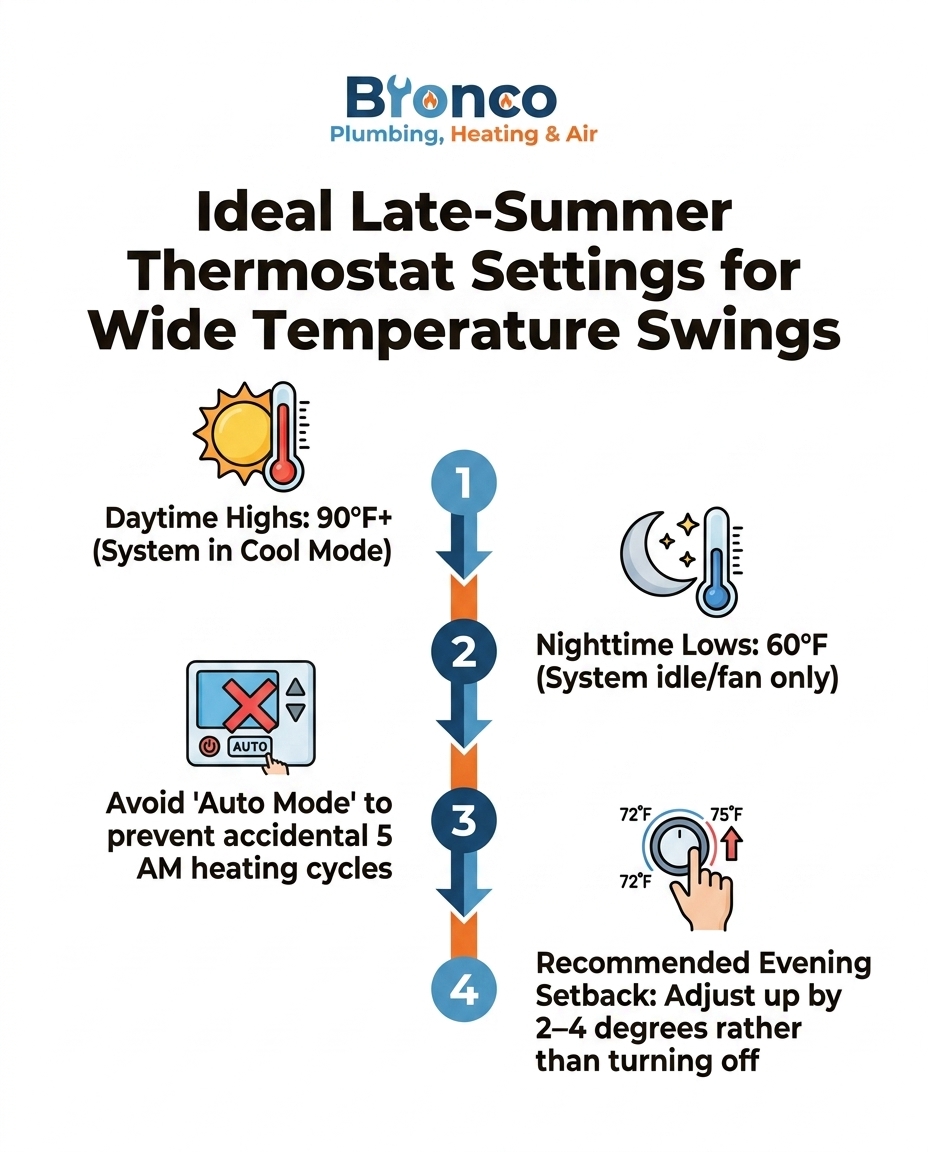
The Cause: The mechanical inefficiency of the system rapidly switching between cooling in the afternoon and heating in the early morning puts immense strain on your heat pump. The biggest danger right now is the "morning heat trap." When the outdoor temperature dips to 60 degrees before sunrise, your house naturally cools down. If your Auto Mode is set to maintain 70 degrees, the system is tricked into blasting warm air into your home right before the sun comes up—forcing your AC to work twice as hard a few hours later to remove that very same heat.
The Solution: Rather than relying on Auto Mode during the late August transition, we highly recommend locking your system strictly into "Cool" mode with slightly higher setpoints. This prevents the heat pump from ever engaging its heating cycle, even on the chilliest mornings.
• Auto Mode — Behavior During 30-Degree Temp Swings: Triggers AC at 4 PM, triggers Heat at 5 AM. Fights natural weather patterns. — Late-Summer Verdict: Avoid entirely. Wastes energy and stresses components.
• Cool Mode — Behavior During 30-Degree Temp Swings: Cools during the afternoon heat. Remains idle overnight as natural temps drop. — Late-Summer Verdict: Highly recommended. Maximizes efficiency.
• Off / Fan Only — Behavior During 30-Degree Temp Swings: Circulates natural evening air but allows afternoon heat to build up rapidly. — Late-Summer Verdict: Use selectively during late evenings only.
Optimizing Your Thermostat to Leverage Natural Evening Cooling
One of the greatest advantages of living in the Sacramento Valley is the Delta Breeze. This natural marine air pushes into the region during the evening, rapidly cooling the environment. Generic national "set it and forget it" advice doesn't work for our specific local microclimates. If you follow standard factory schedules, your system will actively fight the natural chill provided by the Delta Breeze. Providing your heat pump a break when outdoor temperatures drop rapidly in the evening is one of the smartest ways to save energy.
Here is how you can program your thermostat to work with the local climate rather than fighting it:
1. Program an evening setback: Instead of turning your system completely off, adjust your cooling setpoint up by 3 to 4 degrees around 8:00 PM. This allows the house to cool naturally with the Delta Breeze while keeping the system on standby just in case the marine layer stalls.
2. Implement smart pre-cooling: Use your smart thermostat to pre-cool your home slightly just before the hottest part of the following day (usually around 1:00 PM). Dropping the temperature a couple of degrees early means your system won't have to panic-cool when it hits 95 degrees outside.
3. Optimize multi-zone configurations: If you have a zoned system or utilize ductless mini-split systems, adjust the zones in your living areas to be slightly warmer at night while keeping bedroom zones cooler for optimal overnight comfort.
4. Keep windows closed during the day: Leverage the overnight cooling by opening windows when the sun goes down, but remember to seal the house back up first thing in the morning to trap that free cold air inside.
Setting the Ideal Nighttime Deadband
A "deadband" is the temperature gap between your heating and cooling setpoints before the system activates. During the late August transition, setting the ideal nighttime deadband is crucial. If you must use Auto Mode, widen this gap significantly. We recommend setting your cooling trigger to 76 degrees and your heating trigger down to 62 degrees. This wide 14-degree deadband ensures that normal 30-degree day-to-night temperature drops won't accidentally trigger a heating cycle, effectively preventing the system from short-cycling and wasting power.
Why Manual Toggling Stresses Your Heat Pump Components
It is tempting to simply turn your thermostat completely off when you feel the crisp Sacramento Valley evening air roll in, and then manually crank the AC back on when you get hot the next afternoon. However, this manual toggling is terrible for your equipment. Heat pumps operate most efficiently when they are allowed to maintain a steady, consistent temperature.
The energy spike of deep setbacks: When you turn a system completely off at night, the indoor humidity and temperature slowly rise the next day. By the time you manually turn it back on at 3:00 PM, the system has to run at maximum capacity for hours to remove the built-up heat and moisture. This creates a massive energy spike that often negates any savings from turning it off the night before.
Mechanical wear and tear: Drastic manual temperature changes force the compressor to work under extreme load. Over time, this constant start-and-stop behavior—especially if it leads to short-cycling—degrades the compressor and places heavy strain on the electrical capacitors. Automated, gradual temperature shifts managed by a programmed schedule are vastly superior to erratic manual control. Let the thermostat do the math; your heat pump will last longer and run quieter.
Addressing Inconsistent Airflow and Summer Strain
Months of intense summer operation can leave even the most reliable systems vulnerable to electrical or airflow issues. As we navigate the late August transition, it is incredibly common for the hidden wear and tear of July to finally reveal itself. You might start noticing signs of strain, such as inconsistent blowing from your vents, strange rattling noises, or a failure to reach the set temperature on the thermostat.
A typical pattern we see is summer strain catching up with older equipment just as usage patterns change. For example, one local homeowner recently noticed their older HVAC system was inconsistently blowing air. Because it was their second visit for an AC-related component, a thorough diagnostic was required. The intense summer heat had degraded the electrical components, requiring a replaced circuit board and some rewired circuits. While the heat and cool functions were restored, the final test of the AC component was pending warmer weather.
This perfectly illustrates why catching these inconsistencies now is so important. Electrical components like circuit boards, contactors, and capacitors often show signs of failure during transitional seasons when the system stops running constantly and begins cycling on and off more frequently. Catching these problems today through seasonal HVAC maintenance prevents complete breakdowns when freezing winter weather arrives and heating is truly needed.
Planning Your Final Shift to Heating Mode
While the days are still hot, the 30-degree day-to-night temperature drops are a clear signal that fall is approaching. Planning your final shift to heating mode now ensures you aren't caught off guard by the first true cold snap of the year. Here is a timeline and checklist to guide your transition from late August through early fall:
• Monitor the weather markers: It is time to stop using the cooling mode entirely when daytime highs consistently fail to reach 75 degrees for a full week. Until then, stick to the wide deadband strategy.
• Check and replace air filters: Summer operation moves a massive amount of dust and pollen through your system. Before the first true heating cycle begins, replace your filters to ensure unrestricted airflow. Restricted airflow is the number one cause of heat pump overheating in the winter.
• Clear outdoor unit debris: Late summer winds often blow leaves, dirt, and debris into the fins of your outdoor compressor. Gently clear this away to maintain optimal heat transfer efficiency.
• Test the auxiliary heat: Don't wait for a freezing night in November to find out your heat strips are broken. On a mild morning, bump your thermostat up a few degrees to test the heating function briefly, ensuring warm air flows steadily.
• Evaluate your equipment: If your system struggled all summer, now is the time to research the best heat pump solutions for Sacramento homes so you can upgrade before the winter rush begins.
Frequently Asked Questions About Late-Summer Heat Pump Settings
Should I leave my heat pump on auto mode in late summer?
No, leaving your heat pump on auto mode during late summer is generally a bad idea. Wide temperature swings can trick the system into heating your home on a cool morning, only to immediately switch back to cooling a few hours later. It is much more efficient to lock the system in "Cool" mode and let the house naturally adjust overnight.
How do I stop my heat pump from heating in the early morning?
The easiest way to stop accidental morning heating is to switch your thermostat from "Auto" to "Cool" mode. If you must use a schedule, widen the temperature gap (deadband) between your heating and cooling setpoints so that a 60-degree morning doesn't trigger the system to warm the house.
What is the best thermostat schedule for hot days and cool nights?
The best schedule involves slightly pre-cooling your home in the late morning, maintaining a steady temperature during the peak afternoon heat, and raising the setpoint by 3 to 4 degrees in the evening. This allows you to leverage natural outdoor cooling while preventing the system from overworking to recover from deep temperature setbacks.
Should you turn your heat pump off completely at night?
Turning your heat pump off completely is usually not recommended because it causes a massive energy spike when you turn it back on the next day. Instead of turning it off, raise the cooling setpoint by a few degrees. This gives the system a rest while keeping humidity levels in check.
At what outdoor temperature should I permanently switch my heat pump from cool to heat?
You should permanently switch to heat mode when daytime high temperatures consistently stay below 70 to 75 degrees for several consecutive days. In the Sacramento Valley, this typically happens in late October or early November, long after the late August transition period.
Does constantly changing my heat pump temperature damage the system?
Yes, constantly making drastic manual temperature changes can cause your system to short-cycle, which puts unnecessary wear and tear on the compressor and electrical components. It is much better for the longevity of your equipment to set a consistent, automated schedule that gradually shifts temperatures.
Ensure Your System is Ready: Transitioning Your Heat Pump Settings as August Nights Finally Cool Down
Proper thermostat settings do more than just save energy; they drastically improve your daily comfort and protect the lifespan of your equipment. As you navigate the extreme temperature swings of the Sacramento Valley, remember that your HVAC system thrives on consistency. If you find that your current setup struggles to handle the shift from hot afternoons to chilly evenings, it might be time to explore modern thermostat solutions that can better manage these microclimates. Having a professional evaluate your system's performance after a long summer is the best way to guarantee a seamless, comfortable transition into the cooler months ahead.

Customer Testimonials
Our customer testimonials highlight the reliable service, quality workmanship, and trusted results homeowners experience with Bronco Plumbing Heating and Air.


Ready to Transform your Home?
Create a healthier, more comfortable home with expert HVAC, plumbing, and indoor air quality solutions you can trust. From efficient heating and cooling to cleaner air and reliable repairs, our experienced team is here to keep your family comfortable year-round with dependable service and upfront pricing.
Related Articles
The Relationship Between Attic Insulation and Late Summer Cooling Cycles

What a Sudden Spike in Your August Electric Bill Actually Means for Your AC
Upgrading to a Smart Thermostat vs. Reprogramming Your Old Honeywell