



.svg)

The Relationship Between Attic Insulation and Late Summer Cooling Cycles
If your AC runs constantly during August heat waves but your home stays warm, the issue might not be your HVAC unit. Poor attic insulation allows massive heat transfer that overworks your system.
Why Your AC Struggles to Keep Up as August Drags On
Your air conditioning is running non-stop, but the house still feels uncomfortably warm. Understanding the relationship between attic insulation and late summer cooling cycles is the key to solving this frustrating problem. As the August back-to-school transition arrives, our team at Bronco Plumbing, Heating & Air often hears from homeowners who assume their aging HVAC unit is simply failing. You hear the compressor humming outside all afternoon, you feel cold air trickling from the vents, yet the indoor temperature slowly climbs as the sun beats down.
Before you blame the mechanical equipment, you have to look at the home's thermal barrier. A system that cannot cycle off is a symptom of a much larger issue. Often, severe cooling problems are actually insulation problems in disguise. When you search for why you have an AC running constantly during a heat wave, the answer usually lies just above your ceiling.
If you are struggling to keep your home comfortable, exploring professional air conditioning services is the first step toward restoring your home's thermal balance.
The Mechanics of Radiant Heat Transfer in Your Attic
To understand why your cooling system is losing the battle, we have to examine the physics of your roof. Sunlight hitting your roof shingles creates a massive thermal load. Dark roofing materials absorb solar radiation, transferring that energy directly into the enclosed space below. In our years of servicing the Sacramento Valley, we've seen firsthand how sustained triple-digit temperatures create extreme radiant heat loads that easily overwhelm standard residential thermal envelopes.
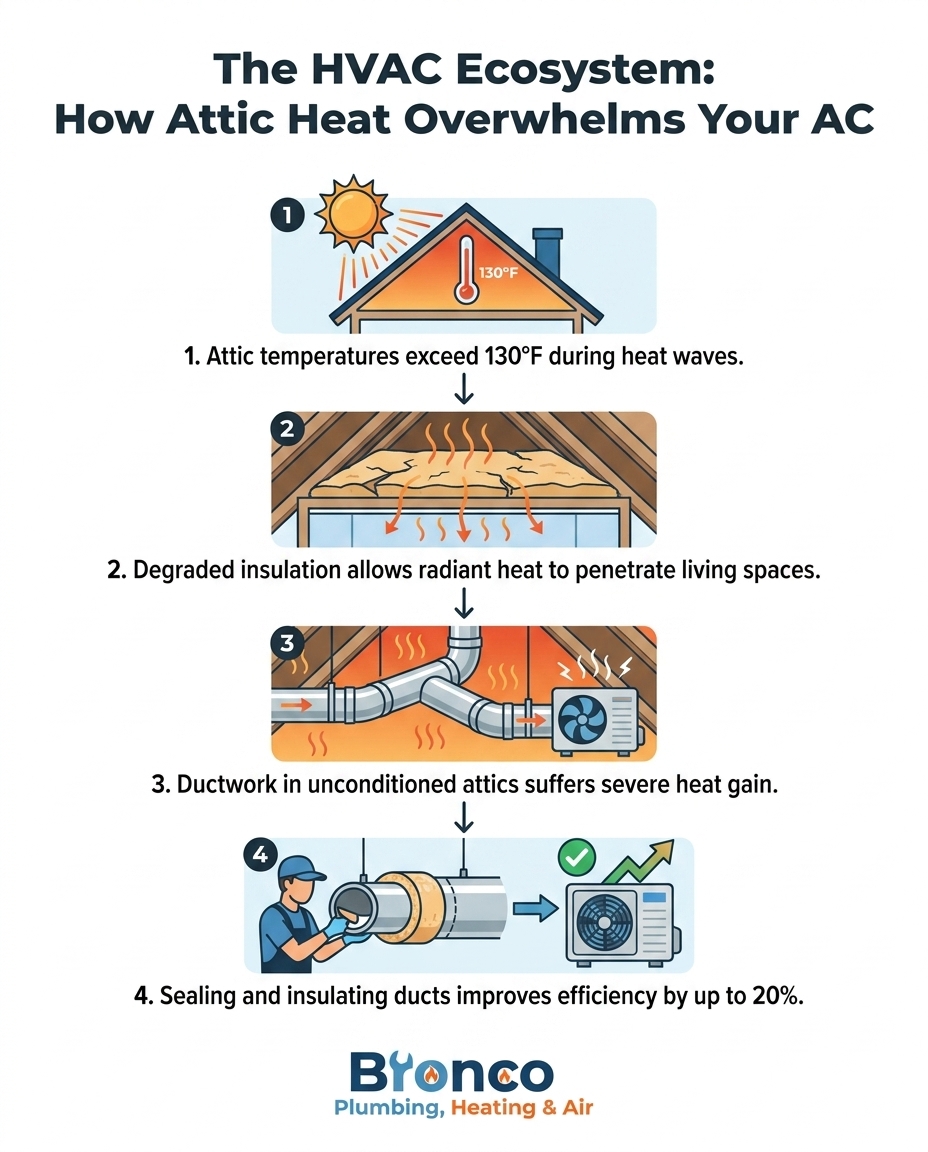
As this solar energy builds up, attic temperatures exceeding 130°F become common. That trapped, superheated air looks for a place to go. Heat always moves toward cooler spaces. If the barrier between that 130-degree attic and your 72-degree living room is compromised, the heat will relentlessly seep downward.
The role of R-value: Insulation is measured by its R-value, which indicates its resistance to heat flow. Over time, blown-in fiberglass or cellulose insulation can settle, compress, or degrade due to moisture and pest activity. When the material compresses, it loses the tiny air pockets that actually do the insulating. A degraded thermal barrier loses its ability to block radiant heat, allowing the ceiling drywall to heat up like a giant radiator radiating warmth into your rooms.
Understanding the Thermal Boundary
The thermal boundary is the critical shield between the unconditioned attic space and your conditioned living space. When this boundary is intact, your air conditioner only has to cool the air inside the house. When the boundary is breached, your HVAC system is essentially trying to cool the outdoors.
• Standard AC tonnage: Air conditioning systems are sized based on Manual J load calculations, which assume your home has an intact, effective thermal envelope.
• Overwhelming the system: If your insulation has degraded from an R-38 down to an effective R-15, the heat gain outpaces the cooling capacity of the unit, regardless of how new or powerful the compressor is.
• Radiant transfer: This specific type of heat transfer bypasses the air entirely, heating the physical objects in your rooms—including you—making the space feel stuffy even if the ambient air temperature reads normal.
How Degraded Thermal Barriers Force Continuous Cooling Cycles
A poorly insulated attic creates a mechanical nightmare for your cooling equipment. The relationship between poor insulation and an overworked AC compressor is direct and punishing. When you have a degraded thermal barrier, radiant heat continuously enters the room from the ceiling above. Your thermostat, mounted on an interior wall, detects this constant influx of warmth.
Because the heat is entering just as fast as the AC is removing it, the ambient temperature never quite reaches the set point on the thermostat. The system simply never gets the signal to turn off. If you are dealing with an AC running constantly on hot day after hot day, you are witnessing this mechanical struggle firsthand. The compressor and the indoor blower motor are forced to run continuously, hour after hour, without the necessary resting cycles they were engineered to have.
The Thermostat Disconnect
This continuous cycle puts immense strain on the moving parts of your system. Heat radiating from the ceiling tricks the thermostat into calling for non-stop cooling. The energy consumption impact of an HVAC system that cannot cycle off is staggering, leading to utility bills that spike drastically during late summer.
Our emergency dispatch team recently helped a local homeowner who experienced this exact breaking point during a late-summer heat wave. Their air conditioner broke down completely after hours on one of the hottest days of the year due to this exact continuous strain. Our technicians provided fast, professional emergency service to rescue them from the extreme indoor heat, highlighting how chronic overwork eventually leads to total mechanical failure.
The Hidden Toll on Attic Ductwork During Heat Waves
Even if your air conditioner is producing perfectly chilled 55-degree air at the indoor coil, that air still has to travel to your living room. In many of the Sacramento homes our crew inspects, the ductwork is routed directly through the attic. This creates a massive vulnerability in your home's HVAC ecosystem. Pushing cold air through thin metal or flex ducts surrounded by attic temperatures exceeding 130°F causes significant heat gain.
Thin duct walls, combined with minor leaks, cracks, and disconnected joints, allow the precious cold air you just paid to cool to escape into the attic. Worse, those same leaks pull superheated, dusty attic air into the duct stream, distributing it throughout your home. This is why the air coming out of your bedroom register might feel lukewarm, even though the AC is running at full capacity.
Properly addressing these vulnerabilities can drastically change your home's comfort. By investing in professional duct sealing and proper insulation, homeowners can improve system efficiency by up to 20 percent. California's Title 24 building energy efficiency standards heavily emphasize this exact issue, requiring high-performance duct design and stringent leakage testing in hot climates to prevent this massive energy waste. Because this is such a priority for home efficiency, federal tax credits or local utility incentive programs may apply to qualifying insulation and duct upgrades—we always advise our customers to verify current programs with their utility provider or a tax professional.
Heat Gain in Unconditioned Spaces
The physics of cold air traveling through a hot environment dictate that thermal transfer will occur unless heavily insulated.
• Conductive heat gain: The hot attic air heats the outer jacket of the ductwork, which transfers heat to the cold air inside.
• Air infiltration: Negative pressure inside leaky return ducts acts like a vacuum, sucking 130-degree air directly into your HVAC system.
• Air exfiltration: Positive pressure in leaky supply ducts blows your expensive, conditioned air into the unconditioned attic space.
Diagnosing the Difference: Failing AC Unit vs. Failing Insulation
When the house is hot and the AC won't stop running, distinguishing between mechanical failure and thermal envelope failure is critical. Our technicians find that many homeowners jump straight to replacing the equipment when the real culprit is the insulation. A chronic cooling issue requires a holistic evaluation before you commit to a major AC replacement.
• Grinding, squealing, or rattling noises from the outside condenser. — Symptoms of Failing Insulation: Ceilings feel noticeably warm to the touch during the late afternoon.
• Air coming directly from the vents feels warm or room temperature. — Symptoms of Failing Insulation: Air from vents is cold, but the room temperature still will not drop.
• Frequent tripped circuit breakers or electrical burning smells. — Symptoms of Failing Insulation: Significant temperature differences between rooms or floors.
• System short-cycles (turns on and off rapidly every few minutes). — Symptoms of Failing Insulation: High energy bills despite having a relatively new, high-efficiency AC unit.
Sometimes, the strain of fighting poor insulation pushes the equipment past its breaking point. During a recent 106-degree Sunday heat wave, one homeowner found their outside AC unit completely unresponsive. One of our service technicians diagnosed the issue as a dead compressor, replacing it to provide immediate relief. This highlights how chronic overwork eventually leads to mechanical death.
To keep your system running optimally and catch these strain indicators early, enrolling in a routine HVAC maintenance plan is a smart strategy for the August back-to-school transition period.
Treating the Whole-Home HVAC Ecosystem
A house is not just a collection of separate parts; it is an interconnected ecosystem. Your plumbing, heating, air conditioning, and insulation must all work together to maintain a comfortable, efficient environment. Treating a symptom without fixing the root cause is a recipe for repeated frustration. If you replace an overworked AC unit without addressing the degraded insulation or leaking ductwork that killed it, you will simply ruin the new unit in a few short years.
Evaluating the complete home ecosystem is a critical differentiator for true comfort specialists. At Bronco Plumbing, Heating & Air, our team approaches home comfort by evaluating the complete ecosystem—plumbing, heating, air, insulation, and ducts—to find true failure points rather than just pushing AC replacements. By looking at the home as a holistic system, our technicians can identify exactly where the thermal boundary is failing in the Sacramento Valley heat, preventing premature equipment failure and ensuring that your investment in cooling actually keeps you comfortable.
Cumulative Wear: Why Late Summer Pushes Systems Over the Edge
There is a specific reason why systems that survived the moderate heat of June and July suddenly fail in late August. The answer is cumulative wear and tear. Over months of continuous operation, the internal components of your HVAC system endure thousands of cycles, intense vibration, and extreme electrical loads.
Late summer heat waves act as the final stress test for aging HVAC systems in the region. Components like capacitors, which store electrical energy to jump-start the motors, are highly sensitive to prolonged heat exposure. The dielectric fluid inside a capacitor slowly degrades when subjected to constant high temperatures. Similarly, blower motors and compressor windings accumulate heat damage when they are not allowed to cool down between cycles.
By the time the August back-to-school transition arrives, your system is fatigued. If it is also fighting a losing battle against degraded attic insulation, this specific time of year becomes the peak danger zone for total system failure. Understanding why late summer is the hardest time on aging HVAC components can help you stay proactive before a breakdown occurs.
Frequently Asked Questions About Attic Heat and AC Performance
Why is my AC running constantly on a hot day?
An AC runs constantly on a hot day because the heat entering your home is matching or exceeding the cooling capacity of the unit. The thermostat never registers that the target temperature has been reached, so it never sends the signal to cycle off. This is often caused by a combination of extreme outdoor temperatures, poor attic insulation, and ductwork that is gaining heat from unconditioned spaces.
Why is my AC running constantly during a heat wave?
During a heat wave, the radiant heat load on your roof is massive, pushing attic temperatures exceeding 130°F. If your thermal boundary is weak, this heat transfers directly into your living space. The air conditioner is forced to run continuously to combat this severe, unending influx of radiant heat, leading to extended cycles and high energy bills.
Can attic insulation help cool the house?
Yes, proper attic insulation is one of the most effective ways to keep a house cool. It acts as a thermal shield, blocking the radiant heat trapped in the attic from penetrating the ceiling drywall. By stopping the heat at the boundary, your air conditioner can easily cool the indoor air and cycle off normally, resulting in a much cooler, more comfortable home.
How does attic heat affect air conditioning?
Attic heat affects air conditioning in two primary ways: it radiates through the ceiling to warm the living space, and it heats up the ductwork routed through the attic. If the ducts are exposed to 130-degree air, the cold air inside them warms up before it ever reaches your vents. This forces the AC to work twice as hard to deliver the same amount of cooling.
How do I know if my AC is dying or if my insulation is bad?
If your AC is blowing freezing cold air from the vents but the room stays warm, or if your ceilings feel hot to the touch, you likely have an insulation problem. If the AC is making grinding noises, blowing warm air directly from the registers, or short-cycling rapidly, the mechanical equipment itself is likely failing. A professional whole-home evaluation can pinpoint the exact cause.
Does duct sealing improve AC performance in the summer?
Absolutely. Duct sealing prevents your expensive, conditioned air from leaking out into the hot attic, and it stops dusty, superheated attic air from being sucked into your air supply. Properly sealed and insulated ductwork can improve your system's overall efficiency by up to 20 percent, delivering colder air directly to the rooms that need it most.
Restore Your Home's Cooling Efficiency Before the Next Heat Wave
Fixing the thermal barrier is the real solution to chronic late-summer cooling problems. If your system is running non-stop, simply replacing the air conditioner without addressing the attic will leave you with the exact same comfort issues. A comprehensive evaluation of your HVAC ecosystem is the only way to ensure lasting relief from the Sacramento Valley heat.
Don't wait for your overworked compressor to fail completely. Seek out a professional system evaluation from our experienced team to assess your ductwork, insulation, and mechanical equipment together. By addressing the root cause of the heat transfer, you can restore your home's cooling efficiency, lower your energy bills, and enjoy a comfortable living space before the next major heat wave strikes.

Customer Testimonials
Our customer testimonials highlight the reliable service, quality workmanship, and trusted results homeowners experience with Bronco Plumbing Heating and Air.


Ready to Transform your Home?
Create a healthier, more comfortable home with expert HVAC, plumbing, and indoor air quality solutions you can trust. From efficient heating and cooling to cleaner air and reliable repairs, our experienced team is here to keep your family comfortable year-round with dependable service and upfront pricing.
Related Articles
What a Sudden Spike in Your August Electric Bill Actually Means for Your AC

Upgrading to a Smart Thermostat vs. Reprogramming Your Old Honeywell
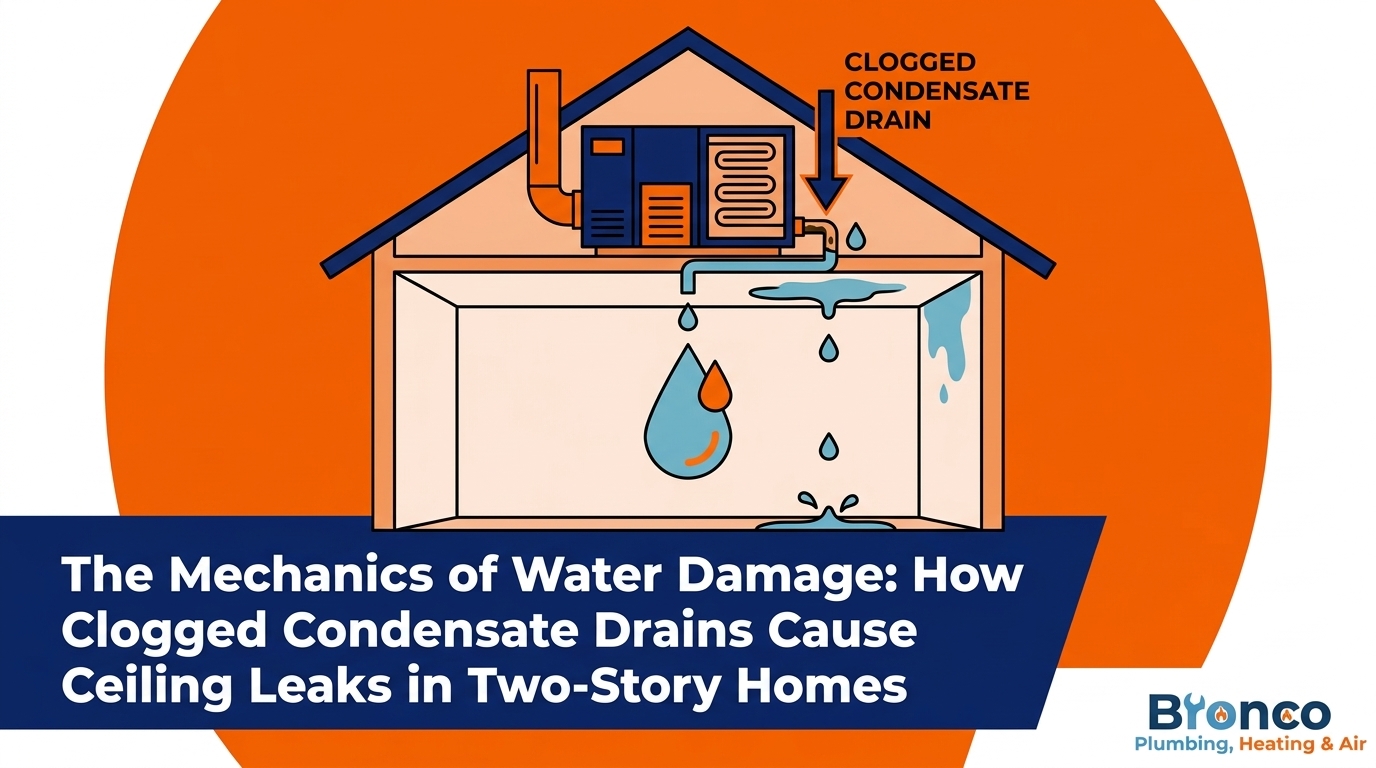
How Clogged Condensate Drains Cause Ceiling Leaks in Two-Story Homes