



.svg)

Diagnosing Weak Airflow in the Farthest Bedroom of Your House
A freezing living room and a sweltering master bedroom usually point to a delivery problem, not a broken AC. See how ductwork distance creates frustrating hot spots.

Battling the Hot Box: When One Bedroom Defies the Thermostat
Your air conditioner is running nonstop, but while the living room feels like a refrigerator, you are still sweating at the opposite end of the hall. Diagnosing weak airflow in the farthest bedroom of your house is a frustrating challenge that leaves many homeowners confused and uncomfortable. You might assume your entire cooling system is failing, but a noticeable temperature differential between the main living area thermostat and the farthest master bedroom usually points to a delivery problem, not a broken central unit.
When conditioned air struggles to reach a distant room, the bottleneck typically lies somewhere in the ductwork journey. Resolving these persistent hot spots often requires professional air conditioning services to evaluate the entire system's layout. A technician will look closely at your duct routing, the position of internal dampers, and the overall capacity of your blower motor to push air across long distances.
For homes with complex layouts or sprawling single-story additions, standard central cooling might always struggle to push air to the extremities. In these cases, upgrading to a zone control system can offer a permanent fix, allowing you to direct cooling exactly where it is needed most without freezing out the rest of the family.
The Physics of Airflow: How Distance and Static Pressure Kill Velocity
The Problem: You place your hand over the vent in the master bedroom and barely feel a breeze, even though the vents in the hallway are blasting cold air. The room remains stagnant, and turning the thermostat down lower doesn't increase the air volume—it just makes the rest of the house uncomfortably cold.
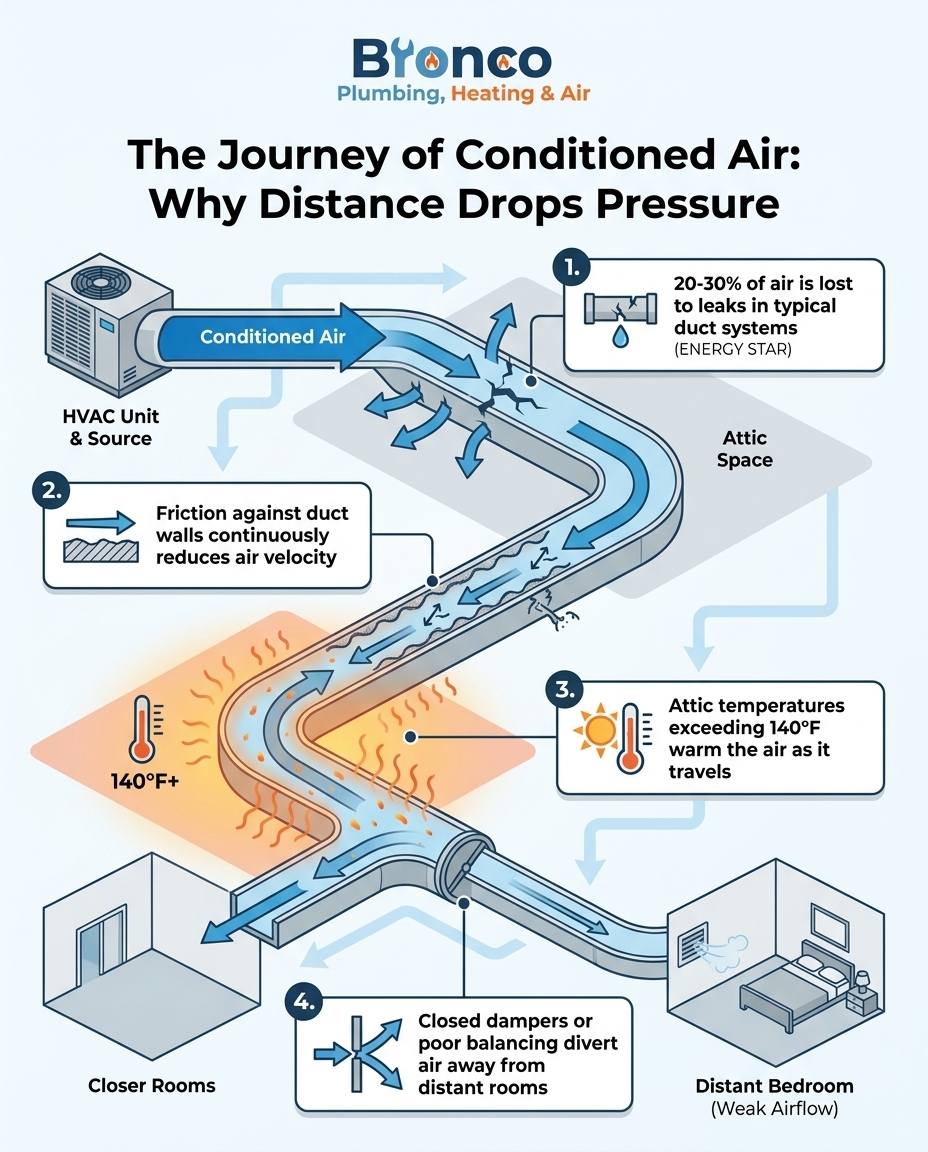
The Cause: The scientific culprit behind this weak breeze is a combination of distance and static pressure. Static pressure is the resistance to airflow within your heating and cooling system. According to standard ASHRAE principles, air naturally loses velocity due to friction loss as it rubs against the interior walls of your ductwork. The longer the duct run, the more energy the air loses along the way.
How Duct Layout Compounds the Issue
Air does not travel in a perfectly straight, frictionless line. Every twist, turn, and junction in your ductwork adds resistance. By the time the air navigates through the main trunk line, branches off into smaller ducts, and pushes through the final bends to reach a distant master suite, the initial force generated by the indoor unit has largely dissipated.
• Friction loss: Corrugated flexible ductwork creates microscopic turbulence that drags on the moving air, slowing it down continuously over long distances.
• Directional changes: Every 90-degree elbow or sharp bend in the ducting acts like a speed bump, significantly dropping the air pressure.
• Proximity advantage: The rooms closest to the indoor air handler always receive the strongest airflow because the air has encountered the least amount of resistance.
The Solution: Overcoming static pressure drops requires a comprehensive look at the duct design. Modifying the ductwork to reduce sharp turns, upgrading to smoother rigid ducting, or adjusting the overall system balance can restore velocity to the air stream by the time it reaches the end of the line.
Attic Heat Gain: The Hidden Enemy of Long Duct Runs
Physical distance is only half the battle; the environment your ductwork travels through plays a massive role in the temperature of the air that finally arrives. In many homes, ductwork is routed through unconditioned spaces like the attic. During the peak of summer, these spaces act like a massive oven baking the air inside your ducts.
With Sacramento summer attic temperatures easily exceeding 140 degrees, your ductwork acts as a heat exchanger in reverse. As the conditioned, cold air travels slowly through long, distant duct runs, it absorbs the ambient heat radiating from the attic space. The longer the air spends in transit, the more heat it absorbs before it ever reaches your bedroom vent.
The Late-Summer Breaking Point
This heat gain exacerbates the feeling of weak airflow because the small amount of air that does manage to push through the vent is no longer refreshingly cold—it is lukewarm. The August late-summer Sacramento heat forces AC systems to run constantly, turning distant rooms into sweltering hot boxes. Because the system is operating at maximum capacity for hours on end, the ductwork never gets a chance to cool down, meaning every cycle is fighting an uphill battle against the intense attic heat.
What to look for: If the air coming out of your farthest vent feels noticeably warmer than the air coming out of a vent right next to the thermostat, environmental heat gain along the duct run is a primary suspect. Improving duct insulation and minimizing the time air spends in the hot attic are critical steps to solving this issue.
HVAC Dampers and System Balancing: Is the Air Being Diverted?
Sometimes, the air isn't just getting lost—it is actively being blocked. HVAC dampers are mechanical valves located inside your ductwork that regulate and direct airflow to different branches of the system. Think of them like traffic cops for your conditioned air. When positioned correctly, they ensure an even distribution of air throughout the house.
However, a closed or stuck damper can completely cut off the air supply to a specific branch, leaving the farthest bedroom starved for cooling. Dampers can be adjusted manually via small levers on the outside of the ductwork, or they can be motorized in a zoned system. If a manual damper was accidentally bumped or intentionally closed during a previous season and never reopened, that noticeable temperature differential between the main living area thermostat and the farthest master bedroom will persist regardless of how long the AC runs.
The Dangers of DIY System Balancing
A common mistake homeowners make when trying to force more air into a hot bedroom is walking around the house and shutting the supply registers in cooler rooms. This DIY tactic is highly discouraged. Closing registers does not magically redirect air to the farthest bedroom; instead, it artificially increases the static pressure within the entire duct system.
Why closing vents is a bad idea:
• It strains the equipment: Increased pressure forces the blower motor to work harder, accelerating wear and tear.
• It causes coil freezing: Restricting airflow over the indoor evaporator coil can cause it to ice over, shutting down the entire cooling process.
• It increases duct leakage: Higher pressure inside the ducts forces more conditioned air out through tiny leaks and seams into your attic or crawlspace.
Proper system balancing involves adjusting the internal dampers near the main trunk line to gently restrict airflow to closer rooms while allowing maximum flow to distant rooms, a process that requires specialized tools to measure air volume accurately.
Blower Motor Limitations at the End of the Cooling Season
The indoor air handler houses the blower motor, which is the beating heart of your home's airflow system. This motor generates the initial force required to push conditioned air through the maze of ductwork and out of every vent in the house. If that motor is struggling, the rooms furthest from the unit will be the first to suffer the consequences.
An aging, dirty, or failing blower motor simply loses its ability to overcome the static pressure of long duct runs. Over time, dust accumulation on the blower wheel blades can reduce their ability to cup and move air efficiently. Similarly, a weakening capacitor can prevent the motor from reaching its optimal spinning speed. These mechanical limitations become glaringly apparent during the August late-summer Sacramento heat, when the system is asked to run continuously for days on end.
Real-World Blower Failures
During a recent summer heat wave, one local homeowner called us when their system seemed to completely stop blowing cold air. The AC was running, but the airflow was virtually nonexistent, leaving the house sweltering. We quickly diagnosed the issue as a failing blower component. By addressing the motor limitation directly, the system was fixed in a timely manner, and strong airflow was restored to every room.
Diagnosing a weak blower is not a guessing game. It requires professional tools like anemometers and manometers to measure the exact cubic feet per minute (CFM) of air being produced at the source versus what is being delivered at the vent. If the motor is underperforming, replacing it or upgrading to a variable-speed model can provide the extra push needed to reach the farthest corners of your home.
Leaky Ductwork: Losing Conditioned Air Before It Arrives
If the blower is working perfectly and the dampers are open, but the airflow is still weak at the end of the line, you are likely losing air along the way. According to ENERGY STAR data, in typical houses, about 20 to 30 percent of the air that moves through the duct system is lost due to leaks, holes, and poorly connected ducts.
Think of your ductwork like a long garden hose. If you want strong water pressure at the nozzle, the hose must be completely sealed. If there is a puncture halfway down the hose, the pressure at the end drops dramatically. The same physics apply to your conditioned air. A leak in a long duct run destroys the static pressure needed to push the air all the way to the farthest bedroom.
Where the Air Escapes
Ductwork is assembled in sections, and over time, the thermal expansion and contraction of your house can cause these connections to loosen. Common areas for significant air leaks include:
• Poorly sealed joints: Connections between rigid metal ducts and flexible ducting often develop gaps if not properly sealed with mastic.
• Disconnected branch lines: It is not uncommon to find a duct that has completely slipped off its collar in the attic, blowing ice-cold air directly into the unconditioned space.
• Torn flex duct: Rodents or accidental damage during attic storage can tear the outer jacket and inner lining of flexible ductwork.
When you have a noticeable temperature differential between the main living area thermostat and the farthest master bedroom, sealing these leaks is often the most impactful remedy. Professional duct sealing involves inspecting the entire duct run, identifying pressure drops, and applying specialized mastic sealant and metal-backed tape to secure every joint. This locks the conditioned air inside the system, restoring velocity and pressure to the distant rooms where you need it most.
Professional Diagnostics: Finding the Root Cause Beyond DIY Fixes
When faced with a hot master bedroom, many homeowners resort to quick DIY band-aids, such as installing a register booster fan. While a booster fan might pull a slightly larger volume of air out of the vent, it completely ignores the root cause of the problem. If the air in the duct is already warm from attic heat gain, or if a damper is closed upstream, a booster fan will simply blow warm air around the room slightly faster.
During the hottest days of summer, one customer reached out after hours when their system failed to keep up with the extreme temperatures. We provided fast, professional service to isolate the exact cause of their airflow restriction. This is why a comprehensive diagnostic approach is so critical. Instead of defaulting to selling a larger AC unit—which often worsens the problem by short-cycling—a licensed professional will evaluate the entire airflow envelope.
The Multi-Point Diagnostic Process
1. Testing Static Pressure: Technicians use manometers to measure the pressure inside the supply and return ducts, identifying exactly where the resistance is too high.
2. Inspecting Damper Functionality: Every manual and motorized damper is located and tested to ensure air is flowing freely to the distant branches.
3. Evaluating Blower Performance: The indoor motor is tested for proper amperage draw, speed, and cleanliness to ensure it can push the required volume of air.
4. Assessing Duct Integrity: The ductwork is visually and mechanically inspected for leaks, kinks, and undersized runs that throttle the air supply.
By isolating the specific bottleneck, a professional can recommend targeted repairs that actually solve the August late-summer Sacramento heat issue, rather than just masking the symptoms with loud, ineffective booster fans.
Long-Term Solutions for Consistent Whole-House Cooling
Fixing a hot farthest bedroom requires addressing the specific bottleneck identified during the diagnostic phase. Because every home is built differently, there is no single universal fix. However, once the root cause is known, several long-term solutions can restore consistent comfort to your entire floor plan.
If the issue is primarily friction loss and distance, modifying the duct routing can make a massive difference. Enlarging the diameter of the specific duct run feeding the master bedroom reduces friction and allows a larger volume of air to travel with less resistance. Additionally, replacing sagging or kinked flexible duct with smooth, rigid metal ducting can drastically improve air delivery speeds.
Comparing Your Options
• Duct Sealing & Modification — Best For: Homes with leaky joints, kinked flex ducts, or undersized branch lines. — Impact on Airflow: Restores lost static pressure and delivers more air to the end of the run.
• System Balancing — Best For: Homes where closer rooms get too much air and distant rooms get none. — Impact on Airflow: Redirects existing air volume evenly without adding strain to the blower.
• Zone Control Systems — Best For: Large single-story homes or multi-level houses with distinct temperature needs. — Impact on Airflow: Provides independent temperature control and dedicated airflow to specific areas.
As we often discuss when exploring why upstairs bedrooms stay hot while the ground floor freezes, sometimes standard central air distribution is simply outmatched by the home's architecture. In these scenarios, installing a zone control system is the ultimate long-term solution. By placing motorized dampers in the ductwork and linking them to multiple thermostats, a zoned system can direct the full force of the blower motor exclusively to the farthest bedroom when it needs cooling, bypassing the rooms that are already comfortable.
Frequently Asked Questions
Why is one room in my house not getting air?
One room may not get air if there is a blockage or severe pressure drop in the ductwork leading to it. Common culprits include closed internal dampers, disconnected duct joints in the attic, or a duct run that is simply too long and narrow for the blower motor to push air through effectively. A professional pressure test can pinpoint the exact location of the restriction.
Can ductwork distance affect AC airflow?
Yes, distance heavily impacts airflow due to friction loss and static pressure. As air travels through long duct runs, it rubs against the interior walls, continuously losing velocity and energy. By the time the air reaches a distant bedroom, the initial force generated by the blower motor has significantly decreased.
How do HVAC dampers affect airflow to my bedroom?
HVAC dampers act as internal valves that control how much air flows down a specific branch of your ductwork. If a manual damper leading to your bedroom was accidentally bumped closed, or if a motorized damper fails to open, it will physically block the conditioned air from reaching your vents, regardless of how hard the AC runs.
Why is the master bedroom always hotter than the rest of the house?
Master bedrooms are often located at the farthest end of the house or over a garage, making them the hardest rooms to cool. The long duct runs leading to them suffer from pressure drops and absorb ambient heat from the attic, meaning the air that finally arrives is both weak and warmer than intended.
Do air duct booster fans actually work for weak airflow?
Air duct booster fans rarely solve the underlying problem of weak airflow. While they might pull a slightly larger volume of air out of the register, they cannot fix closed dampers, leaky ductwork, or the fact that the air in the duct has already absorbed excessive attic heat. They treat the symptom, not the root cause.
How can I tell if my weak airflow is a duct issue or an AC unit issue?
If the vents near the thermostat are blowing strong, cold air while distant vents are barely trickling, you have a duct delivery issue. If the airflow is weak out of every single vent in the house, or if the air is blowing at a normal volume but feels warm everywhere, you likely have an issue with the central AC unit itself.
Restoring Comfort to Every Corner of Your Home
You do not have to accept living with a sweltering master bedroom just because it happens to be located far from the indoor unit. Battling the August late-summer Sacramento heat is miserable enough without having to retreat to a hot box at the end of the day. Diagnosing weak airflow in the farthest bedroom of your house is the first step toward reclaiming your entire floor plan.
Before the cooling season ends, schedule a professional airflow evaluation to uncover the true bottlenecks hiding in your ductwork. Whether the solution involves sealing leaks, rebalancing internal dampers, or upgrading to an advanced zone control system, expert diagnostics will ensure you get the right fix for your home's unique layout.

Customer Testimonials
Our customer testimonials highlight the reliable service, quality workmanship, and trusted results homeowners experience with Bronco Plumbing Heating and Air.


Ready to Transform your Home?
Create a healthier, more comfortable home with expert HVAC, plumbing, and indoor air quality solutions you can trust. From efficient heating and cooling to cleaner air and reliable repairs, our experienced team is here to keep your family comfortable year-round with dependable service and upfront pricing.
Related Articles

Why Placer County Soil Shifting Causes Underground Plumbing Stress in Late Summer

Transitioning Your Heat Pump Settings as August Nights Finally Cool Down
The Relationship Between Attic Insulation and Late Summer Cooling Cycles