



.svg)


The Hardware Store Dilemma: More Isn't Always Better
Your air conditioner is running nonstop, but the house still feels warm, leaving you searching for the truth about MERV ratings and air conditioner strain. At Bronco Plumbing, Heating & Air, we often hear from Sacramento homeowners standing in the hardware store aisle, assuming the highest-rated allergen filter is the responsible choice for their home's indoor air quality. The packaging promises to trap microscopic particles, smog, and pet dander, making it incredibly tempting to grab the most expensive, highly rated option on the shelf.
To make the best choice for your equipment, it helps to understand how different air filtration systems interact with your cooling infrastructure. During the August late-summer cooling season, as kids head back to school and dry, dusty air infiltrates the house, our team sees homeowners frequently upgrade their filters. The intention is good, but the execution often leads to unintended mechanical consequences.
While these premium filters capture more particles, they introduce a significant mechanical problem: severe air restriction. An HVAC system is designed to breathe. It relies on a precise, constant volume of air moving across its internal components to function correctly. When you install a dense, highly rated filter, you are essentially suffocating the blower motor. What starts as a well-meaning attempt to improve indoor air quality can quickly escalate from poor airflow to a complete, expensive system breakdown.
Understanding MERV 11 to 13+ Ratings and Airflow Restriction
MERV, which stands for Minimum Efficiency Reporting Value, is the industry standard measurement for how effectively a filter traps airborne particles. The rating scale typically runs from 1 to 16 for residential applications, with higher numbers indicating a finer level of filtration. Our technicians note that while a higher number sounds universally better, it represents a physical trade-off between filtration capability and aerodynamic efficiency.
The Mechanics of High-Efficiency Filtration
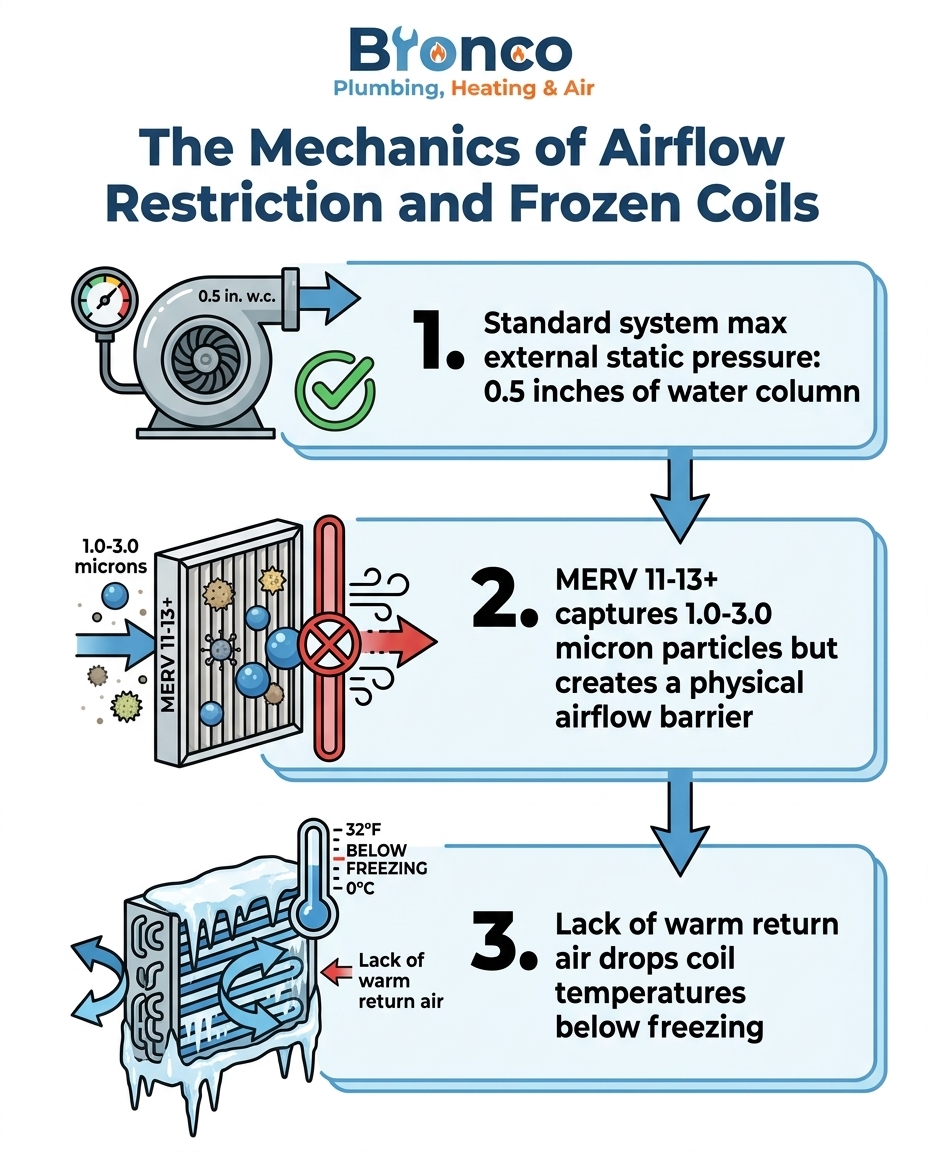
MERV 11 to 13+ ratings are highly effective at capturing microscopic particles between 1.0 and 3.0 microns. This includes fine dust, auto emissions, pet dander, and various allergens. To physically trap these tiny particles, the filter media must be incredibly dense. Manufacturers achieve this by tightly weaving synthetic fibers together and pleating the material to increase the surface area.
However, this dense construction fundamentally changes how air moves through your return vent. Instead of acting as a breathable screen that protects the equipment from large debris, a highly restrictive filter acts more like a physical wall. The blower motor must work exponentially harder to pull the same volume of air through this dense barrier.
Comparing Common Filter Ratings
• MERV 8 — Primary Target Particles: Dust mites, pollen, mold spores — Airflow Impact on Standard Systems: Minimal restriction; allows standard blowers to operate efficiently and maintain proper airflow.
• MERV 11 — Primary Target Particles: Pet dander, auto emissions, fine dust — Airflow Impact on Standard Systems: Moderate to high restriction; often causes older or undersized blower motors to strain.
• MERV 13+ — Primary Target Particles: Bacteria, virus carriers, microscopic allergens — Airflow Impact on Standard Systems: Severe restriction; typically requires a specially designed or modified HVAC system to prevent damage.
When you force a standard residential system to pull air through a MERV 13+ filter, the blower motor is subjected to immense resistance. This resistance alters the entire pressure dynamic of the ductwork, leading to cascading failures throughout the heating and cooling equipment.
The Hidden Threat of High Static Pressure on Residential Blowers
HVAC systems do not simply blow air randomly; they operate on precise, mathematical airflow calculations. The resistance the system faces as it pushes and pulls air through the ductwork and filter is measured in external static pressure (ESP). Understanding ESP is critical to understanding why premium filters often do more harm than good.
The Limits of Residential Equipment
Standard residential HVAC systems are typically calibrated by the manufacturer to handle a maximum external static pressure of 0.5 inches of water column. This measurement accounts for the resistance of the ductwork, the evaporator coil, the supply registers, and a standard air filter. The blower motor is sized specifically to overcome this exact amount of resistance while delivering the correct volume of cubic feet per minute (CFM) of air to your living spaces.
The Overheating Blower Motor
Inserting a high-MERV filter immediately spikes the static pressure well beyond the system's design limits. In our daily service calls across Sacramento, our technicians regularly measure dense filters adding 0.2 to 0.3 inches of water column to the total ESP all on their own, pushing the system dangerously close to or beyond its breaking point.
When the blower motor fights against this excessive resistance, we see several mechanical failures begin to develop:
• Increased electrical draw: The motor pulls more amperage as it struggles to maintain its RPMs against the dense filter.
• Severe overheating: Without a sufficient volume of air moving over the motor to cool it, the internal temperature of the blower rises rapidly.
• Premature wear and tear: The constant strain degrades the motor's bearings and electrical windings, significantly shortening its functional lifespan.
The system is actively tearing itself apart trying to breathe through a filter that is simply too dense for its design specifications.
Why Restricted Airflow Leads to Frozen Evaporator Coils
The damage caused by a restrictive filter is not limited to the blower motor. When our team responds to late-summer emergency calls, the most common and visible symptom of suffocated airflow we find is a completely frozen evaporator coil. This occurs due to a disruption in the delicate thermodynamic balance required for air conditioning.
The Refrigeration Cycle Disrupted
The evaporator coil, located inside your home near the blower, relies on a steady, robust flow of warm, unconditioned return air. As this warm air passes over the highly conductive metal fins of the coil, the cold liquid refrigerant inside absorbs the heat. This heat transfer process is what cools the air before it is pushed back into your home. It is also what prevents the refrigerant from dropping too low in temperature.
When a dense filter chokes off this vital supply of warm airflow, the heat transfer process stalls. The consequences unfold in a predictable, destructive sequence:
1. The temperature of the evaporator coil plummets rapidly below the freezing point (32°F).
2. Normal humidity and condensation that naturally collect on the coil begin to freeze instead of dripping into the condensate drain pan.
3. A thin layer of frost develops, which acts as an insulator, further preventing the refrigerant from absorbing any remaining heat from the limited air that does make it through.
4. The frost rapidly turns into a solid block of ice, completely encasing the coil and blocking 100% of the remaining airflow.
An iced-over coil stops the cooling process entirely. Worse, it poses a severe risk to the outdoor unit. If the refrigerant cannot absorb heat indoors, it may return to the outdoor compressor as a liquid rather than a gas. Compressors are designed to pump gas; liquid refrigerant flowing backward will destroy the compressor valves, leading to a catastrophic system failure. Understanding how a dirty condenser coil impacts AC performance is similarly important, as both issues fundamentally disrupt the heat transfer process.
Late-Summer Heat Waves and Compounding AC Strain
The stress placed on an HVAC system by a restrictive filter does not happen in a vacuum; it is heavily influenced by the outdoor climate. In regions that experience intense, prolonged heat, the mechanical strain compounds at an alarming rate.
Our team at Bronco Plumbing, Heating & Air knows the reality of Sacramento's intense late-summer heat—air conditioners are required to run for extended, uninterrupted cycles just to maintain basic indoor comfort. During extreme triple-digit heat waves, a system might run for hours at a time without cycling off. When a system is forced to pull air through a highly restrictive MERV 13 filter during these marathon cycles, it has absolutely no opportunity to recover.
The blower motor runs hotter, the static pressure remains critically high, and the evaporator coil teeters on the edge of freezing for hours on end. When an AC unit fails on a 106-degree day, it is rarely a sudden, random event; it is often the culmination of poor airflow and overworked components finally giving out under the pressure of the climate.
We recently helped a Sacramento homeowner who experienced this firsthand during one of the hottest days of the summer when their air conditioner stopped working entirely. Fast, professional service was required even after hours to get the system back online, clear the airflow restrictions, and rescue them from the heat. Maximizing airflow is the single most critical factor in keeping a system operational during the hottest weeks of the year.
Better Solutions for Indoor Air Quality
If high-MERV filters pose such a risk to standard residential HVAC systems, homeowners are left wondering how to address dust, allergens, and poor indoor air quality. The answer lies in separating the mechanical needs of the heating and cooling equipment from the air purification goals of the household.
The True Purpose of the Return Filter
Protecting the internal HVAC equipment should always be the primary goal of the return air filter. The filter's job is to keep hair, large dust particles, and debris out of the blower motor and off the evaporator coil. For the vast majority of residential systems, standard pleated filters rated at MERV 8 offer the absolute best balance of equipment protection and necessary airflow.
At Bronco Plumbing, Heating & Air, our recommendation is to prioritize the lifespan of your expensive HVAC system over the perceived, often marginal benefit of premium, highly restrictive filters. A system that breathes easily will run efficiently, cool effectively, and last years longer than one struggling against a dense allergen filter.
Active Air Purification
Homeowners seeking meaningful relief from microscopic allergens, volatile organic compounds (VOCs), and fine dust should look beyond the standard return vent. Instead of trying to force a passive filter to do an active job, installing dedicated air purifiers is the mechanically sound solution.
Whole-home purifiers, UV lights, and electronic air cleaners are designed to integrate into the ductwork and clean the air actively without adding dangerous static pressure to the HVAC blower. Separating the filtration of microscopic allergens from the mechanical airflow needs of the AC unit ensures that you achieve both optimal indoor air quality and maximum system longevity.
End-of-Season Maintenance to Prevent System Failure
As the cooling season winds down, taking proactive steps can prevent the accumulated strain of summer from turning into a sudden, costly breakdown. Identifying airflow issues early is the key to protecting your compressor and blower motor.
Here is what our technicians recommend checking and monitoring:
• Inspect the current filter media: Pull the filter from the return grille. If it is a heavily pleated, premium allergen filter (MERV 11 or higher) and your system is struggling, replace it immediately with a standard MERV 8 pleated option.
• Monitor cooling cycle lengths: Pay attention to how long the system runs. Unusually long cycles, even on milder days, often indicate that the system is starving for air and failing to move enough conditioned air into the living spaces.
• Check register airflow: Place your hand over the supply vents in the rooms furthest from the indoor unit. Weak, anemic airflow is a primary indicator of high static pressure or a frozen coil.
• Feel the air temperature: If the air blowing from the vents feels warm or room temperature while the AC is running, shut the system off immediately. This is a strong sign that the coil has frozen over or the compressor has stalled.
Our technicians recently rescued another local homeowner's system that completely shut down late in the season due to severe airflow restrictions. By addressing the root cause quickly and securing professional intervention, we were able to repair the AC unit efficiently before the compressor suffered permanent, catastrophic damage.
Professional check-ups are critical, especially when the system has been pushed to its limits during the hottest days of the year. Enrolling in a routine HVAC maintenance plan ensures that static pressure is measured, blower motors are inspected, and coils are checked for signs of freezing before the system fails entirely.
Protecting Your HVAC System's Lifespan
Your heating and cooling equipment represents a significant investment in your home's comfort. An HVAC system requires unobstructed, calculated airflow to function efficiently, maintain correct pressures, and avoid catastrophic freezing at the evaporator coil. Choosing the right filter means balancing your indoor air quality goals with the strict mechanical limits of the equipment.
By stepping away from overly restrictive premium filters and utilizing standard MERV 8 options, you allow the system to breathe as the manufacturer intended. For personalized guidance on improving your home's air quality without damaging your blower motor, exploring professional AC maintenance and repair services and dedicated IAQ options is the safest, most effective next step. Protecting the airflow today ensures your system remains reliable for years to come.
Frequently Asked Questions
Can a high MERV filter damage my AC?
Yes, installing a filter with a MERV rating that is too high for your specific system can cause significant mechanical damage. High-MERV filters are densely woven, which creates a physical barrier that drastically increases static pressure within the ductwork. This excess resistance forces the blower motor to overwork, leading to overheating, increased electrical consumption, and premature motor failure. Additionally, the restricted airflow can disrupt the refrigeration cycle, causing the evaporator coil to freeze and potentially damaging the outdoor compressor.
Does MERV 13 restrict airflow?
MERV 13 filters restrict airflow significantly more than standard residential filters. They are designed to capture microscopic particles like bacteria and virus carriers, which requires an incredibly tight, dense filter media. While excellent for air quality, this density acts like a wall against the blower motor. Most standard residential HVAC systems are not engineered to handle the high external static pressure created by a MERV 13 filter, often resulting in poor cooling performance and severe equipment strain.
Why does my AC coil freeze in the summer?
An AC coil freezes in the summer primarily due to a lack of warm return air passing over the cold evaporator fins. When airflow is restricted—often by a dirty or overly dense high-MERV filter—the heat transfer process stops. Without the heat from the indoor air, the temperature of the liquid refrigerant drops below freezing, causing the normal condensation on the coil to turn into a solid block of ice. Once the ice forms, it blocks all remaining airflow, completely halting the cooling process.
What MERV rating is best for home AC?
For the vast majority of standard residential HVAC systems, our team considers a MERV 8 pleated filter to be the best choice. A MERV 8 filter provides an optimal balance by effectively trapping common household dust, pollen, and mold spores while still allowing the blower motor to pull the necessary volume of air without excessive strain. If you require higher levels of air purification for health reasons, it is usually better to install a dedicated whole-home air purifier rather than forcing a high-MERV filter into a standard return grille.
How often should I change a MERV 8 filter during peak summer?
During peak summer months when the air conditioner is running frequently, you should inspect and likely change a standard 1-inch MERV 8 filter every 30 to 45 days. High usage, combined with dry, dusty outdoor conditions or the presence of indoor pets, causes the filter media to load with debris much faster than in the milder shoulder seasons. Regularly replacing the filter ensures that static pressure remains low, airflow stays strong, and the evaporator coil is protected from freezing.

Customer Testimonials
Our customer testimonials highlight the reliable service, quality workmanship, and trusted results homeowners experience with Bronco Plumbing Heating and Air.


Ready to Transform your Home?
Create a healthier, more comfortable home with expert HVAC, plumbing, and indoor air quality solutions you can trust. From efficient heating and cooling to cleaner air and reliable repairs, our experienced team is here to keep your family comfortable year-round with dependable service and upfront pricing.
Related Articles
Diagnosing Weak Airflow in the Farthest Bedroom of Your House


Why Placer County Soil Shifting Causes Underground Plumbing Stress in Late Summer
Transitioning Your Heat Pump Settings as August Nights Finally Cool Down