



.svg)

Why September is the Critical Window for Sacramento Valley Wildfire Smoke Prep
Blocking toxic PM2.5 particles is a delicate balancing act for your HVAC system. Here is exactly how to choose the right MERV filters to secure your indoor air before peak fire season hits.
The Urgent Reality of Fall Wildfire Smoke in Northern California
Before the late-summer winds shift, every homeowner needs to understand exactly why September is the Critical Window for Sacramento Valley Wildfire Smoke Prep. At Bronco Plumbing, Heating & Air, our team has spent years helping local families navigate the peak September/October fall wildfire season, and we know firsthand that the threat of dense, hazardous smoke infiltrating residential homes is an immediate and unavoidable reality. You are no longer just trying to keep your house cool during lingering heatwaves; you are actively fighting to keep dangerous, microscopic pollutants out of your living spaces. Standard home defenses are simply not built to handle the sheer volume of particulate matter generated by regional fires.
For professional guidance on securing your home's air, explore our indoor air quality services or learn more about upgrading to reliable whole-home air filtration systems.
The core challenge every homeowner faces during this season is a delicate balancing act. You must configure your HVAC system to filter out toxic air without suffocating the equipment in the process. When smoke blankets the region, the instinct is to block it by any means necessary. However, aggressively upgrading filtration without understanding your system's airflow limits often leads to frozen evaporator coils, burned-out blower motors, and sudden mechanical failures right when you need your air conditioning the most. Professional indoor air quality solutions offer the safest, most effective path forward, ensuring your home remains a breathable refuge without compromising your HVAC system's lifespan.
Understanding the Sacramento Valley Basin Effect and PM2.5
To effectively protect your home, you have to understand the specific environmental forces working against it. In our years of servicing HVAC systems across the region, we've seen exactly how the geography of the Sacramento Valley plays a massive role in how severe and long-lasting our local smoke events become. The valley essentially acts as a massive topographical bowl. When fires burn in the surrounding Sierra Nevada mountains or the coastal ranges, the resulting smoke pours down into the valley floor and gets trapped. This is known as the Sacramento Valley Basin Effect, and it creates a uniquely high-strain environment for residential HVAC systems.
During these events, standard fiberglass furnace filters—the cheap, see-through ones you buy at the hardware store—are entirely ineffective. They are designed to catch large debris like pet hair and dust bunnies to protect the furnace machinery, not to clean the air you breathe. When faced with dense wildfire smoke, these basic filters allow harmful pollutants to pass right through the ductwork and circulate continuously into your bedrooms and living areas.
What Makes PM2.5 Particles So Dangerous?
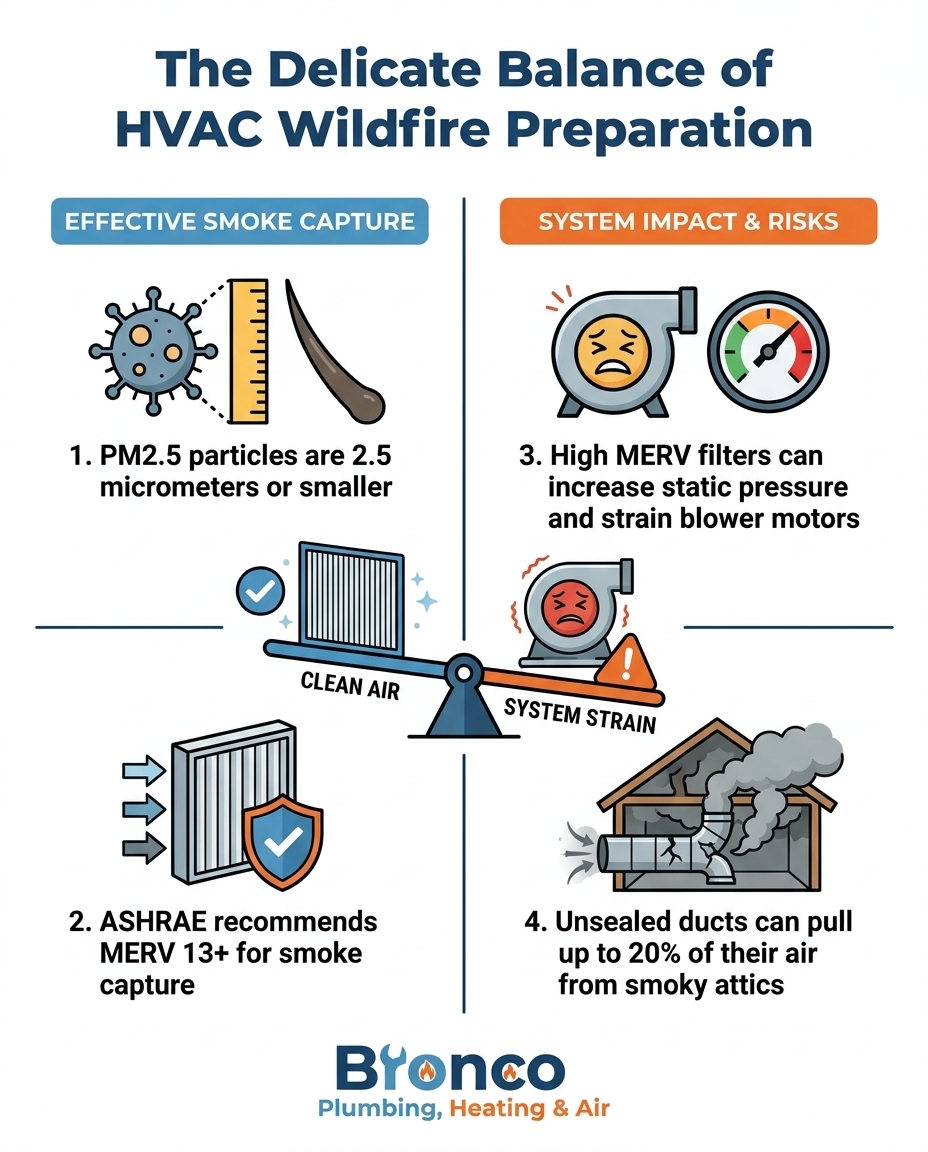
The primary threat in wood smoke is particulate matter known as PM2.5 particles. These microscopic pollutants are 2.5 micrometers in diameter or smaller—about 30 times smaller than a single strand of human hair. Because they are so tiny, they easily bypass basic weatherstripping, window seals, and standard air filters.
More alarmingly, PM2.5 particles bypass the human body's natural defenses. When inhaled, they travel deep into the lungs and can even enter the bloodstream. Both the Environmental Protection Agency (EPA) and the American Society of Heating, Refrigerating and Air-Conditioning Engineers (ASHRAE) have issued strict guidelines on managing indoor air quality during fire events specifically to combat PM2.5 exposure. Protecting your family requires filtration technology specifically rated to capture particles of this exact microscopic size.
How Temperature Inversions Trap Smoke
The situation in early fall is frequently compounded by a meteorological phenomenon known as a temperature inversion. Normally, warm air rises and carries pollutants away. During an inversion, a layer of warm air settles over the valley, acting like a lid that traps cooler air—and dense smoke—close to the ground. These inversions can keep polluted air stagnant over our region for days or even weeks at a time.
This creates a brutal compounding issue for your HVAC system. Late-season heatwaves often coincide with these inversions, meaning you need to run your air conditioner constantly to stay comfortable, but the air outside is toxic. Your system is forced to operate under maximum load while simultaneously battling heavy particulate pollution, making proper preparation absolutely critical.
The MERV Filter Dilemma: Blocking Smoke vs. Suffocating Your HVAC
When the sky turns orange, the most common do-it-yourself mistake our technicians see homeowners make is rushing to the store and buying the thickest, highest-rated air filter they can find. While the intention is good, this sudden filter swap often triggers a cascade of mechanical problems. ASHRAE recommends higher MERV ratings to capture microscopic smoke, but forcing air through a dense filter requires a tremendous amount of mechanical effort.
This is where the concept of static pressure comes into play. Think of your HVAC system like a human breathing through a straw. A standard filter is like a wide milkshake straw—air moves easily. A highly restrictive smoke filter is like a tiny coffee stirrer. If your system isn't designed to push air through that much resistance, the airflow drops dramatically. Slapping a highly restrictive filter onto an older, incompatible system is a recipe for disaster. Reduced airflow causes the cooling coils to freeze solid into a block of ice, and the blower motor will eventually overheat and burn out from the strain. Before you upgrade your defenses, understanding the importance of air filters and their compatibility with your specific machinery is non-negotiable.
Understanding MERV Ratings for Smoke
The Minimum Efficiency Reporting Value (MERV) scale measures how effectively a filter captures particles of varying sizes. Standard filters simply cannot handle the demands of the September/October fall wildfire season. Here is a breakdown of how different ratings perform:
• Standard Fiberglass — MERV Rating: MERV 1-4 — Smoke Capture Ability: Zero protection against PM2.5 — Airflow Impact on Standard HVAC: Excellent airflow, no strain
• Basic Pleated — MERV Rating: MERV 8 — Smoke Capture Ability: Captures dust/pollen, poor for smoke — Airflow Impact on Standard HVAC: Moderate, usually safe for most systems
• High-Efficiency Pleated — MERV Rating: MERV 11-12 — Smoke Capture Ability: Moderate smoke capture — Airflow Impact on Standard HVAC: High resistance, requires system check
• Premium Smoke Filter — MERV Rating: MERV 13+ — Smoke Capture Ability: Excellent PM2.5 capture (ASHRAE Recommended) — Airflow Impact on Standard HVAC: Severe resistance on older/incompatible systems
To achieve high MERV ratings without killing airflow, thicker filters—often 4-inch or 5-inch media filters—perform vastly better than standard 1-inch pleated filters because they have significantly more surface area for the air to pass through.
The Hidden Danger of High Static Pressure
High static pressure is the silent killer of HVAC systems during fire season. When airflow is restricted by an overly dense filter, the blower motor is forced to overwork in a desperate attempt to circulate air through the house. Because the motor runs hotter and longer, its lifespan is drastically reduced.
Warning signs of a suffocating HVAC system include high-pitched whistling noises near the return vents, noticeably weak airflow coming from your supply registers, and frequent, short cycling where the system turns on and off rapidly. At Bronco Plumbing, Heating & Air, our technicians specialize in testing static pressure to ensure that high-efficiency filters won't void your manufacturer warranties or cause catastrophic breakdowns right when you need relief from the heat and smoke.
Upgrading to System-Safe Whole-Home Air Filtration
If standard 1-inch MERV 13 filters are too restrictive for your current setup, we typically recommend upgrading to a professional whole-home air filtration system as the most sustainable solution. Instead of relying on a tiny slot in your ductwork, these advanced solutions involve retrofitting a professional media cabinet directly into your existing HVAC infrastructure. This creates the necessary space to house deep, 4-inch or 5-inch pleated media filters.
The primary benefit of a deep media cabinet is surface area. Because the filter is folded like an accordion, it provides massive square footage for air to pass through. This allows the system to capture microscopic PM2.5 particles with high-efficiency media while maintaining excellent airflow and keeping static pressure safely within manufacturer limits. You get the heavy-duty smoke protection you need without the severe pressure drop that destroys blower motors.
Furthermore, these systems provide tremendous year-round benefits. Once the September/October fall wildfire season passes, that same media cabinet continues to scrub the air of spring pollen, pet dander, and everyday household dust. It is also worth noting that many energy-efficient HVAC and indoor air quality upgrades may qualify for generic utility incentive programs or tax credits. We always advise homeowners to verify current local programs, as upgrading your system's efficiency often comes with valuable financial perks.
Why Leaky Ductwork is Your Hidden Vulnerability
You can install the most advanced, highest-rated air filter on the market, but it will be entirely useless if the air bypassing the filter is contaminated. During our early fall tune-ups, one of the most common and overlooked vulnerabilities our team uncovers in Sacramento Valley homes is leaky ductwork running through unconditioned spaces like attics or crawlspaces. Over time, the seals and joints on your ductwork degrade due to intense temperature fluctuations, creating gaps and cracks.
Here is the physics of the problem: when your HVAC system turns on, it creates pressure dynamics inside those ducts. If there are leaks on the return side (the ducts pulling air back to the furnace), negative pressure acts like a vacuum. It actively sucks smoke-filled, outdoor air directly from your dusty attic into the duct stream. This toxic air is then blown straight into your living spaces, completely bypassing the air filter you just installed.
The only solution is professional duct sealing. A licensed technician will thoroughly inspect the hidden runs of your ductwork, locate the compromised joints, and seal them using specialized mastic or aeroseal technology. Finding and sealing these hidden leaks is mandatory for effective smoke preparation. The best filter in the world cannot clean air that never passes through it.
Thermostat Fan Settings and Supplemental Protection
Having the right equipment is only half the battle; knowing how to operate it actively during a heavy smoke day is just as important. Your thermostat settings dictate how air moves through your home, and making a few strategic adjustments can drastically improve your indoor air quality when the skies are gray.
A common point of confusion we hear from customers is the difference between the "Auto" and "On" fan settings. In "Auto" mode, the blower fan only runs when the system is actively cooling or heating the house. Once the target temperature is reached, the fan shuts off, and air stops circulating through your filter. During a smoke event, this allows pollutants that seeped inside to settle in your living spaces.
Optimal Thermostat Settings During a Smoke Event
If your system is equipped with a proper, system-safe smoke filter, switching your thermostat fan from "Auto" to "On" can be highly beneficial. Running the fan continuously forces the indoor air to constantly cycle through the filter, actively scrubbing the PM2.5 particles from the environment. While continuous fan operation does use more electricity, the trade-off for significantly improved indoor air quality during a crisis is usually worth it.
Additionally, if your HVAC system features a fresh air intake damper (common in newer builds to bring in outside air), you must ensure it is closed or set to recirculate indoor air only. Pulling fresh air from outside during a fire event will rapidly fill your home with smoke. Combine this by keeping all windows and doors tightly sealed to maintain positive indoor pressure.
Layering Defenses with Air Purifiers
For highly sensitive individuals—such as those with asthma, allergies, or respiratory conditions—relying solely on the central HVAC system might not be enough. Layering your defenses with standalone HEPA air purifiers is an excellent supplemental strategy.
These portable units complement the central system by providing localized, targeted filtration in the rooms you use most. For maximum effectiveness, place HEPA purifiers in primary living areas and bedrooms, keeping the doors to those rooms closed to create a highly filtered micro-environment while you sleep.
Your Early Fall HVAC Preparation Checklist
Preparation is the only way to ensure your home remains a safe haven when the smoke rolls in. Do not wait until you can smell smoke in your living room to take action. Follow this early fall checklist to secure your HVAC system:
• Schedule a comprehensive system tune-up: Have a professional verify that your blower motor is operating at peak efficiency and can handle the increased workload of smoke filtration.
• Stock up on compatible filters early: Purchase the correct, system-safe MERV-rated filters now. Local hardware stores routinely sell out of high-quality filters within hours of a major fire breaking out.
• Inspect and seal ductwork: Have a licensed professional test your ducts for leaks in the attic and crawlspaces to prevent smoke from bypassing your filtration system.
• Evaluate whole-home IAQ upgrades: If your current system cannot handle MERV 13 filters, schedule an assessment for a professional media cabinet retrofit.
• Monitor local AQI forecasts daily: Keep an eye on the Air Quality Index so you know exactly when to switch your thermostat fan to "On" and deploy your supplemental air purifiers.
Frequently Asked Questions About Wildfire Smoke and HVAC Systems
What MERV rating is best for wildfire smoke?
ASHRAE recommends using a filter with a MERV 13 rating or higher to effectively capture PM2.5 wildfire smoke particles. However, it is critical to ensure your specific HVAC system can handle the airflow restriction of a MERV 13 filter. Slapping a highly restrictive filter on an incompatible system can cause severe mechanical damage, so consult a professional if you are unsure.
Should I run my AC on fan mode during a fire?
Yes, running your thermostat fan in the "On" position can significantly improve indoor air quality, provided you have a high-quality filter installed. Continuous fan operation constantly circulates the air in your home through the filter, actively scrubbing out smoke particles even when the air conditioner isn't actively cooling the house.
How do I stop smoke from coming through my vents?
If you smell smoke coming from your vents, it usually indicates that your ductwork has leaks in unconditioned spaces like the attic, or your fresh air intake is open. To stop this, you need to have a professional inspect and seal your ductwork, and ensure your system is set to recirculate indoor air rather than pulling from the outside.
Can wildfire smoke damage my AC unit?
Yes, heavy wildfire smoke can damage your HVAC system, primarily by rapidly clogging the air filter and restricting airflow. When airflow drops, the blower motor is forced to overwork, which can lead to overheating, burned-out components, and frozen evaporator coils. Regular filter checks are mandatory during heavy smoke events.
Is it safe to run a whole-house fan when it's smoky outside?
No, you should never run a traditional whole-house fan during a wildfire smoke event. Whole-house fans work by pulling large volumes of outdoor air through open windows and exhausting it through the attic, which will immediately fill your living spaces with toxic PM2.5 particles. Keep windows closed and rely on your central AC and air purifiers instead.
How often should I change my HVAC filter during a wildfire event?
During a heavy smoke event, you may need to check and replace your filter every two to three weeks, rather than the standard 90-day schedule. The heavy concentration of airborne particulates will clog the filter media rapidly, and running the system with a blocked filter will severely strain your equipment.
Protect Your Home's Air Quality Before the Smoke Settles
When the September/October fall wildfire season peaks, the air outside becomes a hazard, and your home should be your ultimate refuge. Waiting until the sky is thick with smoke to figure out your filtration strategy is a gamble that often results in suffocated blower motors, frozen coils, and compromised indoor air. The dangers of DIY filtration mistakes are real, and guessing which filter won't break your system is a risk you don't have to take.
Proactive preparation is the only way to ensure a safe, breathable environment for your family. By scheduling a professional assessment today, you can evaluate your ductwork integrity, test your static pressure, and explore whole-home filtration options that actually work. Take control of your air quality now, and gain the clear, actionable guidance you need to keep your home comfortable and safe all season long.

Customer Testimonials
Our customer testimonials highlight the reliable service, quality workmanship, and trusted results homeowners experience with Bronco Plumbing Heating and Air.


Ready to Transform your Home?
Create a healthier, more comfortable home with expert HVAC, plumbing, and indoor air quality solutions you can trust. From efficient heating and cooling to cleaner air and reliable repairs, our experienced team is here to keep your family comfortable year-round with dependable service and upfront pricing.
Related Articles
Recognizing the Difference Between Normal AC Wear and Impending System Failure

The Truth About MERV Ratings and Air Conditioner Strain
Diagnosing Weak Airflow in the Farthest Bedroom of Your House